Thymosin Alpha-1 is an immune-regulating peptide, not a general-purpose immune booster. It has been studied in people with specific illnesses, but those findings do not establish that healthy people need it or will feel better after using it. The important question is not simply whether it affects immune cells. It is whether it improves a meaningful outcome in the condition being treated. [1][2]
The research includes a large sepsis trial without a clear survival benefit and a 2026 hepatitis B review with substantial uncertainty. These results belong alongside the proposed immune benefits. [2] [3]
Related calculation references: Our Thymosin Alpha-1 5 mg and 10 mg vial pages cover concentration and measurement. A correct calculation does not establish a treatment’s effectiveness or suitability.
What is Thymosin Alpha-1?
Thymosin Alpha-1, also written Tα1 or TA1, is a 28-amino-acid peptide. Thymalfasin is its synthetic form. Research describes effects on T cells and antigen presentation, the process by which immune cells show pieces of a potential threat to other immune cells. [1]
“Immune modulation” means changing aspects of an immune response. It does not mean turning every part of the immune system up. An effect on cell signaling is a starting point for investigation, not a substitute for evidence that patients benefit.
Benefits and uses: what has actually been studied?
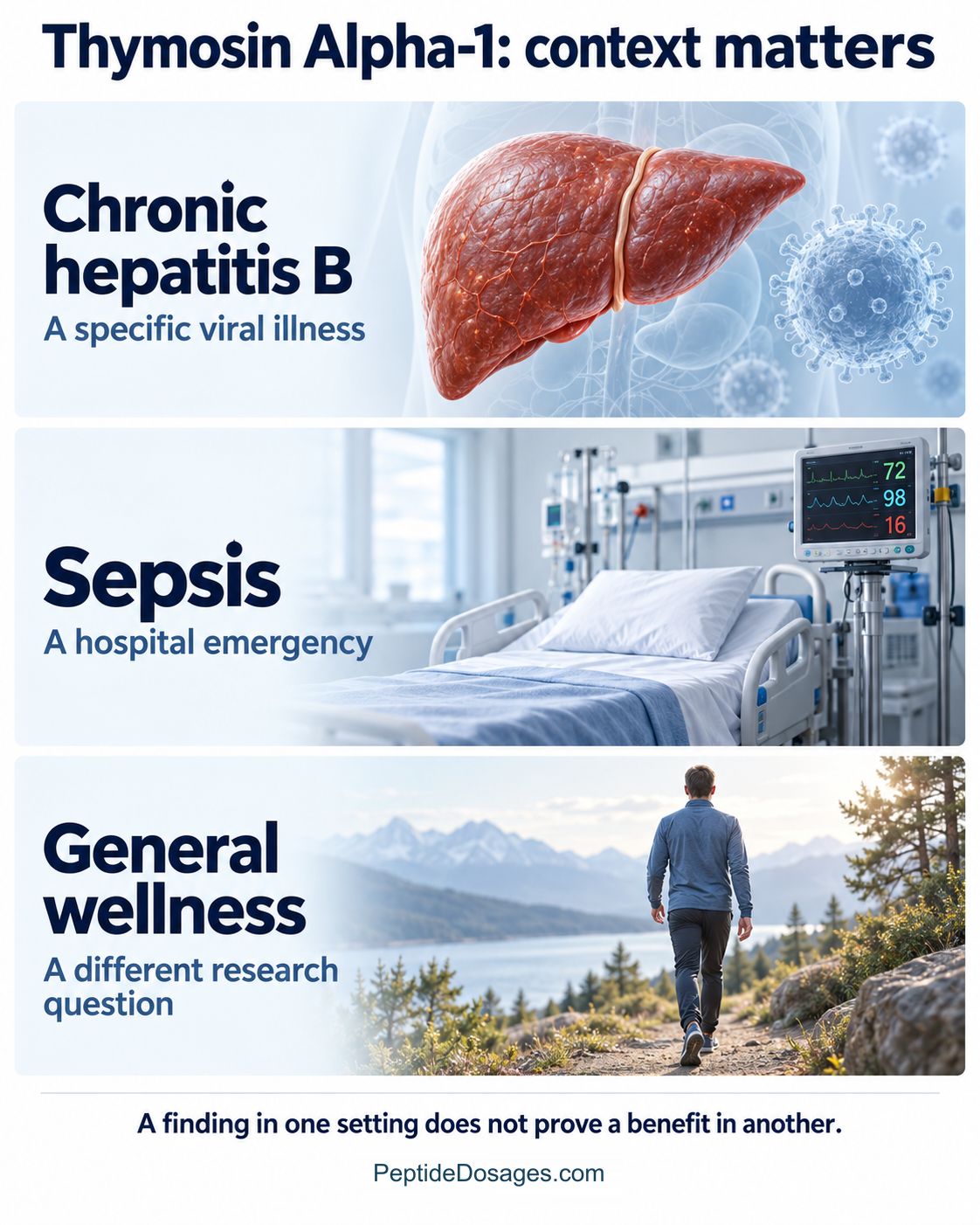
| Setting | What the evidence means |
|---|---|
| Sepsis | The large TESTS randomized trial found no clear reduction in deaths at 28 days. [2] |
| Chronic hepatitis B | A 2026 Cochrane review found low or very low certainty evidence, depending on the outcome. [3] |
| Healthy-person wellness | Neither of those patient populations establishes a benefit for someone without the studied illness. |
A large sepsis trial changed the picture
The 2025 TESTS study randomized 1,106 adults with sepsis at 22 centers in China. In the analysis of participants who received study treatment, 28-day mortality was 23.4% with thymosin α1 and 24.1% with placebo. The trial did not demonstrate a clear survival benefit. [2]
The trial doesn’t rule out biological effects, but it shows that a plausible immune mechanism isn’t proof of better survival. An exploratory subgroup result shouldn’t replace the main finding. Read the journal’s subsequent statistical correction with the report. [4]
Hepatitis B findings remain uncertain
A Cochrane review published in September 2026 included ten trials involving 1,349 adults with chronic hepatitis B. Some used TA1 alone; others added it to background treatment. All ten trials had methodological limitations. [3]
Although some pooled results suggested possible benefits, the authors rated evidence very low certainty for most outcomes and low certainty for serious adverse events. They could not confidently establish effects on mortality, quality of life or liver-related outcomes. This is a reason for better trials, not a reason to replace prescribed antiviral treatment. [3]
Is Thymosin Alpha-1 FDA approved?
No FDA-approved drug containing TA1 was identified in FDA’s evaluation. The agency documented approvals in some other countries for particular indications. Approval elsewhere is not US approval, and an approved finished medicine is not interchangeable with an unreviewed vial sold online. [5]
A discussion about whether a substance can be used in compounding is also different from approval of a drug for a particular disease. Avoid treating an advisory meeting, a product listing or an available prescription as proof of effectiveness.
Side effects and safety concerns
FDA’s review describes reported injection-site discomfort and less common reactions such as redness or rash. Its broader concerns include product quality, aggregation and immune reactions to peptide-related impurities. [5]
The agency’s safety page says the information for proposed compounded TA1 products is inadequate to fully characterize the risks. That does not provide a reliable side-effect percentage for a product purchased online. [6]
The TESTS trial did not find a statistically significant difference in measured safety outcomes between its groups. That result applies to the study’s setting and follow-up; it does not prove that every formulation or long-term wellness regimen is safe. [2]
Before discussing an immune-active treatment, give your clinician a complete medication and medical history. This is particularly important if you receive immunosuppressive treatment, have an autoimmune condition, are pregnant or have had a transplant. Do not stop prescribed treatment to try a peptide.
How does it make you feel, and how long does it take?
There is no validated “working” sensation. Feeling more energetic, sleeping differently or noticing no change does not establish what is happening to immune function. An individual experience also cannot separate the compound’s effect from illness recovery, other treatments or ordinary day-to-day variation.
A useful question is: what outcome are we trying to change, and how would we measure it? Trial endpoints such as survival or liver outcomes are very different from a general impression of better immunity. A promised number of days until you feel a benefit is not supported by the studies discussed here.
Is there a standard dosage or cycle?
There is no single regimen that can be taken from one disease study and applied to everyone. The TESTS trial used a short course in hospitalized patients, while the hepatitis B evidence involved different treatment contexts and longer follow-up. Those are study designs, not interchangeable instructions for self-treatment. [2][3]
A vial’s mass, the amount of water added and a syringe marking answer measurement questions. They do not answer whether the treatment should be used, for which condition or for how long.
Is Thymosin Alpha-1 the same as TB-500?
No. The names refer to different peptides. FDA lists thymosin-alpha 1 separately from the thymosin beta-4 fragment also known as TB-500. Evidence about one should not be used to establish the other’s effects. [6]
Bottom line: TA1 has genuine clinical research behind it, but the results are mixed and depend on the condition. Ask for evidence tied to the specific medical problem, the actual product and outcomes that matter, rather than a general promise of stronger immunity.
Related Thymosin Alpha-1 dosage protocols
Continue with the vial-strength-specific research protocol that matches the material being evaluated. Each page keeps its own concentration, reconstitution, and syringe-unit calculations.
Practical measurement and handling guides
References
- National Cancer Institute. Thymalfasin: NCI Drug Dictionary.
- Wu J, et al. The efficacy and safety of thymosin α1 for sepsis (TESTS). BMJ. 2025;388:e082583. Read with the correction below.
- Naing C, et al. Thymosin-α1 for people with chronic hepatitis B. Cochrane Database of Systematic Reviews. September 2026.
- Correction to the TESTS trial report. BMJ. 2025;389:r1098.
- FDA. Thymosin Alpha-1-related bulk drug substances: December 2024 advisory committee briefing.
- FDA. Certain bulk drug substances for use in compounding that may present significant safety risks. TA1 and thymosin beta-4 fragment entries.