
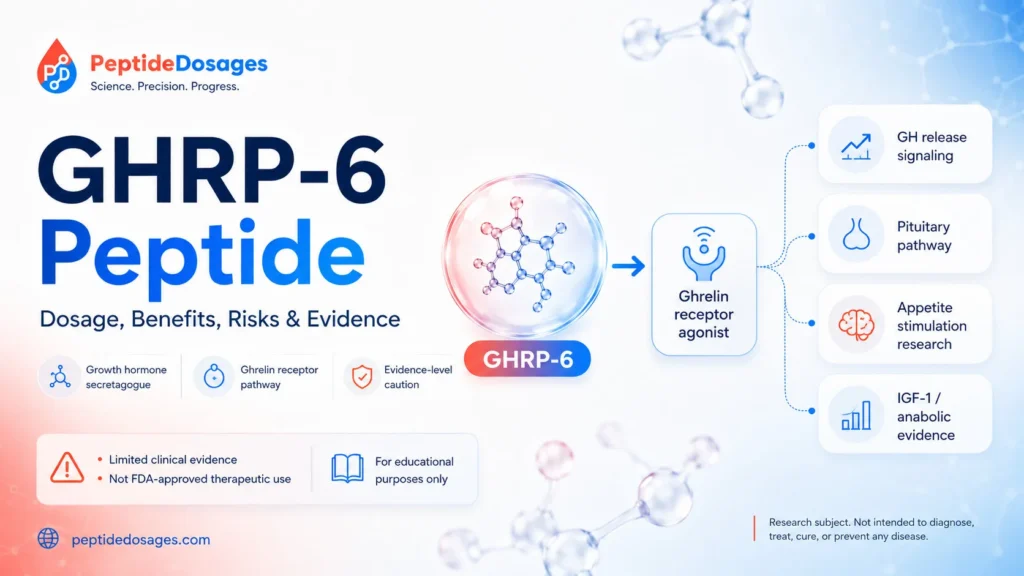
GHRP-6 peptide is a synthetic hexapeptide growth hormone secretagogue studied for its ability to stimulate growth hormone release through the ghrelin or growth hormone secretagogue receptor pathway 1 2. This educational article reviews what GHRP-6 is, how GHRP-6 works, potential benefits, study uses, side effects, dosage information from published literature, safety issues, and evidence limits. GHRP-6 is not FDA-approved as a medical treatment, and any interpretation of research should be separated from personal dosing or self-administration decisions 3 4.
- GHRP-6 is a synthetic peptide commonly described as growth hormone-releasing peptide 6 or growth hormone releasing peptide-6 [1].
- GHRP-6 works through the growth hormone secretagogue receptor pathway, the same receptor family linked to ghrelin signaling and GH secretion [2] 5.
- Human research is mainly early and physiology-focused, with older studies and reviews examining GH release, GH response to GHRP-6, and interactions with GHRH rather than long-term therapeutic outcomes 6 7.
- Potential benefits of GHRP-6 are evidence-sensitive. Growth hormone release is the best-supported research endpoint, while muscle growth, anti-aging effects, recovery, and performance claims remain less established [6] [7].
- There is no approved-label GHRP-6 dosage. Published study protocols should not be interpreted as personal dosing advice, and no FDA-approved GHRP-6 prescribing information is listed in FDA approval databases [3] [4].
- Safety concerns include endocrine and metabolic monitoring issues. Published GHRP literature discusses hunger, GH-axis hormone changes, and possible cortisol, prolactin, insulin, and glucose-related considerations [6] [7].
- Regulatory status matters. FDA materials explain that compounded drugs are not FDA-approved, and FDA bulk-substance policy is relevant when discussing quality risks around unapproved peptides 8 9.
Related dosage pages: For vial-specific concentration, reconstitution, and measurement examples, see GHRP-6 (2 mg Vial) Dosage Protocol, GHRP-6 (5 mg Vial) Dosage Protocol, and GHRP-6 (10 mg Vial) Dosage Protocol. Each linked protocol remains a separate reference because vial strength changes concentration and syringe-unit calculations.
Fast Answer
GHRP-6 peptide is a synthetic growth hormone-releasing peptide studied for its ability to stimulate GH release through the ghrelin-related growth hormone secretagogue receptor pathway [1] [2]. People often search for it because of claims about growth hormone levels, appetite, recovery, muscle growth, and anti-aging effects, but the strongest evidence is mainly early human physiology research and mechanistic literature, not approved medical use [6] [7]. GHRP-6 has no FDA-approved label, so dosage and safety claims require caution [3] [4].
What Is the GHRP-6 Peptide?
GHRP-6 is a synthetic peptide that belongs to the growth hormone-releasing peptides, a class of compounds studied because they can stimulate growth hormone release under controlled research conditions [1] [6]. It is often discussed alongside other growth hormone secretagogues, but that category includes compounds with different structures, evidence levels, and regulatory status [6] [7].
A central point for this GHRP-6 guide is that “studied for GH release” is not the same as “approved for treatment.” GHRP-6 does not have FDA-approved prescribing information, labeled indications, or an approved dosage for medical treatment in the United States [3] [4].
Growth Hormone-Releasing Peptide 6 and Peptide Classification
Growth hormone-releasing peptide 6 is generally described as a synthetic hexapeptide, meaning it is made from six amino acid residues [1]. PubChem lists GHRP-6 as a distinct compound, and endocrine reviews classify it as part of the growth hormone secretagogue family rather than as recombinant human growth hormone [1] [6].
This distinction matters. Human growth hormone products replace or supplement GH directly, while GHRP-6 acts as a peptide that stimulates endogenous growth hormone pathways in research settings [6] [7].
Why Is GHRP-6 Discussed in Therapeutic Contexts?
GHRP-6 is discussed in therapeutic contexts because GH secretagogues can trigger the release of growth hormone from the pituitary gland and interact with hypothalamic-pituitary signaling [2] [6]. Researchers have studied these pathways to better understand GH secretion, growth hormone-releasing hormone, ghrelin biology, endocrine testing, and possible drug development [5] [6].
The therapeutic discussion should stay evidence-graded. GHRP-6 offers a biologically plausible way to affect GH release, but clinical outcomes such as muscle growth, recovery, or anti-aging effects are not established by the same level of evidence as approved medicines [6] [7].
How GHRP-6 Works in the Growth Hormone Axis
GHRP-6 works by activating growth hormone secretagogue receptor signaling, a pathway identified in pituitary and hypothalamic tissues before ghrelin was discovered as an endogenous ligand [2] [5]. GHRP-6 acts within a broader endocrine network involving the hypothalamus, pituitary gland, growth hormone-releasing hormone, somatostatin, GH secretion, and downstream insulin-like growth factor signaling [6] [7].
How Does GHRP-6 Bind the Ghrelin Receptor?
The growth hormone secretagogue receptor, often discussed as the ghrelin receptor or GHS-R, was cloned from pituitary and hypothalamic tissue and shown to function in growth hormone release [2]. GHRP-6 binds this receptor system as a synthetic agonist, while ghrelin is the naturally occurring acylated peptide ligand first isolated from the stomach [5].
In plain language, GHRP-6 activates a receptor switch involved in GH release. That switch is not exclusive to one outcome, because ghrelin receptor biology also connects to appetite, metabolism, gastrointestinal function, and broader neuroendocrine signaling [5] 10.
What Role Do the Pituitary Gland, Hypothalamus, and GHRH Play?
The pituitary gland contains somatotropic cells that release GH, while the hypothalamus helps regulate that secretion through growth hormone-releasing hormone and somatostatin [6] [7]. GHRP-6 and GHRH can amplify GH release through partially distinct but interacting pathways, which is why research literature often discusses GHRP-6 and GHRH together [6] [7].
This interaction is one reason “stacking GHRP-6” appears in online searches. In medical literature, however, combined administration of GHRP-6 and GHRH is a research concept—not a self-directed stack, cycle, or protocol [6] [7].
Mechanism of Action: Receptors, Hormones, and Signaling
The proposed mechanism of action for GHRP-6 begins with growth hormone secretagogue receptor activation and ends with measurable changes in GH secretion under study conditions [2] [6]. The pathway is biologically plausible, but mechanism alone cannot prove patient benefit, long-term safety, or therapeutic effectiveness [6] [7].
Growth Hormone Secretagogue Receptor Activation
The growth hormone secretagogue receptor is a G protein-coupled receptor involved in GH release and ghrelin signaling [2] [5]. Mechanistic literature describes receptor-linked intracellular pathways that may involve phospholipase C, inositol trisphosphate, diglyceride, calcium signaling, and protein kinase C activity, although clinical interpretation depends on human outcome data rather than receptor activity alone [2] [6].
GHRP-6 activates a receptor pathway similar to ghrelin in some respects, but synthetic secretagogues and endogenous ghrelin are not interchangeable. They differ in structure, exposure pattern, dose context, and regulatory status [1] [5] [6].
Effects on GH Secretion, Insulin, Cortisol, and Prolactin
Older human and endocrine-challenge literature reports that GHRP-6 can raise GH secretion, and reviews also discuss possible changes in ACTH-cortisol and prolactin responses depending on dose, route, and population [6] [7]. Because growth hormone and GH secretagogues can intersect with insulin and glucose regulation, metabolic context matters when interpreting any study [6] [10].
GHRP-6 can elevate cortisol or prolactin in some study settings, but those findings should not be simplified into a predictable response for every person. Hormone responses vary by age, sex, body composition, baseline GH status, medications, and hypothalamic-pituitary function [6] [7].
Why Mechanism Does Not Guarantee Clinical Benefit
A receptor mechanism can explain why GHRP-6 stimulates GH release, but it cannot prove benefits such as muscle growth, fat loss, injury recovery, or anti-aging effects. Reviews of GH secretagogues emphasize physiology, dose-response, and endocrine endpoints, while therapeutic conclusions require controlled human outcomes, long-term safety data, and regulatory review [6] [7].
This is a key evidence distinction. A peptide that stimulates a biomarker is not automatically a treatment that improves health outcomes.
What Is GHRP-6 Peptide Used For in Research?
GHRP-6 peptide has been used in research to study growth hormone release, ghrelin receptor biology, GH secretagogue pharmacology, and hypothalamic-pituitary function [6] [7]. It has not been established as an FDA-approved therapeutic product for diagnosing or treating growth hormone disorders [3] [4].
Growth Hormone Deficiency and Diagnostic Testing Contexts
Growth hormone deficiency evaluation often uses stimulation testing because random GH levels are difficult to interpret, and endocrine guidelines discuss diagnostic testing within a specialist-supervised framework 11. Macimorelin, a different oral growth hormone secretagogue, has FDA-approved labeling for diagnosing adult growth hormone deficiency, but that approval does not apply to GHRP-6 12.
GHRP-6 has been studied as a GH-releasing stimulus in research contexts, but it should not be substituted for approved diagnostic products or guideline-based evaluation [6] [7] [11].
Why Do Questions About GHRP-6 Use Need Clinical Context?
Questions about whether to use GHRP-6 need clinical context because GH-axis manipulation can affect hormones, glucose metabolism, and endocrine test interpretation [6] [11]. A person’s age, pituitary history, cancer history, diabetes status, medications, pregnancy status, and reason for testing can all change the risk-benefit discussion [11] 13.
The phrase “use GHRP-6” should therefore be framed as “what has GHRP-6 been studied for?” rather than “what should an individual take?” This article does not provide a personal dosing protocol.
Potential Benefits of GHRP-6 Peptide: What Evidence Supports Them?
The potential benefits of GHRP-6 peptide depend on the evidence level behind each claim. The best-supported research endpoint is growth hormone release, while claims about body composition, anabolic effects, muscle growth, anti-aging effects, or recovery are much less certain [6] [7].
| Evidence Area | What Has Been Studied | Evidence Level | What It Can and Cannot Show |
|---|---|---|---|
| GH release | GHRP-6 and related secretagogues have been studied for GH secretion and GH response in human endocrine settings [6] [7]. | Early human / clinical physiology | Supports GH-releasing activity; does not prove long-term therapeutic benefit. |
| GHRH synergy | Combined GHRP-6 and GHRH administration has been studied because the pathways can produce a synergistic effect on GH release [6] [7]. | Early human / mechanistic | Explains physiology; does not justify self-directed stacking. |
| Appetite | Ghrelin receptor biology is linked to appetite and feeding regulation [5] [10]. | Mechanistic / early human for ghrelin biology | Supports plausibility for hunger effects; does not establish weight-gain or metabolic treatment use. |
| Muscle growth and performance | GH/IGF-1 biology is relevant to body composition, but GHRP-6 outcomes in healthy adults are not established by high-quality therapeutic trials [6] [11]. | Unsupported for broad online claims | Does not prove bodybuilding, recovery, or performance benefits. |
| Anti-aging claims | GH-related anti-aging claims are common online, but approved endocrine guidance focuses on diagnosed GH disorders, not aging reversal [11] [13]. | Unsupported / evidence-limited | Does not prove anti-aging effects or safety for wellness use. |
Benefits of GHRP-6 for Growth Hormone Release
The clearest benefit studied in the literature is that GHRP-6 stimulates GH release under controlled conditions [6] [7]. GHRP-6 primarily acts through secretagogue receptor pathways rather than replacing GH directly, which is why it is discussed differently from approved somatropin products [2] [13].
The release of growth hormone is a measurable endocrine endpoint. It should not be interpreted as proof of improved strength, longevity, injury recovery, or overall health.
What Is Known About Appetite Stimulation?
One unique feature of GHRP-6 is its relationship to ghrelin receptor biology, which is also tied to hunger and feeding behavior [5] [10]. Reviews of ghrelin biology describe effects of ghrelin on appetite, energy balance, gastrointestinal physiology, GH secretion, insulin, and glucose metabolism [10].
GHRP-6 triggers hunger in some reports because it acts in a pathway related to ghrelin. Still, appetite stimulation is not the same as an approved treatment indication, and weight-related claims need clinical evidence rather than anecdotal reports [6] [10].
Evidence Gaps for Anti-Aging Effects and Performance Claims
Online claims often suggest that GHRP-6 provides anti-aging effects, recovery benefits, anabolic effects, or muscle-growth support. Those claims are not established by approved labeling or strong clinical trials for GHRP-6, and they should be treated as anecdotal or unsupported unless tied to specific human evidence [3] [4] [6].
The same caution applies to claims that GHRP-6 has minimal side effects or fewer side effects than other peptides. Side effect profiles require direct comparative safety studies, not marketing claims or forum reports [6] [7].
What Does Human Research Say About GHRP-6?
Human research on GHRP-6 is best described as early clinical physiology evidence. Reviews and PubMed-indexed literature show human studies examining GH release, dose-response, GHRH interaction, age-related response, and endocrine markers, but not large modern outcome trials proving broad therapeutic benefits [6] [7] 15.
What Have Early Clinical Studies Examined?
Early human studies evaluated whether administration of GHRP-6 could stimulate growth hormone and how the GH response changed with GHRH, age, obesity, pituitary function, or other endocrine conditions [6] [7]. These studies are useful for understanding pharmacology, but many were small, short-term, and focused on hormone sampling rather than patient-centered outcomes [6] [7].
That makes the evidence narrower than many online discussions imply. Human studies can show that GHRP-6 enhances GH secretion in a controlled setting, but they do not establish routine therapeutic use.
Which GH-Related Conditions Have Been Studied?
The GH-related conditions discussed in the literature include growth hormone deficiency evaluation, hypothalamic-pituitary disorders, aging-related changes in GH secretion, obesity-related GH response differences, and pediatric endocrine research contexts [6] [7] [11]. These studies should be understood as specialist research or diagnostic physiology, not as broad treatment evidence.
Approved medical care for GH deficiency relies on diagnostic standards, specialist interpretation, and approved therapies when indicated [11] [13]. GHRP-6 remains outside that approved-use framework in the United States [3] [4].
What Biomarkers Were Measured in Human Studies?
Human studies and reviews of GHRP-6 research commonly discuss GH secretion, GH peaks, GH area-under-the-curve measures, IGF-1 context, cortisol, prolactin, insulin, and glucose-related markers [6] [7]. These biomarkers help describe endocrine response, but they are surrogate endpoints.
A surrogate endpoint may help explain biological activity. It does not automatically prove improved symptoms, function, body composition, or long-term safety.
What Does Preclinical Research Suggest?
Preclinical research helped identify the receptor biology behind GHRP-6 and related growth hormone secretagogues [2] [6]. Animal and cell models can clarify receptor activity, feeding behavior, GH secretion, and intracellular signaling, but translation to humans remains uncertain [6] [7].
Animal Models of GH Release and Feeding Behavior
Animal studies of ghrelin and growth hormone secretagogues have examined GH release, feeding behavior, and metabolic signaling [5] [10]. These models support biological plausibility for appetite and GH-axis effects, but animal feeding behavior is not the same as a proven human therapeutic outcome.
For GHRP-6, preclinical evidence is most useful when it explains mechanism. It becomes less reliable when used to support broad claims about human performance, recovery, or anti-aging effects.
Cell and Receptor Studies of Secretagogue Activity
Cell and receptor studies show how synthetic secretagogues can activate growth hormone secretagogue receptor pathways [2] [6]. These studies may explore receptor binding, agonist activity, calcium signaling, phospholipase C pathways, inositol trisphosphate, diglyceride, and protein kinase C signaling [2] [6].
This level of evidence is mechanistic. It can explain how GHRP-6 activates a receptor, but it cannot define the best peptide for a patient, an effective treatment plan, or a safe long-term protocol.
GHRP-6 Dosage: What Has Been Used in Studies?
GHRP-6 dosage information should be read as literature context only. Published studies and reviews describe supervised research protocols, not approved-label dosing, personal dosing advice, or self-administration instructions [6] [7].
Why Is There No Approved-Label GHRP-6 Dosage?
There is no approved-label GHRP-6 dosage because GHRP-6 is not an FDA-approved drug product with labeled indications, approved dosing instructions, contraindications, or adverse-reaction tables [3] [4]. By contrast, approved products such as macimorelin for adult GH deficiency diagnosis and somatropin products have FDA-reviewed labeling for specific uses [12] [13].
Study doses should not be interpreted as personal dosing advice. A published protocol answers a research question under monitoring; it does not define what an individual should take.
Reported mcg per Injection Ranges in Published Research
Older endocrine studies summarized in reviews generally used supervised microgram-per-kilogram dosing strategies, often as single bolus challenge tests, to evaluate GH release [6] [7]. Some discussions convert this into “mcg per injection,” but published context depends on body weight, route, fasting status, sampling schedule, population, and co-administration with GHRH [6] [7].
Exact values belong to the specific protocol being cited. A dose used to measure GH response in a study is not a general GHRP-6 dosage recommendation.
How Do Study Doses Differ From Personal Medical Advice?
Study doses are selected for research design, diagnostic physiology, safety monitoring, and statistical interpretation. Personal medical advice requires a licensed clinician who can evaluate diagnosis, contraindications, current medications, lab results, and approved alternatives [11] [13].
This distinction is especially important for unapproved peptides. Without approved labeling, there is no regulator-reviewed dose, formulation, manufacturing standard, or patient instruction set for GHRP-6 as a medical treatment [3] [4].
Administration of GHRP-6 in Medical Literature
Administration of GHRP-6 has been discussed in medical literature as part of controlled research, often using supervised parenteral routes such as intravenous or subcutaneous administration in endocrine-challenge contexts [6] [7]. This article does not provide injection, mixing, reconstitution, or self-administration instructions.
Which Routes Are Discussed in Clinical Research?
Clinical and pharmacology literature on GHRP-6 and related growth hormone secretagogues has discussed routes including intravenous and subcutaneous administration, with broader GHS research also exploring oral or intranasal delivery for some compounds [6] [7]. Route matters because it can affect absorption, timing of GH peaks, pharmacokinetics, and safety monitoring.
A route described in a study is not a how-to guide. It is part of the research protocol.
Why Do Administration Decisions Require Licensed Medical Oversight?
Administration decisions require licensed medical oversight because GH-axis stimulation can affect endocrine labs, glucose control, and interpretation of diagnostic testing [11] [13]. In addition, unapproved or compounded peptide products may vary in quality, identity, sterility, strength, and labeling [8] [9].
For readers, the safest interpretation is simple: literature routes explain research design, not personal use.
Side Effects and Safety Concerns
Side effects and safety concerns for GHRP-6 must be interpreted through a limited evidence base. There is no FDA-approved GHRP-6 label with a formal adverse-reaction section, so safety discussion relies on research reports, reviews, mechanism-based concerns, and comparison with related GH-axis products where appropriate [3] [4] [6].
Commonly Reported Effects: Hunger, Flushing, and Fatigue
Hunger is a plausible and commonly discussed effect because GHRP-6 acts in a pathway related to ghrelin receptor biology and feeding regulation [5] [10]. Reviews of GHRPs also describe transient effects such as flushing, tiredness, or subjective symptoms in some study contexts, although reporting varies by protocol and population [6] [7].
Claims that GHRP-6 has minimal side effects should be treated cautiously. Limited reporting is not the same as proof of long-term safety.
Hormonal Risks: Cortisol, Prolactin, Insulin, and Glucose
GHRP-6 has been associated with changes in GH secretion and may affect other endocrine markers such as cortisol, prolactin, insulin, or glucose depending on context [6] [7]. Because GH and GH-axis therapies can influence glucose metabolism and fluid-related adverse effects, clinicians usually consider metabolic and endocrine monitoring when evaluating GH-related interventions [11] [13].
This does not mean GHRP-6 produces the same risk profile as approved recombinant GH. It means GH-axis manipulation should be treated as medically significant rather than casual wellness experimentation.
Who Should Avoid GHRP-6 Entirely or Use Extra Caution?
People with known or suspected pituitary disorders, active malignancy, uncontrolled diabetes, severe illness, pregnancy, breastfeeding, or complex endocrine disease should discuss GH-axis interventions with a qualified clinician and may be advised to avoid GHRP-6 entirely [11] [13]. Approved somatropin labels include important warnings and contraindications in specific contexts, and those warnings show why GH-axis products require careful medical evaluation [13].
There is not enough GHRP-6-specific safety evidence to define safe use in pregnancy, breastfeeding, children outside research, older adults with multiple illnesses, or people taking multiple hormone-active medications.
Contraindications, Drug Interactions, and Monitoring
No FDA-approved GHRP-6 label exists to define formal contraindications or drug interactions [3] [4]. In practice, clinicians would need to consider GH-axis physiology, diabetes risk, pituitary history, cancer history, concurrent medications, and whether approved diagnostic or therapeutic alternatives are more appropriate [11] [13].
Conditions to Discuss Before Considering GH Secretagogues
Conditions to discuss include pituitary tumors or surgery, unexplained headaches or vision changes, active cancer, diabetes, untreated thyroid disease, adrenal disease, edema, sleep apnea, and severe acute illness [11] [13]. These topics matter because GH physiology interacts with endocrine, metabolic, and tissue-growth pathways [11] [13].
This section is not a screening tool. It is a list of reasons why clinician assessment matters.
Medication Interactions That Could Affect Hormone or Glucose Control
Medication review is important because drugs affecting glucose, corticosteroid exposure, thyroid hormone, estrogen therapy, and diabetes treatment can change endocrine interpretation or GH-axis risk [11] [13]. Approved GH product labeling discusses drug-interaction concerns such as glucocorticoids, insulin or diabetes medicines, oral estrogen, and cytochrome P450 substrate metabolism [13].
Those label warnings are not GHRP-6-specific proof. They are relevant safety context for discussing any intervention intended to alter GH-related physiology.
Regulatory Status: Is GHRP-6 FDA-Approved?
GHRP-6 is not FDA-approved for medical treatment in the United States, and it does not have FDA-approved prescribing information, labeled indications, or an approved dosage [3] [4]. Regulatory status matters because approved and unapproved products are not evaluated in the same way for evidence, manufacturing quality, labeling, and safety monitoring [8].
GHRP-6 Is Not FDA-Approved for Medical Treatment
FDA approval is product-specific and indication-specific. FDA databases list approved drug products and labels, while GHRP-6 does not have an approved U.S. product label like macimorelin or somatropin products do [3] [4] [12] [13].
This means claims about GHRP-6 use for GH release, muscle growth, recovery, anti-aging effects, or body composition should not be treated as FDA-reviewed medical claims.
Compounded or Unapproved Peptides and Quality Risks
FDA explains that compounded drugs are not FDA-approved, which means FDA does not verify their safety, effectiveness, or quality before marketing in the same way it does for approved drugs [8]. FDA’s 503A bulk drug substance materials are also relevant when evaluating whether a bulk substance may be used in compounding and how regulators consider quality and safety risks [9].
Unapproved peptide products can create risks related to identity, purity, potency, sterility, contamination, and labeling. None of those risks are solved by claims that a product is “research grade” or by vendor marketing language [8] [9].
Stacking GHRP-6 With GHRH or Other Peptides
Stacking GHRP-6 is a common online phrase, but the responsible medical framing is “co-administration studied in research.” GHRP-6 and GHRH have been studied together because they can produce greater GH release than either pathway alone in some settings [6] [7].
GHRP-6 and GHRH: Potential Synergistic Effect in Research
The synergistic effect between GHRP-6 and GHRH is a research observation tied to complementary hypothalamic-pituitary mechanisms [6] [7]. GHRH directly supports pituitary GH release, while GHRP-6 activates growth hormone secretagogue receptor pathways that can amplify GH response [2] [6].
This does not justify a personal stacking protocol. Combining hormone-active compounds can increase uncertainty and monitoring needs.
How GHRP-6 Compares With GHRP-2 and Ipamorelin
GHRP-2, GHRP-6, and ipamorelin are related growth hormone secretagogues, but they are not identical in selectivity, potency, side effect profiles, appetite effects, or research history [6] [7]. GHRP-6 strongly overlaps with ghrelin-receptor appetite discussions, while some related secretagogues have been explored for different endocrine response patterns [6] [10].
No comparison should be read as “the best peptide” for personal use. The more useful comparison is mechanism, evidence level, approved status, safety data, and quality of human outcomes.
Evidence Limitations and Unsupported Online Claims
GHRP-6 research has real scientific value, but the evidence base is limited for broad therapeutic claims. ClinicalTrials.gov and PubMed-indexed literature can help identify research activity, but database presence alone does not establish approved use, clinical effectiveness, or safety for wellness use 14 [15].
Claims About Muscle Growth, Recovery, and Anti-Aging Need Caution
Claims about muscle growth, recovery, fat loss, performance, and anti-aging effects are common online, but they are not supported by approved GHRP-6 labeling or large high-quality clinical trials [3] [4] [14] [15]. GH biology is related to growth factor signaling and body composition, but using that biology to promote unapproved peptide use overstates the evidence [11] [13].
The evidence-sensitive language matters. “GHRP-6 can raise GH in a study” is a much narrower claim than “GHRP-6 builds muscle” or “GHRP-6 reverses aging.”
Evidence Quality Framework for GHRP-6 Claims
A practical evidence framework for GHRP-6 claims is:
- Approved medical use: No FDA-approved GHRP-6 medical treatment or label was identified in FDA drug approval databases [3] [4].
- Clinical physiology evidence: Human studies and reviews support GH-releasing activity under controlled conditions [6] [7].
- Early human evidence: Some findings involve small or older studies focused on hormone endpoints, not long-term outcomes [6] [7].
- Preclinical evidence: Animal, receptor, and cell models support mechanistic plausibility but do not prove human benefit [2] [5] [6].
- Unsupported or anecdotal claims: Muscle growth, recovery, anti-aging, and “minimal side effects” claims need stronger human evidence before they can be treated as reliable [14] [15].
This framework helps separate what GHRP-6 research has demonstrated from what online claims imply.
What Should Readers Discuss With a Clinician?
Readers considering any peptide-related medical decision should discuss the evidence, regulatory status, safety concerns, approved alternatives, and personal medical context with a licensed healthcare professional. This is especially important for GH-axis compounds because endocrine changes can affect testing, glucose control, and broader hormone interpretation [11] [13].
A practical clinician-discussion checklist includes:
- The reason GHRP-6 is being considered and whether an approved option exists.
- Personal history of pituitary disease, cancer, diabetes, thyroid disease, adrenal disease, edema, or sleep apnea.
- Current medications, especially diabetes medicines, glucocorticoids, thyroid hormone, estrogen therapy, and other hormone-active drugs.
- Pregnancy, breastfeeding, fertility plans, or pediatric use.
- Whether GH, IGF-1, glucose, insulin, cortisol, prolactin, or other labs are relevant.
- Whether the claim being considered is approved, clinical, early human, preclinical, or unsupported.
- Regulatory status, product quality, compounding risks, and whether an approved diagnostic or therapeutic pathway is more appropriate.
- Sports rules, since growth hormone secretagogues and related peptide hormones are prohibited in many competitive settings under WADA rules 16.
Key Takeaways on Benefits, Dosage, Safety, and Research
GHRP-6 is a synthetic growth hormone releasing peptide studied mainly for GH release, ghrelin receptor biology, and GH secretagogue activity [1] [2] [6]. The benefits of GHRP-6 are most defensible when limited to research-supported GH secretion, while claims about anti-aging effects, muscle growth, recovery, and performance remain evidence-limited or unsupported [6] [14] [15].
There is no approved GHRP-6 dosage, no FDA-approved treatment label, and no basis for converting study protocols into personal dosing advice [3] [4]. The safest way to interpret GHRP-6 peptide is through evidence quality, regulatory status, safety data, and clinician-guided decision-making.
FAQs
What is GHRP-6 peptide used for?
GHRP-6 peptide is used in research to study growth hormone-releasing activity, GH-axis physiology, and ghrelin receptor signaling. It has been examined as a way to stimulate growth hormone release in controlled endocrine studies, but it is not an FDA-approved treatment or diagnostic product [3] [4] [6]. Any discussion of GHRP-6 use should separate research context from personal medical decisions.
How does GHRP-6 work in the body?
GHRP-6 works by activating the growth hormone secretagogue receptor, a receptor pathway related to ghrelin signaling and pituitary growth hormone release [2] [5]. In research settings, GHRP-6 can amplify GH response, especially when studied alongside growth hormone-releasing hormone, but this mechanism does not prove broad clinical benefit [6] [7]. Receptor activity should be interpreted as biological plausibility, not guaranteed therapeutic effect.
What are the potential benefits of GHRP-6?
Potential benefits of GHRP-6 are most defensible when limited to study findings on growth hormone release and endocrine response [6] [7]. Claims about muscle growth, recovery, sleep, energy, fat loss, or anti-aging effects require much stronger clinical evidence and are not established as approved uses [3] [4]. The evidence is best viewed as early human physiology plus mechanistic research, not proven outcome-based therapy.
What are the potential side effects of GHRP-6?
Potential side effects of GHRP-6 may include hunger, flushing, fatigue, and hormone-related changes involving cortisol, prolactin, insulin, or glucose, depending on the study context [6] [7]. Serious side effects are harder to define because GHRP-6 has no FDA-approved label with a formal adverse-reaction profile [3] [4]. Safety questions should include product quality, medical history, and clinician-supervised risk review.
What dosage or administration route information has been reported for GHRP-6?
Dosage information for GHRP-6 should be interpreted only from published study protocols, not as personal dosing advice. Older endocrine studies used supervised research dosing to measure GH response, while administration routes were discussed as part of study design rather than self-use instructions [6] [7]. There is no approved-label GHRP-6 dosage because it is not an FDA-approved medical treatment [3] [4].
What is the legal status of GHRP-6?
The legal status of GHRP-6 depends on product type, intended use, and jurisdiction, but GHRP-6 is not FDA-approved for medical treatment in the United States [3] [4]. Compounded or unapproved peptide products are not evaluated like FDA-approved drugs for safety, effectiveness, or quality before approval [8] [9]. Competitive athletes should also consider that growth hormone secretagogues fall under anti-doping restrictions [16].
Related dosage protocols and research
Use the available links to move between research context, dosage pages or comparisons, and supporting guides. When vial-size variants exist, they remain separate because concentration and syringe-unit calculations change with vial strength. Comparisons do not imply that different compounds are interchangeable.
Matching dosage protocols
Further research context
REFERENCES
- National Center for Biotechnology Information. PubChem Compound Summary for GHRP-6. PubChem. Accessed 2026.
- Howard AD, Feighner SD, Cully DF, et al. A receptor in pituitary and hypothalamus that functions in growth hormone release. Science. 1996. PMID: 8954994.
- U.S. Food and Drug Administration. Drugs@FDA: FDA-Approved Drugs Database. FDA. Accessed 2026.
- U.S. Food and Drug Administration. Approved Drug Products With Therapeutic Equivalence Evaluations, Orange Book. FDA. Accessed 2026.
- Kojima M, Hosoda H, Date Y, Nakazato M, Matsuo H, Kangawa K. Ghrelin is a growth-hormone-releasing acylated peptide from stomach. Nature. 1999. PMID: 10604470.
- Smith RG, Van der Ploeg LHT, Howard AD, et al. Peptidomimetic regulation of growth hormone secretion. Endocrine Reviews. 1997. PMID: 9331545.
- Camanni F, Ghigo E, Arvat E. Growth hormone-releasing peptides and their analogs. Frontiers in Neuroendocrinology. 1998. PMID: 9465282.
- U.S. Food and Drug Administration. Compounding and the FDA: Questions and Answers. FDA. Accessed 2026.
- U.S. Food and Drug Administration. Bulk Drug Substances Used in Compounding Under Section 503A of the FD&C Act. FDA. Accessed 2026.
- van der Lely AJ, Tschöp M, Heiman ML, Ghigo E. Biological, physiological, pathophysiological, and pharmacological aspects of ghrelin. Endocrine Reviews. 2004. PMID: 15180951.
- Molitch ME, Clemmons DR, Malozowski S, Merriam GR, Vance ML; Endocrine Society. Evaluation and treatment of adult growth hormone deficiency: an Endocrine Society clinical practice guideline. The Journal of Clinical Endocrinology & Metabolism. 2011. PMID: 21602453.
- U.S. Food and Drug Administration. Macrilen, macimorelin acetate prescribing information. FDA label. 2017.
- Pfizer. Genotropin, somatropin prescribing information. FDA-approved product labeling. Accessed 2026.
- U.S. National Library of Medicine. ClinicalTrials.gov search results for GHRP-6. ClinicalTrials.gov. Accessed 2026.
- U.S. National Library of Medicine. PubMed search results for GHRP-6 human growth hormone. PubMed. Accessed 2026.
- World Anti-Doping Agency. The Prohibited List. WADA. Accessed 2026.
Researchers Cited in This Article
The researchers below authored or co-authored publications cited in this article. Listing them here identifies sources; it does not mean they wrote, independently reviewed, sponsored, or endorsed this PeptideDosages.com article. The site author is identified in the article byline.
Roy G. Smith
Researcher profile: PubMed Author Search
Roy G. Smith is a scientific author whose publications are central to the growth hormone secretagogue literature relevant to GHRP-6 peptide. His work helped define the receptor biology and pharmacology behind synthetic compounds that stimulate growth hormone release, including the growth hormone secretagogue receptor pathway discussed in this article. These publications provide useful context for interpreting GHRP-6 as a research compound with measurable endocrine activity, while also reinforcing the need to separate mechanism of action from clinical evidence, regulatory status, and therapeutic conclusions.
Selected publications:
- A receptor in pituitary and hypothalamus that functions in growth hormone release — Science, 1996. PMID: 8954994
- Peptidomimetic regulation of growth hormone secretion — Endocrine Reviews, 1997. PMID: 9331545
Ezio Ghigo
Researcher profile: PubMed Author Search
Ezio Ghigo is a clinical and scientific author whose published work is closely connected to growth hormone-releasing peptides, ghrelin biology, and endocrine pathway interpretation. His publications are relevant to the article’s discussion of GHRP-6, GHRH interactions, growth hormone release, appetite-related mechanisms, and evidence limitations in the broader peptide research field. This work is especially useful for understanding why early human endocrine findings and mechanistic studies should not be treated as proof of broad therapeutic benefit.
Selected publications:
- Growth hormone-releasing peptides and their analogs — Frontiers in Neuroendocrinology, 1998. PMID: 9465282
- Biological, physiological, pathophysiological, and pharmacological aspects of ghrelin — Endocrine Reviews, 2004. PMID: 15180951