

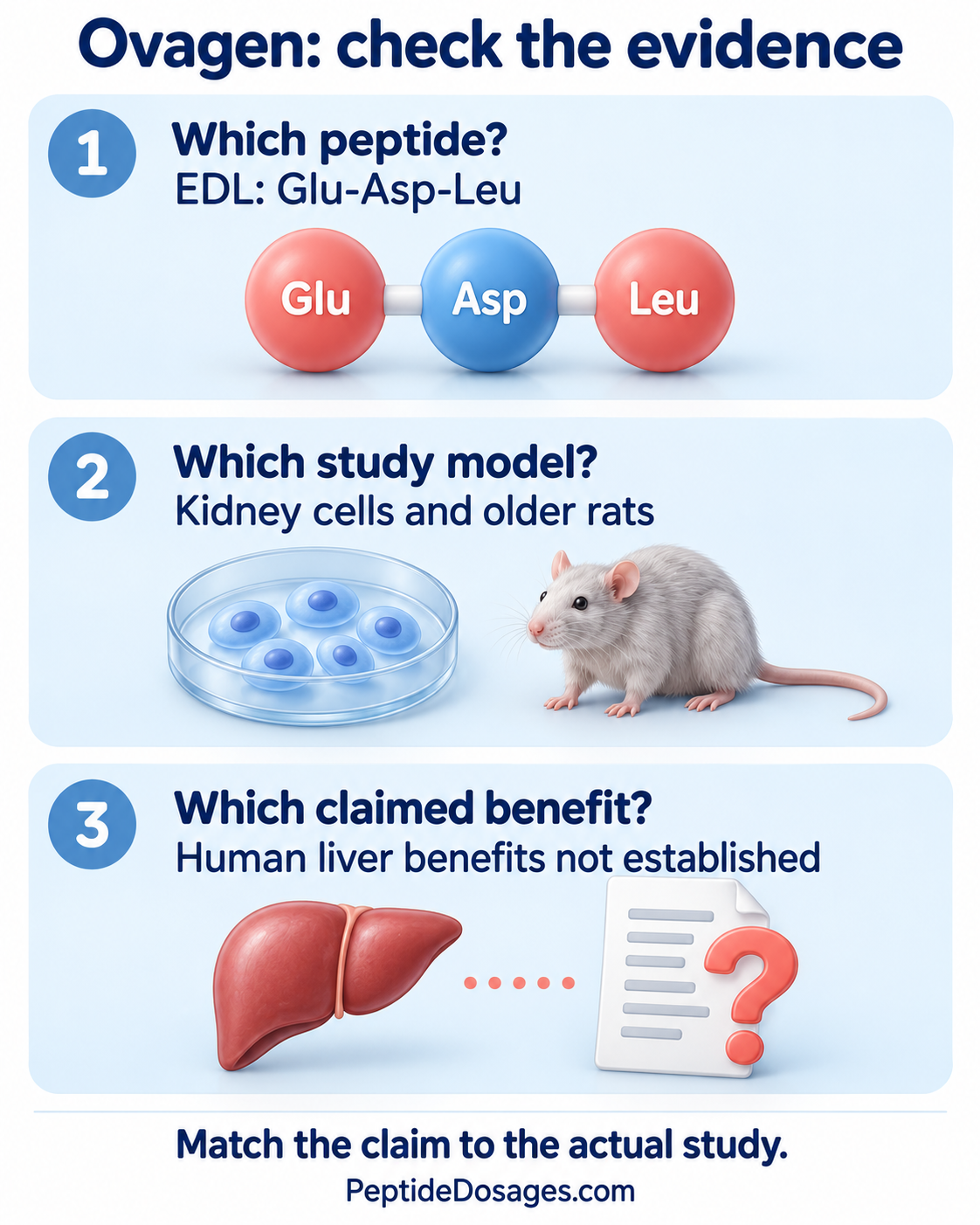
Ovagen is the name used for the short peptide Glu-Asp-Leu, also written EDL. It is commonly described as a liver or gastrointestinal bioregulator. The name tells you how it is positioned, but the clearest experimental papers on EDL concern kidney cells and older rats, not a proven liver treatment.1,2,3
Check the tissue, peptide sequence and preparation used in each study. A finding about one isn’t automatically evidence for another.
What is Ovagen?
EDL is a tripeptide: glutamic acid, aspartic acid and leucine joined in that order. The originating research group’s review lists Ovagen as EDL among its short peptide bioregulators.1 “Bioregulator” describes a proposed approach to biological regulation; it does not by itself establish an approved indication or a clinical benefit.
Ovagen is not Livagen. It is also not the four-amino-acid sequence AEDL. A search that returns a paper on a longer peptide containing EDL may look relevant without actually studying Ovagen.
What has EDL actually been studied for?
Kidney-cell aging experiments
A 2014 paper examined EDL and another short peptide, AED, in aging renal cell cultures. Researchers reported changes in proliferation and several cell-aging markers, including p16, p21, p53 and SIRT6. They also modeled interactions between the peptides and DNA.2
This is useful mechanistic work, but it did not test symptom relief, recovery from liver disease or improved digestive health in people. Computer modeling adds a possible explanation, not a separate clinical result.
Studies in older rats
A 2018 study tested several peptide preparations in older rats. EDL was associated with changes in urine output and sodium handling; the kidney-tissue findings were interpreted as consistent with protection in that model. The abstract reports different findings for the different preparations, so not every result belongs to EDL. 3
| Common claim | What the cited evidence supports |
|---|---|
| “Regulates aging cells” | Changes in selected markers in cultured kidney cells |
| “Supports kidney function” | Experimental findings in older rats, not established treatment in people |
| “Repairs the liver or gut” | Not established by the kidney experiments |
| “Safe for repeated cycles” | Not established by a cell experiment or a short animal study |
Study interpretation based on the EDL renal-cell and rat reports.2,3
Does Ovagen improve liver or digestive health?
The papers discussed here do not establish that it does. This is not the same as proving that EDL could never have such an effect. It means the advertised benefit extends beyond what these experiments measured.
Terms such as “detox,” “repair” and “normalization” can hide important questions: Which condition? Which measurement? Compared with what? Over what period? A useful human trial would specify those details and report both benefits and adverse events.
The same caution applies to gene-expression claims. Altering a cellular marker is not automatically beneficial, and it does not show that an organ has returned to normal function.
Side effects and interactions
The limited EDL literature does not provide a dependable list of human side effects, their frequency or interactions with common medicines. An animal study reporting no nephrotoxic changes under its conditions cannot establish that repeated use is safe for people with kidney disease.3
If a product is described as gentle or tissue-specific, ask what human evidence supports that description. “No side effects mentioned” is different from a study designed to look for them.
Someone with abnormal liver tests, persistent digestive symptoms or kidney disease should not use a peptide claim to delay assessment. The reason for the problem matters more than choosing a compound with an organ-related label.
Ovagen dosage and preparation questions
There is no validated human regimen established by these EDL studies. Converting a vial’s labeled mass into a concentration only answers a measurement question. It does not identify a safe or effective amount for a person.
The Ovagen 20 mg research reference is separate from this evidence overview. Its calculations should not be mistaken for a prescribing label or clinical-trial proof.
Frequently asked questions
Can Ovagen be combined with Livagen or other peptides?
The fact that two compounds are discussed in liver-related research does not validate their combination. Combination safety and efficacy require their own evidence, including the exact ingredients and route.
How long does Ovagen take to work?
A reliable human timeline has not been established by the studies reviewed here. Laboratory or animal follow-up periods do not predict when a person should notice a change.
What should I look for in an Ovagen study?
Look for the exact EDL sequence, the preparation, the population and the outcome. Then check whether the result is a cell marker, an animal observation or a meaningful outcome in people. Those distinctions are more useful than the number of citations attached to a product page.
Related Ovagen dosage protocols
Continue with the vial-strength-specific research protocol that matches the material being evaluated. Each page keeps its own concentration, reconstitution, and syringe-unit calculations.
Practical measurement and handling guides
References
- Khavinson VK. Short peptide bioregulators and aging research. Advances in Gerontology. 2014. Originating-group review; identity and research context, not proof of clinical efficacy.
- AED and EDL peptide effects in aging renal cell cultures. 2014. Experimental study and molecular modeling.
- Zamorskii II, et al. The influence of peptides on the morphofunctional state of old rats’ kidneys. Advances in Gerontology. 2018.