If you’ve been around peptides, biohacking, or “cellular energy” conversations, you’ve seen NAD+ everywhere. People talk about NAD+ shots, IV drips, “NAD boosters,” and longevity protocols. The problem is that most explanations skip the basics—or overpromise results. This guide explains what NAD+ is, what it does, what the human evidence actually supports, and how to think about NAD+ products responsibly (educational only, not medical advice). [1]
Fast Answer / Executive Summary
NAD+ (nicotinamide adenine dinucleotide) is a coenzyme found in every cell that helps convert nutrients into usable energy and also serves as “fuel” for enzymes involved in DNA repair and cellular signaling. NAD+ constantly cycles between NAD+ and NADH, and NAD+ levels tend to decline with age. Most human studies show oral precursors (like NR or NMN) raise NAD-related biomarkers, but health outcomes are mixed. [2]
Core Concepts & Key Entities
NAD+ is not a peptide, but it shows up in “peptide” circles for a reason
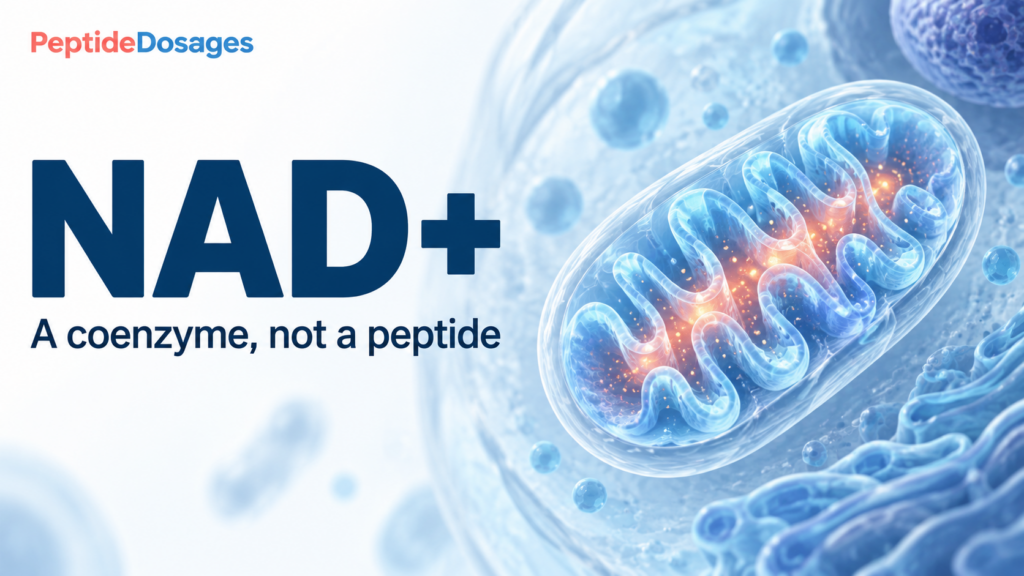
NAD+ is a coenzyme (not a peptide) that’s central to cellular metabolism and cell-signaling pathways. [3]
So why do peptide enthusiasts talk about it? Because NAD+ is often sold in similar formats (lyophilized vials, “research use” labeling) and discussed in protocol-style language. If you’re new, it’s important to separate the biochemistry (NAD+ is essential) from the marketing (not every NAD+ product or clinic claim is proven). [4]
What does NAD+ do?
NAD+ helps your body extract energy from food by carrying electrons during key metabolic reactions, and it supports cellular maintenance by acting as a substrate for NAD+-consuming enzymes. [5]
Think of NAD+ as doing two major jobs:
- Energy/redox job: NAD+ accepts electrons and becomes NADH during breakdown of carbs, fats, and amino acids. Then NADH helps drive ATP production through mitochondrial respiration. [5]
- Signaling/repair job: NAD+ is consumed as a substrate by enzymes involved in processes like DNA repair and post‑translational modification—especially sirtuins, PARPs, and CD38. [6]
This “dual role” is why NAD+ is discussed in both performance/energy contexts and aging/repair contexts. [1]
NAD+ vs NADH: the most important “normalization” to understand early
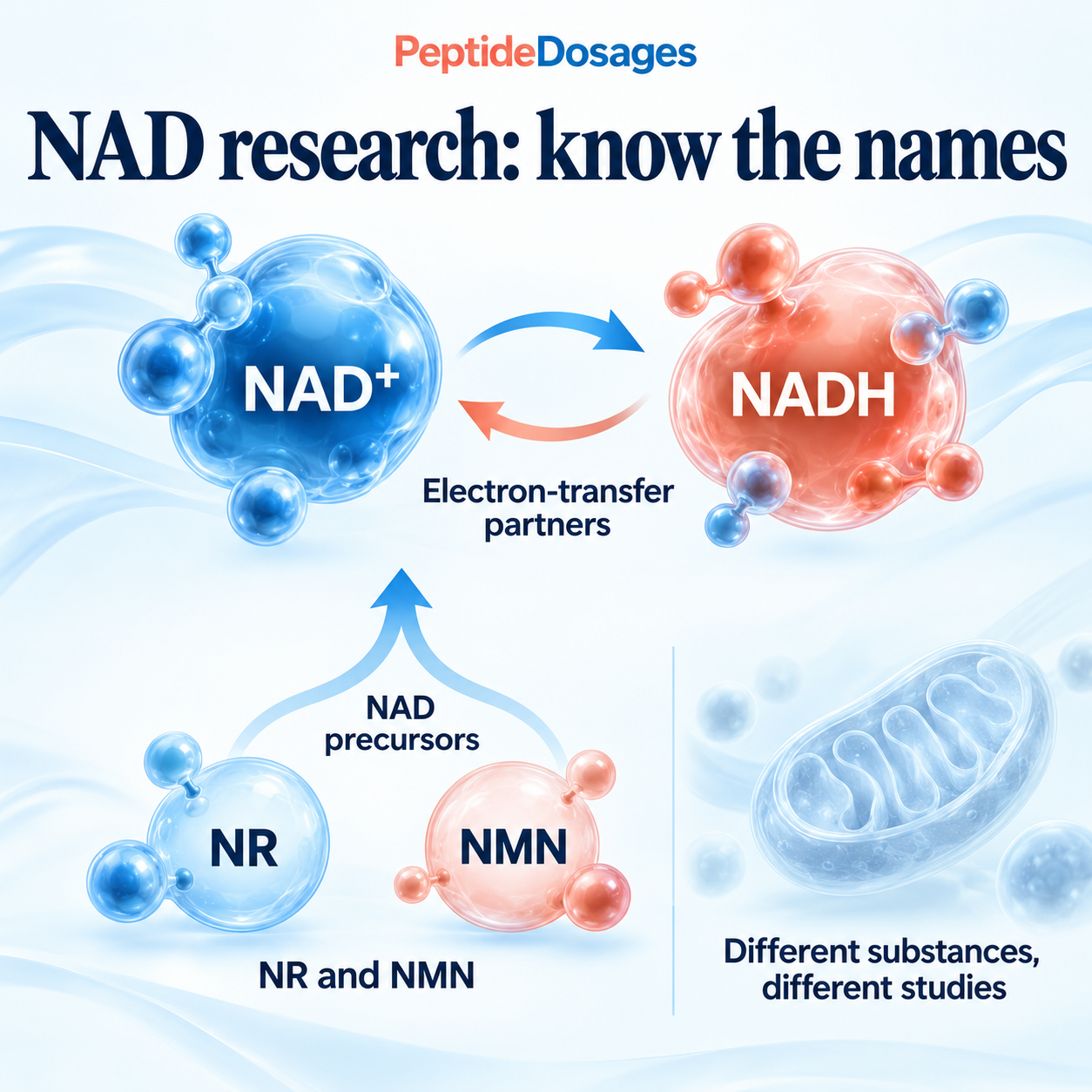
You’ll see people write “NAD,” “NAD+,” “NADH,” or even “NAD plus.” Here’s the clean way to think about it:
NAD+ is the oxidized form, and NADH is the reduced form—together they form a rechargeable redox pair that cycles constantly. [7]
Practical translation:
- NAD+ = electron acceptor (helps “pull” energy from fuels)
- NADH = electron donor (helps “spend” those electrons to make ATP) [7]
When people say “boost NAD,” they may mean increasing the overall NAD pool (NAD+ + NADH) or improving the NAD+/NADH balance. Those goals are not identical. [5]
NADP+ and NADPH: related, but used for a different job
NADP+ / NADPH are closely related to NAD+ / NADH, but they are primarily used for antioxidant defense and anabolic (building) reactions rather than fuel breakdown. [8]
In plain language:
- NAD+ / NADH tends to support catabolic pathways (breaking down fuel).
- NADPH tends to support anabolic pathways (building lipids, nucleic acids) and cellular antioxidant systems. [8]
This matters because some “energy” claims about NAD+ are really claims about broader redox balance (which may involve NADPH too). [9]
Where is NAD+ in the body?
NAD+ is present in essentially all living cells and is compartmentalized inside cells (cytoplasm, mitochondria, nucleus), with different pools regulated differently. [10]
That compartmentalization is a big reason why “raise NAD+” is not as simple as “take more NAD+.” A supplement might raise blood biomarkers while having unclear effects in specific tissues or organelles. [11]
The NAD+ Budget Framework: the fastest way to reason about “NAD+ boosting”
Most competing articles list “benefits” without explaining why results vary. Use this instead:
Your NAD+ level is like a budget controlled by how much you make, how much you recycle, and how much you spend. [12]
Here’s the framework:
- Make (inputs): NAD+ can be made from precursors such as tryptophan and vitamin B3 forms (niacin/nicotinamide), as well as “NAD+ precursors” like NR and NMN. [13]
- Recycle (salvage): Cells heavily rely on salvage pathways (notably involving NAMPT) to recycle nicotinamide back into NAD+. [14]
- Spend (consumption): NAD+ is consumed by enzymes including sirtuins, PARPs, and CD38 (and others). [12]
Unique insight most people miss: If “spending” is high (for example, high inflammation increasing CD38 activity), raising “inputs” may have limited impact unless the spending side is addressed too. [15]
Do NAD+ levels decline with age?
NAD+ levels tend to decline with age in multiple organisms, and human observational data supports age-associated reductions, but the exact drivers vary by tissue and context. [6]
Mechanistically, two themes show up repeatedly in the literature:
- Higher consumption: Aging is associated with increased NAD+ consumption pathways; CD38 is frequently highlighted as increasing with age and contributing to NAD+ decline. [16]
- Regulatory changes: NAD+ biology is tied to circadian rhythm and metabolic regulation (NAMPT and sirtuins), so changes in sleep, metabolism, and inflammatory state can matter. [17]
This is why “NAD+ decline” is real as a general trend, but it is not a promise that every person needs aggressive intervention. [18]
NAD+ and vitamin B3: the foundational connection most beginners overlook
Vitamin B3 (niacin/niacinamide) exists partly because your body needs it to make NAD and NADP. [19]
Historically, severe niacin deficiency causes pellagra (classically dermatitis, diarrhea, dementia), which reflects how central NAD biology is to basic health. [10]
Where beginners get tripped up: “more” is not always better. The National Institutes of Health Office of Dietary Supplements[20] documents that high supplemental intakes—especially pharmacologic niacin—can cause adverse effects (flushing can occur around tens of mg for nicotinic acid; gram‑level dosing has broader risks and should be medically supervised). [21]
Step‑by‑Step / How‑To
First: decide what you actually want from NAD+ (energy, recovery, longevity, or “numbers”)
You should choose an NAD+ strategy based on your goal because different approaches affect NAD biomarkers differently and have different evidence. [22]
A “better workout week” goal is not the same as an “anti‑aging” goal—and human outcome data for many “longevity” endpoints is still inconclusive. [23]
Next: start with the highest‑signal lifestyle levers
Lifestyle factors influence NAD biology because NAD+ is tightly connected to metabolism, mitochondrial function, circadian rhythm, and inflammation. [24]
Before you spend money on “boosters,” tighten the basics that can alter NAD demand and regulation: consistent sleep, resistance training + aerobic work, and reducing obvious high-stress/high-alcohol patterns. [25]
Then: choose a “precursor” path if your intent is to raise NAD biomarkers
If your priority is “raise NAD-related biomarkers,” oral precursors like NR and NMN have the most consistent human evidence for biochemical target engagement. [26]
In multiple human studies, NR increases the NAD metabolome (including increases reported in blood and, in a small study, measurable increases in brain NAD+ by MRS after a single 900 mg dose). [27]
If you’re considering “NAD+ IV” or injectable NAD+, treat it as a separate category with separate expectations
NAD+ administered by IV/IM/SC is common in wellness settings, but strong human outcomes trials for anti‑aging or wellness endpoints using IV/IM NAD+ itself are not established. [4]
A 2026 PRISMA‑guided systematic review found no eligible outcomes trials testing IV/IM NAD+ itself for anti‑aging or wellness, even though oral precursors often raise biomarkers. [28]
After that: pressure‑test product quality and labeling (especially in “research” markets)
Quality control matters because NAD+ products are often sold as “research use,” and users may incorrectly assume pharmaceutical‑grade sterility or clinical oversight. [29]
At minimum, verify third‑party testing (COA), storage instructions, and whether the product is explicitly labeled “not for human consumption.” [30]
Finally: track what matters and use clear stop signals
You should track outcomes you can actually observe (sleep, training tolerance, GI symptoms, blood pressure trends) because NAD+ marketing often focuses on vague feelings rather than measurable changes. [31]
If an approach causes persistent adverse symptoms, the safest “optimization” move is to stop and reassess with a clinician, not to stack more compounds. [32]
Comparison / Alternatives
NAD+ vs NR vs NMN vs niacin: which is “best” depends on what you mean by best
There is no single “best” NAD+ option—oral NR/NMN are best supported for raising NAD biomarkers in humans, while IV/IM/SC NAD+ has weaker outcomes evidence for wellness claims. [26]
Below is a practical comparison for peptide and health enthusiasts who want clarity.
| Option | What it is | Best-supported “win” | Human evidence strength | Typical downsides / cautions |
| NAD+ (IV/IM/SC) | Direct NAD+ administered parenterally | Short‑term biomarker/symptom exploration in supervised settings | Limited for wellness outcomes; tolerability issues reported | Infusion can be uncomfortable (GI symptoms, chest pressure reported); sterility/oversight matters; outcomes trials lacking [33] |
| NR (nicotinamide riboside) | Oral NAD+ precursor vitamin | Raises NAD metabolome (blood; some evidence for brain NAD+ acutely) | Moderate (multiple human studies) | Outcomes are mixed; don’t assume “more NAD” = better healthspan endpoints [34] |
| NMN (nicotinamide mononucleotide) | Oral NAD+ precursor | Raises NAD biomarkers; some metabolic signals in specific populations | Moderate but heterogeneous | Not all trials show functional benefits; regulatory landscape has shifted over time [35] |
| Niacin (nicotinic acid) / Nicotinamide (NAM) | Vitamin B3 forms used to make NAD | Foundational “B3 adequacy” | High for deficiency biology | Higher supplemental doses can cause side effects; pharmacologic niacin has meaningful risks and needs supervision [21] |
| Lifestyle (training/sleep/nutrition) | Behavior that changes metabolism/inflammation/circadian signaling | Broad impact on metabolic health | High for general health outcomes | Requires consistency; not “instant,” but often higher ROI than stacks [36] |
NAD+ vs NADH: the comparison people search, but rarely get explained well
NAD+ and NADH are two sides of the same molecule, and your body needs both—what matters is the cycling between them and the overall balance in cellular compartments. [7]
If someone is selling “NADH” as a direct energy fix, remember: energy metabolism is not just “add NADH.” The NAD+/NADH balance and mitochondrial function determine whether those electrons translate into ATP efficiently. [7]
NMN legality note for buyers: it changed recently, so date-stamp your assumptions
As of late September 2025, the U.S. Food and Drug Administration[37] confirmed in letters that NMN is not excluded from the definition of a dietary supplement, reversing its earlier position. [38]
Even with that shift, NMN can still fall under “new dietary ingredient” expectations depending on supplier and filings, so “legal to sell somewhere” is not the same as “every product is compliant.” [39]
Templates / Checklist / Example
The NAD+ Reality Check Checklist (copy‑ready)
Use this before you buy anything, stack anything, or book an IV drip.
- Define your goal in one sentence (energy, recovery, labs, longevity). [28]
- Choose one primary lever (lifestyle or one precursor) for 4–8 weeks before stacking. [23]
- Verify you understand the form: NAD+ vs NR vs NMN vs niacin (they are not interchangeable). [40]
- Screen for obvious risk factors (liver issues, glucose issues, medication interactions) with a clinician if using high-dose B3 forms. [21]
- Prioritize product quality: COA, storage, and clear labeling (especially “research use only”). [41]
- Start conservatively and avoid rapid escalation; adverse effects are often dose or rate related (especially with infusions). [42]
- Track one objective metric (sleep duration, training performance, BP trends, labs ordered by a clinician) and one subjective metric (energy/mood). [18]
- Stop if you get persistent chest pressure, severe GI symptoms, fainting, rash, or signs of intolerance—then reassess medically. [42]
Example: using the NAD+ Budget Framework to troubleshoot “why nothing is happening”
If you “take a booster” but feel nothing, the issue may be that your NAD+ spending is high, not that your NAD+ inputs are too low. [15]
A concrete example: someone sleeping 5–6 hours, stressed, and drinking heavily on weekends may be increasing NAD demand and impairing metabolic resilience. In that scenario, a precursor can raise blood biomarkers, but the lived result can still feel flat because the underlying load is unchanged. [43]
FAQs
What is NAD+?
What is NAD+? NAD+ is a coenzyme (nicotinamide adenine dinucleotide) that cells use for energy metabolism and as a substrate for enzymes involved in DNA repair and signaling. It cycles between NAD+ and NADH, linking nutrient breakdown to ATP production, while also being consumed by enzymes such as sirtuins, PARPs, and CD38. [44]
What is the difference between NAD+ and NADH?
What is the difference between NAD+ and NADH? NAD+ is the oxidized form that accepts electrons, and NADH is the reduced form that carries those electrons to help generate ATP. They are a paired system; your body needs both, and the balance (plus compartment location) influences metabolic direction and efficiency. [7]
How can I raise NAD+ naturally?
How can I raise NAD+ naturally? You can support NAD biology by improving sleep/circadian regularity, training consistently, and ensuring adequate vitamin B3 intake. NAD+ levels and NAD‑dependent enzyme activity are tied to metabolic state, inflammation, and circadian regulation (including NAMPT and sirtuins). Lifestyle improvements often have stronger evidence for real-world health outcomes than “stacking” compounds. [45]
Do NAD+ injections or IV drips work for anti-aging?
Do NAD+ injections or IV drips work for anti-aging? NAD+ IV/IM is used in wellness settings, but strong outcomes trials showing anti‑aging benefits from IV/IM NAD+ itself are not established. A 2026 systematic review did not find eligible outcomes trials testing IV/IM NAD+ for anti‑aging or wellness endpoints, and tolerability issues during infusion have been reported in real‑world data. [46]
Is nicotinamide riboside (NR) proven to raise NAD+ in humans?
Is nicotinamide riboside (NR) proven to raise NAD+ in humans? NR has multiple human studies showing it increases NAD-related biomarkers, including measurable increases in whole blood NAD and even an acute increase in cerebral NAD+ in a small MRS study. However, improvements in clinical outcomes are mixed, so “biomarker increase” should not be treated as guaranteed healthspan improvement. [34]
Is NMN legal and safe?
Is NMN legal and safe? NMN has human trials suggesting it can raise NAD biomarkers and is generally well tolerated in the short term in studied populations, but results vary and long-term outcomes are still being clarified. In the U.S., FDA communications in late September 2025 indicated NMN is not excluded from the dietary supplement definition, reversing a prior stance. [47]
Next Steps
The most useful way to think about NAD+ is as a cellular “budget”: you can increase inputs (precursors), improve recycling, or reduce excessive spending—often by addressing inflammation, sleep, and metabolic strain first. [48]
If you’re exploring NAD+ in the peptide-style ecosystem, use reliable definitions, realistic expectations, and cautious quality standards. For educational protocol-style references from PeptideDosages.com[49], you can review: – NAD+ 500 mg / 10 mL Vial Dosage Protocol [50]
– NAD+ 1000 mg Vial Dosage Protocol [51]
For external “research purchase” pages (always verify legality, labeling, testing, and intended use in your jurisdiction), see PureLabPeptides.com[52]: – Buy NAD+ 500 mg [53]
– Buy NAD+ 1000 mg [54]
[1] [2] [3] [5] [6] [8] [10] [12] [13] [17] [19] [24] [25] [36] [37] [40] [43] [44] [45] NAD+ metabolism and its roles in cellular processes during ageing – PMC
https://pmc.ncbi.nlm.nih.gov/articles/PMC7963035/
[4] [11] [18] [22] [23] [26] [28] [31] [46] NAD⁺ supplementation for anti-aging and wellness: A PRISMA-guided systematic review of preclinical and clinical evidence – ScienceDirect
https://www.sciencedirect.com/science/article/pii/S1568163726000498
[7] [27] [34] [52] Nicotinamide riboside is uniquely and orally bioavailable in mice and humans – PMC
https://pmc.ncbi.nlm.nih.gov/articles/PMC5062546/
[9] Investigating mitochondrial redox state using NADH and …
https://pmc.ncbi.nlm.nih.gov/articles/PMC5145803/?utm_source=chatgpt.com
[14] NAD+ and Sirtuins in Aging and Disease – PMC
https://pmc.ncbi.nlm.nih.gov/articles/PMC4112140/
[15] [48] The Pharmacology of CD38/NADase: An emerging target for cancer and aging diseases – PMC
https://pmc.ncbi.nlm.nih.gov/articles/PMC5885288/
[16] NAD+ metabolism: pathophysiologic mechanisms and therapeutic potential | Signal Transduction and Targeted Therapy
https://www.nature.com/articles/s41392-020-00311-7
[20] [33] [42] [49] Frontiers | Intravenous infusion of nicotinamide adenine dinucleotide (NAD+) versus nicotinamide riboside (NR): a retrospective tolerability pilot study in a real-world setting
https://www.frontiersin.org/journals/aging/articles/10.3389/fragi.2026.1652582/full
[21] [32] Niacin – Health Professional Fact Sheet
https://ods.od.nih.gov/factsheets/Niacin-HealthProfessional/
[29] [30] [50] NAD+ 500mg Dosage Protocol | PeptideDosages.com
https://peptidedosages.com/single-peptide-dosages/nad-500-mg-10ml-vial-dosage-protocol/
[35] [47] The efficacy and safety of β-nicotinamide mononucleotide (NMN) supplementation in healthy middle-aged adults: a randomized, multicenter, double-blind, placebo-controlled, parallel-group, dose-dependent clinical trial – PMC
https://pmc.ncbi.nlm.nih.gov/articles/PMC9735188/
[38] [39] FDA Declares Nicotinamide Mononucleotide Is a Dietary Supplement | Insights | Venable LLP
https://www.venable.com/insights/publications/2025/10/fda-declares-nicotinamide-mononucleotide-is
[41] [53] Buy NAD+ Online | Cellular Energy & Longevity Research
https://purelabpeptides.com/buy-peptides/buy-nad-plus-500mg/
[51] NAD+ 1000mg Dosage Protocol | PeptideDosages.com
https://peptidedosages.com/single-peptide-dosages/nad-1000-mg-vial-dosage-protocol/
[54] Buy NAD+ Online | 1000mg High-Purity Coenzyme for Research