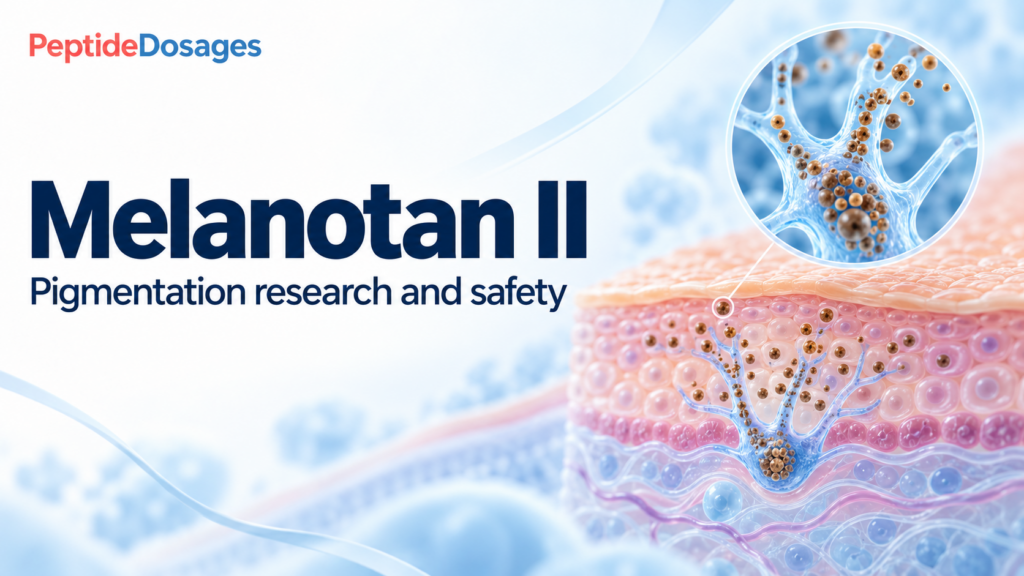
Melanotan II, often called Melanotan 2 or MT-II, is a synthetic peptide that can stimulate skin pigmentation. That effect is real enough to have appeared in early human experiments. It is not evidence that tanning injections or nasal sprays are safe, protect against skin cancer, or provide an approved cosmetic treatment. Regulators warn about serious adverse effects and uncertainty over what unapproved products contain. [1][4][9]
Darker skin and better protection against harm are different outcomes. Before-and-after tanning photographs can’t establish the second.
Related dosage pages: For vial-specific concentration, reconstitution, and measurement examples, see Melanotan II (10 mg Vial) Dosage Protocol. Each linked protocol remains a separate reference because vial strength changes concentration and syringe-unit calculations.
What is Melanotan II?
Melanotan II is a manufactured, cyclic seven-amino acid analogue of alpha-melanocyte-stimulating hormone (alpha-MSH). It acts through melanocortin signaling, which is involved in pigmentation and other bodily functions. It isn’t a natural tanning vitamin. [1]
Its association with melanin, the pigment responsible for much of skin’s color, explains the tanning interest. But the early studies also recorded nausea, appetite changes and spontaneous erections. Those effects are a reminder that a compound discussed for appearance can affect more than skin. [1][2]
What have human studies actually shown?
The best-known early trials were small and designed around particular observations. Neither was large or long enough to establish the safety of repeated cosmetic use.
| Research | Result and limitation |
|---|---|
| Phase I pigmentation pilot, 1996 | Three men participated. Two developed increased pigmentation. Nausea, yawning, fatigue and erections were among the observations. A three-person pilot cannot predict population-wide benefits or uncommon harms. [1] |
| Psychogenic erectile dysfunction study, 1998 | Ten men took part in a blinded, placebo-controlled crossover study. Eight developed clinically apparent erections after Melanotan II. Monitoring occurred over six hours, not months of consumer use. [2] |
| Subsequent safety reports | FDA lists published reports involving melanoma, serious neurological illness, excessive sympathetic stimulation and priapism. Case reports raise concerns but cannot establish the frequency of harm or prove causation in every case. [4] |
The erectile-function result is often repeated as “80% effective.” That shorthand leaves out almost everything needed to interpret it: only ten selected participants, a particular experimental preparation and a short observation period. It is not a reliable success rate for people buying a product online. [2]
What are the side effects of Melanotan 2?
Reported effects include nausea, vomiting, headache, flushing and reduced appetite. The Australian Therapeutic Goods Administration also warns about reports of increased moles or freckles, kidney dysfunction and brain swelling. These are safety signals, not a complete list or a prediction of what one person will experience. [3]
FDA separately notes concerns about immune responses associated with peptide aggregation or impurities in compounded Melanotan II. A product’s label does not establish its identity, concentration or freedom from contamination. [4]
When is an erection a medical emergency?
A persistent erection is not a desirable extension of the research effect. Priapism can damage penile tissue. An erection lasting about three to four hours needs emergency assessment; do not wait for it to pass. People with sickle cell disease should seek emergency help for a painful erection lasting more than one hour. [5]
Does Melanotan II cause melanoma?
Melanoma has been reported in the context of Melanotan II use, and regulators consider the skin-cancer concern serious. However, case reports cannot isolate the compound’s contribution from UV exposure, pre-existing lesions or other factors, and they cannot give a trustworthy numerical risk estimate. “Not proven to cause every reported case” does not mean “proven safe.” [4]
Arrange a medical assessment for a new or changing mole rather than assuming it is an expected tanning effect. The research does not provide a basis for treating pigment changes as harmless cosmetic progress.
Does the tan protect against sun damage?
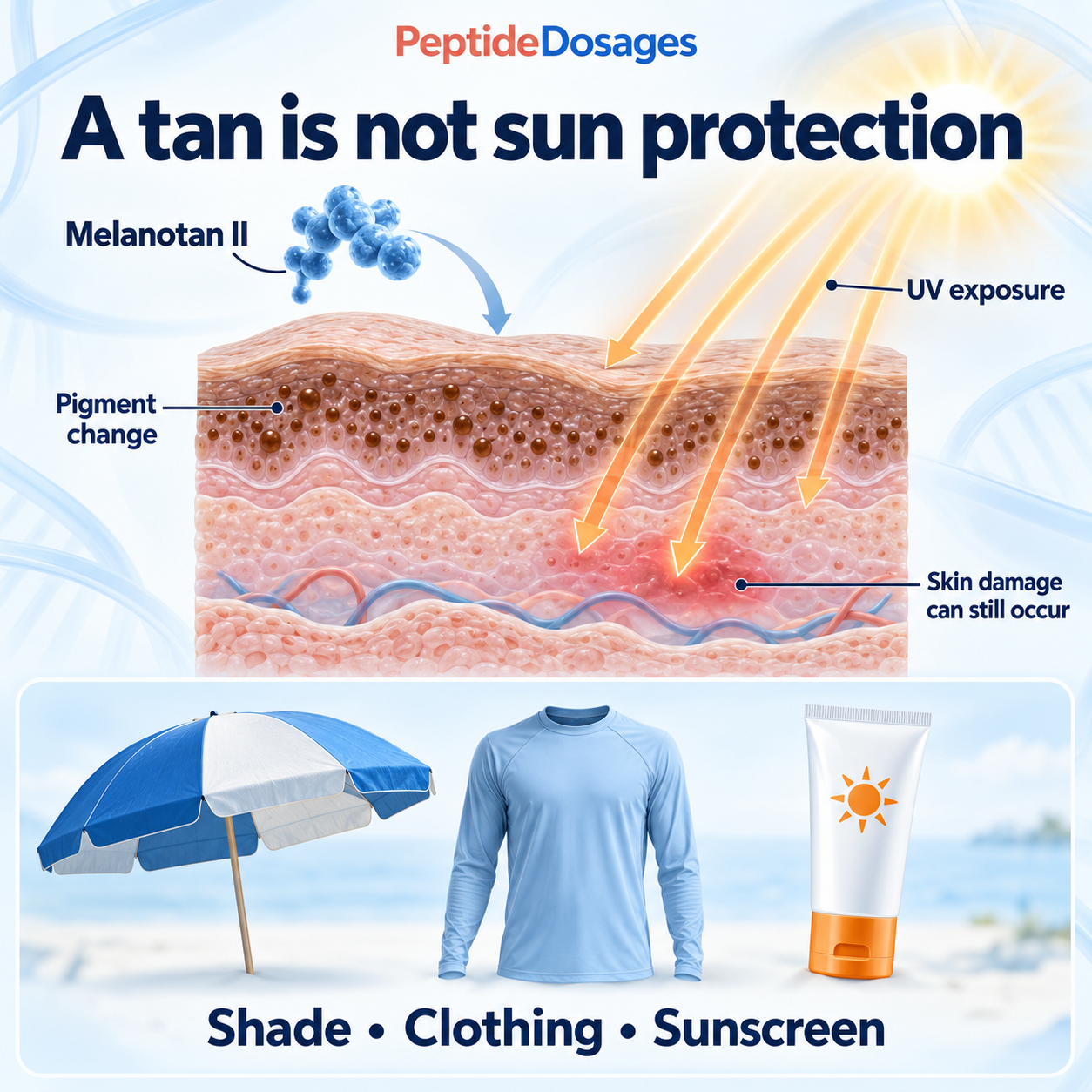
Do not treat Melanotan II as sunscreen or as a reason to use tanning beds. Artificially increasing pigmentation does not provide the protection of a suitable sunscreen. UV exposure from sunlight and tanning equipment can damage skin and contribute to cancer, including in people with naturally darker skin. [6]
Keep ordinary sun protection in place: shade, protective clothing, appropriate sunscreen and avoidance of tanning beds. A darker appearance is not a personal UV safety meter. [6]
Quick check: does a darker tan mean better protection?
No. Skin color and protection against UV injury are not interchangeable outcomes. A photograph can show a color change, but it cannot demonstrate that a product prevents sunburn, DNA damage or skin cancer.
Melanotan I, Melanotan II and PT-141 are not interchangeable
Similar names can make the regulatory picture confusing. Drug approval belongs to a particular product and indication, not to an entire peptide family.
- Melanotan II: remains an unapproved drug in the U.S. FDA’s import alert identifies Melanotan products marketed from research-only material as unapproved drugs. [9]
- Afamelanotide, associated with the Melanotan I name: the approved Scenesse implant is used to increase pain-free light exposure in adults with erythropoietic protoporphyria and a history of phototoxic reactions. That is not an approval for general cosmetic tanning, nor does it validate an online vial carrying a similar name. [7]
- Bremelanotide, also called PT-141: the approved Vyleesi product has an indication for certain premenopausal women with acquired, generalized hypoactive sexual desire disorder. It is a different compound and product, not an approved version of Melanotan II. [8]
Questions about nasal sprays, fat loss and dosage
Is a nasal tanning spray safer than an injection?
Avoiding a needle does not establish overall safety. TGA’s warning includes nasal sprays as well as injectable and ingestible products. Uncertain ingredients and biological effects do not disappear because a product is sprayed into the nose. The injection studies above also cannot validate a spray’s absorption or delivered dose. [3]
Does Melanotan 2 burn fat?
Reduced appetite was reported in the small erectile-function study, but it was not a weight-loss trial. It did not establish sustained fat loss, preservation of muscle or improved metabolic health. An appetite-related observation should not be repackaged as a proven body-composition benefit. [2]
Is there an established safe tanning dose?
No approved Melanotan II tanning dose follows from these studies. A dose selected for an early experiment is not a general-use safety threshold. Product differences, individual susceptibility and the lack of dependable long-term data prevent a simple claim that a particular online schedule is safe. [1][9]
Are changes to eye color an established benefit?
The early studies summarized here do not establish a safe or predictable eye-color effect. They should not be used to support claims about changing the iris, just as a skin-pigmentation result should not be expanded into unrelated cosmetic promises. [1][2]
Bottom line: Melanotan II can affect pigmentation, but the safety and product-quality uncertainties are substantial. It is not a substitute for sun protection or an approved treatment for tanning or sexual function. If you have used an unapproved tanning product, speak with a healthcare professional about symptoms, skin changes and what the product contained. [3]
References
- Dorr RT, et al. Evaluation of melanotan-II, a superpotent cyclic melanotropic peptide in a pilot phase-I clinical study. Life Sciences. 1996;58:1777-1784.
- Wessells H, et al. Synthetic melanotropic peptide initiates erections in men with psychogenic erectile dysfunction: double-blind, placebo controlled crossover study. Journal of Urology. 1998;160:389-393.
- Therapeutic Goods Administration. Don’t risk using tanning products containing melanotan. January 2025 safety warning.
- U.S. Food and Drug Administration. Certain bulk drug substances for use in compounding that may present significant safety risks. Melanotan II entry.
- NHS. Priapism (painful erections). Emergency assessment guidance.
- National Cancer Institute. Sunlight. UV exposure and cancer prevention.
- DailyMed. Scenesse: afamelanotide implant prescribing information. Current label, May 2026.
- DailyMed. Vyleesi: bremelanotide prescribing information. Current label, November 2025.
- U.S. Food and Drug Administration. Import Alert 66-41. Unapproved-drug import guidance and Melanotan entries.
Related dosage protocols and research
Explore related research, dosage references and guides below. Vial strengths have separate references because concentration and syringe-unit calculations differ. A comparison does not mean the compounds are interchangeable.
Matching dosage protocols
Related protocols and comparisons
Further research context