If you searched “What is HMG” and landed in peptide forums, fertility clinics, and “75 IU vial” discussions, you’re not alone. HMG is often treated like a “peptide,” but it’s actually a gonadotropin hormone medication used in reproductive medicine. This guide explains what HMG is, how it works, why it’s used, key risks, and how it compares to hCG and FSH—without fluff. [1]

Educational note: This article is for information only and is not medical advice. HMG and related fertility medications should be used only under qualified clinical supervision with appropriate monitoring. [2]

Fast Answer / Executive Summary

HMG (human menopausal gonadotropin) is a gonadotropin preparation that provides both FSH and LH activity to stimulate reproductive function. In women, it’s used in assisted reproduction and ovulation induction to support follicle development and, when mature, ovulation is typically triggered with hCG. In men with specific hormone deficiencies, gonadotropin therapy may add FSH activity to support sperm production under specialist care. [3]

Core Concepts & Key Entities

What HMG means

HMG stands for human menopausal gonadotropin. In pharmaceutical and clinical contexts, you’ll also see it called menotropins or hMG. The defining idea is simple: HMG supplies gonadotropin activity (FSH + LH) that the body normally produces in the pituitary-driven reproductive axis. [4]

In FDA-approved menotropin products such as MENOPUR (manufactured for Ferring Pharmaceuticals[5]), the label describes a preparation of gonadotropins with FSH and LH activity, extracted from the urine of postmenopausal women and further purified. [6]

HMG is not a single “peptide”

Many “peptide” audiences talk about HMG as if it’s one compound like a short amino-acid chain. It’s not.

HMG is a biologic mixture of glycoprotein hormones (FSH + LH activity), measured by bioactivity (IU), not by “sequence.” In other words: you’re dealing with endocrine signaling molecules, not a single synthetic peptide. [7]

That’s why vendor descriptions may state “sequence: not applicable—mixture,” and why the unit system looks different from mg-only peptides. [8]

The key players you need to understand HMG

GnRH and the HPG axis

GnRH (gonadotropin-releasing hormone) is the upstream signal from the hypothalamus that drives pituitary release of FSH and LH. This hypothalamic–pituitary–gonadal axis (HPG axis) is the control loop that regulates sex hormone production and gamete maturation. [9]

FSH

FSH (follicle-stimulating hormone) is a glycoprotein hormone that supports gametogenesis. In ovaries, it stimulates granulosa cell function and supports follicle development; at the cellular level, it drives steroidogenic processes like aromatase activity (which converts theca-derived androgens into estradiol). [10]

LH

LH (luteinizing hormone) is the gonadotropin that helps coordinate ovulation and steroidogenesis. It is stimulated by GnRH and participates in the HPG axis feedback loop. In ovarian physiology, LH stimulates theca cells to synthesize androgens that become precursors for estradiol production in granulosa cells. [11]

Why HMG is measured in IU, not just mg

If you’re used to peptides dosed by milligrams, HMG can feel confusing. The vial often says something like “75 IU.”

An International Unit (IU) is a standardized measure of biological effect, not mass. It’s used for proteins and hormones where “how much it does” (potency) matters more than “how much it weighs.” [12]

In the MENOPUR prescribing information, each vial is described as containing 75 IU FSH activity and 75 IU LH activity (plus excipients). That “75 IU” is potency-based. [13]

HMG, LH activity, and the “hidden” hCG detail most pages miss

Here’s a nuance that many high-ranking pages gloss over:

In some highly purified urinary hMG products, “LH activity” can be largely driven by hCG present in postmenopausal urine and/or added during processing. MENOPUR’s labeling explicitly notes that hCG is detected in the product. [14]

Why this matters: – It helps explain why you’ll see phrases like “hCG-driven LH activity” in professional materials. [15] – It clarifies why HMG is often discussed alongside hCG in fertility protocols—even when the goal is “LH activity.” [16]

What HMG is used for in real-world practice

HMG is primarily used in fertility treatment to stimulate ovarian follicle growth and maturation, typically within assisted reproductive technology (ART) cycles. In the MENOPUR label, the indication highlights development of multiple follicles and pregnancy in ovulatory women in an ART cycle. [17]

Outside of ART, gonadotropins (including menotropins or FSH preparations) may be used for ovulation induction in selected anovulatory women, but careful low-dose strategies and cancellation thresholds are emphasized to reduce multiple gestation and OHSS risk. [18]

For men, authoritative guidelines discussing fertility-focused gonadotropin therapy describe an approach where hCG is often initiated and monitored first, and then FSH (or FSH analogues / preparations providing FSH activity) may be added to optimize sperm production in hypogonadotropic hypogonadism. [19]

Common confusions to clear up fast

HMG vs hCG

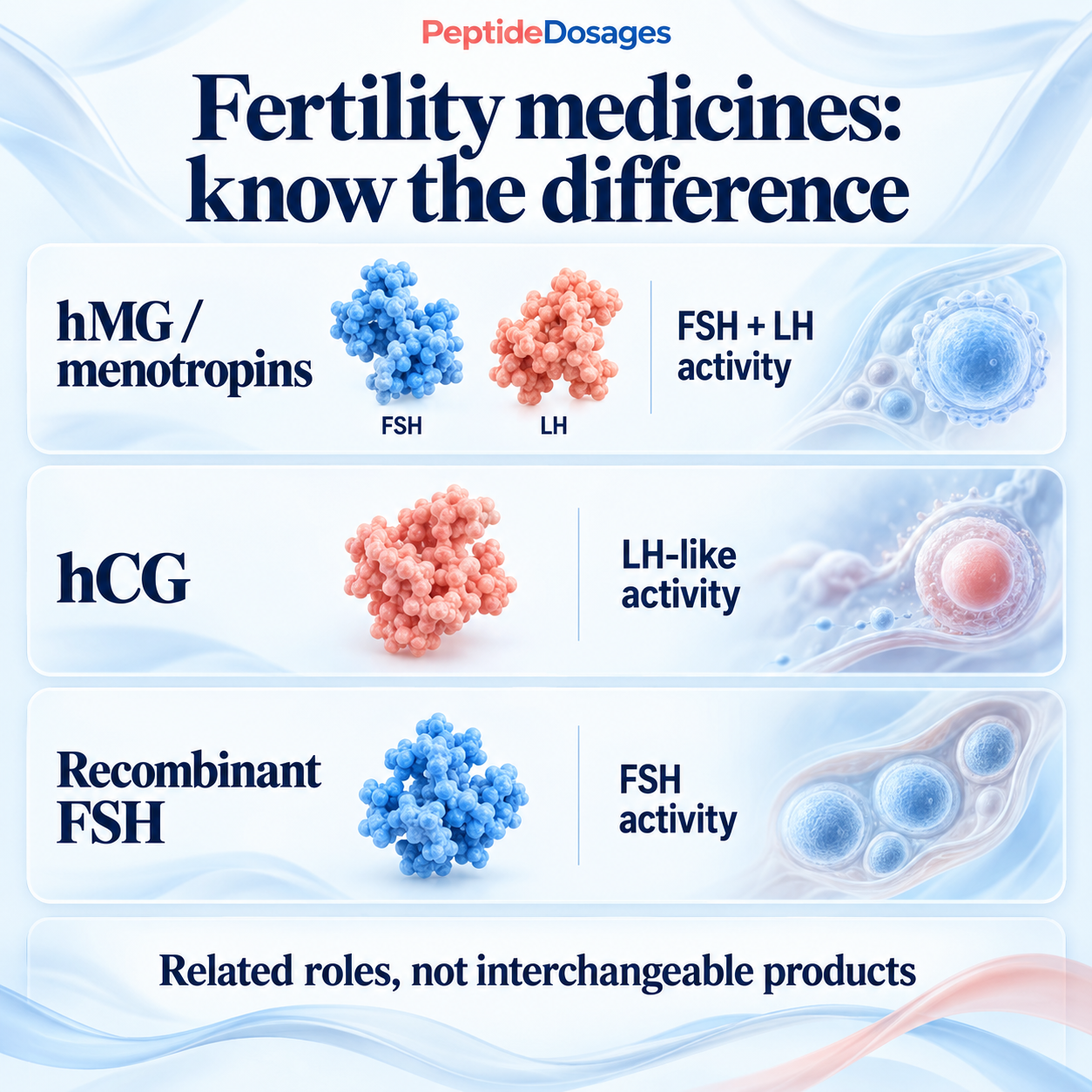
HMG is a mixed gonadotropin preparation that provides FSH + LH activity, while hCG is primarily an LH-receptor agonist used to mimic an LH surge or stimulate steroidogenesis. In many ovarian stimulation contexts, follicle growth is supported first and then ovulation is induced with hCG when follicles are mature. [20]

HMG vs HGH

HMG is sometimes confused with HGH (human growth hormone) because both show up as “vials” in biohacking circles. They are unrelated in mechanism and indication: HMG is reproductive-axis signaling (FSH/LH activity), not growth hormone signaling. [21]

HMG vs HMG-CoA

“HMG” also appears in “HMG-CoA reductase” (a cholesterol pathway enzyme targeted by statins). That’s a completely different biochemical context. [22]

A practical framework for understanding HMG

Competitor pages often list “benefits” without explaining why HMG is chosen. Use this simple framework:

HMG is a two-signal tool: it supports follicle/gamete development via FSH activity and adds LH-like support that influences steroidogenesis and follicle maturation pathways. Think of it as adding both “recruitment” (FSH) and “support” (LH-like activity) into the same protocol—then “trigger” (often hCG) is handled separately. [23]

That framework makes comparisons (below) instantly clearer.

Step-by-Step / How-To

HMG is typically used in structured, monitored fertility protocols—not as a DIY supplement—and the “how-to” is mostly about clinical sequencing and monitoring. [24]

Step one: Confirm the indication and rule out contraindications

The first step is confirming that HMG is appropriate for the clinical goal and that contraindications are addressed. The MENOPUR prescribing information emphasizes thorough evaluation and excludes situations like pregnancy and primary ovarian failure for the indicated use. [25]

For ovulation induction (non-ART), professional guidance emphasizes appropriate patient selection and counseling because gonadotropins can raise the risk of multiple gestation without strict monitoring and cancellation criteria. [26]

Step two: Set a starting dose strategy that prioritizes safety

The second step is choosing a conservative starting strategy and adjusting only based on response. For ART dosing in MENOPUR labeling, the approach is individualized with dose adjustments after several days and limits on how often and how much dosing can be adjusted. [25]

For anovulatory ovulation induction, American Society for Reproductive Medicine[27] guidance emphasizes starting low (commonly 37.5–75 IU/day) and slow titration to target mono-follicular development. [28]

Step three: Administer while monitoring follicles and hormones

The third step is consistent monitoring because gonadotropin response varies widely between individuals. In the MENOPUR labeling, ultrasound evaluation of follicular growth and (often) serum estradiol monitoring are part of dose individualization and risk minimization. [29]

This monitoring is not optional “optimization.” It’s the safety mechanism that reduces the risk of complications such as OHSS and excessive follicle development. [30]

Step four: Adjust, pause, or cancel based on response

The fourth step is responding to the biology, not forcing a calendar plan. In ovulation induction guidance, cycle cancellation is strongly recommended when follicle thresholds are exceeded (for example, more than two larger follicles or multiple intermediate follicles), specifically to reduce multiple gestation risk and OHSS. [31]

This is one of the biggest “information gain” points for beginners: a “successful cycle” is not “more follicles,” it’s “the right number of follicles for the goal.” [32]

Step five: Trigger ovulation or proceed to egg retrieval at the correct time

The fifth step is triggering final maturation when follicles are ready, often using hCG in protocols where ovulation needs to be timed. MENOPUR labeling notes that when sufficient follicular maturation has occurred, hCG must be given to induce ovulation, and hCG should be withheld if monitoring suggests increased OHSS risk. [33]

Step six: Monitor for OHSS and other serious adverse events after treatment

The sixth step is post-treatment surveillance because OHSS can develop after gonadotropins are stopped and may peak days later. MENOPUR prescribing information describes OHSS as a distinct medical event involving increased vascular permeability and possible fluid accumulation, and it notes the need for continued assessment after hCG administration. [34]

If severe symptoms occur (for example, severe pelvic/abdominal pain, rapid weight gain, breathing difficulty), urgent medical evaluation is required. [35]

Comparison / Alternatives

HMG is generally chosen when a protocol benefits from combined FSH + LH activity, while alternatives either provide FSH-only, LH-like activity only, or use oral ovulation induction approaches. [36]

HMG vs common alternatives at a glance

Option What it provides Where it’s commonly used Why someone might choose it Key tradeoffs / risks
HMG (menotropins) FSH + LH activity (often with detectable hCG in some products) ART ovarian stimulation; selected induction settings; selected male fertility deficiency care Adds LH-like support alongside FSH; historically used in ovarian stimulation Requires monitoring; OHSS and multiple gestation risks in women; prescription-only context [37]
Recombinant FSH (rFSH) FSH activity only ART and ovulation induction Pure FSH signaling; flexible dosing Similar outcomes overall vs urinary gonadotropins in large comparisons; still needs monitoring; cost can differ [38]
hCG (alone) LH-receptor stimulation (ovulation “trigger” or steroidogenesis support) Triggering ovulation; parts of male HH fertility protocols Strong LH-like signal; used for timing ovulation or stimulating testosterone production in specific contexts Not a substitute for FSH when spermatogenesis/follicle recruitment needs FSH input; still carries risks depending on context [39]
Oral ovulation induction (letrozole / clomiphene citrate) Indirectly increases endogenous gonadotropins Common first-line in PCOS-related anovulation; other induction contexts Lower complexity than injectables; often first before gonadotropins If inadequate response, injectable gonadotropins may be considered; monitoring still important [40]

What the evidence says about urinary vs recombinant gonadotropins

If you’re trying to decide whether “urinary-derived” options (like hMG/menotropins) are inherently “better” than recombinant gonadotropins, the answer is more nuanced than most marketing copy suggests.

A major Cochrane[41] review comparing recombinant FSH with urinary gonadotropins across many trials found no statistically significant difference in live birth rates overall, with effect sizes close to neutral. [38]

That doesn’t mean the products are identical in every subgroup or protocol. It means that for broad populations, outcomes can be similar—so factors like clinician preference, patient characteristics, protocol design, and cost often drive selection. [42]

Where HMG most clearly “fits” conceptually

Here’s a clean, decision-oriented way to think about it:

  • If the goal is follicle recruitment and growth, you need FSH signaling (directly or indirectly). [43]
  • If the goal is steroidogenic support and maturation pathways, LH-like activity becomes relevant. [44]
  • If the goal is timed ovulation, a strong LH-like surge is typically created with hCG in many protocols. [45]

HMG sits in the “FSH + LH-like support” lane, which is why it’s commonly paired with an hCG trigger in ovarian stimulation workflows and discussed alongside hCG in male fertility deficiency treatment sequences. [46]

Templates / Checklist / Example

Copy-ready HMG clarity checklist

Use this checklist to avoid the most common beginner mistakes (confusing acronyms, misunderstanding IU, and skipping safety context).

  • Define HMG as human menopausal gonadotropin (menotropins), providing FSH + LH activity. [47]
  • Confirm whether you’re reading a prescription medication label or a research-only vendor listing—they are not interchangeable. [29]
  • Understand that IU measures bioactivity, so 75 IU is potency-based, not mass-based. [48]
  • Differentiate HMG from hCG (LH-like signal) and from HGH (growth hormone). [49]
  • Expect clinical monitoring (ultrasound ± estradiol) in women using gonadotropins because risks rise without strict criteria. [50]
  • Learn the red flags of OHSS and take them seriously—OHSS can escalate and may occur after treatment stops. [35]
  • Use official reconstitution and handling instructions for the exact product (for example, some products specify sterile 0.9% sodium chloride and “gently swirl, do not shake,” and recommend using promptly after reconstitution). [51]
  • Choose reputable references first (labels, major medical societies, and peer-reviewed reviews) before optimizing “protocols.” [52]

Example: how to read a “75 IU vial” without guessing

A “75 IU” HMG vial label is telling you potency, not “how many milligrams you should inject.” [48]

A practical way to interpret it: – “75 IU” describes bioactivity measured against reference standards. [53]
– In some prescription products, the labeling may specify 75 IU FSH activity and 75 IU LH activity per vial. [13]
– Preparation instructions can include “use the provided diluent, gently swirl, do not shake,” and “use immediately after reconstitution; discard unused.” [51]

If you see people converting IU to mg across different hormones, pause: IU is substance-specific, and conversions do not carry over between different biologics. [54]

FAQs

What is HMG?

What is HMG? HMG is human menopausal gonadotropin, a menotropin preparation that provides follicle-stimulating hormone (FSH) and luteinizing hormone (LH) activity to support reproductive processes. It is used in fertility medicine, commonly in assisted reproductive technology cycles to stimulate follicle development, with careful monitoring to manage risks. [55]

Is HMG the same as hCG?

Is HMG the same as hCG? HMG is not the same as hCG—HMG provides FSH plus LH activity, while hCG is primarily used for LH-like receptor stimulation (often as an ovulation trigger). In many fertility protocols, gonadotropins support follicle maturation and then hCG is used to induce ovulation timing once follicles are ready. [20]

What does 75 IU mean on an HMG vial?

What does 75 IU mean on an HMG vial? Seventy-five IU refers to biological potency, not mass. An International Unit is a standardized measure of biological effect for substances like hormones and biologics. In some labeled menotropin products, the vial may specify 75 IU of FSH activity and 75 IU of LH activity, plus excipients. [56]

Why does HMG sometimes mention LH activity “from hCG”?

Why does HMG sometimes mention LH activity “from hCG”? Some urinary-derived hMG products can have LH activity that is largely driven by detectable hCG present in postmenopausal urine and/or added during processing. Official materials for some products explicitly note that hCG is detected, which helps explain the phrase “hCG-driven LH activity” in professional contexts. [57]

What are the main risks of HMG in women undergoing fertility treatment?

What are the main risks of HMG in women undergoing fertility treatment? The most serious risk is ovarian hyperstimulation syndrome (OHSS), which can involve fluid shifts and may worsen after treatment stops, especially if pregnancy occurs. Multiple gestation risk also rises without strict monitoring and cancellation criteria. Because of these risks, professional guidance emphasizes careful dosing, monitoring, and prevention strategies. [58]

Is HMG something beginners should self-administer from “research” vials?

Is HMG something beginners should self-administer from “research” vials? No—HMG is a potent reproductive hormone product and should not be treated like a casual beginner peptide. Prescription gonadotropin therapy requires clinician oversight and monitoring facilities in many contexts. If you encounter “research use only” listings, recognize that they are not FDA-evaluated medical treatments and are labeled for laboratory use. [59]

Next Steps

HMG is best understood as a combined FSH + LH-activity gonadotropin used in monitored fertility care—not as a generic “peptide supplement.” [60]

If you’re learning HMG for the first time, your highest-leverage next step is to match the HMG conversation to the correct context: – clinical fertility medication labels and medical society guidance for medical decision-making, and
– clearly labeled research-only documentation for laboratory contexts. [61]

For readers on PeptideDosages.com[62] who want vial-focused context (storage, terminology, and how the “75 IU” presentation is discussed in research communities), see the internal guide here: https://peptidedosages.com/single-peptide-dosages/hmg-75-iu-vial-dosage-protocol/. [63]

If you’re looking at a research listing provided for laboratory contexts, this vendor page is one example of a “research use only” listing (not a medical recommendation): https://purelabpeptides.com/buy-peptides/buy-hmg-75iu/. [64]


[1] [2] [3] [4] [6] [7] [13] [14] [16] [17] [20] [24] [25] [29] [33] [36] [37] [41] [45] [46] [47] [49] [50] [51] [52] [55] [57] [59] [60] [61] https://ferringusa.com/wp-content/uploads/sites/12/2025/03/Menopur-PI-Rev.-05.2018-20Mar2019.pdf

https://ferringusa.com/wp-content/uploads/sites/12/2025/03/Menopur-PI-Rev.-05.2018-20Mar2019.pdf

[5] [18] [26] [28] [32] https://www.asrm.org/practice-guidance/practice-committee-documents/use-of-exogenous-gonadotropins-for-ovulation-induction-in-anovulatory-women-a-committee-opinion-2020/

https://www.asrm.org/practice-guidance/practice-committee-documents/use-of-exogenous-gonadotropins-for-ovulation-induction-in-anovulatory-women-a-committee-opinion-2020/

[8] [30] [34] [35] [58] [62] [64] Buy HMG 75IU | Reliable Gonadotropin for Fertility Research

https://purelabpeptides.com/buy-peptides/buy-hmg-75iu/

[9] https://www.ncbi.nlm.nih.gov/books/NBK558992/

https://www.ncbi.nlm.nih.gov/books/NBK558992/

[10] [23] [43] https://www.ncbi.nlm.nih.gov/books/NBK535442/

https://www.ncbi.nlm.nih.gov/books/NBK535442/

[11] https://www.ncbi.nlm.nih.gov/books/NBK539692/

https://www.ncbi.nlm.nih.gov/books/NBK539692/

[12] [48] [54] [56] https://www.cancer.gov/publications/dictionaries/cancer-terms/def/international-unit

https://www.cancer.gov/publications/dictionaries/cancer-terms/def/international-unit

[15] MENOPUR® (menotropins for injection) for HCPs | Assisted …

https://www.menopurhcp.com/?utm_source=chatgpt.com

[19] [39] https://www.asrm.org/practice-guidance/practice-committee-documents/diagnosis-and-treatment-of-infertility-in-men-aua-asrm-guideline-part2/

https://www.asrm.org/practice-guidance/practice-committee-documents/diagnosis-and-treatment-of-infertility-in-men-aua-asrm-guideline-part2/

[21] [22] https://www.ncbi.nlm.nih.gov/books/NBK279070/

https://www.ncbi.nlm.nih.gov/books/NBK279070/

[27] [31] https://www.asrm.org/practice-guidance/practice-committee-documents/multiple-gestation-associated-with-infertility-therapy-a-committee-opinion-2022/

https://www.asrm.org/practice-guidance/practice-committee-documents/multiple-gestation-associated-with-infertility-therapy-a-committee-opinion-2022/

[38] [42] https://pubmed.ncbi.nlm.nih.gov/21328276/

https://pubmed.ncbi.nlm.nih.gov/21328276/

[40] https://pmc.ncbi.nlm.nih.gov/articles/PMC7846416/

https://pmc.ncbi.nlm.nih.gov/articles/PMC7846416/

[44] https://www.ncbi.nlm.nih.gov/books/NBK441996/

https://www.ncbi.nlm.nih.gov/books/NBK441996/

[53] https://pmc.ncbi.nlm.nih.gov/articles/PMC10218858/

https://pmc.ncbi.nlm.nih.gov/articles/PMC10218858/

[63] HMG Dosage Protocol | PeptideDosages.com

https://peptidedosages.com/single-peptide-dosages/hmg-75-iu-vial-dosage-protocol/