

Chonluten is a synthetic three-amino-acid peptide studied for effects on cellular signaling and inflammation. It is often described as a lung bioregulator, but that description runs ahead of the evidence for treating respiratory disease in people. The most useful way to understand it is to separate the molecule, the laboratory findings and the clinical claims.
Chonluten and Bronchogen are different peptides. A lung-cell finding for one doesn’t demonstrate a benefit from the other.
What is Chonluten peptide?
Chonluten contains glutamic acid, aspartic acid and glycine, written Glu-Asp-Gly or EDG. A 2022 experimental paper identifies that synthetic tripeptide as Chonluten and tests it alongside other short peptides from Vladimir Khavinson’s research program. 1
“Bioregulator” describes the proposed ability of these peptides to influence biological processes. It is not a guarantee of tissue regeneration, selective delivery to the lungs or established clinical effectiveness.
Chonluten vs. Bronchogen: why the sequence matters
Bronchogen is associated with the different four-amino-acid sequence Ala-Glu-Asp-Leu, or AEDL. Research examining gene expression in aging bronchial epithelial cultures used AEDL, not Chonluten’s EDG sequence.2 Bronchial epithelial cells line the airways; their behavior in culture is still not the same as a person’s breathing or lung function.
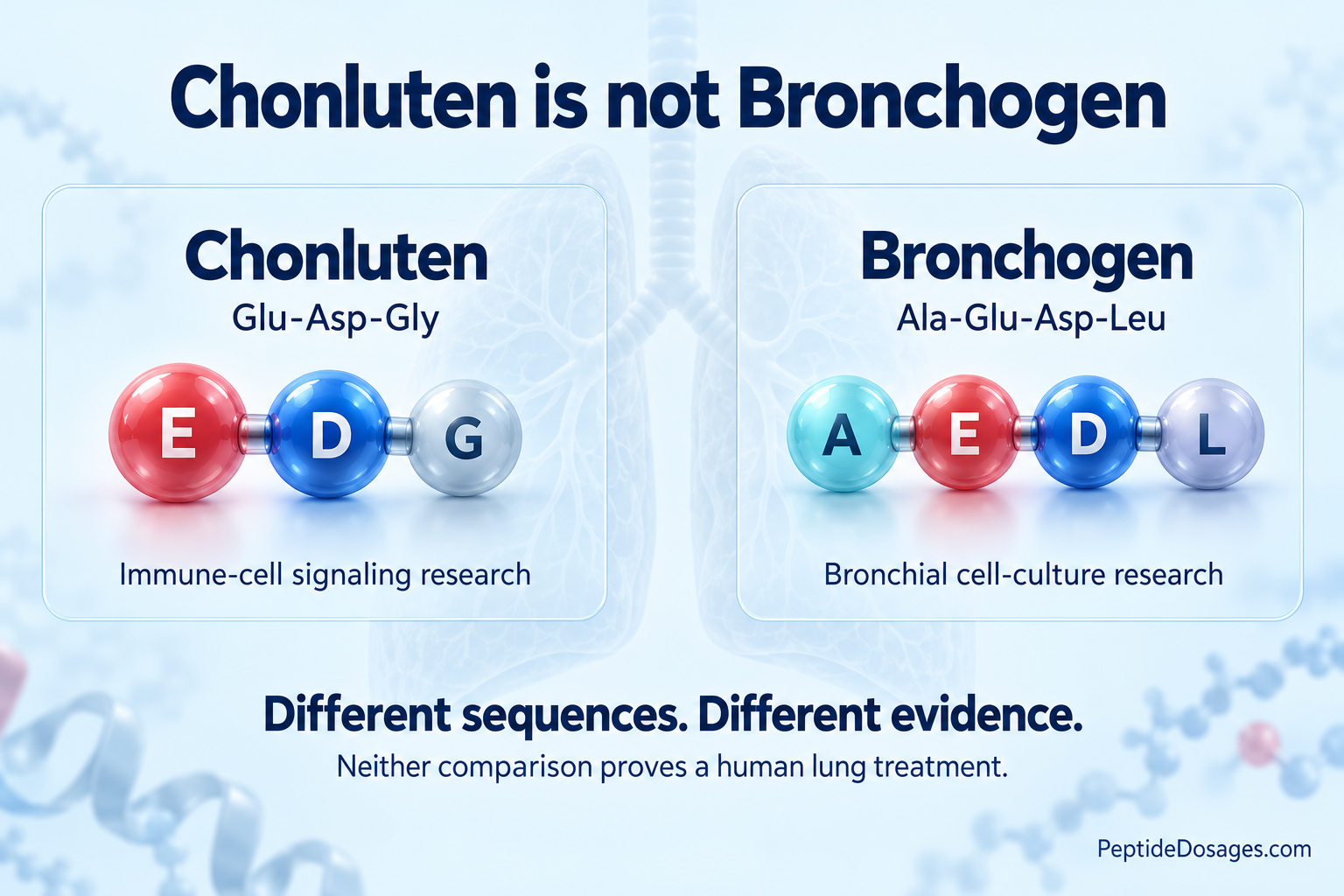
| Name | Sequence | Relevant evidence discussed here |
|---|---|---|
| Chonluten | Glu-Asp-Gly, EDG | Immune-cell signaling experiments and patent-reported studies |
| Bronchogen | Ala-Glu-Asp-Leu, AEDL | Bronchial cell-culture gene-expression research |
This distinction is easy to miss in a long list of references. Before accepting a claim about “lung regeneration,” check which sequence was tested and whether the study measured cells, animals or patients.
How Chonluten works: what the cell study found
In 2022, Avolio and colleagues studied Chonluten in THP-1 cells, a human leukemia-derived monocytic cell line that can be differentiated into macrophage-like cells. They examined inflammatory signaling, proliferation and related responses, including experiments using bacterial lipopolysaccharide to provoke inflammation.1
The results included altered cytokine activity and intracellular signaling. The response varied with the cells’ state and experimental conditions. It was not simply a universal switch that turned inflammation off. The investigators also observed an apoptotic profile in a proportion of Chonluten-treated THP-1 cells, a finding relevant to further safety research.1
These are findings in cultured cells, not a clinical study of people with asthma or COPD. Human-derived cells should not be described as human treatment evidence.
Other research: patents need their own label
A patent for Glu-Asp-Gly describes experiments involving gastric cells and rats with experimentally induced stomach ulcers. The inventors reported protective effects in those models.3 This helps explain why EDG appears in gastrointestinal as well as respiratory discussions. It does not establish a treatment for ulcers or prove lung repair.
Another patent describes a low-oxygen experiment involving 80 healthy young men and reports improved tolerance under the study conditions.4 That is human experimentation reported in a patent, so it would be inaccurate to say there has never been any human exposure research. But it is not equivalent to a well-reported, independently replicated clinical trial in people with chronic lung disease.
Patents are useful for tracing a compound’s development. They should not be treated as the same level of evidence as a rigorously conducted clinical trial, or as regulatory approval of the invention.
Potential benefits for respiratory health
The available findings make inflammatory signaling an interesting research question. They do not establish that Chonluten restores damaged lung tissue, improves exercise capacity or prevents respiratory flare-ups in patients.
A credible trial for a respiratory treatment would need to define the diagnosis and measure relevant outcomes: breathing symptoms, lung function, exacerbations, rescue-medication use and adverse events. A change in a cytokine or a gene-expression marker is not a substitute for those outcomes.
This is also why an “antioxidant,” “anti-aging” or “regenerative” label needs scrutiny. Each is a separate claim requiring suitable evidence. Evidence for one cellular effect cannot support every benefit attached to a product.
Safety and side effects
The sources reviewed here do not provide a reliable human side-effect rate or establish long-term safety. The cell-death finding in the THP-1 study cannot predict what happens in a person, but it should not disappear from a discussion that highlights the favorable laboratory results.
Important gaps include interactions with other medicines, effects of repeated exposure, pregnancy and breastfeeding safety, and the behavior of different formulations. A research vial, an oral supplement and an experimental preparation may not deliver the same exposure.
If you have a respiratory condition, discuss any experimental product with your clinician and continue your prescribed treatment. For asthma, a written action plan identifies medicines, warning signs and when to seek help.5 COPD care may include inhaled medicines, pulmonary rehabilitation and other treatments based on disease severity.6 Chonluten is not a substitute for either plan.
Chonluten dosage: what is actually established?
The evidence reviewed does not establish a validated treatment dose for asthma, COPD or lung repair. Cell-culture concentrations and experimental schedules cannot be converted directly into a personal regimen.
Our separate Chonluten 20 mg research reference covers the site’s protocol and measurement context. A calculation or descriptive schedule is not clinical proof of benefit or safety. For terminology, the peptide glossary explains commonly used research terms.
Frequently asked questions
Is Chonluten an anti-inflammatory peptide?
It has been investigated for effects on inflammatory pathways. Calling it a proven anti-inflammatory treatment for people goes beyond that evidence.
Does it regenerate the lungs?
The sources discussed here do not establish human lung regeneration. Claims based on Bronchogen studies also concern a different peptide.
Can Chonluten replace an inhaler?
No. Do not replace prescribed inhalers or delay assessment of worsening breathing while trying an experimental peptide. Follow your clinician’s treatment and emergency instructions.
What is the bottom line?
Chonluten has early biological research worth understanding, but its respiratory reputation is stronger than the clinical evidence. Check the sequence, study type and actual outcome before treating an appealing mechanism as a demonstrated benefit.
Related Chonluten dosage protocols
Continue with the vial-strength-specific research protocol that matches the material being evaluated. Each page keeps its own concentration, reconstitution, and syringe-unit calculations.
Practical measurement and handling guides
References
- Avolio F, et al. Peptides regulating proliferative activity and inflammatory pathways in the monocyte/macrophage THP-1 cell line. International Journal of Molecular Sciences. 2022;23:3607.
- Ashapkin VV, et al. Epigenetic mechanisms of peptidergic regulation of gene expression during aging of human cells. Biochemistry (Moscow). 2015. AEDL bronchial-cell research, not an EDG clinical trial.
- Pharmaceutical composition comprising the peptide Glu-Asp-Gly and use for treating Helicobacter pylori-induced gastroduodenal diseases. European patent. Experimental claims.
- Peptide substance revealing a stress protective effect. Patent application, example 7. Human low-oxygen experiment reported in a patent.
- National Heart, Lung, and Blood Institute. Asthma treatment and action plan.
- National Heart, Lung, and Blood Institute. COPD treatment.