

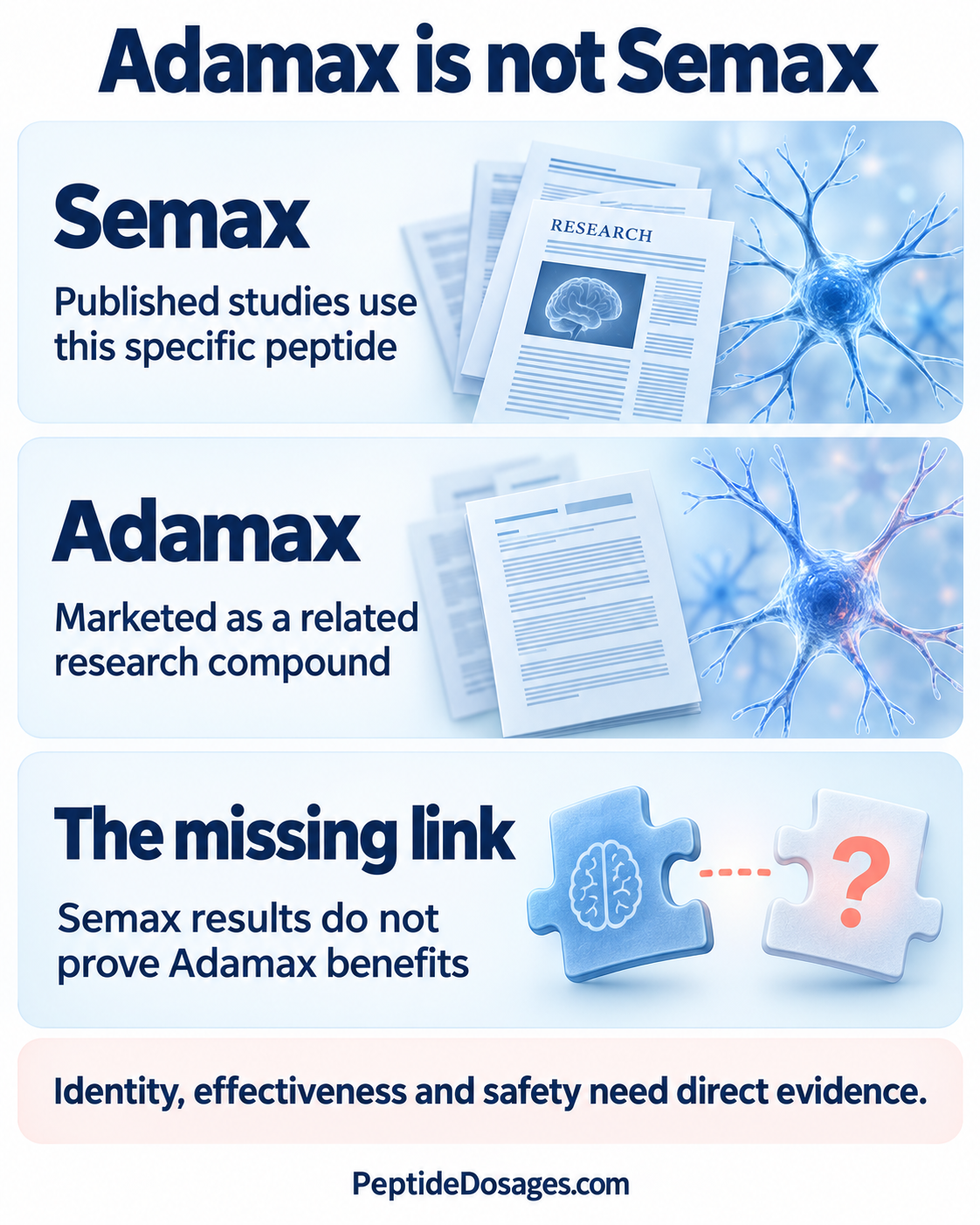
Adamax is a research-product name often discussed alongside Semax as a potential nootropic. The important distinction is evidence: published Semax experiments do not demonstrate that Adamax improves focus, memory or brain health. Direct, well-characterized Adamax research is much harder to find.
Start with the molecule a study actually tested. If it tested Semax rather than Adamax, it can’t settle a comparison of their benefits or half-lives.
What is Adamax peptide?
Adamax is marketed as a Semax-related research compound. A 2025 Medsafe classification submission names Adamax and Semax among ACTH analogues marketed for cognitive enhancement. The document discusses limited clinical research and uncertainty about longer-term effects; it is a regulatory proposal, not evidence of cognitive benefit.1
Product identity deserves particular attention. The name Adamax alone does not tell you the complete amino-acid sequence, terminal modifications or analytical specification. A related peptide name is not enough to establish that two preparations are interchangeable.
For example, Pure Lab Peptides lists an Adamax research product and distinguishes its documentation from background literature on Semax-related molecules. This supports the existence and labeling of a research listing, not a clinical treatment claim.2
Adamax vs Semax: where the evidence separates
Semax has a defined seven-amino-acid sequence, Met-Glu-His-Phe-Pro-Gly-Pro. In a 2006 rat study, investigators measured changes in hippocampal brain-derived neurotrophic factor (BDNF), its receptor TrkB and a learning-related behavioral test after Semax exposure.3
Another experiment examined Semax binding and BDNF protein in the rat basal forebrain. It reported a regional response rather than a uniform effect throughout the brain.4 Neither paper tested Adamax.
| Question | Semax literature | Adamax interpretation |
|---|---|---|
| Which compound was tested? | A specified Semax peptide | Confirm the actual product identity |
| Were BDNF changes measured? | Yes, in the cited rat experiments | Not proof of an Adamax effect |
| Does this establish better memory in people? | These animal experiments do not | No direct conclusion can be transferred |
| Is one more potent or longer lasting? | Requires a direct comparison | A marketing comparison is insufficient |
Comparison is based on the compounds and models in the cited sources, not a head-to-head Adamax trial.1,3,4
What benefits are actually established?
We did not identify a controlled Adamax clinical trial in the sources reviewed for this article. That leaves claims about sharper focus, faster learning, improved mood and neuroprotection unestablished for this specific compound.
BDNF is often the bridge used to connect laboratory research to broad nootropic promises. But a change in one protein in a rat brain is not the same as a meaningful improvement in a person’s daily functioning. Even an interesting mechanism needs direct testing of the intended product and outcome.
A useful Adamax study would identify the material, use an appropriate comparison group, measure relevant outcomes and report unwanted effects. A claim that Adamax lasts longer than Semax needs a direct pharmacokinetic comparison, not just a theory about its chemical modification.
Safety, side effects and human-use claims
The reviewed sources do not establish an Adamax-specific side-effect rate, safe long-term exposure or reliable interaction profile. “No problems reported” is not a substitute for monitored safety data. Small or poorly documented experience can miss uncommon harms.
Medsafe’s proposal specifically highlights uncertainty surrounding ACTH analogues sold with nootropic claims.1 It should not be read as approval for self-treatment, and the proposal itself does not establish the current legal status of every product in every country.
Persistent difficulties with concentration, memory or mood deserve a clinical assessment. Do not replace that assessment with an experimental peptide or assume a nasal product avoids the uncertainties that apply to other routes.
How to read an Adamax product record
- Identity: look for the complete name, sequence or structural specification, not only the trade name.
- Batch: match the certificate of analysis to the material being described.
- Methods: distinguish a purity measurement from evidence of molecular identity.
- Scope: a product listing or laboratory certificate does not establish clinical benefit.
- Evidence: check whether the cited paper actually says Adamax, rather than Semax.
The site’s Adamax 10 mg research reference is a separate preparation-calculation resource. A calculation can describe a concentration without validating a personal dose, route or cycle.
Frequently asked questions
Is Adamax the same as Semax?
Do not assume so. Semax papers identify the peptide they tested. Adamax’s relationship to that literature does not establish identical chemistry or effects.
Is Adamax stronger than Semax?
A reliable answer needs a direct comparison using clearly identified compounds and a defined outcome. The sources reviewed here do not provide that comparison.
What is the correct Adamax dosage?
The reviewed evidence does not establish a clinical dosage for cognitive enhancement. A supplier’s vial size, an online cycle or a Semax experiment cannot supply the missing clinical validation.
Does a high purity result prove that it works?
No. Purity, identity, safety and effectiveness are separate questions. An analytical result may help answer one without answering the others.
Related Adamax dosage protocols
Continue with the vial-strength-specific research protocol that matches the material being evaluated. Each page keeps its own concentration, reconstitution, and syringe-unit calculations.
Practical measurement and handling guides
References
- Medsafe. Peptide group-classification proposal, ACTH-analogue section. 2025. Regulatory context, not a treatment trial.
- Pure Lab Peptides. Adamax research-product listing. Product documentation only.
- Dolotov OV, et al. Semax and BDNF/TrkB expression in the rat hippocampus. Brain Research. 2006.
- Dolotov OV, et al. Semax binding and BDNF in the rat basal forebrain. Journal of Neurochemistry. 2006.