

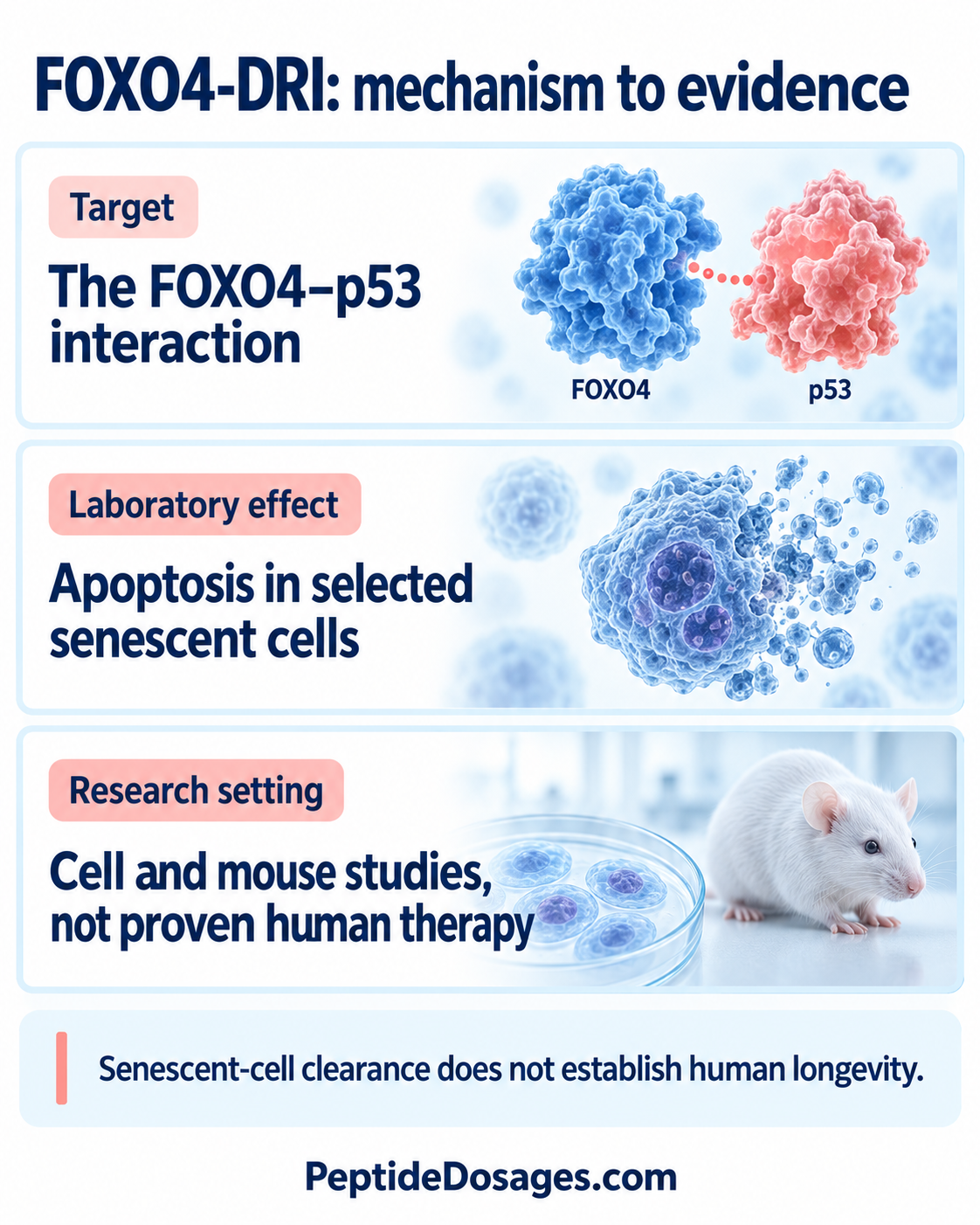
FOXO4-DRI is an experimental senolytic peptide designed to disrupt the interaction between FOXO4 and p53. It has been studied for its ability to trigger apoptosis in selected senescent cells. The central evidence comes from cell and mouse experiments, not a proven human anti-aging treatment.1
FOXO4-DRI is a tool for investigating a specific mechanism. The cell and mouse findings don’t demonstrate that it turns back a person’s biological clock.
What is FOXO4-DRI?
FOXO4 is a transcription factor, a protein involved in regulating gene activity. FOXO4-DRI is a designed peptide, not that protein. DRI stands for D-retro-inverso and describes its amino-acid design. 1
The term senolytic describes an approach intended to eliminate senescent cells. These cells have stopped dividing but can remain metabolically active. The research question is whether removing particular populations can improve tissue function without unacceptable damage.
How does the FOXO4–p53 mechanism work?
Disrupting the FOXO4–p53 interaction promoted p53 movement out of the nucleus and apoptosis, a regulated form of cell death.1
This is not a general promise to remove every “old” or damaged cell. Selectivity observed under experimental conditions has to be checked in other tissues and settings. The meaningful question is which cells are affected, at what exposure, and with what consequences for the surrounding tissue.
What benefits have been reported in studies?
Foundational mouse work
The 2017 study reported improvements in selected measures such as fitness, fur density and kidney function in aging mouse models, as well as effects in a chemotherapy-toxicity setting.1 These observations did not establish a human lifespan benefit or a safe personal regimen.
Leydig cells and testosterone research
A 2020 study linked FOXO4 localization in human Leydig-cell samples with age-related changes, then used senescent cell models and naturally aged mice to investigate the peptide. In mice, treatment improved the testicular environment and testosterone-related findings.2
The human tissue observations were not a trial in which men received FOXO4-DRI. They should not be presented as evidence that it treats low testosterone in people.
Spermatogenesis research
A 2024 study examined senescent Leydig cells, their secreted factors and effects on other cells in culture. FOXO4-DRI-treated aged mice also showed improved sperm-related measures.3 That remains an animal finding, not proof of improved human fertility.
Vascular research published in 2026
A newer study investigated stressed endothelial cells and naturally aged or induced-aging mouse models. The authors reported changes in senescence-related measures and aortic function, with further investigation of p53-associated apoptosis signaling.4 It did not demonstrate fewer cardiovascular events or better vascular health in treated patients.
| Research area | Evidence setting | Claim not established |
|---|---|---|
| Senescent-cell clearance | Cell and mouse experiments | Safe whole-body rejuvenation |
| Testosterone and sperm measures | Cell models and aged mice | Treatment of human infertility or low testosterone |
| Vascular aging | Endothelial cells and mice | Prevention of human heart disease |
Each row keeps the experimental population attached to the outcome.1,2,3,4
Has FOXO4-DRI been shown to work in people?
The studies reviewed here do not establish clinical effectiveness or safety in people. Human-derived cells, human tissue samples and a human clinical treatment trial are different kinds of evidence.
For a meaningful clinical claim, researchers would need a characterized product, carefully monitored exposure and outcomes relevant to the intended use. A broad term such as “anti-aging” is not a substitute for a defined endpoint.
Safety questions and potential side effects
The published experimental work does not provide a dependable human side-effect rate, safe cycle length or interaction profile. A compound intended to promote cell death needs particularly careful assessment of which cells it affects and whether the selectivity holds in a whole organism.
Senescence-associated signaling also has context-dependent roles, including in wound healing.1 More cell clearance is not automatically better.
Do not replace an evaluation for low testosterone, fertility problems or cardiovascular symptoms with an experimental senolytic. The absence of a well-defined adverse-event list should be understood as uncertainty, not reassurance.
Dosage, cycles and research references
No clinical anti-aging schedule is established by the studies summarized here. Converting a mouse amount into a human number does not account for species differences, tissue distribution or safety.
The site’s FOXO4-DRI 10 mg research reference is a separate preparation-calculation resource. It does not establish a validated senolytic regimen.
Frequently asked questions
Does FOXO4-DRI extend lifespan?
Selected improvements in aging mice do not prove extended human lifespan. The outcome and the species both matter.
Is it the same as other senolytics?
No. Senolytic describes a research approach, not one interchangeable drug class with a single safety profile. Evidence for another compound should not be transferred to FOXO4-DRI.
Can it increase testosterone or sperm count?
The cited work reports findings in cell models and aged mice. Those studies do not establish a treatment benefit for men.2,3
Related FOXO4-DRI dosage protocols
Continue with the vial-strength-specific research protocol that matches the material being evaluated. Each page keeps its own concentration, reconstitution, and syringe-unit calculations.
Practical measurement and handling guides
References
- Baar MP, et al. Targeted senescent-cell apoptosis in chemotoxicity and aging models. Cell. 2017.
- FOXO4-DRI, senescent Leydig cells and testosterone in aged mice. Aging. 2020.
- FOXO4-DRI and spermatogenesis in aged mice. 2024.
- Hu Z, et al. FOXO4-DRI and endothelial-cell senescence through p53 signaling. Frontiers in Bioengineering and Biotechnology. 2026.