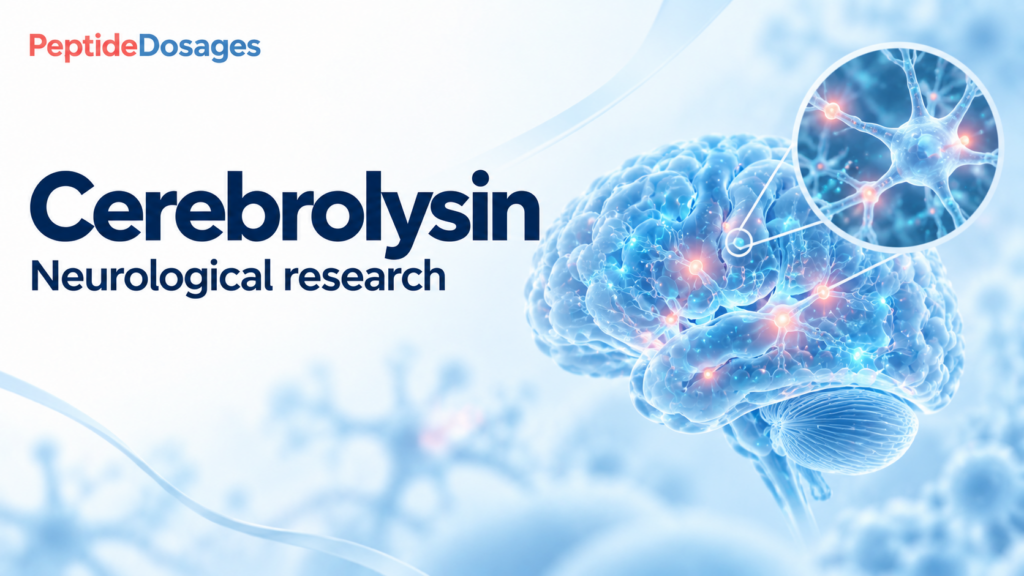
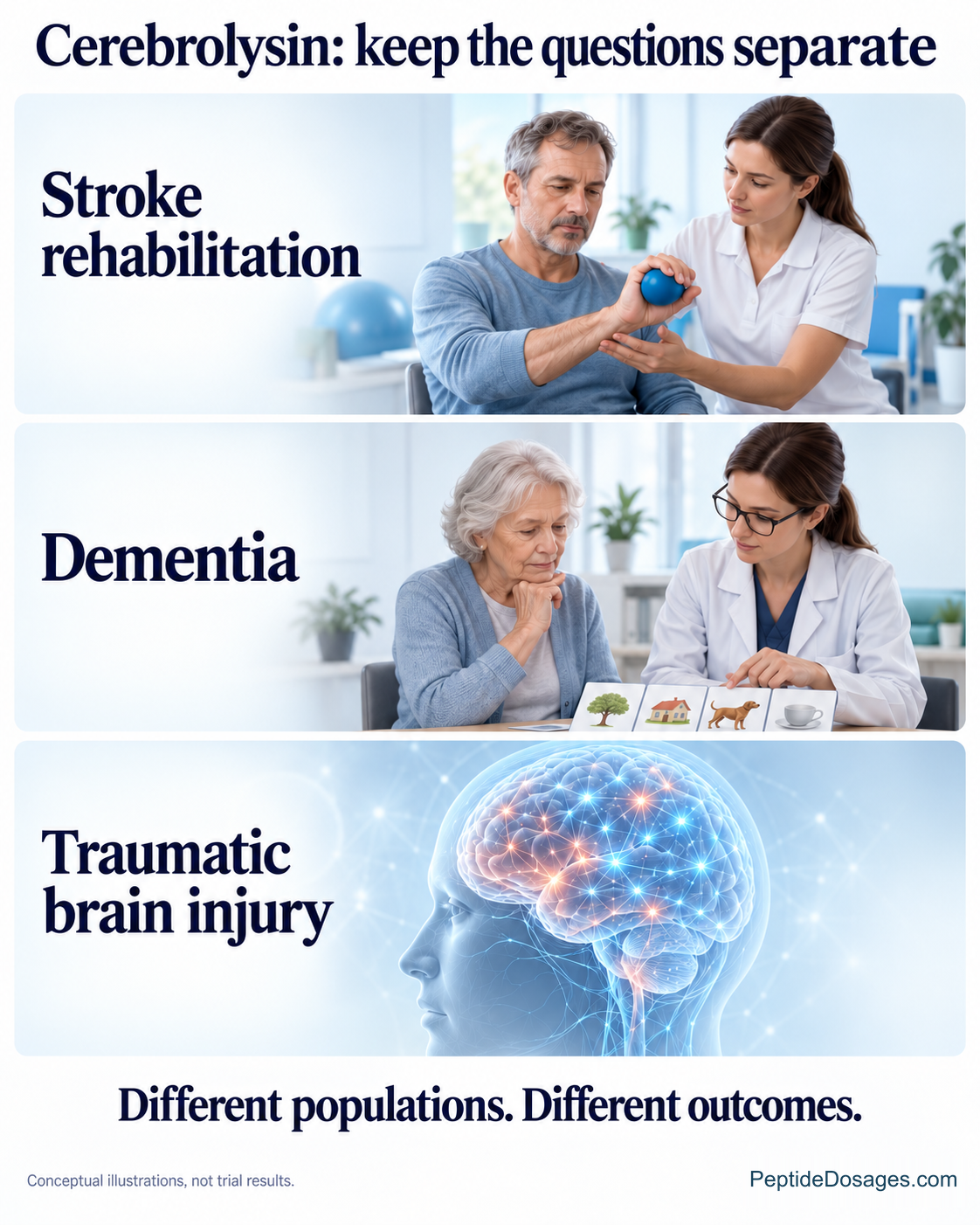
Cerebrolysin is an injectable mixture of peptides and amino acids derived from pig brain tissue, not a single synthetic peptide. It has been studied in stroke, dementia and traumatic brain injury, with mixed results. A positive rehabilitation trial does not establish that it prevents death after a stroke, reverses dementia or improves a healthy person’s memory. Those are different questions, and the evidence needs to stay separate. [1][2]
The mixed conclusions partly reflect different patients, treatment settings and definitions of improvement. Look at the outcome each study measured, rather than counting favorable headlines.
What is Cerebrolysin peptide?
The Austrian product information describes an injectable porcine brain-protein peptide fraction. It’s a mixture, not a dietary supplement or a single defined peptide sequence. Keep that formulation in mind when reading a study. [3]
A product with a similar name or a different vial strength should not automatically be treated as the same intervention. Concentration arithmetic cannot establish biological equivalence.
Related reference: Our Cerebrolysin 60 mg vial page is a separate product-specific reference. Its calculations do not demonstrate equivalence to the pharmaceutical preparation studied in the trials below.
What benefits have clinical trials actually measured?
| Question | What the evidence says |
|---|---|
| Survival after acute ischemic stroke | A 2023 Cochrane review found little or no mortality benefit from Cerebrolysin or a related agent added to standard care. [1] |
| Arm function during stroke rehabilitation | The exploratory CARS trial reported an advantage at 90 days, alongside a rehabilitation program. Confirmation in larger trials was recommended. [2] |
| Vascular dementia | Some cognitive and global-function findings favored treatment, but Cochrane rated the supporting evidence very low quality. [4] |
| Moderate-to-severe traumatic brain injury | A pooled CAPTAIN analysis reported a small-to-medium effect across combined functional and neuropsychological outcomes. This is not evidence about routine brain fog. [5] |
Stroke: survival and rehabilitation are not interchangeable
The 2023 Cochrane review included seven trials and 1,773 participants; one trial studied Cortexin, a related agent, rather than Cerebrolysin. It found no convincing survival advantage. Cerebrolysin probably increased nonfatal serious adverse events, although total serious adverse events showed little or no difference. These findings argue against describing it as a proven, low-risk acute-stroke treatment. [1]
CARS asked a different question: would adding Cerebrolysin to a structured rehabilitation program improve arm function? It reported better Action Research Arm Test results at day 90. The investigators described the trial as exploratory and called for larger confirmation. An improvement on an arm-function scale does not contradict a lack of demonstrated mortality benefit; the outcomes are different. [2]
Dementia: encouraging scores, uncertain practical benefit
Cochrane’s vascular-dementia review included six trials with 597 participants. It found possible benefits, but methodological problems, variable treatment schedules and uncertain clinical importance limited confidence. Quality of life and caregiver burden were not reported. [4]
An Alzheimer’s disease subgroup analysis also reported improvements on selected measures. Results varied by dose and outcome; not every daily-function or cognitive test improved. The authors called for larger trials in more advanced disease. This is not evidence that Cerebrolysin cures Alzheimer’s or stops its progression. [6]
Traumatic brain injury
The CAPTAIN analysis combined two randomized trials involving 185 patients with moderate-to-severe injury. Combined functional and neuropsychological outcomes favored Cerebrolysin at 30 and 90 days, with comparable reported tolerability. Treatment was added to usual care in a defined clinical population. It cannot be extrapolated to a healthy person seeking sharper focus or to every concussion. [5]
How is Cerebrolysin thought to work?
Research focuses on neuroprotection and neuroplasticity: protecting injured neurons and supporting changes in their connections. The product information describes experimental effects on synapses, learning and responses to reduced oxygen supply. Much of that mechanistic work comes from animal models. [3]
Terms such as “neurogenesis” or “brain repair” can make a plausible mechanism sound like a guaranteed clinical result. A useful test is to ask what changed in people: a test score, independence, symptoms, hospital stay or survival? Those outcomes cannot be replaced by a diagram of a signaling pathway.
Side effects and safety precautions
Austrian labeling lists hypersensitivity, status epilepticus and severe kidney impairment as contraindications. It warns about seizure disorders and possible interactions with antidepressants or MAO inhibitors. Reported adverse effects include agitation, insomnia, dizziness, gastrointestinal symptoms and allergic reactions. Pregnancy and breastfeeding require clinical risk-benefit assessment. [3]
Trial tolerability is not a blanket assurance of safety. Risk depends on the patient, preparation, accompanying medicines and clinical setting. The stroke review’s serious-adverse-event findings also deserve attention, even when an individual trial describes treatment as well tolerated. [1]
Is Cerebrolysin FDA-approved?
Do not mistake a substance identifier or orphan designation for approval. FDA’s orphan-drug record for a peptide fraction derived from porcine brain protein lists frontotemporal dementia as the designated indication and states that it is not FDA-approved for that indication. [7]
Product information from another country’s regulator establishes what is labeled there, not authorization in the United States. A clinician should verify the current local status and exact product rather than relying on an online listing.
Common questions
Does Cerebrolysin help brain fog or improve memory in healthy adults?
The studies discussed here do not establish that benefit. Stroke recovery, dementia and major brain injury are not equivalent to everyday forgetfulness. Persistent changes in memory or concentration warrant assessment for their cause.
What is the dosage, and how is it administered?
Clinical studies used injectable pharmaceutical preparations under supervision, often intravenously. Schedules differed by condition. There is no universal nootropic cycle established by these trials, and their regimens should not be converted into a home injection plan. [2][5]
Is it better than Semax or other brain peptides?
The cited evidence does not provide a reliable head-to-head ranking for healthy users. Our Semax research guide discusses a different compound and evidence base. Combining separate favorable studies does not establish that a stack works better.
Bottom line: Cerebrolysin has human research, including positive findings, but that is not the same as proof of broad cognitive enhancement. Assess each indication separately with a qualified clinician. Sudden face drooping, arm weakness or speech difficulty can signal a stroke: call emergency services immediately, rather than looking for a peptide treatment. [8]
Related Cerebrolysin dosage protocols
Continue with the vial-strength-specific research protocol that matches the material being evaluated. Each page keeps its own concentration, reconstitution, and syringe-unit calculations.
Practical measurement and handling guides
References
- Ziganshina LE, et al. Cerebrolysin for acute ischaemic stroke. Cochrane. 2023.
- Muresanu DF, et al. Cerebrolysin and Recovery After Stroke (CARS): a randomized, placebo-controlled, double-blind, multicenter trial. Stroke. 2016.
- Austrian Federal Office for Safety in Health Care. Cerebrolysin: summary of product characteristics. March 2021; German-language labeling.
- Cui S, et al. Cerebrolysin for vascular dementia. Cochrane. 2019.
- Vester JC, et al. Cerebrolysin after moderate to severe traumatic brain injury: prospective meta-analysis of the CAPTAIN trial series. Neurological Sciences. 2021.
- Alvarez XA, et al. Efficacy and safety of Cerebrolysin in moderate to moderately severe Alzheimer’s disease. European Journal of Neurology. 2011.
- FDA. Orphan-drug designation record: peptide fraction derived from porcine brain protein.
- CDC. Signs and symptoms of stroke.