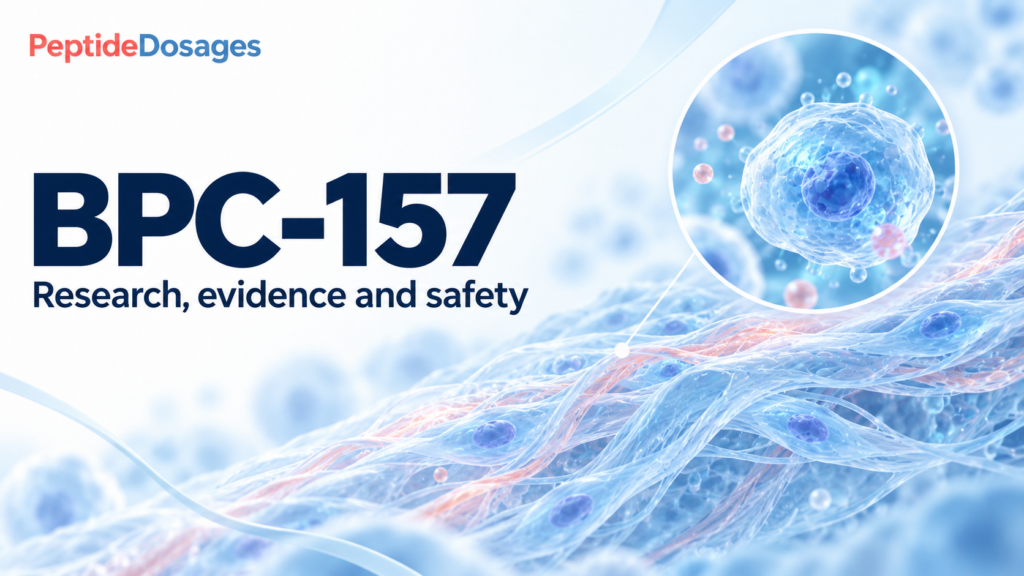
BPC-157 is an experimental synthetic peptide studied for tissue repair and protective effects in laboratory models. The name is commonly expanded as body protection compound 157. It contains 15 amino acids, which is why papers call it a pentadecapeptide. Small human reports exist, but they do not establish BPC-157 as a proven treatment for injuries, gut disease or general recovery. There is no FDA-approved BPC-157 medicine. [1]
Related dosage pages: For vial-specific concentration, reconstitution, and measurement examples, see BPC-157 (5 mg Vial) Dosage Protocol and BPC-157 (10 mg Vial) Dosage Protocol. Each linked protocol remains a separate reference because vial strength changes concentration and syringe-unit calculations.
A long list of healing claims isn’t evidence. Check which findings came from people, how the studies were conducted and whether they measured the outcome you’re interested in.
What does BPC-157 do in laboratory research?
BPC-157’s research history is linked to a protective compound described in gastric juice. That origin doesn’t establish the safety of a manufactured product. Its identity, formulation and route still matter. [1]
Researchers have investigated tendon cells, connective tissue and pathways involved in healing. In one rat-tendon study, BPC-157 increased cell migration and survival under chemical stress. It also affected signaling through FAK and paxillin, proteins involved in how cells attach and move. The same experiment did not directly increase tendon-cell proliferation. [2]
That is a useful distinction. Movement or survival of cells in a dish is not the same outcome as a torn tendon regaining strength in a person. Laboratory mechanisms can help choose the next experiment; they cannot tell a reader how quickly an injury will heal.
What research has been done in humans?
The human evidence is limited, but it is not accurate to say none exists. The reports below involve different conditions, products and routes. They should not be pooled into one success rate for BPC-157.
| Study | Finding and limitation |
|---|---|
| Knee-pain report, 2021 | Sixteen people were reached after treatment. Eleven of 12 who received BPC-157 alone reported improvement; four others received a combination with TB4. No untreated comparison group or standardized functional assessment. [3] |
| Bladder-pain pilot, 2024 | Twelve women reported improvement after a bladder procedure. This small uncontrolled study cannot establish comparative effectiveness or validate use for other conditions. [4] |
| Intravenous safety pilot, 2025 | Two adults, both previously exposed to intravenous BPC-157, had short-term monitoring without reported adverse effects. Two people cannot establish general or long-term safety. [5] |
| Ulcerative-colitis meeting abstract, 2005 | Fifty-three people were randomized and 46 completed the study. FDA’s 2026 assessment found the brief reporting inadequate to establish efficacy or safety. [1] |
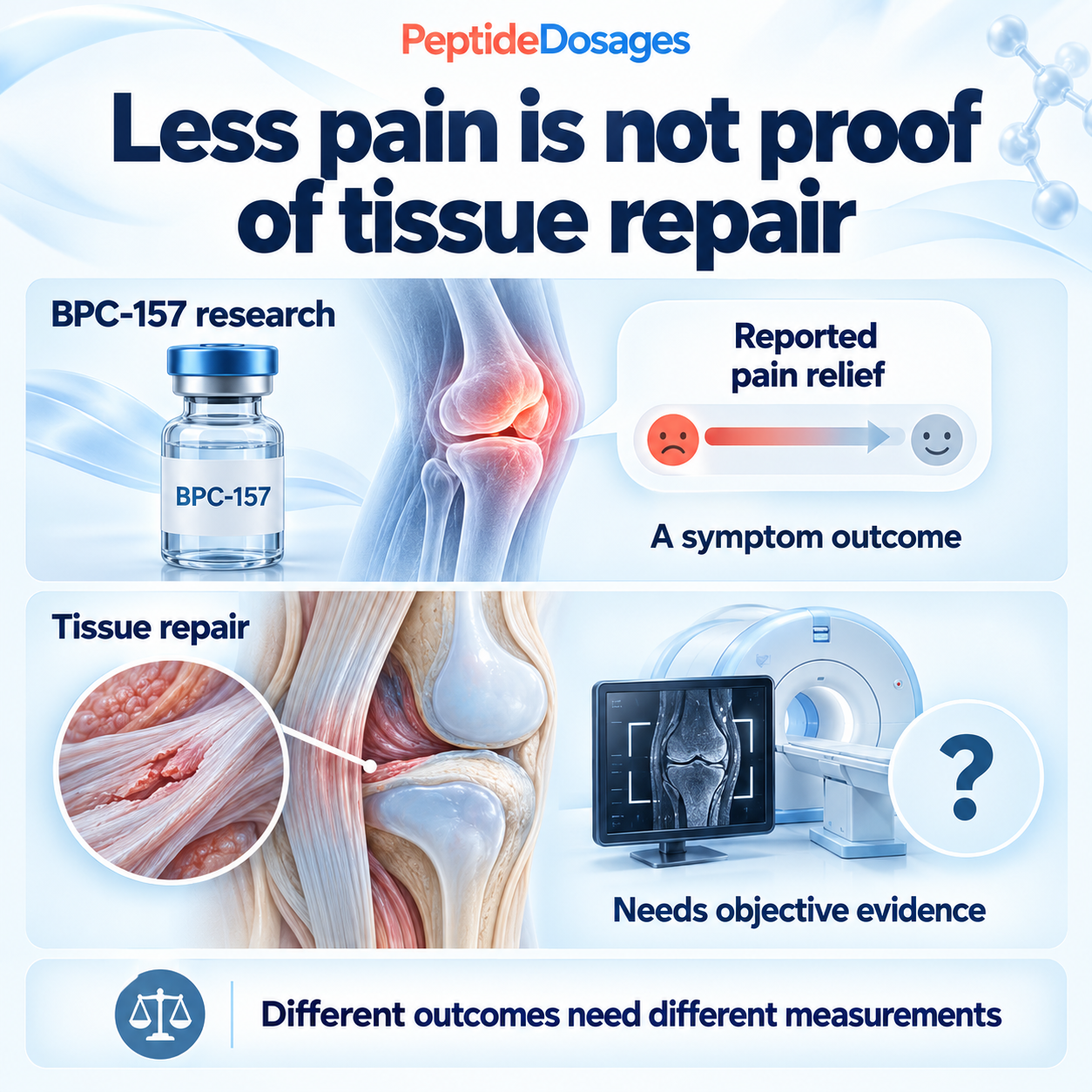
Knee-pain relief is not proof of cartilage repair
The knee report was a retrospective chart review with telephone follow-up, not a randomized trial. It included different causes of knee pain and did not use specific tools to measure function, stiffness or quality of life. Some participants also received thymosin beta-4, or TB4, so those outcomes cannot be attributed to BPC-157 alone. [3]
A report of less pain is worth investigating. It does not show that cartilage regrew, a tear closed or surgery became unnecessary. Those claims would need objective assessments and an appropriate comparison group.
Bladder and gut findings are different evidence
The bladder pilot involved women with interstitial cystitis who had not responded to pentosan polysulfate. Their improvement was reported after a local bladder procedure, not after taking an oral capsule. The study provides a preliminary observation, not a treatment recommendation. [4]
For ulcerative colitis, FDA examined a short conference abstract describing a placebo-controlled study of rectal BPC-157. The report lacked essential details about eligibility, outcome definitions and statistical methods. It did not supply adequate evidence to establish benefit. Bladder symptoms, ulcerative colitis and nonspecific digestive complaints should not be treated as interchangeable. [1]
What are the side effects and safety risks?
A dependable side-effect rate is not known. A short study that reports no adverse events can miss uncommon reactions, delayed problems or risks in a different population. The two-person intravenous pilot is an especially clear example of why the size and duration of safety studies matter. [5]
FDA’s July 2026 briefing discussed reports involving injectable BPC-157, including injection-site redness and swelling, shortness of breath requiring an emergency visit, and pigmentation changes after a mixed BPC-157/TB-500 product. Other ingredients and incomplete information limited interpretation. These reports are safety signals to examine, not proof that BPC-157 caused each event or a way to calculate how often reactions occur. [1]
Additional uncertainties include:
- Immune reactions: FDA identifies potential immunogenicity, meaning an immune response to the product, along with concerns about peptide impurities and active-ingredient characterization. [6]
- Long-term effects: available human reports are too small and brief to characterize repeated use over months or years. [1]
- Formulation differences: products described with the same common name can differ in salt form, purity and other characteristics. Evidence for one preparation does not validate every vial or capsule. [1]
Severe or rapidly worsening symptoms after any injected product, particularly difficulty breathing, need urgent medical attention. Keep the product packaging available for the treating team.
Is oral BPC-157 better than injectable BPC-157?
There is no established clinical comparison that lets this article rank them. FDA’s 2026 review found no human pharmacokinetic data for oral, subcutaneous, nasal or transdermal administration. Pharmacokinetics describes how much of a substance reaches the body, where it goes and how it is cleared. [1]
The review also identified a registered oral phase 1 study without posted results or an associated publication it could find. Registration shows that a study was planned; it is not a positive study result. Laboratory stability or an animal absorption experiment cannot fill that gap for a commercial product. [1]
FDA status and sports restrictions
BPC-157 is not an FDA-approved drug. The July 2026 advisory materials concern possible use of bulk ingredients in compounding, which is distinct from approval of a finished medicine. An advisory recommendation is nonbinding, and the briefing itself is not a final legal determination. [1][8]
WADA’s 2026 Prohibited List explicitly includes BPC-157 in the S0 category for non-approved substances. It is prohibited at all times, in and out of competition. A research label or availability online does not make it permitted in sport. [7]
Questions about BPC-157
Is there an established dosage for injury recovery?
No approved therapeutic dose or validated general recovery schedule exists. Different experimental routes and conditions cannot be converted into a universal personal-use protocol. The limited clinical safety record is part of that uncertainty, not something a syringe calculation can solve. [1]
Does BPC-157 affect the liver or testosterone?
The studies discussed here cannot establish long-term liver safety or a reliable effect on testosterone. Normal short-term laboratory results in two participants are not evidence of safety for everyone, and a tissue-healing hypothesis does not establish a hormone benefit. [1][5]
Do combinations with TB-500 have better evidence?
The small knee report included a TB4 combination group, but that was not a controlled test establishing an advantage over BPC-157 alone. Nor should the name TB4 be assumed to describe every product marketed as TB-500. More ingredients do not resolve uncertainty about which substance caused a benefit or an adverse reaction. [3][1]
Quick check: does less pain prove an injury has healed?
No. Pain, physical function and structural repair are different outcomes. A useful study needs to specify which it measured. A telephone report of less pain cannot substitute for imaging, strength testing or other appropriate measures of tissue recovery.
Bottom line: BPC-157 has generated research interest, particularly around musculoskeletal injuries, but enthusiasm has moved ahead of dependable clinical evidence. For persistent pain, an injury or digestive symptoms, seek a diagnosis and discuss established options with a qualified healthcare professional rather than relying on a healing claim alone.
References
- U.S. Food and Drug Administration. BPC-157-related bulk drug substances: briefing document for the July 2026 Pharmacy Compounding Advisory Committee. Identity, effectiveness and safety evaluation.
- Chang CH, et al. The promoting effect of pentadecapeptide BPC 157 on tendon healing involves tendon outgrowth, cell survival, and cell migration. Journal of Applied Physiology. 2011;110:774-780. Rat-tendon laboratory research.
- Lee E, Padgett B. Intra-Articular Injection of BPC 157 for Multiple Types of Knee Pain. Alternative Therapies in Health and Medicine. 2021;27:8-13. Retrospective report.
- Lee E, Walker C, Ayadi B. Effect of BPC-157 on Symptoms in Patients with Interstitial Cystitis: A Pilot Study. Alternative Therapies in Health and Medicine. 2024;30:12-17.
- Lee E, Burgess K. Safety of Intravenous Infusion of BPC157 in Humans: A Pilot Study. Alternative Therapies in Health and Medicine. 2025;31:20-24.
- U.S. Food and Drug Administration. Certain bulk drug substances for use in compounding that may present significant safety risks. BPC-157 entry.
- World Anti-Doping Agency. The 2026 Prohibited List. Section S0.
- U.S. Food and Drug Administration. July 23-24, 2026: Pharmacy Compounding Advisory Committee meeting. Scope of review and advisory role.
Related dosage protocols and research
Explore related research, dosage references and guides below. Vial strengths have separate references because concentration and syringe-unit calculations differ. A comparison does not mean the compounds are interchangeable.
Matching dosage protocols
Related protocols and comparisons
Further research context