
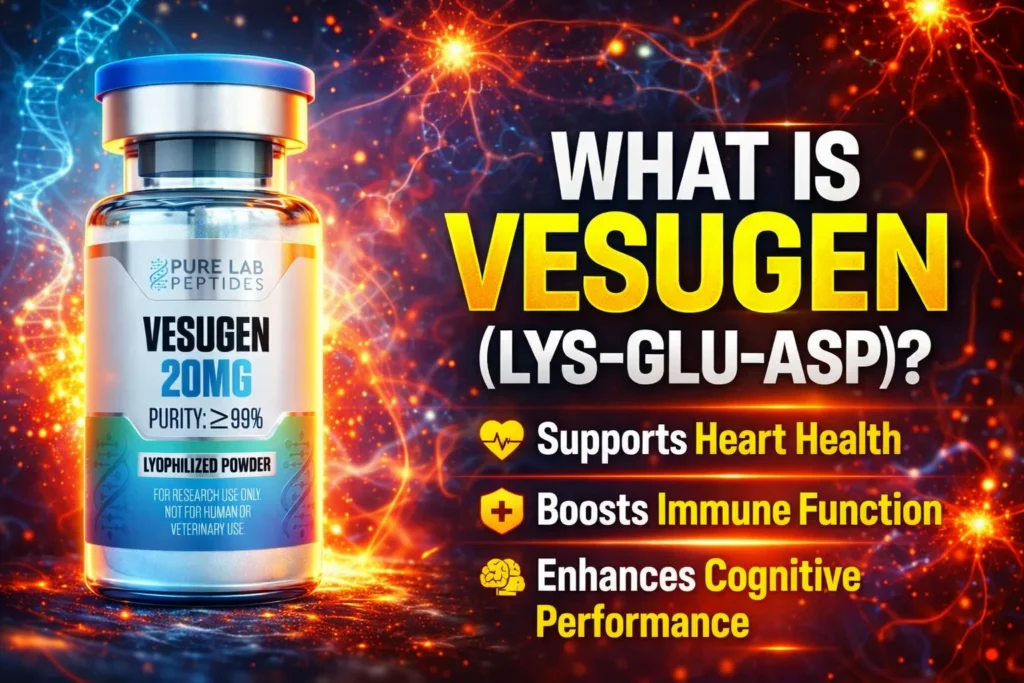
If you’ve been Googling “What is Vesugen (Lys‑Glu‑Asp)”, you’re usually looking for three things: what it actually is, what it’s supposed to do for blood vessels, and whether the evidence (and product quality) backs up the hype. This guide explains Vesugen/KED in plain English, separates research from marketing claims, and shows how to sanity‑check identity, dosing math, and safety signals.
This is educational content only—not medical advice. Many vendors sell Vesugen as research use only and explicitly prohibit human or animal consumption and “bodily introduction.” [1]
Fast Answer / Executive Summary
Vesugen (Lys‑Glu‑Asp), also called KED, is a short synthetic tripeptide studied mainly for vascular/endothelial signaling and gene‑expression regulation in lab models. It is typically sold for research use only and is not an FDA[2]‑approved medicine; human clinical data exist but are limited and mostly outside Western drug‑approval frameworks. [3]
Core Concepts & Key Entities
What is Vesugen (Lys‑Glu‑Asp)?
Vesugen is a sequence‑defined tripeptide made of three amino acids—lysine, glutamic acid, and aspartic acid—ordered as Lys‑Glu‑Asp. In one‑letter amino‑acid code, that’s K‑E‑D, which is why you’ll often see “KED peptide” used as shorthand. You’ll see the sequence written as Lys‑Glu‑Asp, Lys-Glu-Asp, or simply KED; they refer to the same tripeptide, and we’ll use the standardized Lys‑Glu‑Asp/KED notation throughout. [4]
In chemical catalogs, Vesugen is typically anchored to specific identifiers: CAS 204271‑66‑9, molecular formula C15H26N4O8, and molecular weight about 390.39 g/mol. Those numbers matter because “Vesugen” is a name, but CAS/MW/sequence define the molecule. [5]
Be aware of transliteration: older Russian‑origin literature may spell it “Vezugen,” but it refers to the same Lys‑Glu‑Asp tripeptide. [6]
What does “KED” mean, and why do the letters matter?
“KED” is not a brand—it’s a sequence code. K = lysine, E = glutamic acid, D = aspartic acid, in that exact order, making Lys‑Glu‑Asp. [7]
The reason this matters is simple: tripeptides are tiny. Swapping one amino acid changes the molecule, the charge pattern, and potentially the biology. That’s why “KED” (Vesugen) and “EDR” (a different tripeptide) are not interchangeable—even though the names look similar on a product page. [8]
What kind of peptide is Vesugen in the bigger “peptide landscape”?
Vesugen belongs to a category often described as short “bioregulator” peptides (di‑, tri‑, tetrapeptides) that some researchers propose can influence tissue function and aging‑related pathways. Reviews from this research tradition discuss broad claims (e.g., lifespan changes in animal models for certain peptide preparations), but those are not the same as “Vesugen is proven to do X in humans.” [9]
It also helps to contrast Vesugen with the peptide drugs you may already know: modern FDA‑approved peptide medicines usually have extensive development programs (pharmacology, toxicology, dose‑finding, manufacturing controls) and published clinical evidence. FDA guidance documents emphasize that peptide drug development requires clinical pharmacology work appropriate for the intended product. [10]
Practical meaning: Vesugen should be treated as a research hypothesis with some mechanistic literature—not as a “finished medicine” with mature regulatory backing. [11]
The core entity: vascular endothelium
When people say Vesugen is “for vascular health,” they usually mean the vascular endothelium—the cellular lining of arteries, veins, and capillaries. Vascular aging and endothelial dysfunction are tied to arterial stiffening, inflammation, oxidative stress, impaired repair capacity, and progression of atherosclerosis in many models and human studies. [12]
So the claimed target is not “blood” in general. The implied target is endothelial cell behavior: proliferation/renewal signals, barrier integrity, and communication between endothelial cells. [13]
Proposed mechanism: Ki‑67, promoter binding, and “epigenetic regulation”
The most specific mechanism repeatedly attached to Vesugen/KED concerns Ki‑67 (MKI67). Ki‑67 is strongly associated with cell proliferation and is present during active phases of the cell cycle but absent in resting (G0) cells, which is why it’s widely used as a proliferation marker. [14]
A PubMed[15]‑indexed abstract reports that Vesugen and a comparison peptide stimulated Ki‑67 in aging‑related vascular cell culture models and that molecular docking suggested interaction with promoter regions of the MKI67 gene. The abstract even specifies a promoter sequence window relative to the transcription start site. [16]
The translated PDF publication expands on this: it describes organotypic and dissociated vascular cell culture experiments and frames the vasoprotective effect as potentially mediated by promoter‑level interaction of peptide with DNA and consequent regulation of Ki‑67 expression. [17]
An analogy helps: think of a promoter as a “dimmer switch” for a gene. The Vesugen hypothesis is essentially, “a very short peptide can selectively touch the switch and nudge it.” Docking and in‑vitro changes are a starting point, but they are not the same as proving consistent gene regulation in living humans. [6]
What the Ki‑67 data actually looks like (in vitro)
In the translated Advances in Gerontology paper, Ki‑67 signal in vascular cell cultures is reported as an “expression area (%)” and compared across young vs old cultures and control vs peptide conditions. In organotypic vascular tissue cultures from old rats, Ki‑67 expression area is lower than in young cultures, and Vesugen exposure increases the Ki‑67 expression area compared with control in both young and old tissues. [18]
This is important because it clarifies what “supports vascular repair” usually means in this literature: a measurable shift in proliferation‑associated signaling in controlled cell culture, not a guaranteed whole‑body outcome. It also means the most defensible claims about Vesugen are “marker‑level” claims (Ki‑67, endothelin‑1, SIRT1), not sweeping promises like “reverses atherosclerosis.” [19]
How strong is the promoter‑binding evidence?
The same paper reports in‑silico docking estimates for Vesugen interaction with MKI67 promoter regions and illustrates peptide localization in DNA grooves in a model. Docking can suggest plausibility and guide hypotheses, but it does not prove that the peptide reaches the nucleus, binds DNA in vivo, and produces consistent downstream effects in humans. [20]
Other reported vascular signals: endothelin‑1, connexins, and SIRT1
KED research isn’t only Ki‑67. Another PubMed‑indexed abstract (in vitro) reports that KED normalized endothelin‑1 expression (elevated in atherosclerosis/restenosis models), affected connexin‑linked cell interactions, and increased SIRT1 expression—framed as part of its “geroprotective” effect in endothelial models. [21]
These markers are biologically plausible in vascular contexts. Endothelin‑1 is a potent vasoconstrictor peptide, connexins help coordinate cellular communication, and SIRT1 is commonly discussed as an aging‑related regulator in DNA repair and stress response contexts. Still, plausibility is not clinical proof. [22]
What human evidence exists (and what it does not prove)
One PubMed page reports a clinical trial‑type study with 41 patients where blood flow in penile arteries improved after treatment with “Vezugen” for vasculogenic erectile dysfunction as a manifestation of atherosclerosis. This is a human signal, but it is not a large, multi‑center trial with contemporary regulatory standards. [23]
Separately, a vascular‑peptides PDF brochure (industry/marketing style) describes Vesugen as the active principle of a vascular polypeptide complex (Ventfort) and presents dosing “schemes of application” in capsules and sublingual drops, plus an illustrated study design for chronic arterial insufficiency. Treat this as contextual information, not as definitive clinical evidence. [24]
How Vesugen is packaged and discussed in “Ventfort” materials
In some Russian‑origin materials, Vesugen (KED) is described as the active principle of a vascular polypeptide complex named Ventfort and is presented in oral forms (capsules and sublingual drops). That’s a very different product context than the modern online “20 mg lyophilized powder vial,” and it’s one reason dosage discussions get messy across sources. [25]
If you see Vesugen discussed as a “dietary supplement” for vascular issues, you’re typically reading that Ventfort‑style framing. If you see it discussed as a reconstituted vial with syringe measurements, you’re reading the U.S. research‑peptide market framing. They are not automatically interchangeable, and neither replaces the need for controlled human trials. [26]
Bottom line: Vesugen has some human‑adjacent literature, but the evidence base is not comparable to mainstream cardiovascular therapies or well‑validated pharmaceutical peptides. [27]
Neuro‑adjacent research exists, but it’s not the dominant intent here
The same research tradition studies multiple short tripeptides in brain‑related models. One PubMed abstract reports that in a mouse hippocampal neuron culture model under amyloid synaptotoxicity, KED (200 ng/mL) increased the number of mushroom spines by 20%, while EDR had a larger effect in that experiment. [28]
This matters for two reasons. First, it shows that “ultrashort peptides” are being evaluated across tissues. Second, it reinforces identity discipline: EDR and KED are different molecules with different effects in at least some models. [8]
Is Vesugen FDA‑approved? How is it generally sold?
In the U.S. market, Vesugen is typically sold as research use only, not as an FDA‑approved medicine. One vendor page explicitly states its peptides are for research/lab use, are not medicines/drugs, have not been evaluated or approved by the FDA for disease claims, and prohibit bodily introduction. [1]
Manufacturers and suppliers commonly attach similar disclaimers, presenting Vesugen as a laboratory research chemical and not for human or veterinary consumption. [29]
This is not a semantic detail. It affects expectations (no approved indication), risk (unknown long‑term safety), and quality control (you must verify documentation instead of assuming regulated drug‑grade manufacturing). [11]
Potential benefits people talk about vs what is supported
The best‑supported “benefit statements” about Vesugen should be phrased as research‑level hypotheses, such as “may influence endothelial proliferation markers (Ki‑67)” or “may modulate endothelin‑1/SIRT1 expression in vitro.” Those are grounded in PubMed‑indexed abstracts and related publications. [30]
Claims like “regenerates blood vessels,” “restores elasticity,” or “normalizes microcirculation” are common in vendor/marketing language, but they are bigger leaps than the available mechanistic evidence supports on its own. Use these phrases as prompts to ask, “Which endpoint and which study design?” [31]
Potential risks and uncertainties to keep in mind
The dominant risk with Vesugen is uncertainty: limited contemporary clinical data, unclear pharmacokinetics in humans, and quality variability when sold under “research only” labels. Major medical reporting has also highlighted broader risks of unapproved injectable peptides sold online (purity variability, contamination, mis-dosing), even when users self‑describe as “careful.” [32]
There’s also a scientific nuance worth stating plainly: if a mechanism involves proliferation markers like Ki‑67, that can be interpreted as “repair signaling” in a controlled model, but uncontrolled proliferation is not a universally “good” thing. Without robust long‑term human safety data, you should treat claims cautiously. [33]
Information gain: the 3‑point identity check most people skip
Here’s the fastest way to avoid the most common Vesugen problem: confusing Vesugen (KED) with a different tripeptide entirely.
The Vesugen identity check = Sequence + CAS + Molecular weight. If all three don’t line up, you may not be looking at KED.
- Canonical Vesugen identity is typically reported as sequence Lys‑Glu‑Asp (KED) with CAS 204271‑66‑9 and ~390.39 g/mol molecular weight. [7]
- But at least one retail product page labeled “Vesugen 20mg” lists CAS 99469‑43‑9, a different molecular formula/weight, and the sequence EDR—which is not KED. [34]
This is not nitpicking. If you don’t verify identity, you can’t meaningfully interpret any “results,” because you might be reading KED papers while holding (or testing) EDR—or something else—on the bench.
Quality signals to prioritize when buying Vesugen for research
Because Vesugen is often sold under “research use only” policies, you should assume quality varies by supplier unless documented otherwise. Prioritize vendors who provide batch‑level COAs and identity confirmation (HPLC and MS), and treat missing documentation as a reason to walk away. [35]
Also scrutinize product spec blocks for internal consistency. If a “Vesugen” page lists a non‑KED sequence or a molecular weight that doesn’t match Lys‑Glu‑Asp references, that’s a practical sign the listing may be unreliable—even if the brand is reputable in other areas. [36]
Step‑by‑Step: How to Handle Vesugen as a Research Peptide
Verify identity and documentation
Step 1: Start by confirming the peptide is actually KED (Lys‑Glu‑Asp) using a COA plus orthogonal checks like HPLC and mass spectrometry whenever available. A manufacturer example from Conscientia Industrial Co., Ltd[37] explicitly describes batch validation with HPLC/MS for identity and molecular weight confirmation. [29]
Choose a model and endpoints before choosing a “dose”
Step 2: Pick endpoints that map to what Vesugen is studied for—e.g., Ki‑67 immunostaining or MKI67 expression, endothelin‑1 expression, connexin‑related markers, or senescence‑adjacent readouts in endothelial models of vascular aging. [38]
If working from a vial protocol, redo the math yourself
Step 3: If you’re referencing educational vial protocols, confirm concentration and unit conversions so you can measure precisely. One example protocol describes reconstituting a 20 mg vial with 3.0 mL bacteriostatic water to make ~6.67 mg/mL, then using insulin‑syringe “units” as a measurement aid. [39]
Store like a peptide, not like a pill
Step 4: Keep lyophilized peptide cold and dry, and avoid repeated freeze–thaw cycles after reconstitution—storage guidance on Vesugen protocols commonly recommends frozen storage for lyophilized powder and refrigerated storage after reconstitution. [40]
Use real stop‑conditions
Step 5: Stop the experiment (or discard a vial) if you see particulate contamination, unexpected color change, labeling uncertainty, or temperature excursions that break cold‑chain assumptions—because compromised identity/purity makes downstream observations meaningless. [35]
How to read a Vesugen COA in 90 seconds
A good COA should let you answer: “Is this molecule KED?” and “Is it clean enough for what I’m doing?” The fastest checks are sequence/identity, purity, and mass. [29]
Look for the sequence printed explicitly (Lys‑Glu‑Asp or KED), and compare the molecular weight on MS to the expected ~390.39 g/mol. If the COA doesn’t show MS (or shows the wrong mass), treat it as a red flag. [7]
Then check purity (often via HPLC). “99%” sounds neat, but what you really want is: a chromatogram, a stated method, batch number, and a date. Those are the details that make a COA more than a marketing badge. [35]
Finally, note counter‑ion information if provided (e.g., acetate or TFA). It won’t change the peptide sequence, but it can affect mass readouts and how the powder behaves in solution. [29]
Why small peptides are easy to mishandle
Lyophilized peptide powder behaves like a sponge for moisture. A practical protocol note is to let cold vials reach room temperature before opening so condensation doesn’t get pulled into the vial. [41]
After reconstitution, freeze–thaw cycles can create repeated stress that degrades peptides or changes practical concentration via evaporation/condensation over time. This is why many protocols emphasize aliquoting and “avoid freeze–thaw.” [40]
Common dosing‑math mistakes beginners make
The #1 error beginner peptide users make is mixing up mg and mcg. 1 mg equals 1,000 mcg—so a “2 mg” line item is 2,000 mcg, not 200. Protocols that jump between units without repeating the conversion invite errors. [39]
The #2 error is forgetting that “units” on an insulin syringe are volume units, not mass units. The mass you deliver depends entirely on how you reconstituted the vial (mg/mL), which is why re‑doing the math is non‑negotiable. [42]
The #3 error is assuming “bacteriostatic water” and “sterile water” are interchangeable. They can differ because bacteriostatic water typically includes benzyl alcohol as a preservative, and labeling carries specific warnings and intended use as a diluent. [43]
Reconstitution, bacteriostatic water, and what “units” really mean
If 20 mg is reconstituted into 3.0 mL total volume, concentration is 6.67 mg/mL (6,670 mcg/mL). That means 0.10 mL contains ~667 mcg. One educational protocol uses this math to map U‑100 insulin syringe “units” (0.01 mL per unit) to microgram amounts. [42]
Why does bacteriostatic water come up so often? DailyMed[44] labeling explains that bacteriostatic water for injection is sterile water containing benzyl alcohol (commonly 0.9% or 1.1%) as a preservative for multi‑dose use. It is a drug diluent, not a peptide. [43]
If you’re reading this because you saw subcutaneous “peptide protocols” online, remember: general subcutaneous injection pages (like those on MedlinePlus[45]) are medical education resources, and they do not authorize use of research peptides; some vendors explicitly state bodily introduction is prohibited. [46]
Vesugen vs Other Peptides and Vascular Strategies
Vesugen is most often positioned as an endothelial/vascular peptide bioregulator with gene‑expression signaling hypotheses, while other popular peptides target different biology (growth factors, actin dynamics, ECM remodeling) and have different evidence profiles. [47]
A comparison that matters uniquely for Vesugen is KED vs EDR, because they’re both short tripeptides from the same research ecosystem and are easy to confuse in catalogs. In one PubMed‑indexed neuron culture model under amyloid synaptotoxicity, KED increased mushroom spines by 20% while EDR increased them by 71% in that setup—evidence that similar‑looking tripeptides can behave very differently. [28]
If your core goal is “vascular health,” don’t skip the boring but proven foundations. Reviews of vascular aging emphasize mechanisms like inflammation, oxidative stress, endothelial dysfunction, and arterial stiffening—areas where lifestyle and standard medical therapies have the strongest evidence base. Peptides may be interesting research tools, but they don’t replace established risk‑reduction strategies. [12]
For broader “recovery peptide” context: – GHK‑Cu is a copper‑binding peptide complex discussed for wound healing/skin repair and broad gene‑expression modulation; open‑access reviews summarize mechanisms and potential applications. [48]
– Thymosin beta‑4 is a larger peptide with regenerative biology literature (including cardiovascular/regenerative themes) and is often discussed alongside “TB‑500,” a fragment marketed online. [49]
– BPC‑157 has extensive preclinical literature and rising popularity, but recent reviews emphasize minimal human data and the need for caution until better trials exist. [50]
Quick comparison table
| Option | What it is (plain English) | Main research “headline” | Human evidence (high-level) | Common confusion or quality risk |
| Vesugen (KED) | Tripeptide: Lys‑Glu‑Asp | Endothelial proliferation markers (Ki‑67), endothelin‑1/SIRT1 signals in models | Some human reports exist; overall limited vs mainstream care | Often confused with other tripeptides if identity isn’t verified |
| EDR | Tripeptide: Glu‑Asp‑Arg | Neuro‑epigenetic / synaptic models in some studies | Primarily preclinical/in vitro | Sometimes listed on “Vesugen” pages due to catalog errors |
| GHK‑Cu | Copper‑binding peptide complex | Skin/wound repair and broad gene‑expression discussions | Evidence varies by application; stronger topical/dermal focus | Confused with “GHK” alone; formulations vary widely |
| Thymosin beta‑4 / TB‑500 | Larger endogenous peptide; TB‑500 is a fragment marketed online | Actin dynamics, repair signaling, migration/angiogenesis in models | Human TB4 data exist; TB‑500 itself not an approved drug | “TB‑500” products vary; identity/analysis is a known issue in sport testing |
| BPC‑157 | 15‑aa gastric pentadecapeptide | Cytoprotection/regeneration hypotheses across many models | Reviews note minimal human data; investigational status | Widely sold online; quality and regulatory controversies reported |
The table is intentionally high‑level. Verify identity, then read the primary literature for your exact outcome (endothelium vs skin vs tendon vs CNS) before you treat any row as more than a research hypothesis. [51]
Vesugen Research Checklist
A Vesugen plan that doesn’t waste your time starts with identity, endpoints, and documentation—then moves to storage and measurement discipline. [52]
- Confirm the sequence is Lys‑Glu‑Asp (KED), not a different tripeptide. [53]
- Match CAS and molecular weight to KED references before trusting the label. [7]
- Request a COA with HPLC and MS identity checks (or buy only where these exist). [29]
- Define your primary endpoint (Ki‑67, endothelin‑1, SIRT1, connexins). [54]
- Select an appropriate model (young vs aged endothelial cells; atherosclerosis/restenosis in vitro). [55]
- Calculate your concentration in mg/mL and mcg/mL before you touch a pipette. [39]
- Label vials with concentration, date mixed, and storage temperature immediately. [41]
- Store lyophilized vials frozen and reconstituted vials refrigerated; avoid freeze–thaw. [40]
- Document any cold‑chain breaks; discard if identity/purity is uncertain. [29]
- Compare results against controls (vehicle, untreated, positive control).
- Stop if contamination or unexpected precipitation appears after reconstitution.
- Log adverse observations as rigorously as “benefits,” especially with unapproved peptides. [32]
FAQs
What is Vesugen (Lys‑Glu‑Asp) used for?
What is Vesugen (Lys‑Glu‑Asp) used for? Vesugen is used in research contexts mainly as a vascular/endothelial peptide hypothesis, where endpoints include Ki‑67‑linked proliferation signals and endothelin‑1/SIRT1/connexin markers in models of vascular aging or atherosclerosis. Marketing often expands this to “circulation” and “anti‑aging,” but clinical proof is limited compared with standard cardiovascular care. [38]
Is Vesugen the same thing as “KED peptide”?
Is Vesugen the same thing as “KED peptide”? KED peptide is Vesugen’s sequence shorthand, using one‑letter amino acid codes: K = lysine, E = glutamic acid, D = aspartic acid, forming Lys‑Glu‑Asp. In other words, “Vesugen” is the commonly used name and “KED” is the same molecule described by sequence. Always verify because some product pages label “Vesugen” but list a different sequence. [53]
Is Vesugen FDA‑approved or legal to use?
Is Vesugen FDA‑approved or legal to use? Vesugen is not presented by common U.S. vendors as an FDA‑approved medicine; it’s typically sold with “research use only” language and explicit statements that it is not intended for human or animal consumption and has not been evaluated/approved by the FDA for disease claims. Regulatory status can vary by country, but “research only” labeling should be treated as a major safety and quality signal. [11]
What is a typical Vesugen dosage protocol?
What is a typical Vesugen dosage protocol? A typical Vesugen dosage protocol shown on educational peptide sites is in the 500–2000 mcg/day range with gradual titration, often using a 20 mg vial reconstituted to a known concentration for measurement. This is not medical advice and does not override vendor restrictions that prohibit human use; treat it as dosing math for research planning and measurement, not a prescription. [56]
Why do some Vesugen product pages show different CAS numbers or sequences?
Why do some Vesugen product pages show different CAS numbers or sequences? Some listings appear to contain copy/paste or catalog errors, and short peptides are easy to confuse because “EDR,” “KED,” and other tripeptides look similar but are different molecules with different literature. A practical safeguard is to verify the “sequence + CAS + molecular weight” trio before you interpret any results or compare studies. [57]
What are the side effects of Vesugen?
What are the side effects of Vesugen? Reported side effects in public sources are limited, and many descriptions come from small studies or educational summaries rather than large safety trials. One educational protocol notes Vesugen is generally well tolerated in reported studies with occasional mild injection‑site irritation mentioned for subcutaneous protocols, but long‑term safety data remain limited. Treat it as investigational. [58]
Related dosage protocols and research
Use the available links to move between research context, dosage pages or comparisons, and supporting guides. When vial-size variants exist, they remain separate because concentration and syringe-unit calculations change with vial strength. Comparisons do not imply that different compounds are interchangeable.
Matching dosage protocols
Further research context
Next Steps
If you remember only one thing: Vesugen (KED) is a specific Lys‑Glu‑Asp tripeptide, and verifying identity is the fastest way to avoid bad outcomes and wasted experiments. [53]
If you’re new, start with one clear question (e.g., Ki‑67 change in an endothelial assay), one identity‑verified batch, and one notebook page of calculations. That discipline beats stacking multiple peptides and guessing what “worked.” [59]
If you want a measurement‑friendly overview of vial math, storage, and a conservative educational schedule, start with the internal protocol page on PeptideDosages.com[60]:
– Vesugen (Lys‑Glu‑Asp) (20 mg Vial) Dosage Protocol [61]
If you’re looking for an external purchasing reference from Pure Lab Peptides[62] that explicitly positions the product as research‑only, the page provided in your brief is:
– Buy Vesugen 20mg (research use only) [1]
[1] [11] [31] [34] [36] https://purelabpeptides.com/buy-peptides/buy-vesugen-20mg/
https://purelabpeptides.com/buy-peptides/buy-vesugen-20mg/
[2] [39] [40] [41] [42] [56] [58] [61] https://peptidedosages.com/single-peptide-dosages/vesugen-20-mg-vial-dosage-protocol/
https://peptidedosages.com/single-peptide-dosages/vesugen-20-mg-vial-dosage-protocol/
[3] [6] [16] [30] [38] [44] [47] [54] [62] [Epigenetic aspects of peptidergic regulation of vascular endothelial cell proliferation during aging] – PubMed
https://pubmed.ncbi.nlm.nih.gov/25051766/
[4] Vesugen
https://en.wikipedia.org/wiki/Vesugen
[5] [7] [15] [29] [35] [37] [52] [53] [57] [60] https://www.conscientia-industrial.com/peptides/vesugen-cas-204271-66-9
https://www.conscientia-industrial.com/peptides/vesugen-cas-204271-66-9
[8] [28] [51] https://pubmed.ncbi.nlm.nih.gov/28853087/
https://pubmed.ncbi.nlm.nih.gov/28853087/
[9] https://pubmed.ncbi.nlm.nih.gov/19830585/
https://pubmed.ncbi.nlm.nih.gov/19830585/
[10] https://www.fda.gov/regulatory-information/search-fda-guidance-documents/clinical-pharmacology-considerations-peptide-drug-products
[12] [27] https://www.ahajournals.org/doi/10.1161/CIRCRESAHA.118.312563
https://www.ahajournals.org/doi/10.1161/CIRCRESAHA.118.312563
[13] [21] [22] [55] https://pubmed.ncbi.nlm.nih.gov/28539025/
https://pubmed.ncbi.nlm.nih.gov/28539025/
[14] [33] https://pubmed.ncbi.nlm.nih.gov/10653597/
https://pubmed.ncbi.nlm.nih.gov/10653597/
[17] [18] [19] [20] https://khavinson.info/assets/files/skan/2015-khavinson_tarnovskaya.pdf
https://khavinson.info/assets/files/skan/2015-khavinson_tarnovskaya.pdf
[23] [The efficacy of peptide bioregulators of vessels in lower limbs chronic arterial insufficiency treatment in old and elderly people] – PubMed
https://pubmed.ncbi.nlm.nih.gov/25051774/
[24] [25] [26] https://peptideproduct.com/news/clinical_and_experimental_studies_of_the_effectivnes_of_vascular_peptides.pdf
[32] [45] [59] https://www.washingtonpost.com/health/2025/11/26/peptides-bodybuilding-injections-side-effects/
https://www.washingtonpost.com/health/2025/11/26/peptides-bodybuilding-injections-side-effects/
[43] https://dailymed.nlm.nih.gov/dailymed/lookup.cfm?setid=87d6e9dc-fe3b-4593-ac9a-d7493d1959c7
https://dailymed.nlm.nih.gov/dailymed/lookup.cfm?setid=87d6e9dc-fe3b-4593-ac9a-d7493d1959c7
[46] https://medlineplus.gov/ency/patientinstructions/000430.htm
https://medlineplus.gov/ency/patientinstructions/000430.htm
[48] https://pmc.ncbi.nlm.nih.gov/articles/PMC6073405/
https://pmc.ncbi.nlm.nih.gov/articles/PMC6073405/
[49] https://pmc.ncbi.nlm.nih.gov/articles/PMC8228050/
https://pmc.ncbi.nlm.nih.gov/articles/PMC8228050/
[50] https://pmc.ncbi.nlm.nih.gov/articles/PMC12446177/