
Vilon is a synthetic dipeptide, Lys-Glu, studied in immune-cell and aging research. Its best-known findings concern chromatin in cultured lymphocytes and biological changes in mice. They do not establish that Vilon rejuvenates people or reliably improves immunity.1,2
Vilon’s laboratory effects are worth examining. Whether they translate into better health is a separate question that the experiments can’t settle.
What is Vilon peptide?
Vilon contains lysine followed by glutamic acid. It is commonly grouped with short peptide bioregulators linked to thymic and immune-system research. That grouping does not make it identical to Thymogen or a mixture such as Thymalin.
The early thymic-peptide literature describes Vilon as a synthesized immunomodulatory dipeptide and distinguishes it from Thymogen, which contains glutamic acid and tryptophan, and Thymalin, a natural peptide preparation.3 Evidence should stay attached to the specific preparation studied.
Vilon, chromatin and gene expression
Chromatin is the packaging of DNA and associated proteins inside the nucleus. How tightly regions are packed can affect access to genetic instructions. This is the background to the phrase “reactivation of chromatin” in Vilon research.
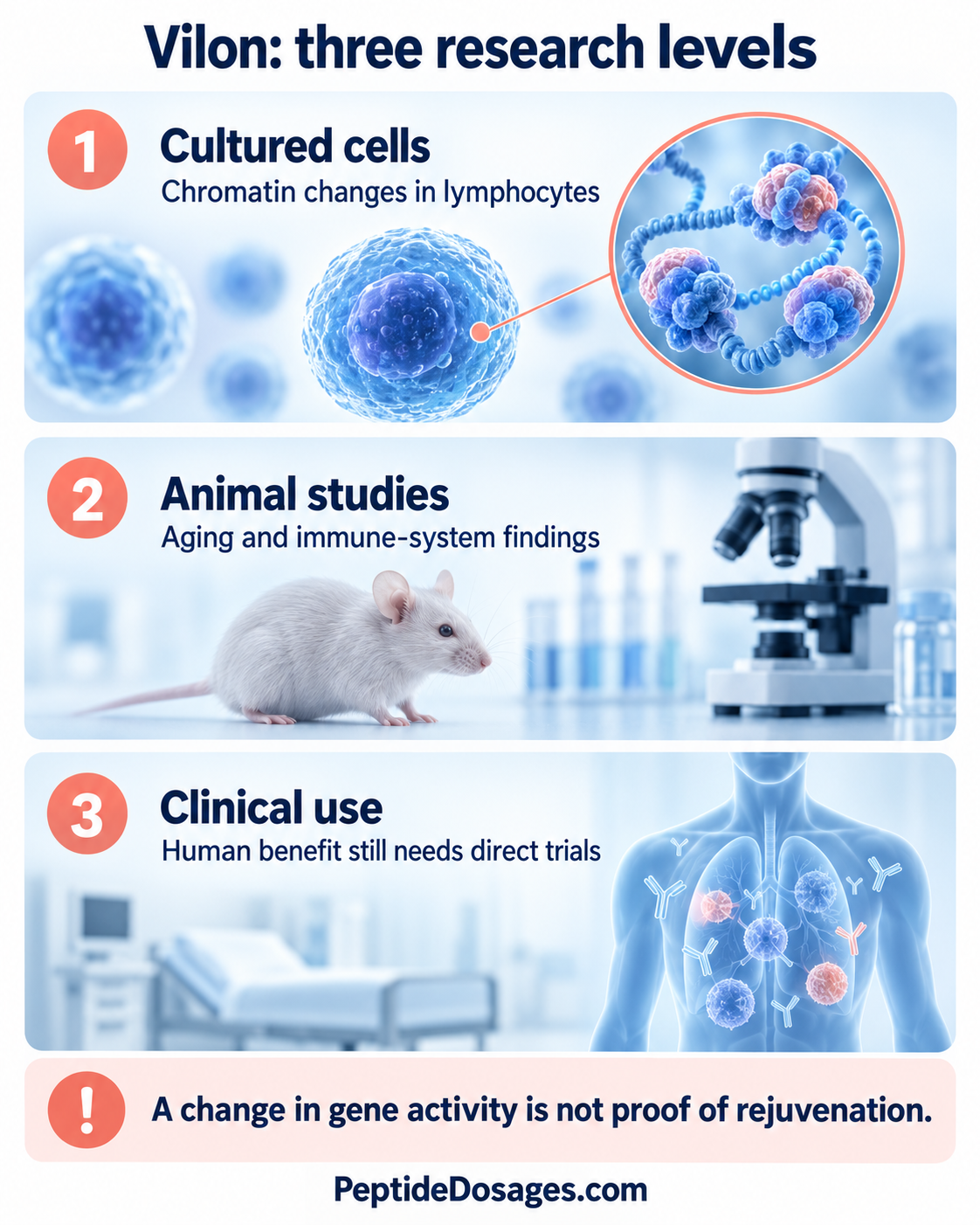
A 2004 study exposed cultured lymphocytes from older people to Vilon. Researchers reported changes in facultative heterochromatin, a form of condensed chromatin, and in regions associated with ribosomal genes. They did not report uniform decondensation of every chromatin type.1
The distinction is easy to miss: the source cells came from people, but the experiment happened in culture. It did not demonstrate that giving Vilon to older adults reversed their biological age, prevented infection or extended life.
What does aging research show?
A 2000 study in female CBA mice reported longer lifespan and changes in activity, endurance and body temperature with Vilon exposure. Some measures did not change, including age-related estrous changes and the reported free-radical processes.2
Both sides of that result matter. It is not accurate to turn a mixture of positive and unchanged animal outcomes into a claim that the peptide “reverses aging.” Nor does tolerability in one mouse experiment establish long-term safety in people.
| Finding | Study setting | What remains unanswered |
|---|---|---|
| Chromatin changes | Cultured human lymphocytes | Whether treatment improves health in people |
| Lifespan and activity signals | Female mice | Whether effects translate across species |
| Immune-cell signaling | Experimental cell and tissue systems | Whether patients have fewer or milder illnesses |
These are different experimental endpoints, not three independent confirmations of a human longevity benefit.1,2,4,5
What about immune function?
A comparative spleen-aging study reported different responses to Vilon, Thymogen, Crystagen and another short peptide. Vilon was associated with T-helper-cell activity and reduced apoptosis in that experimental context.4 This is more precise than describing all the compounds as interchangeable “immune boosters.”
A 2022 experiment also tested Vilon among several peptides in THP-1 cells, a human leukemia-derived cell line used for monocyte/macrophage research. The compounds affected proliferative signaling. Importantly, the paper’s specific finding of reduced TNF production after inflammatory stimulation concerned Chonluten, not a blanket effect that should be assigned to Vilon.5
An immune-cell change isn’t necessarily better protection against illness. A clinical study would need to specify who was studied and measure outcomes such as infections or symptoms, alongside harms.
Is Vilon safe for long-term use?
The studies summarized here do not establish a robust human benefit-risk profile for repeated self-directed use. A small molecule made of familiar amino acids can still have biological effects that depend on context and exposure.
There is also a difference between no adverse effect being observed in a particular experiment and a product being shown safe across ages, medical conditions and medications. Missing interaction or pregnancy data should stay an uncertainty, not become reassurance.
People with immune disorders or those taking immune-modifying medicines should discuss concerns with their treating clinician rather than experimenting with an unvalidated immune-enhancement plan.
Vilon dosage and research references
The evidence in this overview does not establish a clinical anti-aging dose or cycle. Animal exposures and concentrations used in cultured cells answer experimental questions; they are not interchangeable with human schedules.
The Vilon 20 mg research reference provides a separate calculation context. It should not be treated as proof of longevity or immune benefit.
Frequently asked questions
Does Vilon extend human lifespan?
The mouse lifespan paper does not establish that. Demonstrating a human longevity benefit would require evidence in people with appropriate follow-up and controls.
Is Vilon the same as Thymogen?
No. They have different amino-acid identities. Sharing a research category does not make their findings or safety data interchangeable.3
Does chromatin reactivation mean DNA has been repaired?
Not necessarily. Changes in DNA packaging and gene activity should not be relabeled as repair of genetic damage or reversal of aging.
Related Vilon dosage protocols
Continue with the vial-strength-specific research protocol that matches the material being evaluated. Each page keeps its own concentration, reconstitution, and syringe-unit calculations.
Practical measurement and handling guides
References
- Lezhava T, et al. Vilon and chromatin in cultured lymphocytes from older donors. Biogerontology. 2004.
- Khavinson VK, et al. Vilon, biological-age measures and lifespan in mice. Bulletin of Experimental Biology and Medicine. 2000.
- Morozov VG, Khavinson VK. Natural and synthetic thymic-peptide research. International Journal of Immunopharmacology. 1997.
- Immunoprotective peptide effects in spleen-aging research. Advances in Gerontology. 2014.
- Peptide effects on proliferative and inflammatory pathways in THP-1 cells. 2022.