
Humanin is a small mitochondrial-derived peptide studied for cell survival, metabolism and aging. One intriguing finding is that children of people who lived to 100 had higher circulating humanin levels than a comparison group. That raises a useful question: is humanin helping, or is it a sign of something else?1
Higher humanin levels in that group don’t tell us whether giving humanin extends life. To understand the finding, keep observations in people separate from experiments in cells and animals.
What is humanin peptide?
Humanin, often abbreviated HN, is commonly described as a 24-amino-acid peptide associated with the mitochondrial genome. It attracted attention after researchers identified a factor that protected cultured neuronal cells from several Alzheimer’s disease-related insults.2,3
The discovery began with cells in a laboratory, not a successful Alzheimer’s treatment trial. It gave researchers a way to investigate how certain nerve cells survive stress.
You may also see HNG or S14G-humanin. These names refer to a modified version of humanin, not merely a shortened name. That distinction matters when comparing experiments.1
How humanin affects cell survival
One well-studied mechanism involves apoptosis, the regulated process of cell death. In laboratory work, humanin interacted with BAX, a protein that can help trigger mitochondrial cell-death signaling, and interfered with its movement to mitochondria.3
Further laboratory experiments found that humanin and BAX can form fibers together, offering a possible explanation for how BAX activity is restrained.4 This helps explain a cellular mechanism, rather than showing a treatment benefit in people.
But which cells are being protected? Keeping a stressed healthy cell alive may be useful. Helping a cancer cell survive is a different matter, as the safety findings below illustrate.6
What humanin studies have found
| Research area | Research so far | What it cannot tell us |
|---|---|---|
| Neuroprotection | Cultured-cell experiments involving Alzheimer’s-related stress | Not proof of memory improvement in patients |
| Insulin sensitivity | Rodent experiments with humanin and analogs | Not an established diabetes treatment |
| Aging | Worm and mouse experiments; human observational findings | Association is not proof that supplementation extends life |
| Cell survival and cancer | Experimental breast-cancer models identified a potential harm | Cell protection is not always beneficial |
Different models support different conclusions.1,2,5,6
Brain and memory research
The original experiments found protection in nerve cells exposed to specific Alzheimer’s-related genes and amyloid-beta, but not against every cause of cell death tested.2 The finding concerns those particular experimental stresses, not memory improvement in patients.
Glucose regulation and insulin action
A 2009 study examined humanin signaling in rodent metabolic experiments. Central administration improved insulin sensitivity, and potent analogs delivered peripherally reproduced selected effects. A modified humanin peptide also lowered blood glucose in diabetic rats.5
This links mitochondrial signals with glucose regulation in rodents. Whether the same approach would be useful and safe in people requires clinical testing; the experiments do not establish a replacement for diabetes treatment.
Longevity and the difference between a marker and a treatment
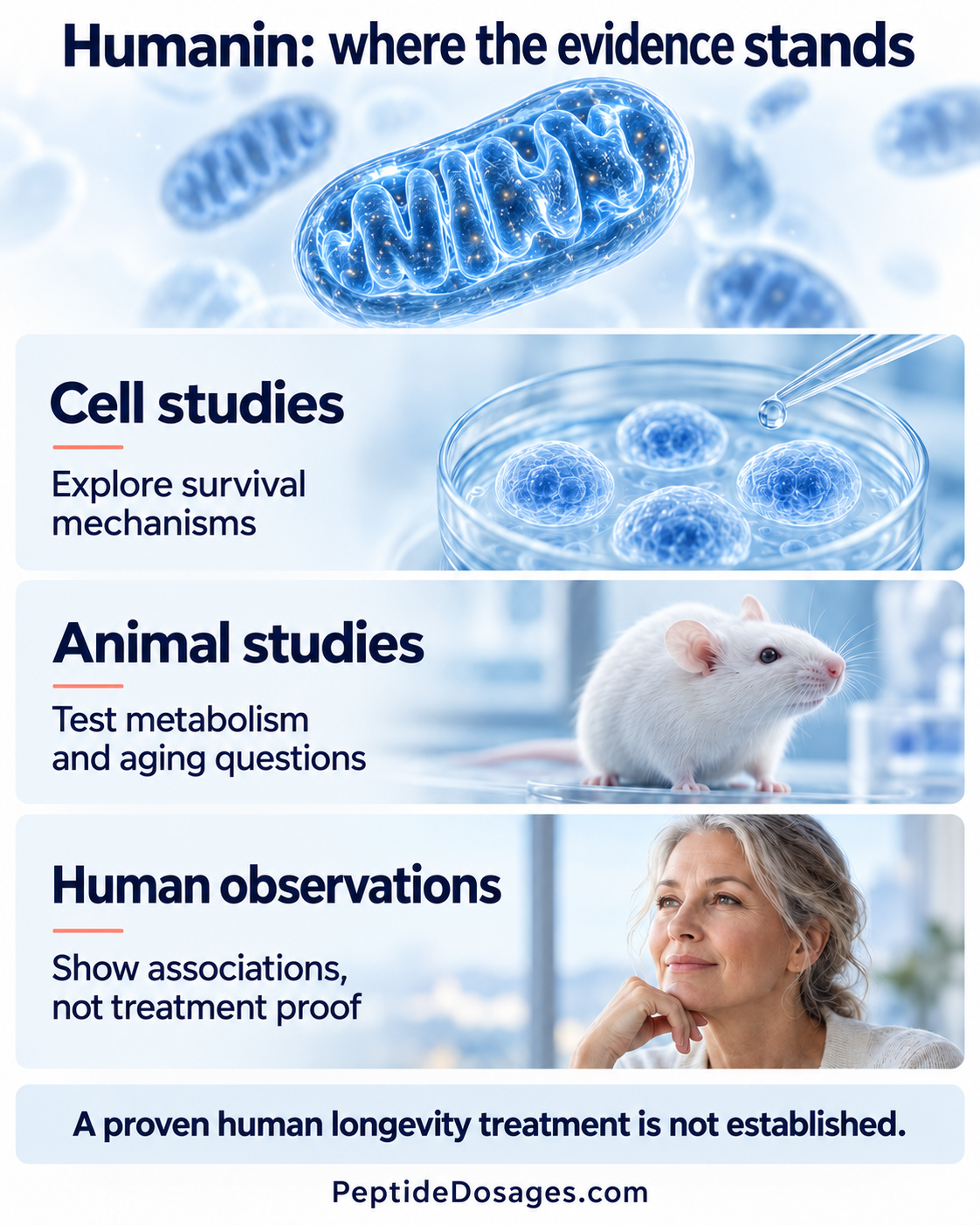
A 2020 paper reported longer lifespan in worms overexpressing humanin, selected healthspan changes in mice, and higher circulating humanin in offspring of centenarians compared with controls.1
The people in that comparison were not assigned humanin treatment. Researchers measured levels they already had. Higher levels could contribute to longevity, reflect other biology, or both. The finding alone cannot tell us whether giving humanin would extend someone’s life.
Why cell protection raises a safety question
A 2020 study of experimental triple-negative breast cancer found that humanin protected cancer cells from apoptotic stimuli. In tumor-bearing mice, systemic humanin promoted tumor progression and impaired aspects of chemotherapy’s antitumor effect.6
This is not proof that humanin causes cancer in people. It shows why the type of cell matters: a survival signal that protects one tissue may help an existing tumor in another setting.
People with cancer or a history of cancer should not use an experimental peptide as a self-directed wellness intervention. The studies above also cannot establish human side-effect rates, long-term safety or a standard anti-aging treatment course.
Humanin versus MOTS-c
Humanin and MOTS-c are different mitochondrial-derived peptides. A result for one does not establish the same effect for the other. Check the compound named in the experiment, including whether it used humanin or the modified analog HNG.
What would make the evidence more useful
- Controlled human studies with clinically meaningful outcomes.
- Clear identification of humanin versus a modified analog.
- Safety monitoring that includes longer-term and tissue-specific risks.
- Replication by independent research groups.
- Results that distinguish a biomarker from an actual treatment effect.
The Humanin 10 mg research reference is a separate preparation resource, not an approved or clinically validated human treatment regimen.
Frequently asked questions
Is there an established humanin dosage?
The studies discussed here do not establish a human treatment dose. An animal experiment cannot supply one without the clinical work needed to assess exposure, benefit and safety.
Can a natural peptide still carry risks?
Yes. Having a normal role in the body does not make extra amounts automatically safe. The experimental cancer findings show why the tissue and circumstances matter.6
Related Humanin dosage protocols
Continue with the vial-strength-specific research protocol that matches the material being evaluated. Each page keeps its own concentration, reconstitution, and syringe-unit calculations.
Practical measurement and handling guides
References
- Yen K, et al. The mitochondrial derived peptide humanin is a regulator of lifespan and healthspan. Aging. 2020.
- Hashimoto Y, et al. A rescue factor abolishing neuronal cell death by familial Alzheimer’s disease genes and amyloid-beta. PNAS. 2001.
- Guo B, et al. Humanin peptide suppresses apoptosis by interfering with Bax activation. Nature. 2003.
- Humanin induces conformational changes in BAX and sequesters it into fibers. Journal of Biological Chemistry. 2019.
- Muzumdar RH, et al. Humanin: a novel central regulator of peripheral insulin action. PLOS One. 2009.
- Humanin promotes tumor progression in experimental triple negative breast cancer. Scientific Reports. 2020.