
AICAR is an experimental metabolic compound, not a peptide. It is widely used to study AMP-activated protein kinase (AMPK), a cellular energy regulator. The famous endurance findings come from mice, not a proven exercise substitute for people.1,2
Seeing AICAR beside peptides in a catalog can obscure what it actually is. The often-used phrase “exercise in a pill” also leaves out the limits of the research.
What is AICAR?
In experimental pharmacology, AICAR usually means 5-aminoimidazole-4-carboxamide ribonucleoside, also called AICA riboside or acadesine. It’s a small molecule, not an amino-acid chain. The abbreviation can also refer to the related phosphorylated metabolite ZMP, so check the full chemical name in each paper. 1 3
Think of the distinction as the material entering a cell versus the material it becomes inside that cell. They are connected, but they are not chemically identical. A paper discussing an intracellular concentration of ZMP does not automatically describe an equivalent amount of a product labeled AICAR.
How does AICAR activate AMPK?
After uptake, adenosine kinase can convert AICA riboside to ZMP. This metabolite mimics some actions of AMP, helping activate AMPK. Early experiments in isolated rat liver cells showed changes in enzyme phosphorylation and suppression of fatty-acid and sterol synthesis.1,3
AMPK helps cells respond to energy demand. It is not a simple “fat-burning switch” that can be turned up indefinitely. A change in a metabolic pathway is a useful laboratory finding; whether it improves health depends on the tissue, exposure and outcome being measured.
What did the endurance study actually show?
A 2008 study in Cell found that four weeks of AICAR treatment increased treadmill running endurance by 44% in sedentary mice. It also changed expression of metabolic genes. This helped establish the idea of an exercise mimetic: a substance that reproduces selected biological effects associated with exercise.2
The missing words in many summaries are in mice. The experiment did not show a 44% improvement in human fitness, and it did not establish that AICAR reproduces the cardiovascular, psychological or musculoskeletal benefits of regular activity. A laboratory endurance test and long-term health are different endpoints.
| Evidence | What it tells us | What it does not establish |
|---|---|---|
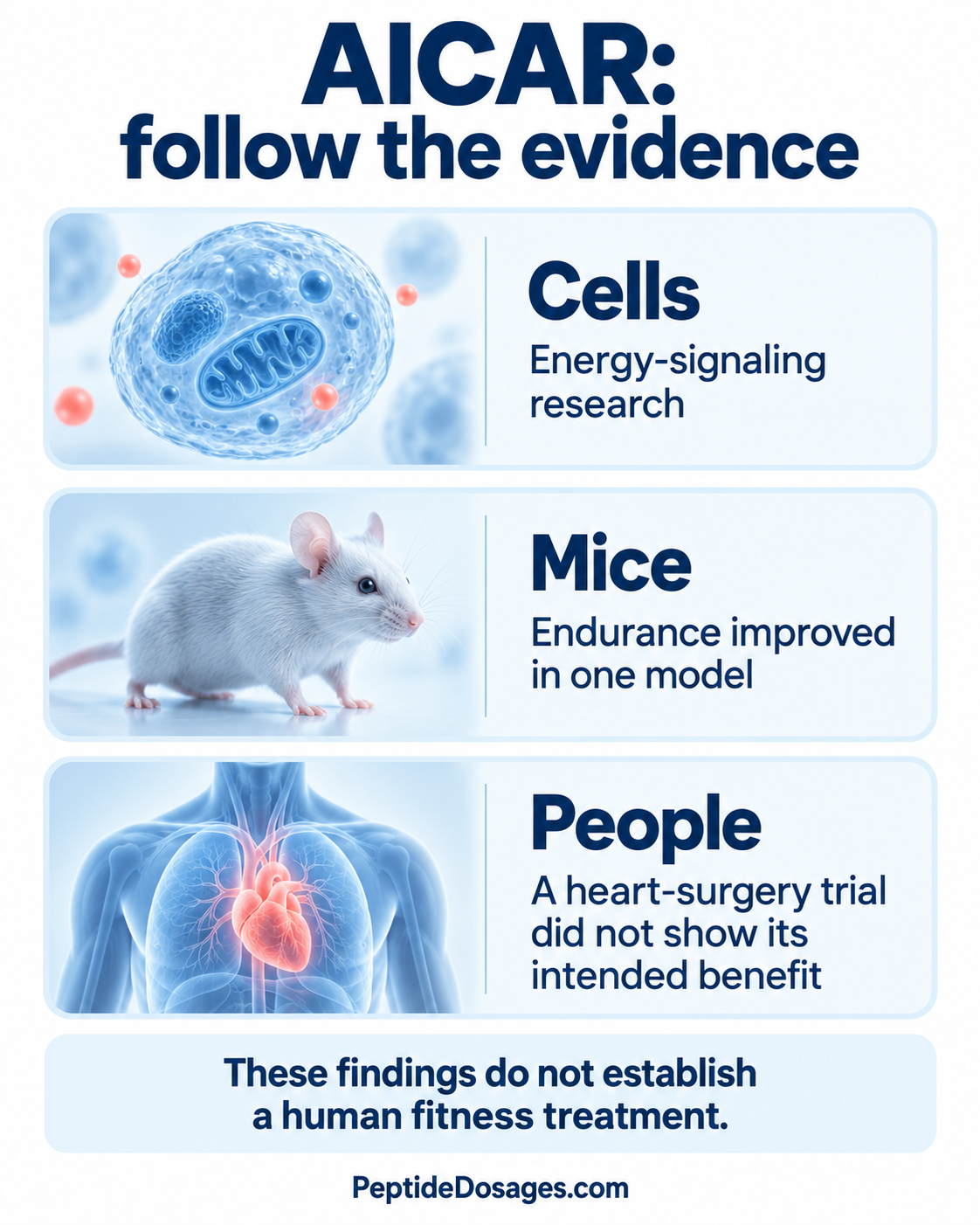
| Cell experiments | AICAR can alter energy-related signaling | A safe wellness treatment |
| Mouse treadmill study | Endurance improved in that model | The same improvement in people |
| RED-CABG human trial | Tested acadesine around heart surgery | A successful exercise or weight-loss medicine |
These studies answer different questions and should not be combined into a single claim of clinical benefit.1,2,4
Has AICAR been studied in humans?
Yes. Acadesine was evaluated in RED-CABG, a large randomized trial involving people undergoing coronary artery bypass surgery. The study tested whether treatment around surgery reduced death, nonfatal stroke or the need for mechanical support for severe left-ventricular dysfunction.4
The trial stopped after 3,080 participants because an interim analysis indicated a low likelihood of demonstrating the intended benefit. It did not improve the primary combined outcome. This is an important counterweight to the idea that a plausible mechanism guarantees a useful treatment.
These patients, their monitoring and the surgical setting were very different from healthy people seeking endurance or fat loss. Human exposure in one research setting is not evidence that unsupervised use is safe in another.
Is AICAR safe, approved or allowed in sport?
USADA identifies AICAR as experimental and not approved for therapeutic use in humans. It is prohibited at all times in sport under the hormone and metabolic modulator category because it activates AMPK.5
Its inclusion on a prohibited list is not a certification of effectiveness. Anti-doping classification and medical approval answer different questions. Athletes should not infer that a research-only product is acceptable because it is available online.
Safety cannot be reduced to a short list of predictable side effects. There is no established benefit-risk profile for repeated self-directed use for fitness or longevity. Product identity and quality add another layer of uncertainty. Discuss any exposure or concerning symptoms with a qualified clinician rather than adjusting an online schedule.
How to read AICAR claims more carefully
- Check whether the study used AICA riboside, intracellular ZMP or a different AMPK activator.
- Look for the species and the actual outcome measured.
- Separate a change in signaling from a change in symptoms or disease.
- Look for negative findings as well as positive ones.
- Do not treat a preparation chart as clinical validation.
The AICAR 50 mg research reference is a separate calculation resource. It does not turn an experimental compound into an approved medicine.
Frequently asked questions
Is AICAR a peptide or a steroid?
Neither. The compound commonly discussed under this name is a ribonucleoside. Being sold alongside peptides does not change its chemistry.1
Does AICAR replace exercise?
No such conclusion follows from the mouse experiment. Reproducing selected metabolic responses is not equivalent to reproducing all the benefits of exercise.2
Is there an established AICAR dosage for fat loss?
The evidence summarized here does not establish one. A cell concentration, animal amount or monitored surgical infusion should not be repurposed into a personal weight-loss regimen.
Related AICAR dosage protocols
Continue with the vial-strength-specific research protocol that matches the material being evaluated. Each page keeps its own concentration, reconstitution, and syringe-unit calculations.
Practical measurement and handling guides
References
- Corton JM, et al. 5-aminoimidazole-4-carboxamide ribonucleoside: a specific method for activating AMPK in intact cells? European Journal of Biochemistry. 1995.
- Narkar VA, et al. AMPK and PPARdelta agonists are exercise mimetics. Cell. 2008.
- Substrate cycling between AICA riboside and its monophosphate in isolated rat hepatocytes. Biochemical Pharmacology. 1996.
- Effect of acadesine on morbidity and mortality associated with coronary artery bypass grafting: RED-CABG. JAMA. 2012.
- USADA. What athletes should know about AICAR and other prohibited AMPK activators.