
Glutathione is a three-amino-acid molecule your cells make to help manage oxidative stress. Its antioxidant role is well established. The harder question is whether taking more as a supplement produces a meaningful benefit for a particular person.1
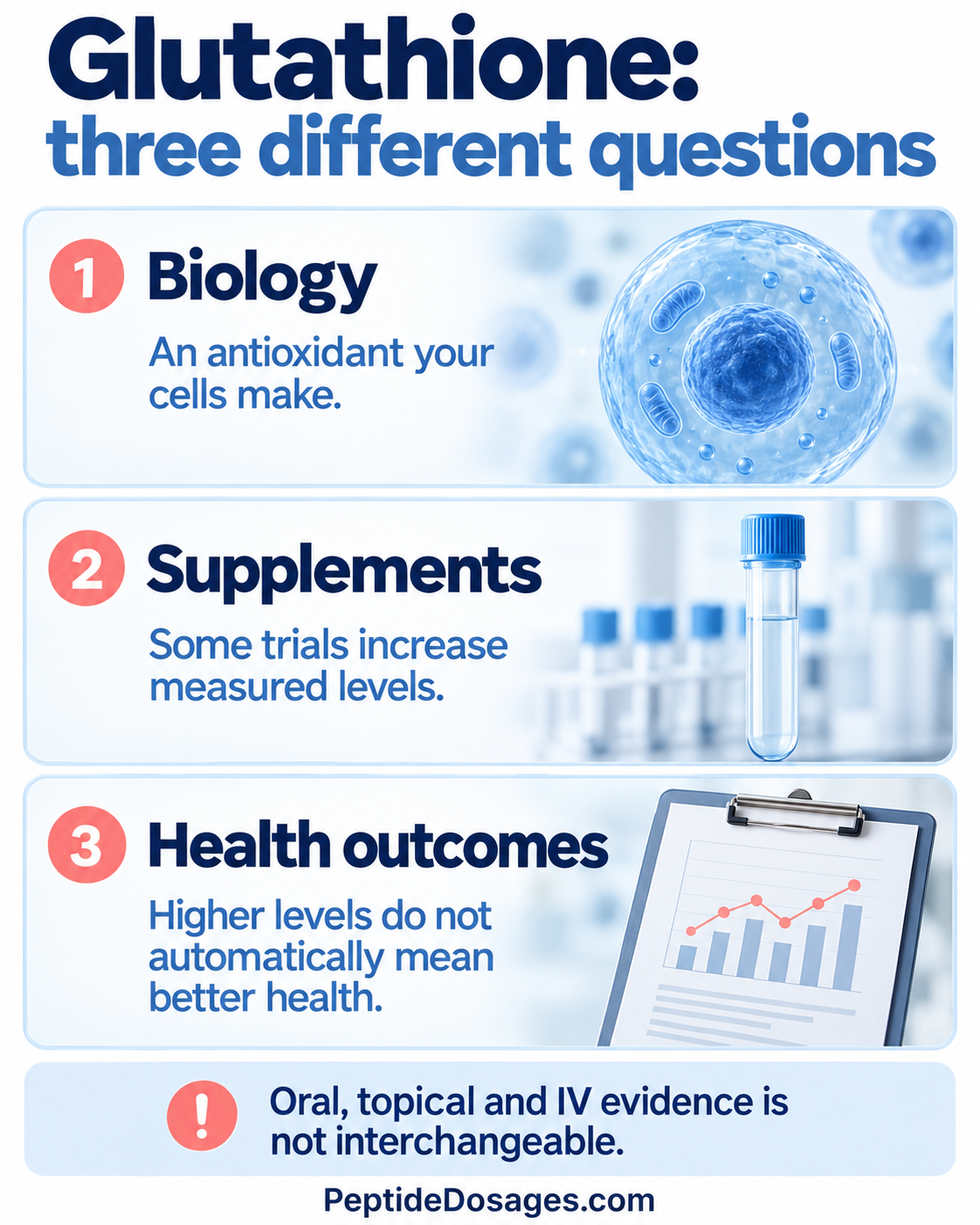
Glutathione capsules, liposomal products, skin creams and intravenous infusions have different evidence. A finding for one formulation doesn’t automatically apply to another. Nor does a higher blood marker necessarily mean better health.
What is glutathione?
Glutathione contains glutamate, cysteine and glycine. Its reduced form is called GSH and its oxidized form GSSG. The two forms help cells balance oxidation and reduction reactions, known as the redox system. 1
The familiar term “antioxidant” describes a function, not a promise that an additional capsule will prevent illness. Your body already uses glutathione within a network of enzymes and other protective systems. More of one substance does not automatically mean better performance of the whole system.
Do oral glutathione supplements work?
For increasing measured glutathione levels, the results are mixed. A four-week placebo-controlled study found no significant improvement in glutathione status or the oxidative-stress markers studied; 39 participants completed the protocol.1
A longer randomized trial in 54 healthy adults found increases in glutathione stores after six months of supplementation. Levels moved back toward baseline after treatment stopped.2 The studies differed in duration and design, so one does not simply cancel out the other.
Neither result establishes that supplementation prevents cardiovascular disease, reverses aging or treats unexplained fatigue. Those claims require trials measuring those outcomes, not just a laboratory value.
| Form or study | Finding | Main limitation |
|---|---|---|
| Oral GSH, four weeks | No significant change in measured status or oxidative-stress markers | Short study in healthy adults |
| Oral GSH, six months | Increased body stores in a randomized trial | Biomarker improvement is not proof of disease prevention |
| Liposomal GSH, one month | Increases in measured stores in a small pilot | Only 12 participants; no placebo comparison |
| IV glutathione | Separate route with important product-quality concerns | Oral studies cannot establish IV safety or benefit |
Sources: oral trials, liposomal pilot and FDA safety communications.1,2,3,5
Is liposomal glutathione better?
Liposomal products package glutathione in lipid-based carriers. In a small pilot, 12 adults took a liposomal formulation for one month. Researchers reported higher glutathione levels in several blood compartments and changes in selected immune-function markers.3
That is a reason to study the formulation further, not enough to rank every liposomal product above every capsule. Without a placebo group and a direct comparison, the study cannot settle which product offers the best clinical benefit. “Better absorbed” and “better for you” are separate claims.
What about skin brightening?
Small clinical studies have examined pigmentation and other skin properties. A 12-week randomized trial in healthy women compared oral reduced glutathione, oxidized glutathione and placebo. It found changes in some skin measures, with results varying by site and outcome.4
This does not support a guaranteed or permanent change in skin tone. It also does not establish that injections work better than oral products. If pigmentation is the concern, a dermatologist can distinguish sun damage, melasma, inflammation and other causes before treatment is chosen.
IV glutathione safety: a separate issue
In August 2026, FDA reported at least 30 patients with adverse events after IV glutathione, alone or with other ingredients. The investigation involved material labeled dietary-supplement grade and concerns about excessive endotoxin. Reported reactions included fever, chills, pain, dizziness and shock or sepsis-like symptoms, sometimes requiring hospitalization.5
FDA had issued a similar warning in 2019 after adverse reactions and testing that found excessive endotoxin in glutathione source material.6 The key lesson is practical: an ingredient suitable for a capsule is not automatically suitable for injection.
These reports do not mean every glutathione product has the same contamination problem. They do show why “natural,” “pure” or a certificate of analysis cannot stand in for appropriate sterile manufacturing controls. A home preparation calculation cannot resolve that issue.
Who should discuss it with a clinician first?
Anyone considering a supplement to manage a medical condition should first clarify the goal and how a benefit would be assessed. This is especially important during pregnancy or breastfeeding, with significant chronic illness, or during cancer treatment, where the small healthy-volunteer studies do not answer the relevant safety questions.
Bring the exact product and ingredient list, not just the word glutathione. Ask about interactions, the evidence for the intended use and whether a symptom needs investigation instead. Seek urgent care for breathing difficulty, faintness or severe symptoms following an infusion.
Food, supplements and related compounds
Glutathione is not the same as glutamine. Glutamine is an individual amino acid; glutathione is a molecule assembled from three amino acids. Likewise, a product supplying precursors is not the same intervention as a trial of glutathione itself.
A balanced diet can supply amino acids without requiring a “glutathione-boosting” shopping list. The useful question is not which single food promises the biggest increase, but whether a person has an actual nutritional or medical need.
For readers comparing research presentations, the glutathione 600 mg reference is separate from supplement evidence. It is not a recommendation to replace food, medical care or an oral product with an injection.
Frequently asked questions
Does glutathione detox the body?
It participates in cellular protective processes. That biological role does not prove a commercial detox program improves health. Ask what specific exposure, symptom or outcome the claim refers to and whether that use has been tested.
How long does it take to notice a difference?
There is no single evidence-based timeline for feeling better. The oral studies above measured laboratory outcomes over weeks or months, not a predictable day when everyone would feel more energetic.1,2
Are capsules safer than injections?
The risks are different. Oral trials cannot justify an injectable product, and injection adds sterility and contamination concerns. A route should be selected for a supported medical purpose, not because it sounds stronger.5,6
Related Glutathione dosage protocols
Continue with the vial-strength-specific research protocol that matches the material being evaluated. Each page keeps its own concentration, reconstitution, and syringe-unit calculations.
Practical measurement and handling guides
References
- Allen J, Bradley RD. Effects of oral glutathione supplementation on systemic oxidative stress biomarkers in human volunteers. 2011.
- Richie JP Jr, et al. Randomized controlled trial of oral glutathione supplementation on body stores of glutathione. European Journal of Nutrition. 2015.
- Sinha R, et al. Oral supplementation with liposomal glutathione elevates body stores of glutathione and markers of immune function. European Journal of Clinical Nutrition. 2018.
- Weschawalit S, et al. Glutathione and its antiaging and antimelanogenic effects. 2017.
- FDA. Do not use dietary supplement grade glutathione for injectables. August 27, 2026.
- FDA. Concerns with dietary ingredient glutathione in sterile injectables. June 7, 2019.