

Bronchogen is a short research peptide studied in airway cells and experimental lung-injury models. Its appeal comes from work on bronchial epithelium, the tissue lining the airways. Those studies are not the same as evidence that it improves breathing or treats COPD in people.
What changed in the airway experiments, and which peptide did researchers test? Those specifics tell us more than the broad phrase “lung repair.”
What is Bronchogen peptide?
Bronchogen belongs to the short-peptide bioregulator literature associated with Khavinson and colleagues. It is described as a tetrapeptide, meaning a chain of four amino acids. A 2014 study in Lung examined Ala-Asp-Glu-Leu, abbreviated ADEL, in cultured human bronchial epithelial cells.1
The sequence needs checking against the individual source. Another paper using the Bronchogen name lists Ala-Glu-Asp-Leu instead.2 Those orders are different. A name shared across papers should not be used to silently merge their chemical identities or results.
How is it thought to work?
The 2014 cell experiment measured proteins involved in cell proliferation and survival, plus genes associated with airway-cell differentiation. Researchers also examined how ADEL interacted with DNA in a laboratory system. These findings support further work on gene regulation; they don’t demonstrate a respiratory treatment. 1
Gene expression describes how actively cells use particular genetic instructions. A change can reveal a biological response, but it does not by itself tell us whether someone coughs less, has fewer exacerbations or can walk farther.
What does published Bronchogen research show?
| Research setting | What was measured | Key limitation |
|---|---|---|
| Human-derived airway cells | Protein and gene-expression changes | Cells in culture are not treated patients |
| Rat lung-disease model | Airway structure and inflammation | An induced model does not establish human benefit |
| Rat tissue explants | Growth responses in cultured tissue | Not a trial of symptoms or lung function |
Evidence settings summarized from the studies below.1,3,4
Airway-cell experiments
The human-derived cell study used cultures at different passages, a way of examining cells after successive rounds of growth. Effects in older cultures were part of the research question. “Human cells” in a paper does not mean volunteers received the peptide.1
An obstructive-lung-disease model in rats
A 2015 experiment used intermittent nitrogen-dioxide exposure to create lung pathology in rats. The investigators reported improvements in several tissue abnormalities and inflammatory measures after Bronchogen treatment, including changes in epithelial remodeling and local immune markers.3
That is a preclinical signal worth distinguishing from a clinical conclusion. The exposure model, animals and tissue endpoints do not reproduce all the causes, accompanying illnesses or treatment needs of people with COPD.
Tissue-culture research
An earlier study examined several short peptides in organotypic tissue cultures from young and older rats. It reported tissue-associated growth responses, including lung explants exposed to Bronchogen.4 This helps explain the bioregulator research interest, but it does not establish a symptom benefit.
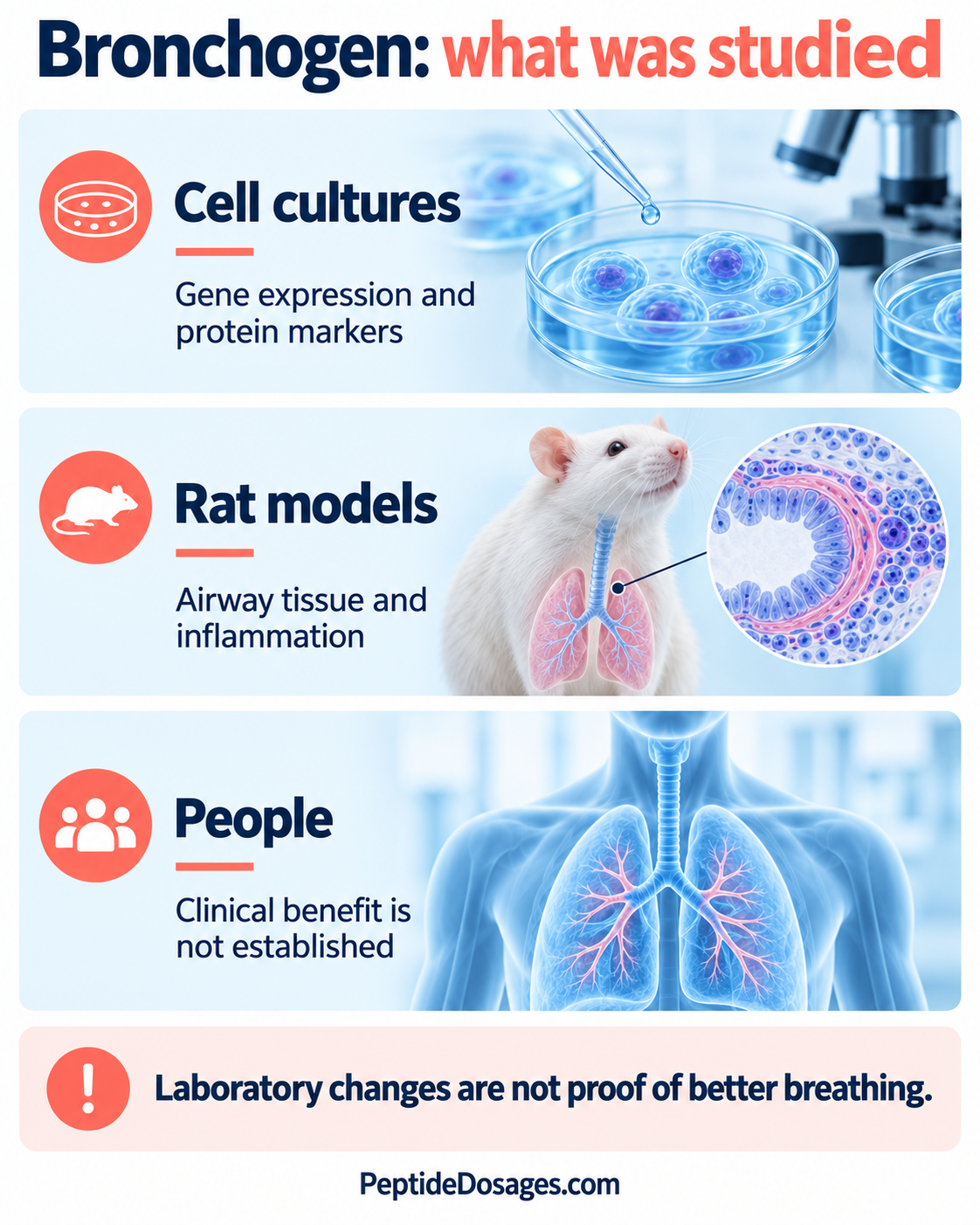
Can Bronchogen treat COPD or repair lung damage?
The cited experiments do not establish either claim in patients. This review did not identify a controlled human Bronchogen trial demonstrating improved lung function, fewer hospitalizations or better quality of life.
Those are the outcomes needed to evaluate a respiratory treatment. A reduction in an inflammatory marker or an improved tissue appearance can guide future research, but it cannot replace them.
Do not substitute a research peptide for prescribed inhalers, oxygen or an individualized respiratory-care plan. New or worsening breathlessness needs medical assessment rather than a change to an online peptide schedule.
Safety and side effects: what remains uncertain?
The sources reviewed here do not establish a dependable human side-effect profile or a safe repeated-use schedule. They also do not resolve interactions with respiratory medicines or the effects of different routes and formulations.
“Short peptide” and “bioregulator” describe aspects of a compound or research approach; neither term guarantees safety. Product identity is another concern when sequence descriptions differ. A certificate should identify the actual material and its batch, not merely repeat a familiar product name.
What about Bronchogen dosage and reconstitution?
There is no clinical dosage established by the evidence summarized here. Amounts used in a cell dish or rat model should not be scaled into a personal treatment plan.
The Bronchogen 20 mg research reference covers a separate preparation context. Correct arithmetic does not establish clinical effectiveness, route suitability or a safe course.
Frequently asked questions
Is Bronchogen the same as Chonluten?
No. They are different named peptides in the respiratory-bioregulator literature. A result attributed to one should not be presented as a result for the other.
Why do some studies mention human cells?
Human-derived cells can be grown and tested outside the body. This is useful research, but it is not a human treatment trial.
What would make the evidence stronger?
Clear compound identity, independent replication, adequate safety characterization and controlled human studies with meaningful respiratory outcomes would be more persuasive than additional lists of potential benefits.
Related Bronchogen dosage protocols
Continue with the vial-strength-specific research protocol that matches the material being evaluated. Each page keeps its own concentration, reconstitution, and syringe-unit calculations.
Practical measurement and handling guides
References
- Khavinson VKh, et al. ADEL gene-expression and protein-synthesis research in bronchial epithelium. Lung. 2014.
- Short peptides and differentiation in aging tissue cultures. 2012. Sequence as reported in that source.
- Bronchogen in a rat model of obstructive lung pathology. 2015.
- Synthetic bioregulatory peptides in young and old rat tissue cultures. Advances in Gerontology. 2006.