
Kisspeptin is a reproductive hormone signal, not simply a supplement for raising testosterone or libido. Human research shows that it can influence reproductive hormones, sexual-response processing and egg maturation. Those findings are interesting, but the form of kisspeptin and the setting of the experiment matter enormously.
Many fertility and sexual-desire studies used kisspeptin-54. Those findings don’t establish the same result for kisspeptin-10 delivered by a different route or schedule. [1] [2] [3]
What is kisspeptin?
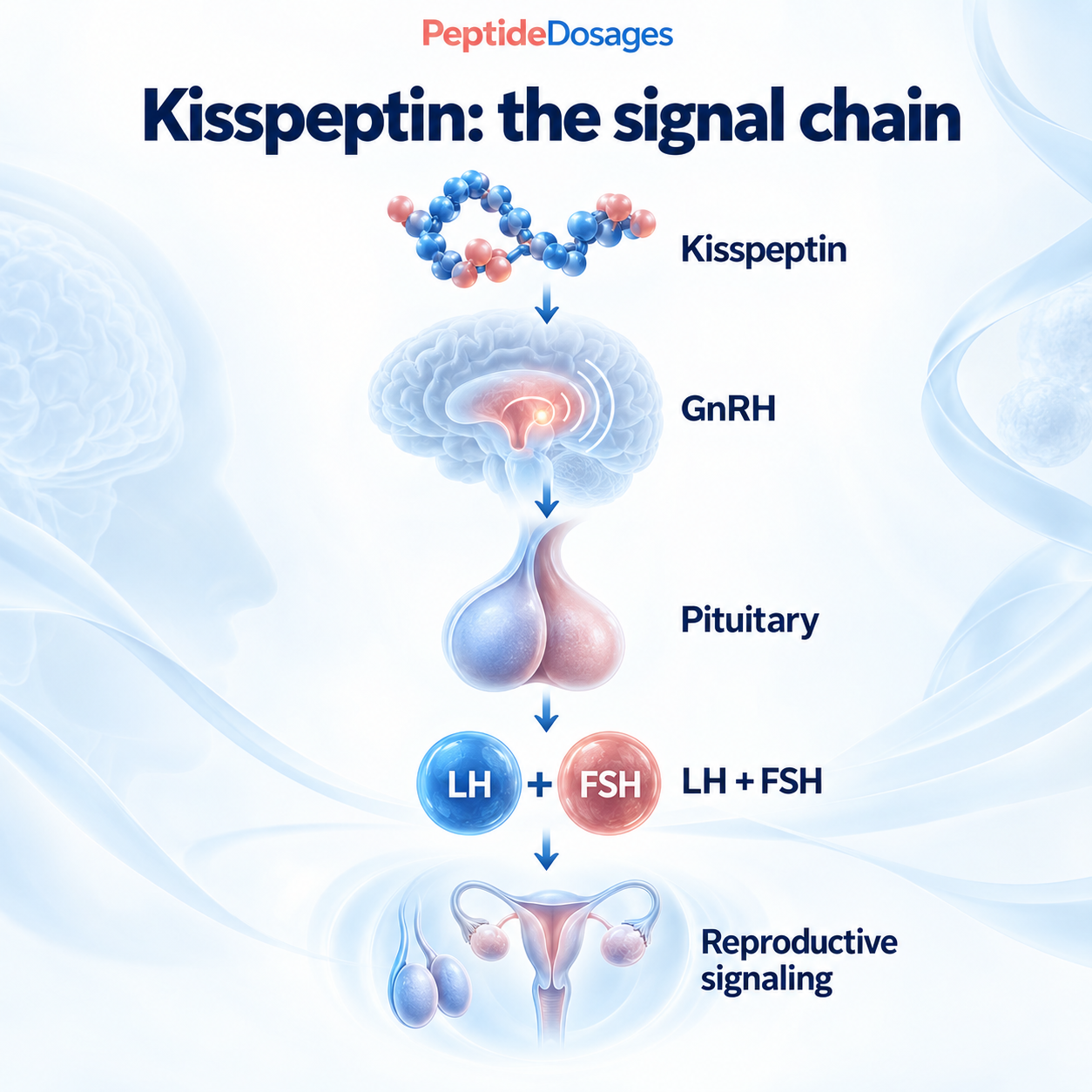
Kisspeptin acts through the KISS1R receptor and helps regulate gonadotropin-releasing hormone, or GnRH. GnRH, in turn, signals the pituitary to release luteinizing hormone (LH) and follicle-stimulating hormone (FSH). These hormones are involved in reproductive function. This places kisspeptin upstream of several hormonal responses, rather than making it a replacement for testosterone or a fertility drug. [1]
Kisspeptin-10 and kisspeptin-54 contain 10 and 54 amino acids, respectively. Shared naming does not make study results interchangeable. Look for the exact peptide name in a paper before applying its findings to a product label.
What have human studies actually found?
| Research question | What was studied | What it means |
|---|---|---|
| Reproductive hormone release | Kisspeptin-10 in small groups of healthy men and women. [4] | Responses depended on sex and menstrual-cycle phase. One uniform hormone response cannot be assumed. |
| Low sexual desire | Acute kisspeptin-54 infusions in women and men with hypoactive sexual desire disorder. [2][3] | Changes in experimental sexual responses are not proof of lasting symptom improvement. |
| Egg maturation during IVF | Kisspeptin-54 as a trigger after ovarian stimulation. [5][6] | Promising specialist fertility research, not a stand-alone way to improve fertility at home. |
| Repeated exposure | Twice-daily kisspeptin-54 for two weeks in a small study of women with hypothalamic amenorrhea. [7] | The hormonal response weakened. More frequent exposure does not necessarily mean more benefit. |
Kisspeptin benefits: separate the research questions
Hormones and testosterone
A hormonal signal can change a blood test without treating the reason a person feels unwell. In a 2011 kisspeptin-10 study, men had increases in LH and FSH. Women in the follicular phase did not show the same response under the tested conditions, while women studied before ovulation did respond. [4]
That variability matters when reading claims about “balancing hormones.” The phrase leaves out the starting diagnosis, the hormone being measured and the population studied. A brief LH response is not evidence that kisspeptin restores fertility, resolves symptoms of low testosterone or replaces a diagnostic evaluation.
Sexual desire
A randomized crossover study enrolled 40 premenopausal women with hypoactive sexual desire disorder; 32 completed it. Researchers compared kisspeptin-54 with placebo during a short infusion and measured brain responses to sexual and attraction-related stimuli. The results suggested changes in relevant brain processing, without establishing a durable treatment benefit. [2]
A separate crossover trial in men enrolled 37 participants, with 32 completing. It found changes in brain activity and penile tumescence during the experiment. Some headlines turn a reported increase in tumescence into a percentage improvement in libido. Those are different outcomes: a physical response recorded during a laboratory session is not a long-term measure of sexual desire or satisfaction. [3]
Fertility and IVF
In an early study of 53 women undergoing IVF, kisspeptin-54 triggered egg maturation after other fertility medicines had already stimulated the ovaries. Fertilization and embryo transfer occurred in 49 participants, and 12 clinical pregnancies were reported. This was an early dose-ranging study, not a comparison proving superiority over standard triggers. [5]
A later phase 2 study involved 60 women at high risk of ovarian hyperstimulation syndrome, or OHSS. It reported egg maturation in 95% of participants and no moderate, severe or critical OHSS. The open-label study was small and lacked an active-treatment comparison. It supports further investigation; it does not show that the risk is zero or that kisspeptin-10 products reproduce the result. [6]
Side effects and unanswered safety questions
Short, closely monitored studies cannot settle the safety of repeated use over months. They also cannot establish the purity, sterility or biological activity of a different product.
The FDA identifies potential safety concerns with compounded kisspeptin-10, including immune reactions associated with peptide aggregation or impurities, difficulty characterizing the active ingredient and limited safety information for proposed routes. These are product and evidence concerns, not a measured side-effect rate that can be applied to every individual. [8]
There is also a biological caution about repeated stimulation. In a small trial of women with hypothalamic amenorrhea, the strong initial response to twice-daily kisspeptin-54 diminished over two weeks. The study did not demonstrate restoration of reproductive function. That finding argues against treating an acute hormone rise as proof that a daily cycle will keep working in the same way. [7]
Why there is no universal kisspeptin dosage
An IVF trigger, a brief infusion during brain imaging and an endocrine research test ask different questions. Their participants, peptide forms and monitoring differ. Combining their numbers into one generic schedule would erase the details that make the studies interpretable.
If you are reading a protocol or conversion chart, first check whether it identifies kisspeptin-10 or kisspeptin-54 and whether the schedule comes from the population being discussed. Correct arithmetic does not establish clinical benefit or safety.
Related dosage pages: For vial-specific concentration, reconstitution, and measurement examples, see Kisspeptin (10 mg Vial) Dosage Protocol. Each linked protocol remains a separate reference because vial strength changes concentration and syringe-unit calculations.
Quick research check: does a kisspeptin-54 result support a kisspeptin-10 claim?
Not on its own. Check the exact peptide, route, population, duration and outcome. A K54 IVF study measures something different from a K10 hormone experiment. If the claim skips those details, its certainty is greater than the evidence allows.
Common questions
Is kisspeptin FDA approved?
The FDA’s 2024 evaluation stated that kisspeptin-10 was not a component of an FDA-approved drug. That document assessed a proposed compounding use; an advisory review is not itself a drug approval. Current FDA safety information continues to flag kisspeptin-10. Availability from a clinic or website does not establish an approved indication. [1][8]
How long does kisspeptin take to work?
It depends on what “work” means. Researchers have observed hormonal and laboratory sexual responses during short experiments. That does not provide a reliable timeline for improved fertility, energy or sexual wellbeing in everyday life.
Does it help with weight loss?
The human studies discussed here investigated reproductive and sexual function, not a validated weight-loss treatment. Their findings should not be repackaged as evidence for losing body fat.
The bottom line
Kisspeptin’s early human findings come from carefully defined experiments, not demonstrations of every claimed benefit. A clinician can help evaluate persistent low libido, possible hormone deficiency or fertility concerns and discuss treatments supported for that diagnosis.
Related dosage protocols and research
Explore related research, dosage references and guides below. Vial strengths have separate references because concentration and syringe-unit calculations differ. A comparison does not mean the compounds are interchangeable.
Matching dosage protocols
Further research context
References
- FDA. Evaluation of kisspeptin-10 for the Pharmacy Compounding Advisory Committee, 2024.
- Kisspeptin and sexual brain processing in women with hypoactive sexual desire disorder. Randomized crossover trial, 2022.
- Kisspeptin and sexual brain processing and penile tumescence in men with hypoactive sexual desire disorder. Randomized crossover trial, 2023.
- The effects of kisspeptin-10 on reproductive hormone release show sexual dimorphism in humans, 2011.
- Kisspeptin-54 triggers egg maturation in women undergoing in vitro fertilization, 2014.
- Kisspeptin-54 as an egg-maturation trigger in women at high risk of OHSS, 2015.
- Repeated kisspeptin-54 exposure in women with hypothalamic amenorrhea, 2009.
- FDA. Bulk substances used in compounding that may present significant safety risks.