
KPV is a three-amino-acid peptide studied for anti-inflammatory activity, particularly in experimental gut inflammation. Its name comes from lysine, proline and valine. Promising results in cells and mice have generated interest, but they do not establish that KPV treats inflammatory bowel disease, eczema or other conditions in people. [1] [4]
Look at what KPV did in the experimental model, how it was delivered and whether a treatment helped patients. These are three different questions.
KPV at a glance
- Identity: a tripeptide sequence from the end of alpha-melanocyte-stimulating hormone, or alpha-MSH.
- Research focus: inflammatory signaling and delivery to intestinal or skin tissue.
- Human benefit: not established by the studies below.
- Safety: no reliable human side-effect rates or established therapeutic dose.
- Regulatory status: not an FDA-approved medicine. [1] [3] [4]
Related dosage pages: For vial-specific concentration, reconstitution, and measurement examples, see KPV (10 mg Vial) Dosage Protocol. Each linked protocol remains a separate reference because vial strength changes concentration and syringe-unit calculations.
How does KPV work in research models?
A key 2008 study examined the peptide transporter PepT1, which helped KPV enter intestinal and immune-cell lines. Investigators observed reduced activity in inflammatory pathways, including NF-κB and MAPK, and lower inflammatory signaling. Oral KPV also reduced disease measures in two chemically induced mouse colitis models. [1]
That is a plausible mechanism for further investigation. It is not evidence that swallowing a commercial capsule produces the same tissue exposure or relieves symptoms in someone with Crohn’s disease. “Human cells” in this study means cells grown in the laboratory, not patients receiving treatment.
KPV peptide benefits: what does the evidence support?
| Study | What researchers tested | What it does not prove |
|---|---|---|
| 2008 intestinal inflammation study | KPV uptake in cell lines and oral exposure in mice with experimental colitis. | Effectiveness or safety for human inflammatory bowel disease. [1] |
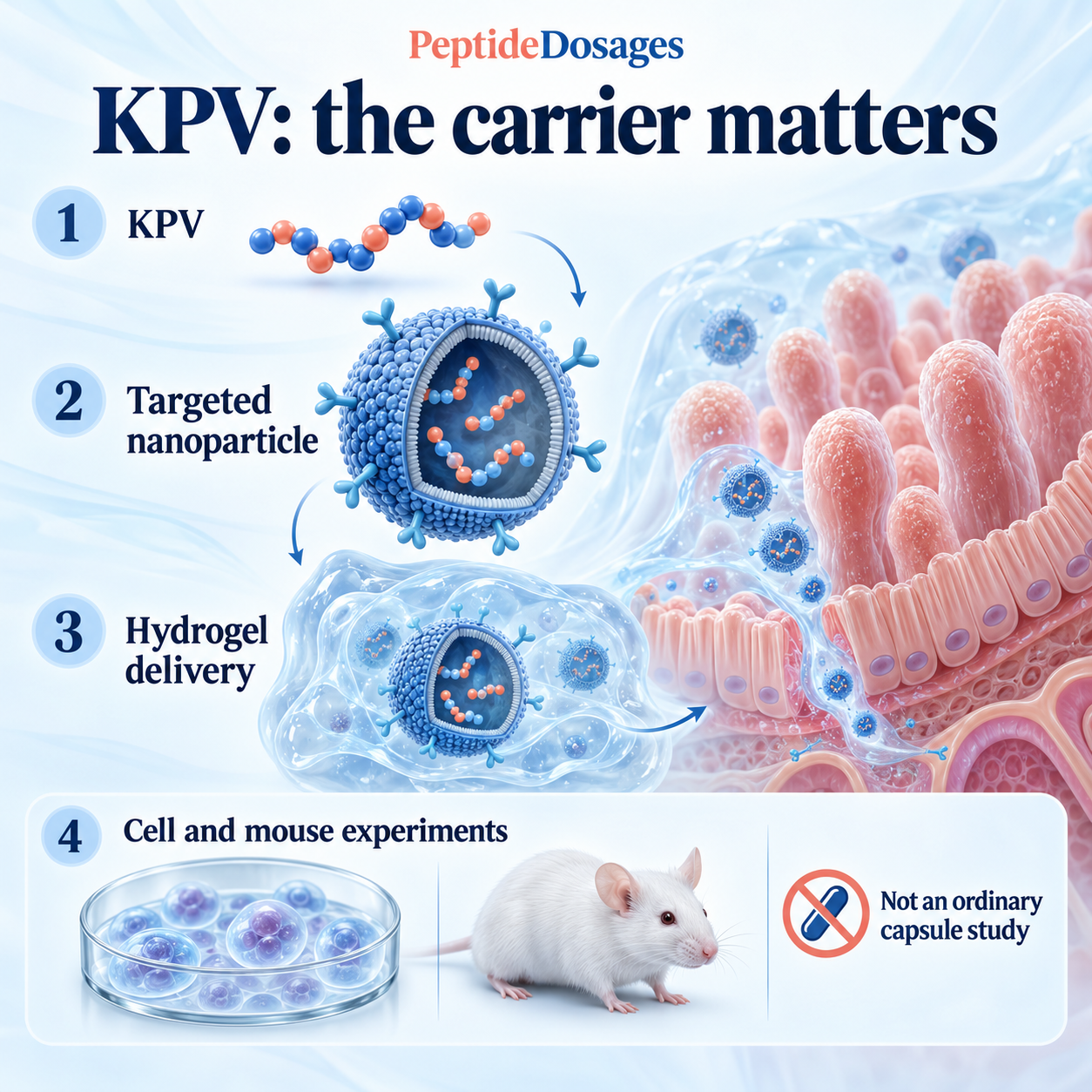
| 2017 targeted gut-delivery study | KPV inside hyaluronic-acid-functionalized nanoparticles, delivered in a hydrogel; cell and mouse experiments. | That an ordinary KPV capsule has the same delivery or effects. [2] |
| 2017 skin-delivery study | Movement of KPV across prepared human skin using microneedles and electrical delivery methods. | That KPV cream treats eczema, psoriasis or wounds in patients. [3] |
| 2026 FDA evidence review | Available information about KPV free base and acetate for a compounding assessment. | An approved indication, dose or established human safety profile. [4] |
Does KPV heal the gut?
“Gut healing” is too broad to be a useful outcome on its own. A patient may mean less pain, fewer bowel movements, improved endoscopy findings or fewer relapses. Those are separate questions. The cell and mouse studies above cannot tell us which, if any, would improve in people.
The 2017 nanoparticle study is especially easy to misread. It investigated a delivery system designed to bring KPV to inflamed colon tissue and relevant cells. The researchers reported improved inflammation and tissue-repair measures in their experimental model. The carrier was part of the intervention, not a minor detail that can be ignored when comparing products. [2]
What about skin inflammation or wound healing?
The human-skin experiment tested transport, not clinical recovery. Passive diffusion was below the study’s detection limit, while microneedles and iontophoresis increased delivery. These results show why route and formulation matter; they do not demonstrate that a cream works or justify trying these delivery methods at home. [3]
Do not confuse a paper tagged “Humans” in a database with a clinical trial. Prepared human tissue can be studied outside the body. A treatment claim needs outcomes from people receiving the specific intervention.
Are there human KPV trials?
FDA’s May 2026 staff review did not identify clinical studies establishing human exposure and safety. A ClinicalTrials.gov search for “KPV peptide” returned no records when checked on October 6, 2026. That search is limited to its terms and database; it is not proof that nobody has ever used KPV. [4] [5]
The sources discussed here don’t establish KPV as a treatment for a defined condition. A future trial would need to identify the product, compare it with appropriate care or placebo, report adverse effects and measure outcomes that matter to patients.
KPV side effects and safety
Unknown does not mean absent. The available data do not support dependable percentages for human adverse effects. FDA highlighted uncertainties about immunogenicity, aggregation and peptide-related impurities. A small molecule made from familiar amino acids is not automatically a well-tested medicine. [4]
Product quality adds a separate risk. FDA notes that poor compounding can produce contamination or incorrect amounts of an ingredient. Compounded medicines are not FDA-approved or equivalent to approved generic drugs. [6]
If symptoms change after an unapproved product, do not assume that worsening inflammation, a rash or digestive symptoms are a normal adjustment. Discuss the product and your medical history with a healthcare professional. Do not stop prescribed treatment to experiment with KPV.
What is the right KPV dosage?
No human therapeutic dose or cycle is established by this evidence. Animal exposures, cell-culture concentrations and experimental delivery systems cannot be converted into a validated personal regimen. An online dosing table may perform arithmetic correctly without demonstrating clinical safety or benefit. [1] [2] [4]
Is KPV approved, compounded or still experimental?
These terms describe different things. KPV free base and acetate are not ingredients in an FDA-approved drug. The 2026 Pharmacy Compounding Advisory Committee materials concern a separate assessment of bulk substances; a staff recommendation is not a final compounding decision or a drug approval. [4]
Likewise, a product described as compounded has not passed the FDA drug-approval process. Its availability alone cannot settle whether the product is appropriate, effective or legally supplied in a particular situation. [6]
Check a KPV claim before sharing it
- Does the source study KPV itself, rather than a different alpha-MSH fragment?
- Does “human research” mean patients, cultured cells or tissue samples?
- Was the peptide given alone or inside a special delivery system?
- Were symptoms and adverse effects measured, or only laboratory markers?
- Does the claimed route match the one actually tested?
A missing answer is a reason to pause, not to fill the gap with a testimonial.
Frequently asked questions
Is KPV the same as taking lysine, proline and valine?
No. KPV refers to those amino acids joined in a specific sequence, not simply consumed separately. The studies discussed here used the peptide or a defined peptide-delivery formulation. [1] [2]
Does oral KPV work better than topical KPV?
There is no patient head-to-head comparison in the evidence reviewed here. Gut-delivery experiments and skin-transport experiments use different models and endpoints, so they cannot establish a preferred route. [2] [3]
Should I replace my current inflammation treatment?
No. KPV research does not justify replacing prescribed care. Bring persistent gut or skin symptoms, your medication list and questions about treatment alternatives to a qualified clinician. The research is worth following; treating it as settled medicine is not.
Related dosage protocols and research
Explore related research, dosage references and guides below. Vial strengths have separate references because concentration and syringe-unit calculations differ. A comparison does not mean the compounds are interchangeable.
Matching dosage protocols
Related protocols and comparisons
Further research context
References
- Dalmasso et al. PepT1-mediated tripeptide KPV uptake reduces intestinal inflammation. Gastroenterology, 2008. Cell and mouse research.
- Xiao et al. Orally Targeted Delivery of Tripeptide KPV via Hyaluronic Acid-Functionalized Nanoparticles Efficiently Alleviates Ulcerative Colitis. Molecular Therapy, 2017. Cell and mouse experiments, not a patient trial.
- Pawar et al. Transdermal Iontophoretic Delivery of Lysine-Proline-Valine (KPV) Peptide Across Microporated Human Skin. Journal of Pharmaceutical Sciences, 2017. Skin-sample delivery experiment.
- FDA briefing document: KPV-related bulk drug substances. Staff evaluation for the July 2026 Pharmacy Compounding Advisory Committee meeting.
- ClinicalTrials.gov search: KPV peptide. Checked October 6, 2026; no records for this search.
- FDA: Compounding and the FDA, Questions and Answers. Approval distinctions and product-quality risks.