
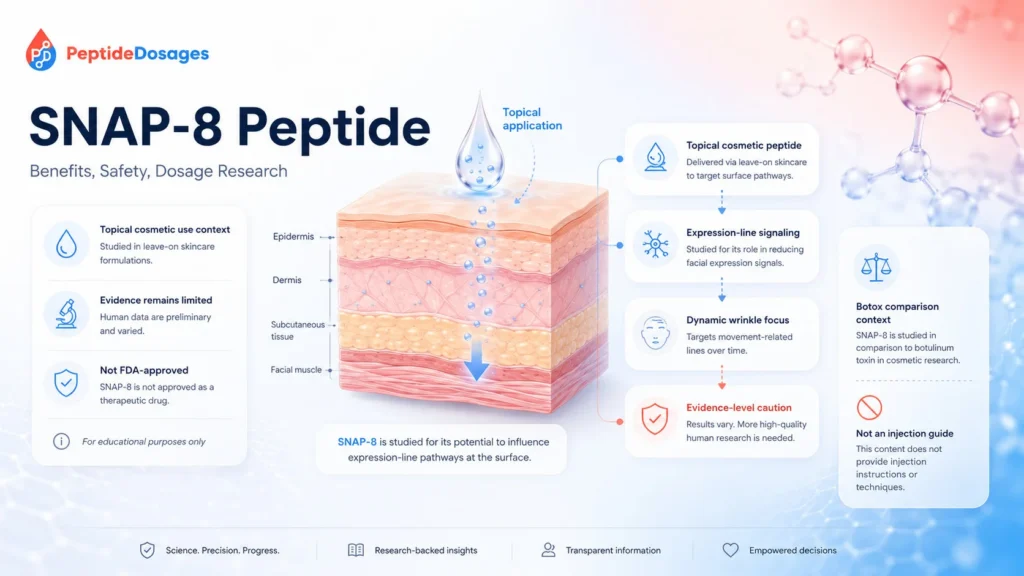
SNAP-8 peptide is a synthetic topical cosmetic peptide, most often identified as acetyl octapeptide-3, that is discussed for expression lines, fine lines, and wrinkles in skincare formulas.1 This educational article reviews what is known about SNAP-8, how its proposed mechanism relates to facial muscle contraction signaling, and why “Botox-like” language should be interpreted cautiously. It does not provide personalized medical advice, product recommendations, or instructions to use any peptide.
- SNAP-8 is generally described as a synthetic octapeptide used in topical skincare, not as an FDA-approved drug.12
- It is commonly discussed for expression lines and wrinkles caused by repetitive facial expressions, especially on the forehead and around the eyes, but evidence quality varies by claim.3
- SNAP-8 is designed to build on the same cosmetic peptide technology family as Argireline, a related acetyl hexapeptide-8 ingredient studied for anti-wrinkle effects.4
- Proposed effects involve the SNARE complex, SNAP-25, and neurotransmitter release, but mechanistic plausibility does not prove clinical wrinkle reduction.45
- Published human evidence for topical neuropeptides and cosmeceutical peptides exists, but the evidence base is smaller and less regulated than approved medication research.67
- Side effects associated with topical peptide serum or cream products may include irritation, redness, sensitivity, or allergic reaction, often related to the full formulation rather than the peptide alone.8
- Peptide dosage for SNAP-8 should be discussed as study concentration or cosmetic label context, not as a personal dosing protocol.
Related dosage pages: For vial-specific concentration, reconstitution, and measurement examples, see SNAP-8 (10 mg Vial) Dosage Protocol. Each linked protocol remains a separate reference because vial strength changes concentration and syringe-unit calculations.
Fast Answer
SNAP-8 peptide is a topical synthetic peptide, commonly listed as acetyl octapeptide-3, used in cosmetic skincare formulas aimed at softening expression lines and wrinkles.1 People search for it as a non-invasive alternative to Botox, but unlike Botox, SNAP-8 is not an FDA-approved injectable medication for facial lines.29 Evidence is strongest for related peptide mechanisms and limited cosmetic studies; safety, concentration, formulation quality, and regulatory status matter.
What Is the SNAP-8 Peptide?
SNAP-8 is a cosmetic peptide ingredient most commonly identified as acetyl octapeptide-3.1 It is used in topical products such as serum and cream formulas marketed for fine lines, wrinkles, and expression lines.
Peptides are short chains of amino acids, and cosmetic peptides are used in skin care for several proposed functions, including signaling, hydration support, and appearance-focused anti-aging claims.610 SNAP-8 is considered a topical peptide ingredient, not a prescription drug with an approved therapeutic indication.
SNAP-8, Acetyl Octapeptide-3, and Naming Clarity
SNAP-8 is commonly associated with the INCI-style ingredient name acetyl octapeptide-3.1 The “acetyl” part refers to an acetyl group, while “octapeptide” indicates that the molecule is composed of eight amino acids.
Some consumer searches use “acetyl hexapeptide serum,” but that wording can blur SNAP-8 with Argireline, which is typically discussed as acetyl hexapeptide-8 or acetyl hexapeptide-3 in older literature and ingredient discussions.4 For accuracy, SNAP-8 and Argireline should be treated as related but distinct cosmetic peptides.
Why SNAP-8 Is Used in Skincare and Peptide Serum Formulas
SNAP-8 appears in skincare because it is designed for topical cosmetic use in areas prone to wrinkles, especially expression lines caused by repetitive facial expressions.7 It is often included in peptide serum formulas alongside humectants such as hyaluronic acid, moisturizers, or other cosmetic ingredients.
A peptide treatment serum and supporting regimen designed for skin appearance is different from a medical treatment plan. Cosmetic products may affect appearance, cleansing, beautifying, or moisturizing, while products intended to diagnose, cure, mitigate, treat, or prevent disease may be regulated as drugs in the United States.11
How SNAP-8 Differs From Approved Peptide Drugs
Approved peptide or biologic drugs are reviewed for specific indications, dosing, manufacturing, safety, and labeling. SNAP-8, as used in cosmetics, does not have the same FDA-approved drug status as products reviewed through drug approval pathways.2
This distinction matters because cosmetic ingredient use does not establish therapeutic efficacy. A topical SNAP-8 serum is not equivalent to an approved prescription medication.
How Does SNAP-8 Peptide Work?
SNAP-8 works by reducing or modulating signals involved in facial muscle contraction in proposed cosmetic mechanisms, although direct clinical proof for each mechanistic step remains limited. The idea is similar to the mechanism proposed for Argireline, where interference with the SNARE complex is hypothesized to reduce neurotransmitter release related to muscle contraction.4
In plain language, the proposed mechanism is about softening the appearance of dynamic wrinkles by affecting signaling at a very local, topical level. This should not be confused with the pharmacologic paralysis produced by injected botulinum toxin products.
The Proposed Link Between SNAP-8 and Muscle Contraction
Dynamic wrinkles form when repeated facial expressions fold the skin over time.3 Facial muscle contractions, skin aging, ultraviolet exposure, collagen changes, and skin elasticity all influence the depth of wrinkles.3
SNAP-8 is designed to influence one part of that process: the signaling pathway linked with muscle contraction. The mechanism is biologically plausible, but clinical outcomes depend on skin penetration, concentration, formulation, duration of consistent use, and study design.
What the SNARE Complex and SNAP-25 Have to Do With Wrinkles
The SNARE complex helps vesicles release neurotransmitters at nerve terminals, and SNAP-25 is one protein involved in that system.5 Botulinum toxin affects neuromuscular signaling through highly specific enzymatic actions on SNARE-related proteins, which is one reason Botox works as an injectable medication in approved indications.59
Cosmetic peptides like Argireline and SNAP-8 are discussed in relation to the same broad signaling system, but they are not the same as botulinum toxin. Unlike Botox, SNAP-8 is topical and is not an approved injectable drug.
Why Mechanism Does Not Prove Clinical Wrinkle Reduction
A mechanism can explain why a compound might work, but it cannot prove that it reduces wrinkle depth in real-world human skin. Skin penetration, stability, product vehicle, concentration of SNAP-8, and endpoint measurement all affect whether a topical peptide produces a visible result.67
This is why claims such as “Botox-like” or “natural alternative to Botox” need caution. SNAP-8 is a synthetic peptide used in cosmetics, not a natural medication or a substitute for clinician-administered botulinum toxin.
Mechanism of Action: From Facial Expressions to Expression Lines
Expression lines and wrinkles develop through multiple pathways. Repeated facial expressions are one contributor, but aging skin also reflects changes in collagen, elastin, hydration, sun damage, and the skin barrier.3
SNAP-8 peptide benefits are usually framed around the appearance of expression lines, not disease treatment. That makes evidence grading especially important.
How Dynamic Wrinkles Form From Repetitive Facial Expressions
Dynamic wrinkles are lines that appear or deepen with movement, such as forehead lines, crow’s feet, and lines around the eyes. Over time, wrinkles caused by repetitive facial expressions can become more visible even when the face is at rest.3
Topical products may improve hydration or skin texture, which can make fine lines and wrinkles look less prominent. However, hydration-related improvement is different from changing facial muscle activity.
How SNAP-8 Is Designed to Affect Neurotransmitter Release
SNAP-8 is designed around peptide technology that aims to influence the release of neurotransmitters that cause facial muscle contractions. The related Argireline literature describes a synthetic peptide intended to interfere with vesicle release machinery involved in neurotransmitter exocytosis.4
For SNAP-8, much of the public discussion extends this mechanism to an octapeptide format. The proposed mechanism should be described as a hypothesis supported by related peptide research and cosmetic-use rationale, not as a proven medical effect.
Where Collagen, Skin Texture, and Hydration Fit In
Collagen loss and skin elasticity changes contribute to wrinkles with age.3 SNAP-8 is not primarily known as a collagen-building peptide in the same way that copper peptide discussions often focus on extracellular matrix and skin remodeling pathways.6
In practice, a peptide serum containing SNAP-8 may also include hyaluronic acid serum components, emollients, or barrier-supporting ingredients. Those ingredients can affect skin texture and the appearance of lines independently of SNAP-8.
What Is SNAP-8 Peptide Used For?
SNAP-8 is used in cosmetic skincare for appearance-focused concerns, especially expression lines and wrinkles. It is not an approved medication for treating a medical condition.2
The safest framing is that topical SNAP-8 is studied or marketed for cosmetic anti-aging effects. It should not be presented as peptide therapy for disease.
Cosmetic Use Around the Forehead and Around the Eyes
Consumer products containing SNAP-8 often target areas prone to wrinkles, such as the forehead and around the eyes. These are common sites for dynamic wrinkles because facial expressions repeatedly fold the skin.3
The eye area is also more prone to irritation from topical products. Readers with sensitive skin, eczema, rosacea, recent procedures, or active dermatitis should discuss topical actives with a clinician before use.
Therapeutic Versus Cosmetic Framing for Anti-Aging Claims
Anti-aging can mean many things: improved hydration, softer fine lines, reduced wrinkle depth, improved skin texture, or prevention of visible aging. These are cosmetic endpoints unless tied to a medical diagnosis or approved drug indication.11
For SNAP-8, the evidence supports cautious cosmetic language. Strong therapeutic claims would require high-quality clinical trials and regulatory review for the intended use.
What Researchers Have Studied in Human Skin
Human research on topical peptides has examined wrinkle appearance, skin smoothness, elasticity, and other cosmetic endpoints.67 Argireline has more visible peer-reviewed discussion than SNAP-8 itself, and SNAP-8-specific claims often rely on limited or less transparent cosmetic data.
This does not mean SNAP-8 has no effect. It means the claim strength should match the quality of evidence.
Potential SNAP-8 Peptide Benefits
Potential benefits of SNAP-8 are mainly cosmetic: softening of expression lines, improvement in the look of fine lines, and possible wrinkle depth reduction when used consistently in a well-formulated product. These benefits should be described as possible or preliminary rather than guaranteed.
The most responsible way to evaluate SNAP-8 peptide benefits is to ask whether a claim is supported by approved labeling, clinical trials, early human evidence, preclinical mechanism, or unsupported marketing language.
Softening of Expression Lines and Wrinkles
SNAP-8 offers a proposed non-invasive way to address expression lines without the need for injections. However, non-invasive does not automatically mean clinically proven or risk-free.
Topical peptide studies and reviews suggest that some peptides may improve the appearance of aging skin, but evidence varies by peptide, formula, and study quality.610 For SNAP-8, claims should be interpreted through the lens of limited cosmetic evidence.
What Is Known About Wrinkle Depth Reduction
Wrinkle depth reduction is a measurable endpoint in some cosmetic studies. Online claims sometimes state that SNAP-8 can reduce wrinkle depth by up to 63 percent, but that number should not be repeated as a general expectation unless the underlying study design, population, concentration, measurement method, and funding context are transparent.
Published evidence for related acetyl hexapeptide technology reported anti-wrinkle activity in human skin contexts, but direct generalization to every SNAP-8 serum is not appropriate.4 Product vehicle, concentration, and consistent use matter.
Why Anti-Aging Benefits Need Evidence Grading
Anti-aging benefits are evidence-sensitive because they are easy to overstate. A claim based on an in vitro mechanism is weaker than a claim supported by randomized, blinded human trials with objective wrinkle measurements.
A practical evidence framework is:
| Evidence Area | What Has Been Studied | Evidence Level | What It Can and Cannot Show |
|---|---|---|---|
| FDA-approved drug use | Botox labeling for approved neurologic and cosmetic indications | Approved medical use | Shows approved indications and safety labeling for botulinum toxin, not SNAP-8.9 |
| Related topical peptide research | Argireline and cosmeceutical peptides for wrinkle appearance | Clinical / early human | Supports plausibility for related peptides but does not prove all SNAP-8 products work.46 |
| SNAP-8 mechanism claims | SNARE-related signaling concepts extended from peptide technology | Preclinical / mechanistic | Explains a proposed pathway but does not establish clinical efficacy.45 |
| Online before-and-after claims | User photos and marketing language | Unsupported / anecdotal | May generate hypotheses but cannot establish causation or typical results. |
What Does Human Research Say About SNAP-8?
Human research directly focused on SNAP-8 is limited compared with the broader literature on topical peptides and Argireline. Reviews of cosmeceutical peptides describe promise for aging skin but also note challenges around formulation, penetration, and clinical validation.610
The best available interpretation is that SNAP-8 sits in an early human or evidence-limited cosmetic category. It should not be described as proven to treat wrinkles in the same way an approved medicine is labeled for a specific indication.
Human Studies of Topical SNAP-8 and Wrinkle Depth
Publicly accessible peer-reviewed SNAP-8-specific human data appear limited. Much of the better-known peer-reviewed evidence relates to Argireline or broader peptide categories rather than acetyl octapeptide-3 alone.46
That distinction matters. A related peptide can support plausibility, but it cannot substitute for direct clinical evidence on SNAP-8.
What Clinical Trial Endpoints Usually Measure
Cosmetic peptide trials may measure wrinkle depth, wrinkle volume, skin roughness, elasticity, hydration, or investigator-rated appearance. These endpoints can be meaningful, but they depend on study controls, blinding, sample size, duration, and objective imaging methods.67
A clinical trial of a peptide treatment serum and supporting regimen may not isolate the peptide if the formula contains multiple active ingredients. Supporting regimen effects can confound interpretation.
How Concentration of SNAP-8 Affects Study Interpretation
The concentration of SNAP-8 matters because topical response depends on dose exposure, formulation, penetration, and contact time. A cream containing 10 percent peptide solution is not necessarily the same as a finished product containing 10 percent pure peptide.
Cosmetic labels can also list blends, trade-name solutions, or ingredient complexes. That makes it hard to compare one peptide serum with another unless the exact concentration and vehicle are disclosed.
Where Early Human Evidence Is Stronger or Weaker
Evidence is stronger when a study is randomized, blinded, controlled, adequately powered, and uses objective measurement of wrinkle depth. Evidence is weaker when it relies on small samples, open-label designs, before-and-after photos, or manufacturer summaries.
For SNAP-8, the evidence base is best described as limited and cosmetic. Readers should be cautious about claims that sound like drug-level efficacy.
What Preclinical Research Suggests About SNAP-8
Preclinical research can explain why topical neuropeptides might influence expression lines. It cannot prove that a serum will reduce the depth of wrinkles in a specific person.
For SNAP-8, preclinical reasoning centers on peptide interaction with neurotransmitter-release machinery, drawing from the same conceptual lane as Argireline research.4
In Vitro Findings Related to SNARE Complex Activity
In vitro findings for related peptides suggest possible effects on SNARE-mediated neurotransmitter release.4 The SNARE complex is biologically relevant to neuromuscular signaling, and botulinum toxin’s approved medical actions also involve SNARE-related targets.59
But the delivery method is very different. A topical peptide does not behave like an injected neurotoxin.
Translational Limits of Cell and Skin Model Research
Cell studies and reconstructed skin models are useful for mechanism discovery. They do not replicate the full complexity of intact human skin, long-term use, real product behavior, or diverse patient factors.
This is the key translational limit: a mechanism may be plausible, but clinical relevance remains uncertain until tested in well-designed human studies.
Evidence Limitations and Unsupported Online Claims
SNAP-8 is surrounded by strong marketing language. Common claims include “Botox in a bottle,” “natural alternative to Botox,” “powerful peptide,” and dramatic wrinkle reduction.
Those phrases are not the same as evidence. A medically responsible article separates cosmetic plausibility from proof.
Why “Botox-Like” Does Not Mean Botox-Equivalent
Botox is an FDA-approved botulinum toxin product with labeled indications, contraindications, warnings, dosing instructions, and adverse-reaction information.9 SNAP-8 is a topical cosmetic peptide ingredient, not an approved botulinum toxin medication.2
The phrase “Botox-like” may refer to a proposed mechanism around expression lines. It should not be interpreted as comparable potency, duration, regulatory review, or clinical effect.
Claims About Reducing Wrinkle Depth by Up to 63 Percent
Claims about reducing wrinkle depth by up to 63 percent should be treated as claim-specific, not universal. Without full access to protocol details, sample size, comparator, measurement methods, and formula composition, the number cannot be generalized to all users or products.
The safer interpretation is that wrinkle depth reduction is a studied cosmetic endpoint. The exact magnitude of effect remains product- and evidence-dependent.
How to Evaluate Before-and-After and Anecdotal Reports
Before-and-after photos can be affected by lighting, facial expression, camera angle, hydration, makeup, retinoid use, and other skincare changes. Anecdotal reports are useful for understanding user experiences but cannot establish causation.
A reliable evaluation should prioritize peer-reviewed studies, transparent methods, objective endpoints, adverse-event reporting, and regulatory context.
Side Effects Associated With SNAP-8 Peptide
Side effects associated with SNAP-8 are not as well characterized as those of approved drugs. For topical cosmetics, possible reactions include irritation, redness, burning, stinging, rash, or allergic reaction, and the FDA advises consumers to stop using a cosmetic and seek medical help when serious reactions occur.8
Because products contain multiple ingredients, a reaction may come from preservatives, fragrance, acids, solvents, penetration enhancers, or other actives rather than SNAP-8 itself.
What Side Effects Have Been Reported With Topical Peptides?
Topical peptides are often described as generally well tolerated in cosmetic literature, but tolerability depends on formulation and user skin type.67 The absence of widespread reports does not prove absence of risk.
People with a history of contact dermatitis, allergy, sensitive skin, or recent cosmetic procedures may have a higher chance of irritation from active skincare products.
Skin Irritation, Redness, Sensitivity, and Allergic Reaction Risk
Any topical product can cause irritation or allergic contact dermatitis. The FDA’s cosmetic reaction guidance lists symptoms such as rash, redness, swelling, and itching as reasons to stop use and consider medical evaluation.8
Severe swelling, breathing symptoms, widespread rash, or eye involvement should be treated as urgent medical concerns. This article does not replace clinical evaluation.
How Formulation Ingredients Can Confound Side Effects
A peptide serum may contain hyaluronic acid, acids, fragrance, alcohols, preservatives, botanical extracts, or other peptides. These ingredients can change tolerability.
This matters for safety interpretation. A side effect after using SNAP-8 may not prove that SNAP-8 alone caused the reaction.
Safety Considerations Before Using SNAP-8
SNAP-8 is generally discussed as a topical cosmetic ingredient, but “topical” does not mean risk-free. Safety depends on the formula, concentration, skin barrier condition, frequency of exposure, and individual sensitivity.
Regulatory status also matters. Cosmetics are regulated differently from approved drugs in the United States, and cosmetic products are not FDA-approved before marketing in the same way drugs are.2
Who Should Discuss SNAP-8 With a Clinician First?
People with active inflammatory skin disease, recent laser or peel procedures, frequent allergic reactions, eye-area irritation, or prescription dermatology treatments should consider clinician guidance before using new active cosmetics. This is especially relevant for products applied around the eyes or on compromised skin.
A clinician can help distinguish normal irritation from contact dermatitis, infection, rosacea flare, or procedure-related sensitivity.
Pregnancy, Breastfeeding, Sensitive Skin, and Active Skin Conditions
There is limited public clinical evidence on SNAP-8 use during pregnancy or breastfeeding. When evidence is limited, the safest approach is clinician-guided decision-making rather than assuming safety.
Sensitive skin and active skin conditions can also increase the chance of irritation. A dermatologist can help evaluate whether a product fits a person’s broader skincare plan.
Drug Interactions and Procedure Timing With Botox or Injectables
Drug interaction data for topical SNAP-8 are limited. However, people receiving Botox, fillers, lasers, microneedling, or other procedures should ask the treating clinician when to pause or resume active skincare, because procedure timing can affect irritation risk and healing.
Botox itself has specific labeled warnings, contraindication-style precautions, and adverse-reaction information that do not apply directly to SNAP-8 but illustrate why approved injectables require clinician oversight.9
Peptide Dosage: What Concentrations Have Been Studied?
Peptide dosage for SNAP-8 should be discussed as topical concentration and study context, not as a personal dosing recommendation. Cosmetic studies and product labels may describe concentrations, but those numbers are not interchangeable with medical dosing.
Study doses should not be interpreted as personal dosing advice. Decisions about active skincare are best made with a clinician when there are medical conditions, pregnancy, breastfeeding, recent procedures, or medication interactions.
Study Concentrations, Cream Containing 10 Percent, and Label Context
Some cosmetic discussions mention a cream containing 10 percent of a peptide solution or ingredient complex. This wording can be misleading because a 10 percent blend may contain much less pure peptide depending on how the raw material is supplied.
For accurate interpretation, the important details are the final concentration of SNAP-8, the product vehicle, duration of use, application area, comparator, and measurement method. Without those details, a concentration cannot be converted into a recommended personal protocol.
Why Published Concentrations Are Not Personal Medical Advice
Published concentrations describe what researchers or manufacturers evaluated under specific conditions. They do not account for a reader’s skin barrier, allergies, medications, dermatologic history, pregnancy status, or concurrent procedures.
This is why peptide dosage language must stay non-personalized. A study concentration is evidence context, not an instruction to use SNAP-8.
Administration Routes Discussed in the Literature
For SNAP-8, the relevant route is topical application in cosmetic skincare. There is no role for describing injection, reconstitution, or self-administration protocols for SNAP-8 in this article.
Administration route matters because topical exposure, local skin penetration, and cosmetic endpoints are different from systemic or injectable drug delivery. Topical medication and topical cosmetic use also differ by regulatory claims and intended purpose.11
What to Know Before Using SNAP-8 in a Peptide Serum
Before using SNAP-8 in a peptide serum, the medically responsible questions are about formulation, tolerability, evidence, and skin context—not how to maximize dose. Readers should look for clear ingredient labeling, avoid applying irritating products to broken skin, and ask a clinician about active skin disease or recent procedures.
A practical clinician-discussion checklist includes:
- Current skin diagnoses, such as eczema, rosacea, acne, dermatitis, or infection
- Recent procedures, including Botox, fillers, laser, peels, or microneedling
- Pregnancy, breastfeeding, or plans for pregnancy
- Current prescription topicals, retinoids, acids, or photosensitizing medicines
- Past allergic reactions to cosmetics
- Whether claims are cosmetic, therapeutic, or unsupported
- What adverse reactions should prompt stopping the product or seeking care
Is SNAP-8 Peptide FDA-Approved?
SNAP-8 is not known as an FDA-approved drug for wrinkles, expression lines, or any medical condition. In the United States, cosmetic products and ingredients generally do not receive FDA premarket approval, although they remain subject to safety and labeling requirements.2
This means regulatory status should be interpreted carefully. A cosmetic ingredient may be legal for cosmetic use without being approved as a medication.
Cosmetic Ingredient Status Versus Approved Medication Status
The FDA distinguishes cosmetics from drugs based partly on intended use and claims.11 If a product claims to treat or prevent disease or affect body structure or function in a drug-like way, it may be regulated differently.
Botox provides a useful contrast because it is an approved prescription biologic with formal labeling, dosing, warnings, and adverse-reaction sections.9 SNAP-8 does not have that same approved medication framework.
How SNAP-8 Compares With Argireline, Botox, and Peptide Technology
SNAP-8, Argireline, and Botox all appear in discussions about expression lines, but they belong to different evidence and regulatory categories. SNAP-8 and Argireline are topical cosmetic peptides, while Botox is an injectable botulinum toxin medication with approved indications and prescribing information.49
| Option | Route and Category | Evidence Context | Key Caution |
|---|---|---|---|
| SNAP-8 | Topical cosmetic peptide | Limited direct human evidence; mechanism based on peptide technology and related research.17 | Not FDA-approved as a wrinkle medication. |
| Argireline | Topical acetyl hexapeptide ingredient | Peer-reviewed anti-wrinkle study and broader cosmeceutical discussion.46 | Related evidence does not prove SNAP-8 efficacy. |
| Botox | Injectable botulinum toxin medication | Approved labeling and clinical use for specified indications.9 | Requires qualified medical administration and carries labeled risks. |
When a Dermatology Professional May Prefer Botox or Other Options
A dermatology professional may consider Botox, retinoids, sunscreen, resurfacing procedures, moisturizers, or other evidence-based options depending on the person’s goals, medical history, and risk tolerance. Botox has a distinct approved medical and cosmetic evidence base, while topical SNAP-8 remains a cosmetic peptide with more limited evidence.
The safest way to interpret SNAP-8 peptide is through evidence quality, regulatory status, safety data, and clinician-guided decision-making. Readers considering peptide-related medical decisions should discuss evidence, risks, alternatives, and regulatory status with a qualified healthcare professional.
Related dosage protocols and research
Use the available links to move between research context, dosage pages or comparisons, and supporting guides. When vial-size variants exist, they remain separate because concentration and syringe-unit calculations change with vial strength. Comparisons do not imply that different compounds are interchangeable.
Matching dosage protocols
Further research context
REFERENCES
- National Center for Biotechnology Information. PubChem Compound Summary: Acetyl octapeptide-3. PubChem database. Accessed 2026.
- U.S. Food and Drug Administration. FDA Authority Over Cosmetics: How Cosmetics Are Not FDA-Approved. FDA. Updated regulatory guidance page.
- MedlinePlus. Aging changes in skin. U.S. National Library of Medicine. Medical encyclopedia.
- Blanes-Mira C, Clemente J, Jodas G, et al. A synthetic hexapeptide with antiwrinkle activity. International Journal of Cosmetic Science. 2002.
- StatPearls Publishing. Botulinum Toxin. NCBI Bookshelf. Updated clinical review.
- Gorouhi F, Maibach HI. Role of topical peptides in preventing or treating aged skin. International Journal of Cosmetic Science. 2009.
- Schagen SK. Topical Peptide Treatments with Effective Anti-Aging Results. Cosmetics. 2017.
- U.S. Food and Drug Administration. What to Do If You Have a Reaction to Cosmetics. FDA consumer safety information.
- AbbVie / Allergan. BOTOX Prescribing Information. Official prescribing information. Current label.
- Zhang L, Falla TJ. Cosmeceuticals and peptides. Clinics in Dermatology. 2009.
- U.S. Food and Drug Administration. Is It a Cosmetic, a Drug, or Both? Or Is It Soap?. FDA cosmetics laws and regulations.
FAQs
What does SNAP-8 peptide do?
SNAP-8 peptide is used in topical cosmetic products for the appearance of expression lines, not as an approved disease treatment. It is commonly identified as acetyl octapeptide-3 and is discussed for a proposed mechanism of action involving facial muscle signaling and neurotransmitter release [1]. This mechanism is biologically plausible, but it should be interpreted as cosmetic and evidence-limited rather than as a Botox-equivalent medical effect.
What are the potential benefits of SNAP-8 peptide?
Potential benefits of SNAP-8 peptide include softening of expression lines, possible reduction in expression lines, and cosmetic improvement in the look of lines and wrinkles. Claims about wrinkle depth reduction should be evidence-graded because direct SNAP-8 clinical evidence is limited. The strongest framing is that SNAP-8 may support appearance-focused skincare goals, but efficacy depends on formulation, concentration, study quality, and individual skin context.
Does SNAP-8 actually work?
SNAP-8 may work for some cosmetic endpoints, but clinical evidence is limited and should not be treated as proof of guaranteed results. Human studies and clinical studies are stronger when they use controlled designs, objective wrinkle measurements, and transparent formulations. Much of the discussion around SNAP-8 relies on related peptide technology, including Argireline research, so direct evidence for each SNAP-8 product remains an important evidence gap [4].
What side effects or adverse events can happen with SNAP-8?
Side effects or adverse events from SNAP-8 products may include skin irritation, redness, sensitivity, stinging, rash, or allergic reaction, especially because topical formulas contain multiple ingredients. A reaction may come from preservatives, fragrance, acids, or other actives rather than the peptide alone. The FDA advises stopping a cosmetic and seeking medical help when a serious reaction occurs [8].
What dosage or route of administration information exists for SNAP-8?
Dosage information for SNAP-8 should be understood as topical concentration or study context, not personal dosing advice. The relevant route of administration is topical use in cosmetic serum or cream formulas, rather than injection or systemic administration. Published or label concentrations can vary by ingredient blend, finished formula, and testing method, so they should not be converted into a self-use protocol.
Is SNAP-8 peptide FDA-approved or legal?
SNAP-8 peptide is not known as an FDA-approved drug for wrinkles or expression lines. In the United States, cosmetic ingredients are regulated differently from approved medications, and cosmetics generally do not receive FDA approval before marketing [2]. Legal status depends on product claims, jurisdiction, and intended use; products making drug-like claims may raise different regulatory concerns under cosmetic-versus-drug rules [11].
Researchers Cited in This Article
The researchers below authored or co-authored publications cited in this article. Listing them here identifies sources; it does not mean they wrote, independently reviewed, sponsored, or endorsed this PeptideDosages.com article. The site author is identified in the article byline.
Tracey J. Falla
Researcher profile: PubMed Author Search
Tracey J. Falla is a published author in the cosmetic peptide literature, with work relevant to topical peptide pharmacology, skin appearance research, and evidence interpretation for peptide-based skincare ingredients. These publications provide useful background for understanding how peptides are discussed in cosmetic science, including mechanism-of-action hypotheses, formulation-dependent effects, and the limits of translating peptide technology into visible skin outcomes. This context is relevant to SNAP-8 peptide because the article distinguishes topical cosmetic mechanisms from approved drug-level clinical evidence.
Selected publications:
- Cosmeceuticals and peptides — Clinics in Dermatology, 2009. PMID: 19695479
- Bioactive peptides: signaling the future — Journal of Cosmetic Dermatology, 2009. DOI: 10.1111/j.1473-2165.2009.00490.x
Dr. Howard I. Maibach
Researcher profile: UCSF Profiles
Dr. Howard I. Maibach is a dermatologist and scientific author whose published work is relevant to topical dermatology, skin barrier interpretation, and cosmetic ingredient safety. His coauthored review on topical peptides is directly relevant to the evidence quality issues discussed in this article, especially the distinction between promising cosmetic mechanisms and well-controlled clinical studies. His broader work on cosmeceuticals and active cosmetics also provides context for separating cosmetic claims from drug-like therapeutic claims in published literature.
Selected publications:
- Role of topical peptides in preventing or treating aged skin — International Journal of Cosmetic Science, 2009. PMID: 19570099
- Cosmeceuticals and Active Cosmetics: Drugs Versus Cosmetics — CRC Press / Routledge, 2005. ISBN: 9780849316628