Oxytocin is a peptide hormone with established medical uses in obstetric care and a much less settled role in research on social behavior, sexual function and appetite. Calling it the “love hormone” makes a complicated subject sound simple. It does not mean a nasal spray reliably creates trust, improves relationships or treats low libido.
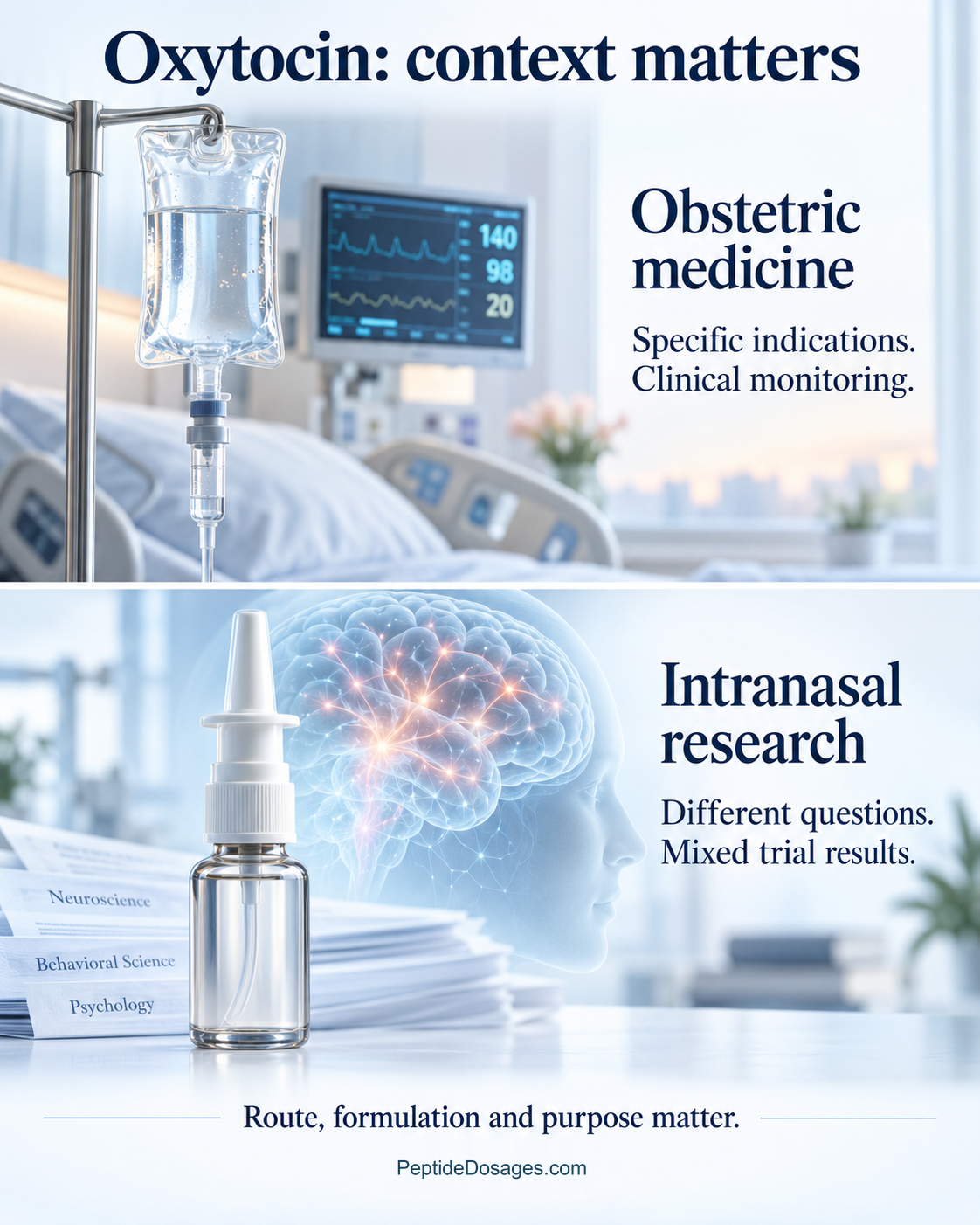
An established use of a prescription oxytocin medicine and an experimental use of the hormone have different evidence. Check the route, formulation and clinical setting.
Measurement references: The site has separate 5 mg and 10 mg oxytocin vial pages. Research-vial calculations are not a substitute for a prescription product’s instructions or medical supervision.
What is oxytocin used for medically?
The Pitocin injection label includes medically indicated induction or reinforcement of labor and control of postpartum bleeding, among specific obstetric uses. For labor induction or augmentation, the label requires intravenous administration with adequate supervision in a hospital. [1]
These uses rely on oxytocin’s ability to stimulate uterine contractions. They do not establish treatment benefits for anxiety, autism, weight loss or sexual concerns. An online research vial is not interchangeable with the labeled medicine simply because both use the word oxytocin.
What do the human trials show?
| Research question | Study | Main finding |
|---|---|---|
| Social functioning in autism | 290 children and adolescents randomized; 24 weeks | No significant advantage over placebo on the primary social-withdrawal measure. [2] |
| Weight loss in adults with obesity | 61 participants randomized; eight weeks | No meaningful between-group weight-loss benefit. [3] |
| Female sexual dysfunction | 30 women; placebo-controlled crossover trial | Both treatment periods improved scores, without a significant oxytocin treatment effect. [4] |
| Vaginal atrophy and sexual function | 96 postmenopausal women; eight-week vaginal-gel trial | Reported improvements, but a different route and population from nasal-spray studies. [5] |
Oxytocin and autism spectrum disorder
A 2021 multicenter trial enrolled participants aged 3–17 years. After 24 weeks, intranasal oxytocin did not outperform placebo on the primary measure of social withdrawal or on the main secondary measures of social and cognitive functioning. Adverse-event incidence and severity were similar between groups. [2]
This does not answer every possible research question about oxytocin and autism. It does mean that earlier small studies or changes on a brain scan should not be presented as proof of a broadly effective treatment. It also does not justify replacing individualized support or established care.
Does oxytocin help with weight loss?
The 2024 obesity trial offers an important reality check. After eight weeks, weight changed by about +0.20 kg in the oxytocin group and +0.26 kg with placebo. The difference was not significant. Body-composition and resting-energy-expenditure results also did not show a benefit. [3]
There was a lower intake at an experimental test meal with oxytocin relative to placebo. That finding did not translate into weight loss over the trial. Eating less during one measured meal and achieving sustained weight reduction are different outcomes.
Claims about appetite should therefore name the endpoint. “Reduced intake in a test setting” is not the same as “proven obesity treatment.”
Sexual function, libido and bonding claims
In the 30-woman crossover trial, participants used oxytocin or placebo during separate eight-week periods. Sexual-function and related scores improved over time in both periods, with no statistically significant treatment effect favoring oxytocin. Quoting improvement in the oxytocin period alone would leave out the essential comparison. [4]
A separate vaginal-gel trial in postmenopausal women reported improvements in vaginal atrophy and sexual-function measures. That is a different formulation acting in a different setting; it cannot establish that nasal oxytocin increases libido in everyone. [5]
Bonding research doesn’t establish oxytocin as a relationship aid. Sexual concerns may involve pain, medicines, hormonal changes, stress or relationship factors, so the actual problem needs assessment. Findings in women shouldn’t be generalized to men without appropriate evidence.
Does intranasal oxytocin reach the brain?
Researchers have measured changes in regional brain blood flow after nasal administration. A 2020 study compared a standard spray, a nebulizer and intravenous delivery. Some effects were associated with increased oxytocin in the circulation, while other findings supported route-specific effects. The delivery method made a difference. [6]
That helps explain why a nasal formulation cannot be treated as a simple substitute for an injection. It also illustrates a recurring distinction: a measurable biological effect is not automatically a clinically useful effect.
A 2024 review of anxiety and autism research described inconsistent findings and called for better standardization of formulation, devices and administration patterns. Oxytocin remains a research topic in these areas, not a general-purpose answer to anxiety or mood symptoms. [7]
Side effects and safety considerations
In obstetric use, the Pitocin label warns about excessive uterine contractions, fetal complications and water intoxication, especially with prolonged infusion. Reported adverse reactions include nausea, vomiting, arrhythmias and allergic reactions. These risks explain the need for careful selection and monitoring. [1]
Selected nasal-spray trials found similar overall adverse-event rates to placebo, but those findings apply to their participants, formulations and follow-up periods. They do not establish safety for every product, prolonged self-directed use or use during pregnancy. [2][3]
Pregnancy is a particularly important reason not to experiment with oxytocin outside appropriate medical care. Discuss any proposed use with a qualified clinician and pharmacist. New severe symptoms after using a product require medical assessment, not an assumption that the reaction is harmless.
Common questions
Is oxytocin the same as Pitocin?
Pitocin is a particular prescription formulation of synthetic oxytocin. The name oxytocin can also refer to the body’s hormone, a research material or other formulations. Product identity and intended use matter.
How often should oxytocin peptide be taken?
There is no universal schedule spanning obstetric medicine, nasal research and online wellness claims. A study’s regimen is not a personal prescription. Use an actual prescribed product only under the instructions of the treating clinician.
Are oxytocin units the same as syringe units?
No. A medicine’s biological activity units and the volume markings on an insulin syringe describe different things. Do not substitute one for the other or assume a research vial’s mass label matches a prescription solution.
Can storage instructions be copied between products?
No. Follow the exact product’s labeling and pharmacist’s guidance. A ready-to-use solution, nasal formulation and research powder should not be assumed to have identical stability.
Bottom line: Oxytocin is an important medicine in defined settings. Its broader research is interesting, but mixed trial results deserve as much attention as its popular reputation.
Related Oxytocin dosage protocols
Continue with the vial-strength-specific research protocol that matches the material being evaluated. Each page keeps its own concentration, reconstitution, and syringe-unit calculations.
Practical measurement and handling guides
References
- DailyMed. Pitocin: oxytocin injection prescribing information.
- Sikich L, et al. Intranasal oxytocin in children and adolescents with autism spectrum disorder. New England Journal of Medicine. 2021.
- Intranasal oxytocin for obesity. NEJM Evidence. 2024.
- Muin DA, et al. Effect of long-term intranasal oxytocin on sexual dysfunction in premenopausal and postmenopausal women: a randomized trial. Fertility and Sterility. 2015.
- The impact of oxytocin vaginal gel on sexual function in postmenopausal women: a randomized controlled trial. Journal of Sex & Marital Therapy. 2020.
- Martins DA, et al. Effects of route of administration on oxytocin-induced changes in regional cerebral blood flow in humans. Nature Communications. 2020.
- Yin H, et al. Intranasal oxytocin as a treatment for anxiety and autism: from subclinical to clinical applications. Peptides. 2024.