If you’re searching “What is Gonadorelin”, you’re likely trying to understand a short-acting peptide that sits at the top of the reproductive hormone signaling chain. Gonadorelin is essentially lab-made gonadotropin-releasing hormone (GnRH)—the messenger your hypothalamus uses to tell your pituitary when to release LH and FSH. This guide explains what it is, how it works, why dosing pattern matters, and how to evaluate product quality and claims. [1]

Fast Answer / Executive Summary

Fast Answer: Gonadorelin is a synthetic version of gonadotropin-releasing hormone (GnRH), a 10–amino acid peptide that signals the pituitary to release luteinizing hormone (LH) and follicle‑stimulating hormone (FSH). Its effects are rapid and pattern-dependent: pulsatile exposure stimulates, while continuous exposure can desensitize the axis. [2]

Core Concepts & Key Entities

Gonadorelin is a GnRH (gonadotropin-releasing hormone) “replacement signal”—a short peptide that binds GnRH receptors on pituitary gonadotroph cells, prompting LH and FSH release. [3]

In older medical literature, GnRH was commonly called LH-RH (luteinizing hormone–releasing hormone), because the LH response is especially prominent. You’ll still see that naming in some peptide discussions and documentation. [4]

The practical definition most readers need

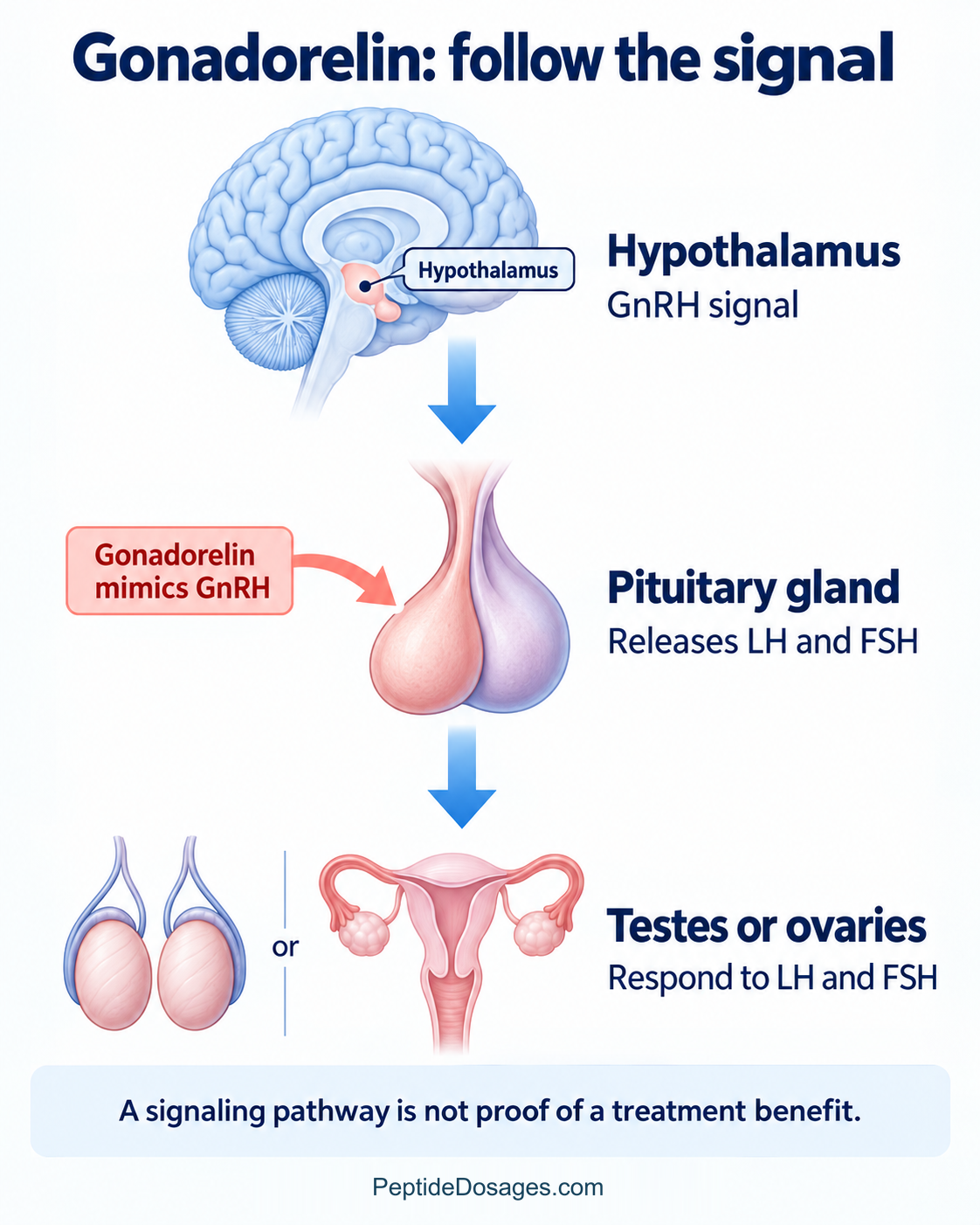
Gonadorelin is “the pituitary’s start signal” for LH/FSH release. Once LH and FSH enter circulation, they act on the gonads (ovaries/testes), influencing ovarian follicle development, ovulation, testosterone production, and spermatogenesis. [1]

Where gonadorelin fits in the hormone hierarchy

The reproductive endocrine chain is often summarized as the HPG axis (hypothalamic–pituitary–gonadal axis):

  • Hypothalamus: releases GnRH in pulses
  • Pituitary (anterior): responds by releasing LH + FSH
  • Gonads: respond by producing sex steroids and supporting gamete production [5]

This “top-down” position is a big reason people look up gonadorelin: it’s upstream enough that it’s often discussed as a way to influence the whole axis rather than only the final step. [6]

Common forms you’ll see on labels

You’ll usually see gonadorelin sold as a salt form, most commonly:

  • Gonadorelin acetate (frequent in clinical pump systems and research vials) [7]
  • Gonadorelin hydrochloride (a labeled active ingredient in at least one UK SmPC listing) [8]

Salt form matters because it affects labeling (mg of “salt” vs mg of “base”), documentation, and sometimes handling details like pH and excipients. [9]

The molecule in one line

In clinical documentation, gonadorelin acetate is described as a synthetic decapeptide with the same amino acid sequence as endogenous GnRH. [10]

That “identical sequence” point is important: gonadorelin is not a trendy “new peptide discovery.” It’s a lab-made version of a foundational neuroendocrine signal. [11]

How It Works

Gonadorelin “works” by binding the GnRH receptor (GnRHR) on pituitary gonadotroph cells and triggering intracellular signaling that results in LH/FSH release. [12]

The plain-English mechanism

When gonadorelin reaches the pituitary, it acts like a doorbell:

  1. Press the button: gonadorelin binds GnRHR at the pituitary. [13]
  2. Signal inside the cell: GnRHR is coupled to Gq/11, activating phospholipase C (PLC) and downstream messengers IP3 and DAG, which raise intracellular calcium. [14]
  3. Hormone release: calcium-linked signaling supports secretion and synthesis processes that lead to LH and FSH release. [15]

If you only remember one functional takeaway: gonadorelin does not “become testosterone.” It tells your pituitary to release the hormones that can drive downstream gonadal hormone production. [16]

Why pulsatility is the headline detail most pages miss

Gonadorelin is tied to one of the most important principles in reproductive endocrinology:

The pituitary responds differently to GnRH depending on exposure pattern—pulses stimulate, while continuous exposure tends to desensitize. [17]

This is not a minor nuance. It’s the reason:

  • Natural GnRH is secreted in pulses. [18]
  • Clinical “replacement” approaches often use programmable pumps designed to mimic pulsing. [19]
  • Many GnRH agonist analogs can end up suppressing gonadotropins when exposure is continuous, because the pituitary becomes less responsive over time. [20]

How fast does it act?

Gonadorelin is considered rapidly hydrolyzed in plasma in at least one UK prescribing summary, with a stated half-life of about 4 minutes. That rapid breakdown is a big reason pulsatile delivery (or carefully structured testing protocols) matter so much in clinical contexts. [21]

Main Uses, Research Interest, or Why People Look It Up

People look up gonadorelin primarily because it’s used (or discussed) as a way to provoke LH/FSH release—either to test the system or to replace missing GnRH signaling in specific clinical situations. [22]

Clinical use concept: diagnostic testing of pituitary response

One well-established context is GnRH stimulation testing, where clinicians administer synthetic GnRH (gonadorelin) and measure LH/FSH response over time to evaluate HPG-axis activation or function. [23]

In pediatric endocrinology, a gonadorelin stimulation test is often referenced as a “gold standard” approach for confirming activation of the HPG axis in suspected central precocious puberty, though availability issues sometimes lead to use of a substitute GnRH agonist for testing. [24]

A practical nuance: these tests are resource-intensive because they typically involve multiple timed blood draws over roughly 90–120 minutes in protocol-driven settings. [25]

Clinical use concept: replacing missing GnRH pulses in GnRH deficiency

Gonadorelin acetate has been marketed and discussed in a “replacement therapy” model for endogenous GnRH deficiency, including infertility contexts in women and men, using an automated injection device (pod/pump). [26]

In Canadian clinical documentation for a gonadorelin acetate pump product, women in studies wore programmable pulsatile infusion pumps for weeks, with dose and pulse frequency set by the investigator—explicitly reflecting the need to reproduce pulsing physiology. [27]

More recent open-access expert commentary on hypothalamic hypogonadotropic hypogonadism describes pulsatile GnRH therapy as pivotal for restoring physiologic cycling and inducing ovulation, noting extensive literature with high ovulation and pregnancy/live birth outcomes and comparatively lower adverse outcome risk profiles than some alternatives. [28]

Male fertility context: hypogonadotropic hypogonadism

In male congenital hypogonadotropic hypogonadism, research comparing a pulsatile gonadorelin pump to cyclical gonadotropin therapy reported earlier median time to spermatogenesis in the pulsatile pump group, with both approaches producing spermatogenesis in a high proportion of participants. [29]

This body of work matters because it reinforces the same theme: the “signal pattern” is not optional when the goal is to replace upstream GnRH physiology. [30]

Why peptide communities talk about it (and where to be cautious)

In peptide enthusiast and “men’s health protocol” circles, gonadorelin is often discussed as a way to “reactivate” the HPG axis because it sits upstream of LH/FSH. That interest is understandable—but it’s also where the biggest misunderstanding happens. [31]

Key distinction: A single injection schedule that does not reproduce a pulsatile pattern may not behave like true “GnRH replacement,” because physiology is pulse-dependent and the molecule is short-acting. [32]

If your goal is educational research, this becomes a “model design” issue: you’re not just choosing a peptide—you’re choosing a signaling pattern. [33]

What to Look For When Evaluating It

Evaluating gonadorelin is mostly about verifying identity, handling reality, and claim-to-evidence fit—because the molecule is short-acting and often misrepresented as if it behaves like longer-acting analogs. [34]

Start with identity: what exactly is in the vial?

At minimum, confirm:

  • Salt form: acetate vs hydrochloride (labeling and documentation should match). [35]
  • Molecular description: clinical documentation describes gonadorelin acetate as a decapeptide matching endogenous GnRH sequence. [10]
  • Basic physical properties: one product monograph explicitly calls gonadorelin acetate hygroscopic and very soluble in water. Hygroscopic peptides can pick up moisture easily, which affects storage and handling. [36]

If a product page can’t clearly state what salt form it is—or the documentation looks copy-pasted across unrelated peptides—that’s a quality signal in the wrong direction. [37]

Don’t skip the “pattern fit” test

Before you evaluate suppliers, evaluate the claim:

If a claim implies long-lasting “axis restoration” from non-pulsatile dosing, ask how that makes sense given rapid hydrolysis and pulse-dependent physiology. [38]

This isn’t cynicism. It’s simply aligning with how the GnRH system behaves:

  • Pulses stimulate gonadotropins. [39]
  • Continuous stimulation is associated with pituitary desensitization and receptor downregulation in GnRH agonist exposure contexts. [40]

So your evaluation should always include: “Is this product being discussed in a way that respects the pulse principle?” [41]

Storage and stability: what reputable labeling actually says

For prescription-only gonadorelin (example UK SmPC), the storage directions are straightforward:

  • Store below a specified temperature (example: below 25°C in one SmPC).
  • After reconstitution, refrigerate and use within a limited time window (example: within 24 hours for one product). [42]

That doesn’t automatically mean every research vial follows the exact same limits (different excipients, concentrations, and sterility assumptions can matter). It does mean you should treat casual “it lasts forever in the fridge” claims with skepticism unless supported by credible documentation. [43]

Safety and risk signals to take seriously

Gonadorelin is not a “side-effect free” peptide just because it’s short.

Examples from prescribing documents include:

  • Hypersensitivity-type reactions (including rare bronchospasm or urticaria in one SmPC listing). [44]
  • Clinical warning context in fertility treatment systems: ovarian hyperstimulation syndrome (OHSS) is explicitly described as a serious risk in consumer-facing pump product labeling, along with cautions around hormone-sensitive tumors and ovarian cysts in that setting. [45]
  • Additional caution notes: one clinical resource warns about a rare GnRH adenoma situation and the possibility that repeated exposure could worsen hormone-dependent tumors due to downstream hormone increases. [46]

Bottom line: educational research discussions should reflect the reality that manipulating the HPG axis can have meaningful downstream effects, and risk depends heavily on context. [46]

Regulatory reality in the U.S.: why the sourcing landscape is confusing

In the U.S., gonadorelin acetate has a history tied to orphan drug approval for ovulation induction in hypothalamic amenorrhea, with a listed marketing approval date in 1989 for a product called Lutrepulse. [47]

Separately, recent FDA documentation about bulk substances for 503B outsourcing facilities includes Gonadorelin Acetate in a category of bulk drug substances under evaluation, with notation indicating it is a component of FDA-approved drugs. [48]

This combination—older approvals, evolving compounding policy, and modern peptide-commerce—creates a market where labels and claims vary widely. For readers, the actionable lesson is to prefer transparent documentation and avoid assuming “available online” means “clinically equivalent.” [49]

A practical decision framework instead of a how-to (the “Pulse Principle” filter)

If your search intent is informational, the most useful “how-to” is a decision process that keeps you on-topic and protects you from common misunderstandings.

Step one: Define the goal in one sentence

A good goal is specific, like “understand what gonadorelin is and how it triggers LH/FSH release,” or “understand why pulsatile delivery is discussed in GnRH-deficiency contexts.” [50]

If your goal is vague (“fix hormones”), you’re more likely to misread what the peptide can realistically do. [46]

Step two: Map the goal to the level of the axis

Gonadorelin is upstream: it acts at the pituitary signaling level, not directly at the gonads. [16]

If a claim sounds like a direct testicular or ovarian stimulant, that’s a signal that the explanation may be skipping steps. [51]

Step three: Apply the Pulse Principle filter

Ask: “Does the discussed use-case account for pulsatile versus continuous exposure?”

This single question resolves a surprising amount of confusion, because continuous exposure is associated with desensitization patterns in the GnRH system, while pulsatile patterns are foundational to physiologic stimulation. [17]

Step four: Confirm product identity and handling constraints

Look for clear labeling of salt form, batch documentation, and handling guidance that aligns with what reputable prescribing documents say about hydrolysis, storage, and reconstitution-limited stability. [52]

Step five: Compare claims to the best-fit evidence

If the claim references ovulation induction in GnRH deficiency, that aligns with documented pumplike replacement approaches. [53]

If the claim implies gonadorelin behaves like long-acting suppressive GnRH agonists, that’s usually a category error (more on that next). [54]

Comparison / Alternatives / Important Distinctions

The most relevant comparison for “What is gonadorelin?” is not a random list of other hormones—it’s the family of GnRH pathway modulators that people commonly confuse with gonadorelin. This matters because different compounds can produce opposite outcomes depending on duration and receptor dynamics. [55]

Gonadorelin vs other GnRH-pathway compounds

Compound/category What it is Typical use pattern Net effect on LH/FSH over time Why this distinction matters
Gonadorelin Synthetic version of native GnRH (decapeptide) Often discussed in testing or pulsatile replacement contexts Stimulates LH/FSH when delivered as pulses Gonadorelin is fundamentally a signal peptide; expectations should match pulse physiology.
GnRH agonist analogs (e.g., triptorelin, leuprolide) Modified agonists with stronger binding and/or longer action than native GnRH Can be used as a single-dose stimulant in testing, but many therapeutic uses rely on long-acting exposure Initial “flare,” then desensitization/downregulation with continued stimulation People often assume “GnRH agonist = more gonadorelin,” but longer exposure can suppress the axis.
GnRH antagonists (e.g., cetrorelix, ganirelix) Receptor blockers (not stimulators) Used when immediate suppression of gonadotropins is desired Blocks LH/FSH release stimulation Helps prevent the common misconception that all GnRH-related compounds “boost” LH/FSH.

[56]

A simple way to remember this table: gonadorelin is the native-like “go” signal—but the endocrine result depends on timing and continuity. [57]

Checklist / Template / Example

Use this checklist to evaluate gonadorelin information and products without getting pulled into off-topic hormone chatter.

Gonadorelin evaluation checklist (copy-ready)

  • Define your goal (testing pituitary response vs modeling GnRH replacement physiology). [58]
  • Confirm the molecule and salt form (acetate vs hydrochloride) from the label and documentation. [59]
  • Check for a pulse-aware explanation (any serious discussion should mention pulsatility). [39]
  • Verify that storage/reconstitution guidance is specific, consistent, and realistic (avoid vague “stable forever” claims). [42]
  • Request a COA with identity and purity methods clearly stated (e.g., mass spec / HPLC listed, not just “99%” marketing). [37]
  • Inspect for moisture risk language when relevant (gonadorelin acetate has been described as hygroscopic in clinical documentation). [60]
  • Separate clinical evidence from community protocol claims (especially for non-pulsatile schedules). [61]
  • Escalate any safety concerns to a qualified clinician if the conversation is about real-world use, fertility, tumors, or pregnancy-related risk. [46]

If you want a practical “math and logistics” example for peptide vial handling, reconstitution conventions, and measurement consistency, you can reference this internal resource: Gonadorelin 2 mg vial dosage protocol. (Educational context only.)

FAQs

What is gonadorelin used for?

What is gonadorelin used for? Gonadorelin is used to provoke LH and FSH release from the pituitary, which makes it useful for evaluating hypothalamic–pituitary function and for specific GnRH-deficiency replacement approaches (often using pulsatile delivery systems). It is also used within GnRH stimulation testing protocols in endocrine settings. [22]

Is gonadorelin the same as GnRH?

Is gonadorelin the same as GnRH? Gonadorelin is a synthetic form designed to match native gonadotropin-releasing hormone (GnRH) signaling, and clinical documentation describes gonadorelin acetate as having the same amino acid sequence as endogenous GnRH. In practice, “gonadorelin” is often used as the drug name for administered GnRH. [62]

Why does gonadorelin need to be “pulsatile” to work as intended?

Why does gonadorelin need to be “pulsatile” to work as intended? The GnRH system is frequency-sensitive: pulsatile GnRH drives gonadotropin release, while continuous stimulation tends to reduce pituitary responsiveness over time (desensitization/downregulation). Because gonadorelin is short-acting and GnRH biology is pattern-dependent, serious replacement models typically account for pulse timing. [17]

How long does gonadorelin last in the body?

How long does gonadorelin last in the body? Gonadorelin is rapidly broken down; one UK prescribing summary notes it is rapidly hydrolyzed and reports a half-life of about four minutes. That short duration is a major reason protocols often focus on timing and repeated pulses rather than expecting one exposure to create a long-lasting effect. [63]

Is it legal to buy gonadorelin online?

Is it legal to buy gonadorelin online? Legal status depends on jurisdiction and product type (prescription medicine, compounded preparation, or “research use only” product). In the U.S., FDA documentation shows gonadorelin acetate appearing in compounding-related bulk substance materials under evaluation, and the FDA orphan drug database lists historical marketing approval for gonadorelin acetate (Lutrepulse). Always verify what category a seller claims and what documentation they provide. [64]

Next Steps

If your main goal was simply answering “what is gonadorelin,” the most important takeaway is this:

Gonadorelin is synthetic GnRH—a short, upstream signal peptide that triggers LH and FSH release, and its outcome depends heavily on pulsatile vs continuous exposure. [65]

If you’re evaluating gonadorelin content online, use the Pulse Principle filter and the checklist above before you trust any “protocol” claims. That approach helps you stay aligned with the real physiology and avoids comparing gonadorelin to unrelated wellness categories. [66]

If you want a practical, beginner-friendly reference for vial handling and dosing math (not medical advice), start with the internal guide on peptidedoses.com: Gonadorelin 2 mg vial dosage protocol.

If you’re specifically looking for a purchase page because you’re comparing availability, here is the external link you provided (use it as a sourcing reference, not as medical guidance): Pure Lab Peptides — Gonadorelin 2 mg.


[1] [2] [3] [6] [16] [22] [31] [46] [50] [62] [65] Gonadorelin (intravenous route, injection route) – Side effects & dosage – Mayo Clinic

https://www.mayoclinic.org/drugs-supplements/gonadorelin-intravenous-route-injection-route/description/drg-20067426

[4] [5] [18] [33] [41] [51] [66] Physiology of GnRH and Gonadotrophin Secretion – Endotext – NCBI Bookshelf

https://www.ncbi.nlm.nih.gov/books/NBK279070/

[7] [9] [10] [11] [19] [27] [35] [36] [37] [45] [59] [60] pdf.hres.ca

https://pdf.hres.ca/dpd_pm/00011278.PDF

[8] [12] [13] [15] [21] [32] [34] [38] [42] [43] [44] [52] [63] Gonadorelin 100 micrograms powder for solution for injection – Summary of Product Characteristics (SmPC) – (emc) | 4853

https://www.medicines.org.uk/emc/product/4853/smpc

[14] KEGG PATHWAY: hsa04912

https://www.kegg.jp/entry/hsa04912?utm_source=chatgpt.com

[17] [39] [57] [61] Hypophysial Responses to Continuous and Intermittent …

https://www.science.org/doi/10.1126/science.100883?utm_source=chatgpt.com

[20] [24] [40] [54] [55] [56] apem :: Annals of Pediatric Endocrinology & Metabolism

https://e-apem.org/m/journal/view.php?number=1035

[23] [25] [58] A Short-Duration Gonadotropin-Releasing Hormone Stimulation Test for the Diagnosis of Central Precocious Puberty

https://www.mdpi.com/1648-9144/60/1/24

[26] [53] Our products – Ferring Global

https://www.ferring.com/science-innovation/our-products/

[28] Management of infertility in women with hypothalamic hypogonadotropic hypogonadism: an expert opinion | Reproductive Biology and Endocrinology | Springer Nature Link

https://link.springer.com/article/10.1186/s12958-026-01535-y

[29] [30] The Pulsatile Gonadorelin Pump Induces Earlier Spermatogenesis Than Cyclical Gonadotropin Therapy in Congenital Hypogonadotropic Hypogonadism Men – Luyao Zhang, Ke Cai, Yu Wang, Wen Ji, Zhen Cheng, Guanming Chen, Zhihong Liao, 2019

https://journals.sagepub.com/doi/10.1177/1557988318818280

[47] [64] Search Orphan Drug Designations and Approvals

https://www.accessdata.fda.gov/scripts/opdlisting/oopd/detailedIndex.cfm?cfgridkey=17086

[48] [49] fda.gov

https://www.fda.gov/media/94164/download