
BPC-157 and TB-500 are often paired in discussions of injury recovery, but a convincing biological story is not the same as a proven treatment. The combination is sometimes called the “Wolverine stack.” Most supporting work concerns individual compounds in cells or animals, not the specific blend sold online.
A small human report examined BPC-157 with thymosin beta-4. Here’s what it can tell us, and why it doesn’t establish that the combination repairs tendons.
What is the BPC-157 and TB-500 blend?
BPC-157 is an experimental peptide investigated in tissue-injury models. TB-500 is a commercial name associated with thymosin beta-4-related material. Exact identity matters: full-length thymosin beta-4 and a fragment are not automatically interchangeable. FDA’s safety listing specifically identifies the LKKTETQ fragment under TB-500.1
A premixed vial contains both ingredients in a fixed ratio. A stack can instead mean two separate vials. Those descriptions tell you how the material is packaged, not whether the combination is effective or compatible in a shared solution.
Why are these peptides paired?
The rationale combines two lines of tissue-repair research. In cultured tendon fibroblasts, BPC-157 increased growth-hormone receptor expression; that finding concerned cells, not improved athletic recovery.2 In a separate rat wound experiment, thymosin beta-4 improved wound closure and related repair measures.3
These observations help explain the interest. They do not demonstrate that combining the peptides produces a larger benefit, that TB-500 products match the experimental material, or that a person with an injury will recover sooner.
What does the human research actually show?
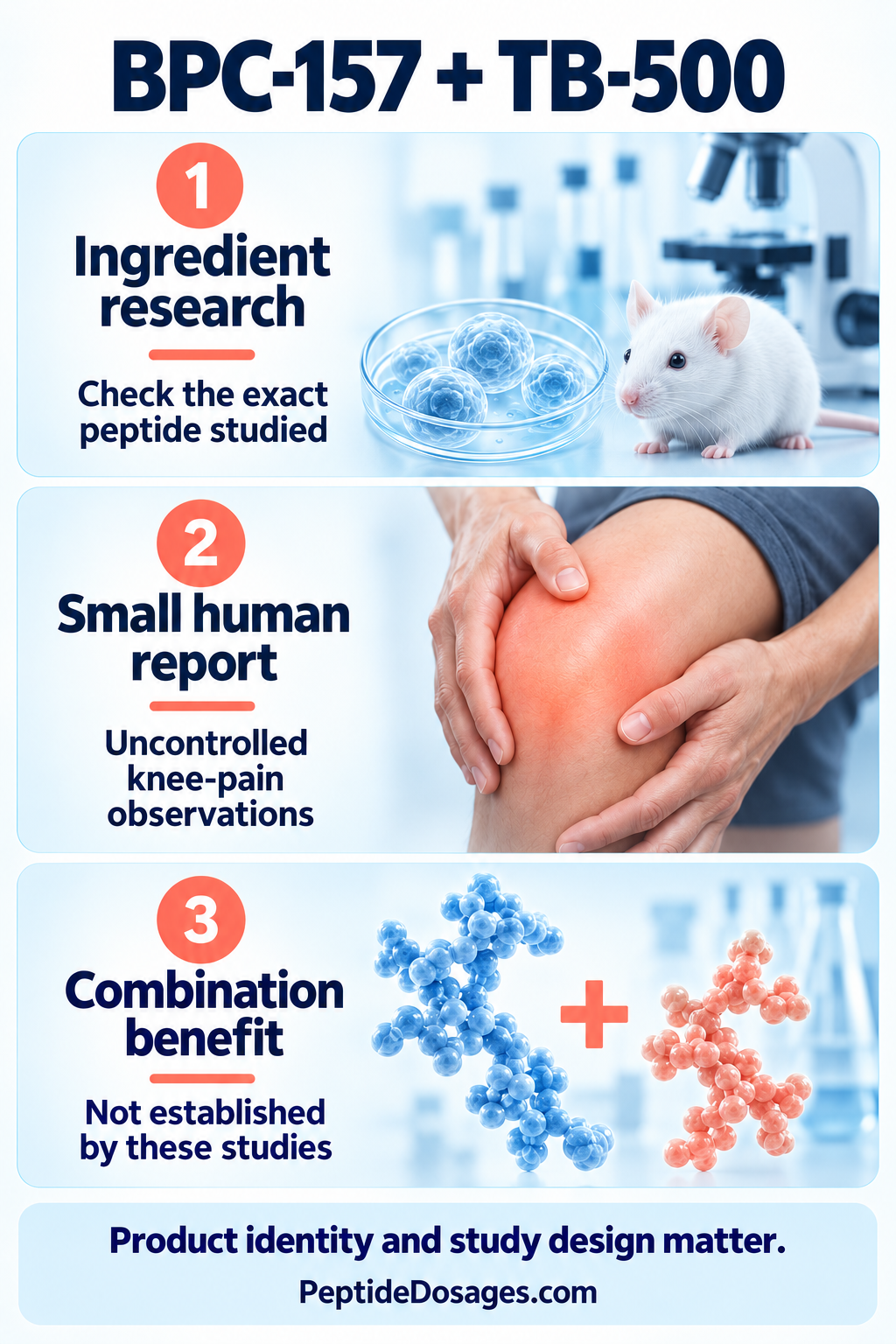
A 2021 retrospective knee-pain report reached 16 patients: 12 had received BPC-157 alone and four had received it with thymosin beta-4. Most reported improvement. However, there was no randomized control group, no standardized functional assessment and no reliable test of whether adding thymosin beta-4 improved the result.4
Self-reported pain relief is relevant, but it does not establish tendon regeneration, cartilage regrowth or a benefit for a different injury. The report also cannot validate every product marketed as BPC-157/TB-500.
| Evidence | What it can tell us | What it cannot establish |
|---|---|---|
| BPC-157 cell experiments | Possible biological pathways | A reliable recovery benefit in people |
| Thymosin beta-4 animal experiments | Effects in defined injury models | Equivalence to every TB-500 product |
| Small retrospective knee report | Patient-reported observations | Combination superiority or tissue regrowth |
Summary of the different research settings, not a ranking of treatment options.2,3,4
Does combining them improve healing?
The evidence reviewed here does not establish that the pair works better than either ingredient, rehabilitation or standard care. A proper comparison would need the same injury type, comparable rehabilitation, defined products and meaningful outcomes such as function or return to activity.
“Synergy” has a specific meaning: the combined effect exceeds what would be expected from the separate effects. Listing two proposed mechanisms is not a demonstration of synergy.
Premixed blend versus separate vials
A fixed-ratio blend links the amounts of its ingredients. Increasing the amount of the blend increases both components together. Separate vials preserve independent concentrations, but do not remove questions about safety or combined exposure.
A blend label gives the total mass, not the mass of each ingredient. For example, a 10 mg blend contains a different quantity from two individual 10 mg vials.
Peptide Dosages keeps the 10 mg blend reference, 20 mg blend reference and separate-vial stack reference distinct. Preparation arithmetic does not validate a treatment schedule.
Side effects and unresolved safety questions
FDA flags limited human safety information and possible immune or impurity-related risks for BPC-157 and the TB-500 fragment.1 The available studies do not establish long-term combination safety.
Reported tolerability in a small group cannot rule out uncommon harm. Product testing also needs context: identity, purity, sterility and endotoxin testing answer different questions. A purity percentage alone is not clinical safety evidence.
Persistent pain, loss of function or a worsening injury should be assessed by a qualified clinician. An experimental peptide should not delay diagnosis or replace a rehabilitation plan.
Frequently asked questions
How long does BPC-157 with TB-500 take to work?
No dependable timeline is established for this combination. Injury severity, natural recovery and other treatments make personal reports difficult to interpret.
Does the blend affect testosterone or the liver?
The cited combination evidence does not answer those questions reliably. It would be misleading to promise hormonal neutrality or liver protection from these studies.
Is there an established dosage?
These sources do not establish a generally applicable clinical dosage for a BPC-157/TB-500 blend. Animal quantities, seller schedules and a small uncontrolled report should not be treated as interchangeable dosing evidence.
References
- FDA. Bulk drug substances that may present significant safety risks.
- BPC-157 and growth-hormone receptor expression in tendon fibroblasts. 2014.
- Malinda KM, et al. Thymosin beta-4 in an experimental wound-healing model. 1999.
- Lee E, Padgett B. Intra-articular BPC-157, alone or with thymosin beta-4, for knee pain. 2021.