
Teriparatide is a prescription bone-building medicine for osteoporosis. Forteo is one brand. It is used for selected people at high fracture risk, including postmenopausal women, men with certain forms of osteoporosis and adults with glucocorticoid-associated osteoporosis.1
Teriparatide has randomized trials that measured fractures, not just laboratory markers. To understand the results, look at who took part, which treatment it was compared with, and how it fits into longer-term bone care.
What is teriparatide?
Teriparatide is the active 34-amino-acid portion of human parathyroid hormone, often written PTH(1–34). Its intermittent administration stimulates bone formation.1 “Anabolic” means bone-building in this context, not an anabolic steroid or a sports-performance claim.
Some osteoporosis medicines mainly slow bone breakdown; teriparatide stimulates bone formation. That difference helps explain why a clinician might consider it for someone with substantial fracture risk. The medicines aren’t interchangeable. 4
What benefits are supported by clinical trials?
The original fracture-prevention trial
A randomized study of 1,637 postmenopausal women with prior vertebral fractures compared PTH(1–34) with placebo. Median follow-up was 21 months. New vertebral fractures occurred in 14% with placebo and 5% in the 20-microgram group; nonvertebral fragility fractures occurred in 6% and 3%, respectively.2
That is a nine-percentage-point absolute difference for vertebral fractures, not a guarantee that a particular person will avoid a fracture. The participants already had vertebral fractures, so this is not evidence for indiscriminate preventive use in healthy adults.
VERO: comparison with an active treatment
VERO compared teriparatide with risedronate in 1,360 postmenopausal women with severe osteoporosis. At 24 months, new vertebral fractures occurred in 5.4% of evaluable participants receiving teriparatide versus 12.0% receiving risedronate. Clinical fractures occurred in 4.8% versus 9.8%.3
| Trial comparison | New vertebral fractures | What to remember |
|---|---|---|
| PTH(1–34) 20 micrograms versus placebo | 5% versus 14% | Women with existing vertebral fractures; median 21 months |
| Teriparatide versus risedronate in VERO | 5.4% versus 12.0% | Women with severe osteoporosis; 24 months |
Different trials, populations and comparison groups. These figures should not be pooled into a personal risk prediction.2,3
VERO’s nonvertebral fragility-fracture result did not reach statistical significance. Reporting that alongside the positive vertebral result gives a more useful picture than claiming every fracture outcome improved equally.3
Who might be considered for treatment?
Professional guidance identifies teriparatide as an option for postmenopausal women at very high fracture risk, including those with severe or multiple vertebral fractures.4 A prescription decision should consider the whole clinical picture, not a single scan number or the presence of the word “peptide.”
Before an appointment, it helps to gather previous bone-density reports, fracture dates, past osteoporosis treatments and a current medication list. If injections, storage or cost could make treatment difficult, raise those issues before starting. A plan that cannot be followed consistently needs attention, however strong the trial result looks.
Teriparatide dosage and the two-year question
The current U.S. Forteo label specifies 20 micrograms once daily by subcutaneous injection. This describes the approved product, not a conversion guide for research vials. Treatment beyond two years is considered only when a person remains at, or returns to, high fracture risk.1
That last point is easily missed in older summaries that present two years as an absolute lifetime prohibition. Longer use is not routine permission to continue indefinitely; it is a clinician-led reassessment of risk.
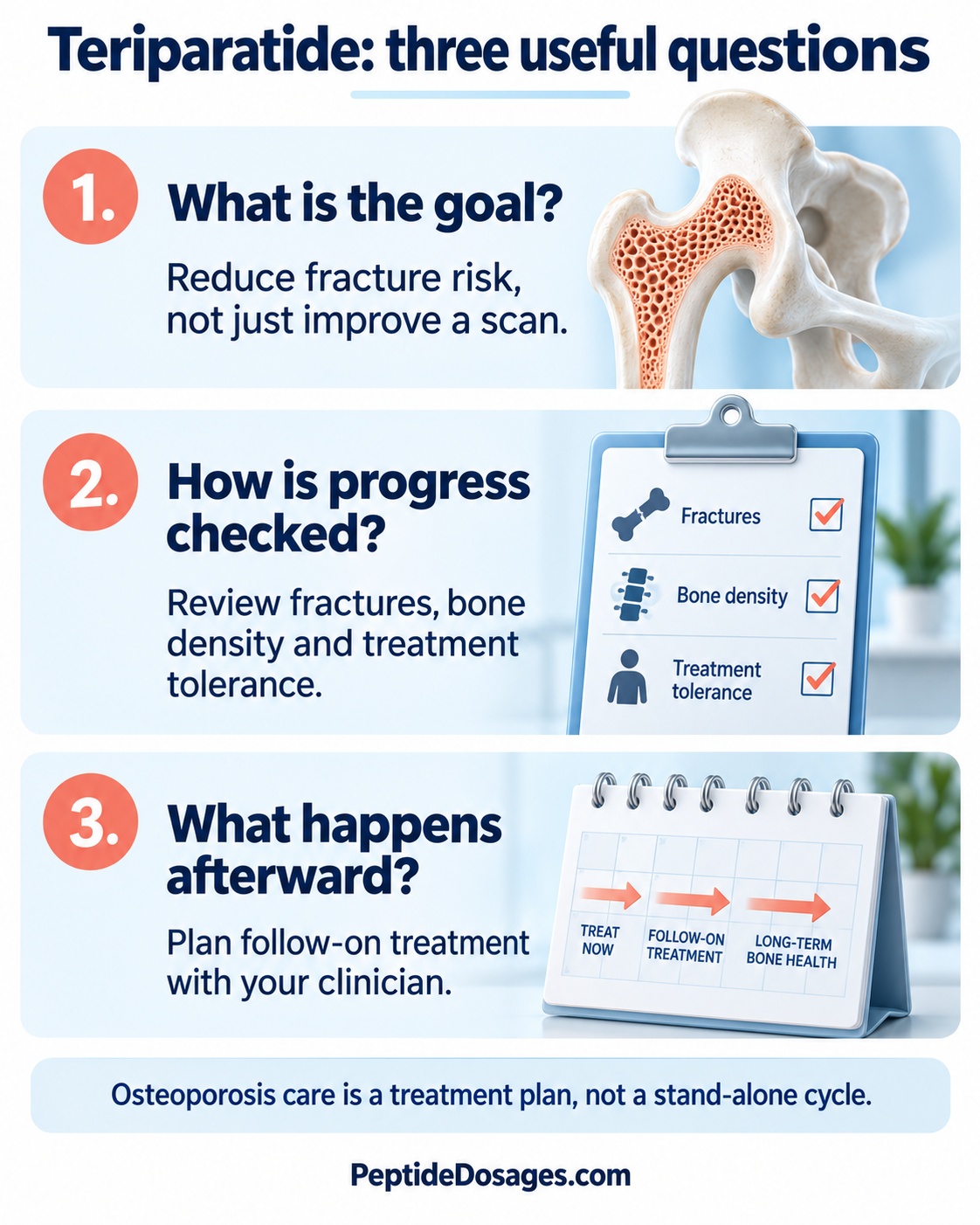
After completing teriparatide, the Endocrine Society recommends antiresorptive treatment to preserve bone-density gains in postmenopausal women.4 Ask about that transition early rather than waiting until the final pen is empty.
Side effects, warnings and interactions
Nausea, pain, dizziness and leg cramps can occur. Lightheadedness on standing may be a problem around early doses. Review troublesome or persistent symptoms with the prescriber, and seek urgent help for breathing difficulty or swelling of the face or throat.5
Tell the clinician about kidney stones, calcium disorders, kidney disease, bone cancer, radiation involving bone, pregnancy or breastfeeding, and all medicines and supplements. These details affect whether treatment is appropriate.5
Forteo’s label warns about osteosarcoma risk factors, hypercalcemia, serious skin calcification and potential digoxin toxicity related to increased calcium. Rat studies found osteosarcoma; observational human studies have not shown an increased risk, but long-duration data remain limited.1
Absence of a detected increase is not proof of zero risk. It also does not mean every person should avoid treatment: the relevant decision weighs the person’s fracture risk against the medicine’s risks.
Storage and practical use
Teriparatide comes as a prefilled liquid pen. Learn its use from a health professional, use a new needle for each injection and never share the pen. MedlinePlus advises refrigerated storage without freezing, and disposal of an opened pen after 28 days even if some liquid remains.5
Always check the exact instructions for the product dispensed to you, particularly when switching brands. Prescription pens should not be treated as interchangeable with the site’s Teriparatide 750 mcg research-vial reference.
Frequently asked questions
Is teriparatide a hormone?
It is a manufactured version of the active fragment of parathyroid hormone. The treatment uses that signaling pathway to stimulate bone formation.1
Is it the same as abaloparatide?
No. They are distinct bone-building medicines. Clinical guidance discusses them together as treatment options, but that does not make their products, doses or treatment histories interchangeable.4
Does a better scan mean I can stop?
Not without discussing the next step. A scan is one measure of response. Follow-up also considers fractures, tolerability and how to maintain the gain after treatment.4
Can trial results tell me which osteoporosis medicine is best?
They help, but population matters. VERO studied severe osteoporosis in postmenopausal women. Its findings support that particular comparison, not a universal ranking of every medicine for every patient.3
Related Teriparatide dosage protocols
Continue with the vial-strength-specific research protocol that matches the material being evaluated. Each page keeps its own concentration, reconstitution, and syringe-unit calculations.
Practical measurement and handling guides
References
- DailyMed. Forteo prescribing information. Revised August 2026.
- Neer RM, et al. Effect of Parathyroid Hormone (1–34) on Fractures and Bone Mineral Density in Postmenopausal Women with Osteoporosis. New England Journal of Medicine. 2001.
- Kendler DL, et al. Effects of teriparatide and risedronate on new fractures in post-menopausal women with severe osteoporosis (VERO). Lancet. 2018.
- Endocrine Society. Pharmacological Management of Osteoporosis in Postmenopausal Women. Clinical practice guideline resources.
- MedlinePlus / ASHP. Teriparatide injection: patient medication information.