
On this page
- Quick reference
- Dosage chart and four steps
- Supplies needed
- Peptide Reconstitution Simulator
- Vial and research context
- 5-Amino-1MQ 50 mg Vial Calculator
- 5-Amino-1MQ Dose and Research Boundary
- Storage and Handling
- What Is 5-Amino-1MQ?
- How 5-Amino-1MQ Works: NNMT Inhibition
- Preclinical Effects on Fat Cells and Body Composition
- 5-Amino-1MQ Injection and Animal Pharmacokinetics
- Benefits of 5-Amino-1MQ: Human Clinical Trials and Safety Limits
- General Subcutaneous Research-Handling Principles
- 5-Amino-1MQ Dosage Frequently Asked Questions
- References
- Related research, protocols, and guides
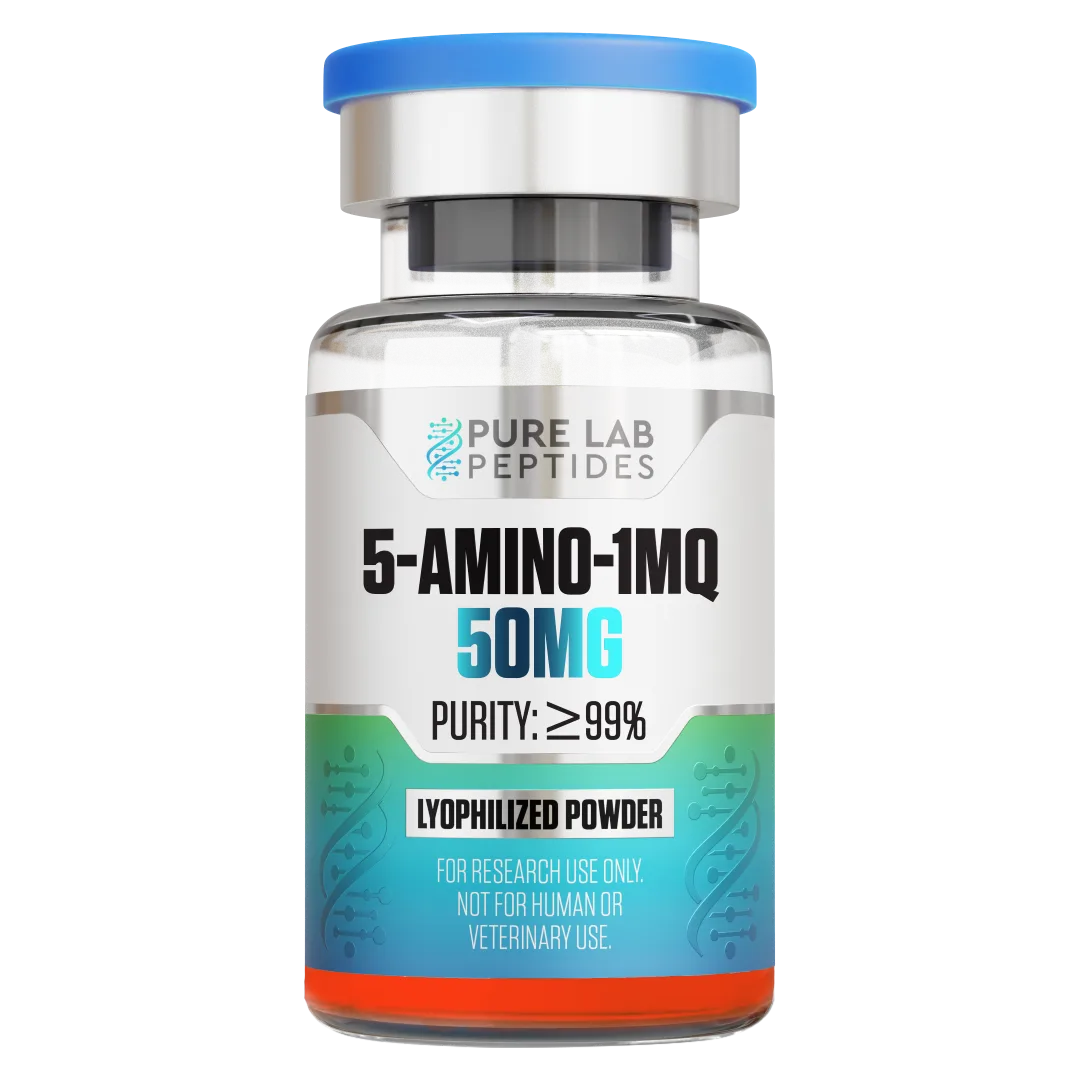
5-Amino-1MQ Quick Reference (50 mg Vial)
- Vial contents
- 50 mg 5-Amino-1MQ
- Final volume
- 4 mL
- Concentration
- 12.5 mg/mL
- One U-100 unit
- 125 mcg in 0.01 mL
Research context: For evidence on mechanisms, human and preclinical research, limitations, and safety, read 5-Amino-1MQ Peptide: Benefits, Uses, Side Effects, Dosage, and Research.
5-Amino-1MQ Dosage Chart
Dosing & Reconstitution Guide
Educational guide for reconstitution and daily dosing
Subcutaneous Protocol (4 mL = 12.5 mg/mL)
| Phase | Daily Dose (mg) | Units (per injection) (mL) |
|---|---|---|
| Days 1–2 (Tolerance) | 2.5 mg once daily | 20 units (0.20 mL) |
| Days 3+ (Standard) | 5 mg once daily | 40 units (0.40 mL) |
| Alternative BID | 2.5 mg twice daily | 20 units (0.20 mL) × 2 |
Frequency: Inject once or twice daily subcutaneously. Due to the compound’s plasma half-life of approximately 3.8–6.9 hours[4], twice-daily (BID) dosing may provide more sustained NNMT inhibition. A single 50 mg vial provides 10–20 days of research material at these doses.
Reconstitution Steps
- Remove the vial from freezer storage (−20 °C / −4 °F) and allow to equilibrate at room temperature for 15–20 minutes.
- Draw 4.0 mL bacteriostatic water with a sterile syringe.
- Inject slowly down the vial wall; avoid foaming.
- Gently swirl/roll until dissolved - solution should be clear (do not shake). Label and refrigerate at 2–8 °C (35.6–46.4 °F), protected from light; follow the exact formulation’s validated use-by period.
Supplies Needed
Plan based on research duration using the 50 mg vial format at 5 mg/day.
- 5-Amino-1MQ Vials (50 mg each):
- 1 week (5 mg/day): approximately 1 vial required
- 2 weeks (5 mg/day): approximately 1 vial required
- 4 weeks (5 mg/day): approximately 2 vials required
- Insulin Syringes (U-100):
- Per week (once daily): 7 syringes
- Per week (BID): 14 syringes
- 4 weeks (once daily): 28 syringes
- Bacteriostatic Water (10 mL bottles): Use 4.0 mL per vial for reconstitution.
- 1 week (1 vial): 4 mL - 1 bottle required (10 mL each)
- 2 weeks (1 vial): 4 mL - 1 bottle required (10 mL each)
- 4 weeks (2 vials): 8 mL - 1 bottle required (10 mL each)
- Alcohol Swabs: One for the vial stopper + one for the injection site each administration.
- Per week (once daily): 14 swabs
- 4 weeks (once daily): 56 swabs - 1 box required (100 swabs each)


Peptide Reconstitution Simulator
Practice preparing this vial with the verified strength and final volume from this protocol.
5-Amino-1MQ Vial and Research Context
- Reconstitute: Add 4.0 mL bacteriostatic water → 12.5 mg/mL concentration.
- Typical daily range: 2.5–5 mg once or twice daily (subcutaneous).
- Easy measuring: At 12.5 mg/mL, 1 unit = 0.01 mL = 0.125 mg (125 mcg) on a U-100 insulin syringe.
- Storage: Lyophilized: freeze at −20 °C (−4 °F); after reconstitution, refrigerate at 2–8 °C (35.6–46.4 °F) and follow the exact formulation’s validated use-by period.
5-Amino-1MQ, or 5-amino-1-methylquinolinium, is a selective small-molecule inhibitor of nicotinamide N-methyltransferase (NNMT). Published dosage research is preclinical; animal studies and rat pharmacokinetic work do not establish a human dose, clinical benefit, or safety profile.[1][3]
5-Amino-1MQ 50 mg Vial Calculator
This 50 mg vial is mixed to the concentration shown in the dosage and reconstitution chart above. The chart keeps peptide mass, U-100 syringe markings, milliliters, and frequency in the same row so the arithmetic can be read without a separate calculator.
- Vial strength: 50 mg of 5-Amino-1MQ.
- Final volume: 4.0 mL after reconstitution.
- Concentration: 12.5 mg/mL.
- U-100 conversion: 1 unit equals 0.01 mL, or 0.125 mg at this concentration.
5-Amino-1MQ Dose and Research Boundary
5-Amino-1MQ is an investigational small molecule that targets NNMT, not an approved medicine. Published work is preclinical and does not establish a human dose, treatment duration, route, safety profile, or expected result. The calculations on this page explain the existing research schedule; they do not convert animal findings into a human recommendation.
Storage and Handling
Keep the unopened and reconstituted material under the product-specific conditions stated above. Label the vial with the preparation date and concentration, protect it from light, and follow the supplier’s lot documentation for any discard date. The linked Pure Lab Peptides page is included for product provenance, not as scientific evidence.[12]
What Is 5-Amino-1MQ?
5-Amino-1MQ, or 5-amino-1-methylquinolinium, is a research compound designed to inhibit nicotinamide N-methyltransferase (NNMT). Although it is often described online as a peptide, its published chemistry identifies it as a selective, membrane-permeable small molecule. NNMT is an enzyme that methylates nicotinamide and participates in metabolic regulation, methyl-donor balance, and cellular energy pathways.[1][6]
Interest in this compound comes largely from animal studies of obesity and metabolic dysfunction. Those studies can explain why blocking NNMT is being investigated, but they cannot supply a validated human guide. No completed human clinical trials have established an approved dose, route and schedule, oral-capsule schedule, or therapeutic benefit.
How 5-Amino-1MQ Works: NNMT Inhibition
Nicotinamide N-methyltransferase transfers a methyl group to nicotinamide. In animal models, elevated NNMT activity has been associated with adipose-tissue energy handling, glucose regulation, and obesity-related changes. The 5-Amino-1MQ molecule was developed as a selective compound that can enter cells and reduce that enzyme activity.[7][8]
Researchers have proposed that NNMT inhibition may preserve nicotinamide and influence NAD-related metabolism, methyl-donor availability, mitochondrial function, and energy expenditure. These are mechanistic hypotheses supported to different degrees by cell and animal experiments; they are not proof that 5-Amino-1MQ increases energy, produces fat loss, or improves insulin sensitivity in people.
NNMT knockdown produced metabolic effects in mouse models before 5-Amino-1MQ was studied as a selective compound. That earlier work helps define the target, while also underscoring that an effect from gene knockdown is not automatically the same as the effect, safety, or dosing of a research compound.[9]
Preclinical Effects on Fat Cells and Body Composition
The principal 5-Amino-1MQ study used diet-induced obese mice. Investigators reported changes in body weight, fat mass, adipocyte size, metabolic markers, and liver-related measures after repeated administration. The work also evaluated cellular target engagement and found results consistent with NNMT inhibition.[1]
A later mouse study examined once-daily administration over 28 days and reported changes in body composition, glucose-related measures, plasma lipids, liver features, and tissue NNMT activity. These findings make the compound relevant to obesity research, but the experiment remained animal-based and did not determine a human dose or clinical outcome.[2]
Additional diet-induced-obesity experiments paired NNMT inhibition with a reduced-calorie diet. They reported body-composition differences, and a related paper evaluated changes in the gut microbiome.[4][5] These studies do not show that 5-Amino-1MQ itself causes appetite suppression. In the original mouse work, changes were discussed without a reduction in food intake, which is different from the appetite mechanism of incretin-receptor drugs.
Terms such as fat oxidation, visceral fat, white adipose tissue, and improved insulin sensitivity therefore belong in a description of the research questions - not in a promise of results. Mouse outcomes cannot predict the magnitude, timing, or safety of effects in humans.
5-Amino-1MQ Injection and Animal Pharmacokinetics
A validated LC-MS/MS assay was used to study the compound’s pharmacokinetics and oral bioavailability in rats.[3] That paper is useful for identifying animal exposure and analytical methods, but it does not establish a human half-life, oral-capsule dose, subcutaneous amount, or dosing interval.
Route matters because oral and injected exposure can differ. A milligram amount from an animal study cannot be copied into a human research schedule by simple body-weight conversion. Species differences, formulation, absorption, distribution, metabolism, elimination, and study purpose all affect interpretation.
The primary chart on this page is a transparent vial-calculation reference. It explains how the existing schedule maps to a 50 mg vial and a U-100 syringe; it is not a pharmacokinetic model and does not claim that the displayed research schedule was validated in a clinical trial.
Benefits of 5-Amino-1MQ: Human Clinical Trials and Safety Limits
No peer-reviewed human clinical trials were identified that establish 5-Amino-1MQ benefits, an effective dose, a maximum tolerated dose, long-term safety, or a standard cycle. The absence of human evidence means online claims about predictable fat loss, lean-mass preservation, stacking, or side effects should not be treated as established facts.
- Unknown human pharmacology: Animal exposure does not define human absorption, distribution, metabolism, or elimination.
- Unknown interaction profile: There is no clinical evidence establishing compatibility with metabolic drugs, stimulants, supplements, or other research compounds.
- Unknown long-term effects: NNMT participates in multiple tissues and pathways; selective inhibition may have consequences not captured by short animal studies.
- Product-specific variables: Purity, formulation, sterility, storage, and batch documentation can affect research interpretation.
These limitations are why this page separates vial math from evidence. The chart helps interpret concentration and syringe volume without presenting the schedule as medical advice, a validated standard, or a recommendation for human use.
General Subcutaneous Research-Handling Principles
General subcutaneous injection literature emphasizes aseptic preparation, appropriate equipment, consistent technique, site rotation, and safe sharps disposal.[10][11] These sources describe administration practice broadly; they do not validate this compound for human use.
- Use a clean work area and a new sterile syringe for every administration.
- Disinfect vial stoppers and allow the antiseptic to dry.
- Record the vial concentration, preparation date, syringe volume, and research observation.
- Place used needles immediately into an appropriate sharps container.
5-Amino-1MQ Dosage Frequently Asked Questions
How is the 50 mg vial concentration calculated?
Dividing 50 mg by the 4.0 mL final volume gives 12.5 mg/mL. On a U-100 syringe, 1 unit is 0.01 mL, so each unit contains 0.125 mg at this concentration. The chart above applies that math to every displayed row.
Is there an established human 5-Amino-1MQ dose?
No. The published evidence cited here is animal-based. Those studies and rat pharmacokinetic work do not establish a human dose, clinical benefit, treatment duration, or safety profile.
Is 5-Amino-1MQ a peptide?
No. Despite the common search phrase “5-Amino-1MQ peptide,” published chemistry describes it as a small molecule that targets NNMT.
Is 5-Amino-1MQ a GLP-1 agonist?
No. It targets NNMT in experimental models, whereas GLP-1 agonists act through a different receptor. There is no clinical-trial evidence establishing a combined-use guide, interaction profile, or combined amount.
What is the difference between the 50 mg and 10 mg pages?
They describe the same research compound at different vial strengths. The vial amount changes the concentration, syringe-unit conversion, vial yield, and supply calculations, so each strength requires its own chart even when the compound-level evidence overlaps.
References
- 1Neelakantan et al. (2018) - Selective and membrane-permeable small-molecule inhibitors of NNMT reverse high-fat-diet-induced obesity in mice.
- 2International Journal of Molecular Sciences (2024) - NNMT inhibition mitigates obesity-related metabolic dysfunctions in mice.
- 3Awosemo et al. (2021) - LC-MS/MS assay, pharmacokinetics, and oral bioavailability of the compound in rats.
- 4Combined NNMT inhibition and reduced-calorie diet (2021) - Body-composition and metabolic findings in obese mice.
- 5Scientific Reports (2022) - Reduced-calorie diet plus NNMT inhibition and the gut microbiome in diet-induced-obese mice.
- 6Roles of NNMT in obesity and type 2 diabetes (2021) - Review of metabolic mechanisms and evidence.
- 7NNMT mechanisms and targeted compounds (2021) - Review of enzyme biology and drug development.
- 8NNMT as an emerging therapeutic target (2021) - Review of disease biology and drug-development questions.
- 9Nature Medicine (2014) - NNMT knockdown protects against diet-induced obesity in mice.
- 10Subcutaneous drug-administration review - Pharmacologic and practical considerations for the subcutaneous route.
- 11WHO/NCBI Bookshelf - General best practices for administration and related procedures.
- 12Pure Lab Peptides - 5-Amino-1MQ product page and batch-documentation destination.
Related research, protocols, and guides
Explore the available research context, protocol variants or comparisons, and practical guides. When vial-strength variants exist, they remain separate because vial strength, concentration, and syringe-unit calculations can differ. Related compounds and blends are comparisons only, not interchangeable.
Research overview
Other vial-strength protocols