
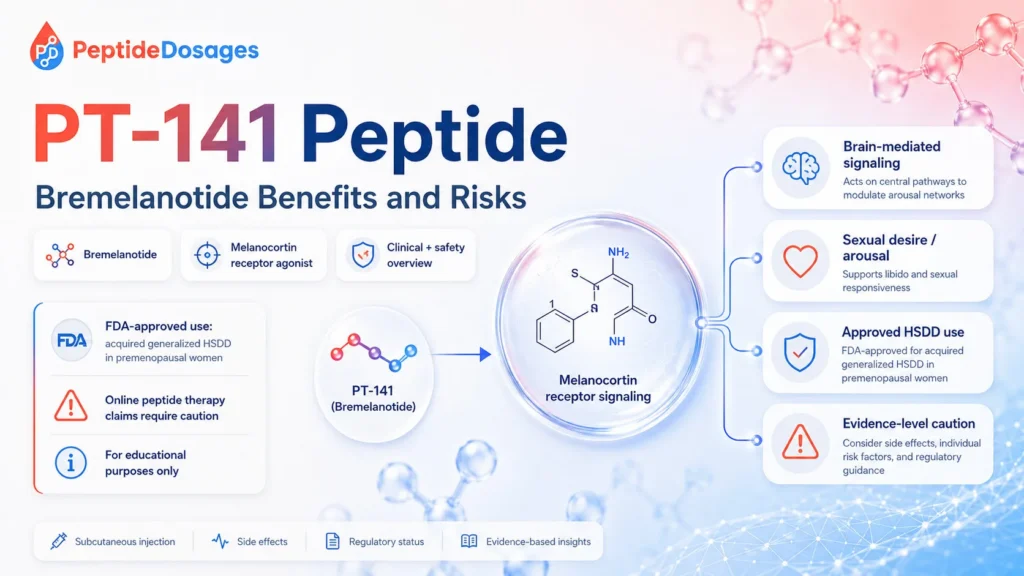
PT-141 Peptide: Benefits, Uses, Side Effects, Dosage, and Research
PT-141 peptide is the common search name for bremelanotide, a melanocortin receptor agonist medication approved in the United States for certain premenopausal women with acquired, generalized hypoactive sexual desire disorder, or HSDD 1. This educational article explains how PT-141 is studied, what the evidence says about libido and sexual desire, and why approved use should be separated from online peptide therapy claims. It does not provide personal dosing, injection, or treatment advice.
- PT-141 is bremelanotide, a synthetic peptide and melanocortin receptor agonist used in an approved prescription product for a narrow HSDD indication [1].
- The strongest evidence is for premenopausal women with acquired, generalized HSDD, not for all forms of low libido, relationship-related desire concerns, postmenopausal women, or men 2.
- PT-141 works through melanocortin receptors in the brain, although the exact pathway by which bremelanotide improves sexual desire is not fully established [1].
- Potential benefits relate mainly to sexual desire and distress outcomes in clinical trials, not guaranteed arousal, sexual performance, or sexual satisfaction for every person 3.
- Common side effects include nausea, flushing, injection-site reactions, headache, and vomiting, with label warnings for transient blood pressure increases and heart rate decreases [1].
- Dosage information should be interpreted from approved labeling or study protocols only, not as personal medical advice; the approved label includes frequency limits and stopping rules [1].
- Regulatory status matters: approved bremelanotide is different from compounded, unapproved, or online “research peptide” products that may not have the same quality or safety oversight 4.
Related dosage pages: For vial-specific concentration, reconstitution, and measurement examples, see PT-141 (10 mg Vial) Dosage Protocol. Each linked protocol remains a separate reference because vial strength changes concentration and syringe-unit calculations.
Fast Answer
PT-141 peptide is bremelanotide, a synthetic melanocortin receptor agonist approved by the FDA as Vyleesi for acquired, generalized HSDD in premenopausal women under specific label limits [1]. People often search for it for libido, sexual desire, arousal, and sexual dysfunction questions, but the evidence is strongest only for its approved HSDD context [2]. Safety issues include nausea, blood pressure effects, contraindications, drug interactions, and the need to distinguish approved medication from unsupported peptide therapy claims [1].
What Is the PT-141 Peptide?
PT-141 is another name for bremelanotide, a synthetic peptide drug developed from melanocortin biology and used as the active ingredient in the FDA-approved product Vyleesi [1]. It is discussed in sexual and reproductive health because melanocortin signaling is involved in parts of the human sexual response cycle, including desire and arousal pathways in the nervous system [1].
The FDA-approved indication is narrow: bremelanotide is approved for acquired, generalized HSDD in premenopausal women when the low sexual desire is not due to a coexisting medical or psychiatric condition, relationship problems, or the effects of medication or another drug substance [1]. The label also states that it is not indicated for postmenopausal women or men and is not indicated to enhance sexual performance [1].
What Makes PT-141 a Synthetic Peptide Called Bremelanotide?
PT-141 is a synthetic peptide, and bremelanotide is the nonproprietary drug name used in medical labeling and scientific databases 5. PubChem identifies bremelanotide as a defined chemical compound, while FDA labeling describes it as the active drug substance in a regulated prescription product 5.
In medical writing, “bremelanotide” is usually the more precise term when discussing approved prescribing information, adverse reactions, contraindications, and dosage. “PT-141 peptide” is common in search behavior and online peptide therapy discussions, but it should not be used to imply that every product advertised as PT-141 is equivalent to the FDA-approved drug.
How Is Approved Bremelanotide Different From Online PT-141 Therapy Claims?
Approved bremelanotide has been reviewed for a specific indication, formulation, manufacturing controls, prescribing information, and labeled safety warnings 14. Online PT-141 therapy claims may use broader language about libido in both men and women, sexual performance, or general “peptide therapy,” but those claims may not match FDA-approved labeling or clinical-trial populations.
This difference matters because regulatory approval does not apply to every possible use, dose, route, compounded product, or internet-sourced peptide. FDA materials on compounding also explain that compounded drugs are not FDA-approved, meaning FDA does not verify their safety, effectiveness, or manufacturing quality before marketing [4].
What Do Libido, Sexual Desire, Arousal, and Sexual Dysfunction Mean?
Libido is a general term for sexual desire, while HSDD is a clinical diagnosis involving persistently low sexual desire and associated personal distress 6. Arousal is related but distinct; it may involve subjective excitement, genital response, lubrication, erection, or other elements of sexual function depending on the person and clinical context [6].
The FDA-approved bremelanotide indication focuses on desire disorder in premenopausal women, not every type of sexual dysfunction [1]. That distinction is important because erectile dysfunction, arousal disorder, orgasm concerns, pain disorders, menopause-related sexual symptoms, hormone-related libido changes, and relationship-related concerns may have different causes and treatments [6].
How Does PT-141 Peptide Work?
PT-141 works differently from drugs that primarily affect genital blood flow. Bremelanotide is described in prescribing information as a melanocortin receptor agonist, but the precise mechanism by which it improves HSDD symptoms is unknown [1].
In plain language, PT-141 targets signaling systems in the brain rather than acting only on local vascular pathways. This central mechanism is one reason it is often discussed separately from phosphodiesterase type 5 inhibitors such as sildenafil or tadalafil, which are approved for erectile dysfunction and act through nitric oxide–cyclic GMP pathways in penile vascular tissue 7.
How PT-141 Targets Melanocortin Receptors in the Brain
Bremelanotide binds to melanocortin receptors, a receptor family involved in several physiologic processes, including pigmentation, energy balance, and aspects of sexual behavior 8. The FDA label states that bremelanotide is a melanocortin receptor agonist and that the mechanism for HSDD benefit is unknown [1].
The phrase “melanocortin receptors in the brain” is often used because central nervous system melanocortin pathways have been studied in relation to sexual behavior. However, receptor activity does not automatically predict a clinical benefit for every person or every type of sexual dysfunction.
How Melanocortin Signaling May Influence Desire and Arousal
Melanocortin signaling may interact with neural circuits involved in desire, reward, autonomic response, and sexual arousal 8. Dopamine and other neurotransmitter systems are also involved in sexual motivation, but bremelanotide’s clinical label does not define a single proven pathway that explains response in all patients [1].
The effect of PT-141 should therefore be described as biologically plausible and clinically studied in a specific population, not as a universal “peptide that works” for libido. Mechanism explains why a drug might have an effect; trials and labeling determine what can be claimed clinically.
Why Central Nervous System Effects Differ From Blood Flow Drugs
Sildenafil and tadalafil improve erectile function by enhancing nitric oxide–mediated vasodilation in erectile tissue, which is a hemodynamic mechanism 7, 12. Bremelanotide, by contrast, is not approved as a blood-flow drug and is not indicated to enhance sexual performance [1].
This distinction is especially relevant for people comparing PT-141 for men with ED drugs. Erectile dysfunction may involve vascular, neurologic, hormonal, medication-related, or psychological factors, and a central desire pathway is not the same as a treatment pathway for erection physiology 9.
What Is PT-141 Peptide Used For?
The approved medical use of PT-141 is narrower than many online discussions suggest. FDA-approved bremelanotide is used for acquired, generalized HSDD in premenopausal women, with specific exclusions in the label [1].
Other uses, including PT-141 for men, erectile dysfunction, postmenopausal low libido, general arousal concerns, and sexual performance claims, should be treated as off-label, investigational, or unsupported depending on the specific claim and evidence source.
FDA-Approved Use in Premenopausal Women With HSDD
The Food and Drug Administration approved bremelanotide in 2019 for acquired, generalized HSDD in premenopausal women [2]. The label defines acquired HSDD as HSDD that developed in a person who previously had no problems with sexual desire, and generalized HSDD as low desire regardless of activity type, situation, or partner [1].
The label also excludes HSDD caused by a coexisting medical or psychiatric condition, relationship problems, or the effects of medication or a drug substance [1]. That means a person’s symptoms require clinical evaluation rather than assuming that a libido concern fits the approved indication.
Off-Label Interest in PT-141 for Men
PT-141 for men is a common search topic, especially in connection with erectile dysfunction and libido in both men and women. However, the approved label states bremelanotide is not indicated for use in men [1].
Earlier human research explored melanocortin agonists and erectile response, but that does not create an approved indication for dysfunction in men [8]. Off-label use should be discussed only in a clinician-guided context that considers diagnosis, cardiovascular risk, current medications, and approved alternatives.
Uses That Remain Investigational or Unsupported
Claims about PT-141 peptide therapy for broad sexual performance, relationship-related low libido, menopause-related sexual concerns, or general sexual satisfaction often go beyond approved labeling. Some of these topics have clinical or mechanistic relevance, but evidence quality varies and may not support broad therapeutic claims.
Unsupported claims should be separated from approved medical use. A claim can be biologically plausible, popular online, or reported anecdotally without being established as safe and effective in high-quality clinical trials.
Potential Benefits of PT-141 Peptide
The potential benefits of PT-141 peptide are best discussed by evidence level. The strongest claim is not that it improves every aspect of sexual health, but that approved bremelanotide has shown benefit on certain HSDD-related outcomes in premenopausal women studied in clinical trials [3].
The FDA label describes statistically significant improvements in sexual desire score and reduction in distress score compared with placebo in pivotal trials, while also noting limitations in sexual event outcomes [1]. These results should not be converted into promises for individual outcomes.
Benefits of PT-141 for Sexual Desire: What Evidence Supports
Clinical trials supporting approval evaluated bremelanotide in premenopausal women with HSDD and measured outcomes related to sexual desire and distress 10. These trials are the main evidence base for the benefits of PT-141 in its approved context.
In the FDA label, bremelanotide improved desire and distress endpoints compared with placebo, but did not meaningfully increase the number of satisfying sexual events as a key endpoint [1]. That distinction helps explain why “increase sexual desire” may be a more evidence-aligned phrase than “improve sexual performance.”
Why Benefits of PT-141 Peptide May Not Apply to Everyone
The trial population matters. Premenopausal women with acquired, generalized HSDD are not the same as postmenopausal women, men with erectile dysfunction, people with relationship-related low libido, or people whose desire changes are linked to medication, depression, hormone changes, or chronic disease [1].
Benefit also depends on tolerability. Nausea was common in clinical development, and label warnings include cardiovascular effects and focal hyperpigmentation [1]. A therapy can be effective for a studied endpoint and still be inappropriate for some patients.
What Does Human Research Say About PT-141?
Human evidence for PT-141 is strongest in the bremelanotide HSDD program that supported FDA approval. Those studies evaluated safety and efficacy in a defined group and used prespecified measures of sexual desire and related distress 15.
The evidence is weaker for broad claims outside this indication. When reading clinical studies, the key questions are who was studied, what dose and route were used, what outcomes were measured, and whether the findings apply to the claim being made.
Clinical Trials Behind Bremelanotide Approval
Two phase 3 trials, often discussed as the RECONNECT studies, evaluated bremelanotide for HSDD in premenopausal women 3. ClinicalTrials.gov records for the pivotal studies describe randomized, double-blind, placebo-controlled designs in women with HSDD 10 11.
FDA’s review and labeling provide the most practical interpretation for approved use because they integrate efficacy, safety, dosing, population limits, and risk-management language [1]. Published trial data can add detail, but label language should guide public-facing claims.
Study Outcomes for Low Libido and Personal Distress
The pivotal bremelanotide program used endpoints related to sexual desire and distress, not simply the number of sexual events [1]. This is important because HSDD is defined by low sexual desire with personal distress, not by a single measure of sexual activity [6].
In published phase 3 results, bremelanotide showed statistically significant improvement versus placebo in sexual desire and distress measures among studied premenopausal women with HSDD [3]. The findings support a treatment option for that population, but they do not establish benefit for every type of sexual dysfunction.
What Clinical Studies Suggest About Safety and Efficacy
Clinical studies suggest that bremelanotide can improve some desire-related outcomes in the approved population, but side effects are common enough to shape clinical decision-making [1]. The FDA label reports nausea as the most common adverse reaction and includes warnings about transient blood pressure increases, heart rate decreases, and focal hyperpigmentation [1].
This creates a balanced safety and efficacy picture: there is approved evidence for a specific condition, but the decision to use pt-141 must consider risks, contraindications, response, and alternatives.
Where Human Evidence Is Stronger or Weaker
| Evidence Area | What Has Been Studied | Evidence Level | What It Can and Cannot Show |
|---|---|---|---|
| Acquired, generalized HSDD in premenopausal women | FDA-reviewed bremelanotide trials and labeling for desire and distress outcomes [1], [3] | Approved / Clinical | Supports approved use in the labeled population; does not prove benefit for all libido concerns |
| PT-141 for men or ED | Earlier melanocortin research and off-label interest, but no FDA-approved male indication [1], [8] | Early human / investigational | May inform mechanism; does not establish labeled treatment for men |
| General sexual performance | Often discussed online, but the label says bremelanotide is not indicated to enhance sexual performance [1] | Unsupported for broad claims | Should not be presented as a performance enhancer |
| Melanocortin receptor biology | Mechanistic and pharmacologic literature on melanocortin signaling [8] | Preclinical / mechanistic | Helps explain plausibility; does not guarantee clinical response |
| Compounded or online PT-141 products | Products may differ from FDA-approved medication and are not FDA-approved when compounded [4] | Regulatory caution | Cannot assume equivalent quality, safety, or efficacy |
PT-141 for Men and Erectile Dysfunction: What Is Known?
PT-141 for men is an evidence-sensitive topic because search interest is high, but the approved bremelanotide product is not indicated for men [1]. Any discussion of men with ED should distinguish early research and off-label interest from approved erectile dysfunction treatments.
Erectile dysfunction is not a single disease mechanism. Cardiovascular disease, diabetes, neurologic disease, medications, testosterone deficiency, psychological factors, and relationship factors may all contribute, which is why guideline-based evaluation matters [9].
Men With ED in Earlier Bremelanotide Studies
Melanocortin agonists have been studied in relation to male sexual response and erection physiology, including central nervous system effects [8]. However, early human evidence is not the same as an approved indication, and the FDA-approved bremelanotide labeling explicitly states that it is not indicated for men [1].
For readers, the practical takeaway is that published or historical research does not justify self-directed use. Men with erectile dysfunction or low libido should discuss evaluation, cardiovascular risk, hormones, medications, mental health, and evidence-based options with a qualified clinician.
Why PT-141 Is Not the Same as Sildenafil or Tadalafil
Sildenafil and tadalafil are phosphodiesterase type 5 inhibitors that are approved for erectile dysfunction and work through vascular smooth muscle signaling [7], 12. PT-141 targets melanocortin receptor pathways and is approved for a different sexual dysfunction indication in a different population [1].
This comparison is not about which therapy is “best.” It is about matching mechanism, diagnosis, evidence level, contraindications, and regulatory status to the medical question.
Preclinical and Mechanistic Research on PT-141
Preclinical and mechanistic research helps explain why melanocortin receptor agonists were investigated for sexual function. It does not, by itself, prove therapeutic benefit in humans.
Animal and pharmacology studies can identify receptor pathways, dose-response patterns, and biologic plausibility. But human sexual desire is influenced by biology, psychology, relationship context, medications, hormones, mental health, and culture, so translation is limited.
Animal Models of Melanocortin Receptor Agonist Activity
Melanocortin receptor research has examined central pathways involved in sexual behavior, including receptor-mediated effects in animal models [8]. Such work supports the idea that melanocortins can influence sexual response, but animal behavior models do not fully represent human HSDD or personal distress.
Bremelanotide’s approved label remains cautious: it identifies the drug class but states that the mechanism by which it improves HSDD is unknown [1]. That is a useful reminder that mechanistic research and clinical outcomes are related but not interchangeable.
What Preclinical Findings Can and Cannot Show
Preclinical findings can show that a pathway is biologically active, that a compound interacts with a receptor, or that animal models respond in measurable ways. They cannot establish human efficacy, long-term safety, appropriate patient selection, or real-world benefit.
For PT-141, preclinical research is best used as background context. The strongest human conclusions should come from FDA labeling, clinical trials, and postmarketing safety data rather than from animal studies alone.
Translational Limits for Sexual Function Claims
Sexual function claims require caution because human sexual response includes desire, arousal, erection, lubrication, orgasm, satisfaction, distress, and relationship context [6]. A change in one domain does not prove improvement in all others.
This is why “PT-141 works” is too broad unless the sentence states what outcome, what population, and what evidence level it refers to. The more responsible phrasing is that bremelanotide has clinical evidence for specific desire and distress outcomes in the FDA-approved HSDD population [1], [3].
Evidence Limitations and Unsupported Online Claims
Online PT-141 therapy content often compresses many different claims into one promise: higher libido, better arousal, improved sexual performance, and improved satisfaction. Published evidence does not support presenting all of these as guaranteed outcomes.
The evidence is strongest for approved bremelanotide in acquired, generalized HSDD in premenopausal women. It is weaker for men, postmenopausal women, broad “low libido,” sexual performance, compounded products, or nonmedical use.
Why Anecdotal Libido Reports Need Caution
Anecdotal libido reports can be affected by placebo response, expectation, relationship context, concurrent medications, hormone changes, alcohol use, stress, depression, and natural symptom fluctuation. These reports may be meaningful to individuals, but they do not establish safety and efficacy.
Placebo response is especially relevant in sexual medicine trials because desire and distress outcomes are subjective and context-sensitive [3]. That does not invalidate clinical findings, but it explains why randomized trials and validated measures matter.
Claims About Sexual Performance Versus Published Evidence
The FDA label specifically states that bremelanotide is not indicated to enhance sexual performance [1]. Therefore, headings or claims that frame PT-141 as a performance-enhancing peptide are not aligned with approved use.
Sexual satisfaction and sexual performance can be affected by desire, arousal, erection, pain, orgasm, confidence, relationship factors, and health conditions. A treatment studied for low sexual desire should not be marketed as a broad sexual performance solution.
Side Effects of PT-141 and Bremelanotide
The side effects of PT-141 are best understood from the approved bremelanotide label and clinical trials. The most common adverse reaction in labeling is nausea, and the label also includes other adverse reactions and warnings [1].
Safety should be interpreted differently for approved medication versus compounded or unapproved peptide products. Approved labeling provides structured safety information; unapproved products may lack comparable evidence, quality controls, and risk information [4].
Common Side Effects: Nausea, Flushing, Headache, and Injection Reactions
Common side effects reported in the bremelanotide label include nausea, flushing, injection-site reactions, headache, vomiting, cough, fatigue, hot flush, paresthesia, dizziness, and nasal congestion [1]. Nausea was frequent enough that some patients in clinical development used anti-nausea medication or discontinued therapy [1].
MedlinePlus also lists nausea, flushing, headache, vomiting, tiredness, dizziness, and injection-site reactions as possible effects and advises patients to follow prescribing instructions from a health professional 13. Side-effect risk is one reason PT-141 dosage and administration should not be approached as a self-directed peptide protocol.
Blood Pressure and Heart Rate Effects
The bremelanotide label warns that it can transiently increase blood pressure and reduce heart rate after each dose [1]. It is contraindicated in people with uncontrolled hypertension or known cardiovascular disease [1].
This warning is clinically important because sexual dysfunction and cardiovascular disease can overlap, especially in erectile dysfunction evaluation [9]. People with blood pressure concerns, cardiovascular disease, or related medications need clinician assessment rather than online dosing advice.
Safety Risks, Contraindications, and Medical Screening
Safety screening is not a formality with bremelanotide. The label includes contraindications, warnings, drug interaction concerns, pregnancy and lactation information, and limits on frequency of use [1].
Medical screening also helps determine whether low sexual desire may be related to depression, relationship distress, medication effects, pain, menopause, hormone changes, chronic disease, or another condition that needs a different approach [6].
Who Should Avoid PT-141 Based on Label Warnings?
The approved label contraindicates bremelanotide in patients with uncontrolled hypertension or known cardiovascular disease [1]. The label also warns about focal hyperpigmentation, especially with more frequent use, and recommends discontinuation if hyperpigmentation develops [1].
Pregnancy is another caution area. Labeling states that bremelanotide is not recommended during pregnancy and includes information about potential fetal harm based on animal data [1]. Pregnancy, breastfeeding, and reproductive plans should be discussed with a clinician.
Why Medical Supervision Matters for Peptide Therapy
Medical supervision matters because low libido and sexual dysfunction can have multiple causes, and because bremelanotide has label-defined contraindications and interactions [1], [6]. A clinician can assess whether symptoms fit HSDD, whether approved alternatives are more appropriate, and whether the risk profile is acceptable.
This is also where the phrase peptide therapy needs caution. A regulated prescription product is not the same as an internet peptide vial, compounded product, or “research use” product marketed for human use.
Drug Interactions and Medication Considerations
The bremelanotide label includes drug interaction information related to delayed gastric emptying and oral medication absorption [1]. This is a practical concern for people taking medications that require reliable timing, absorption, or blood levels.
Medication review is also important because some drugs can contribute to low sexual desire, erectile dysfunction, arousal problems, or orgasm difficulty [6]. Treating sexual dysfunction often starts with identifying reversible contributors.
Oral Medication Absorption and Gastric Emptying Concerns
Bremelanotide may slow gastric emptying and therefore may reduce the rate and extent of absorption of some oral medications [1]. The label advises avoiding use when delayed oral drug absorption could be clinically important, such as for medications that require a rapid onset of effect [1].
This does not mean every oral medication is affected in the same way. It means medication timing and clinical importance should be reviewed by a health professional.
Interaction Considerations With Naltrexone and Cardiovascular Drugs
The label notes that bremelanotide may significantly decrease systemic exposure to orally administered naltrexone and that patients should avoid using bremelanotide with oral naltrexone-containing products intended to treat alcohol or opioid addiction [1]. This interaction is clinically important because reduced naltrexone exposure could affect treatment effectiveness [1].
Cardiovascular medications and cardiovascular disease history also deserve careful review because of the blood pressure and heart rate warnings [1]. This is not a place for self-experimentation or stacking therapies.
PT-141 Dosage Information From Approved Labels and Studies
PT-141 dosage information should be limited to approved labeling and published study context. Study doses should not be interpreted as personal dosing advice.
The FDA-approved Vyleesi label describes bremelanotide as a subcutaneous injection used as needed before anticipated sexual activity, with specific maximum frequency limits and discontinuation guidance if there is no symptom improvement [1]. Those label details are medical context, not instructions for self-directed use.
Approved Bremelanotide Dosage for HSDD
The approved label describes a 1.75 mg dose administered subcutaneously at least 45 minutes before anticipated sexual activity [1]. It also states not to use more than one dose within 24 hours and not more than eight doses per month [1].
These details apply to the approved prescription product and indication. They should not be generalized to compounded PT-141, other formulations, intranasal PT-141, different patient groups, or unapproved uses.
How Study Doses Differ From Personal Medical Advice
Clinical trials and labels define dosing within a controlled medical framework, including eligibility criteria, monitoring, endpoints, adverse-event collection, and stopping rules [1], [10], [11]. Personal medical decisions require individual evaluation.
This distinction is especially important for peptides because people may encounter online dosing tables that are not based on approved labeling. A published dose is not a recommendation for a reader to use pt-141.
Stopping Rules and Frequency Limits in Prescribing Information
The label recommends discontinuing bremelanotide after eight weeks if there is no improvement in symptoms [1]. It also limits use to no more than one dose in 24 hours and no more than eight doses per month because more frequent dosing may increase risks such as blood pressure effects and hyperpigmentation [1].
Stopping rules are part of responsible prescribing. They help prevent indefinite exposure when benefit is absent or unclear.
Administration Routes Discussed in Medical Literature
Administration route affects how a drug is absorbed, how fast it acts, and how study findings should be interpreted. The approved bremelanotide product uses subcutaneous administration [1].
Other forms, including intranasal PT-141 discussed historically or online, should not be assumed equivalent to approved bremelanotide. Route, formulation, dose, and regulatory status all matter.
Subcutaneous Injection in Approved Medical Use
The FDA-approved product is administered by subcutaneous injection using a prefilled autoinjector [1]. This article does not provide injection instructions, device training, reconstitution steps, or self-administration protocols.
For approved products, patients receive instructions through prescribing information, product labeling, and clinician or pharmacist counseling [1], [13]. For unapproved or compounded peptides, safety, sterility, dose accuracy, and product identity may be uncertain [4].
Regulatory Status: Is PT-141 FDA-Approved?
PT-141 is FDA-approved when referring specifically to bremelanotide in the approved Vyleesi product and labeled indication [1], [2]. That does not mean all products marketed as PT-141 peptide are FDA-approved.
The FDA approval is indication-specific, product-specific, and label-specific. It covers acquired, generalized HSDD in premenopausal women under defined conditions, not general libido enhancement, men’s sexual performance, or unregulated peptide products [1].
FDA Approval, Brand-Name Bremelanotide, and Indication Limits
The FDA approved Vyleesi in 2019 for acquired, generalized HSDD in premenopausal women [2]. The label states it is not indicated for HSDD in postmenopausal women or in men and is not indicated to enhance sexual performance [1].
Regulatory status may differ by country. Readers outside the United States should verify approved indications through their national regulator or a licensed healthcare professional rather than assuming FDA approval applies locally.
How PT-141 Compares With Related Sexual Dysfunction Therapies
PT-141 is best compared with related therapies by mechanism, evidence level, approved population, contraindications, and outcome target. It should not be framed as the best option for everyone.
Approved or guideline-discussed sexual dysfunction therapies may include counseling, medication review, hormone evaluation, treatment of pain or mood conditions, PDE5 inhibitors for erectile dysfunction, and selected therapies for HSDD depending on diagnosis and patient factors [6], [9].
PT-141 Versus Hormone Therapy, Sildenafil, and Tadalafil
Bremelanotide acts through melanocortin receptor pathways and is approved for HSDD in premenopausal women [1]. Sildenafil and tadalafil are PDE5 inhibitors used for erectile dysfunction, with vascular mechanisms and different contraindications, including nitrate-related warnings [7], [12].
Hormone therapy is a separate category and may be relevant when sexual symptoms are related to menopause, estrogen deficiency, testosterone deficiency, or other endocrine factors, but it requires diagnosis-specific evaluation [6]. Comparing these therapies only makes sense after defining the sexual dysfunction being addressed.
Practical Clinician Discussion Points and Key Takeaways
A practical discussion about PT-141 should focus on evidence, diagnosis, safety, alternatives, and regulatory status. It should not start with a self-selected dosage or online peptide product.
Topics to discuss with a qualified health professional include:
- Whether symptoms fit acquired, generalized HSDD or another sexual health concern [1], [6]
- Current medications that may affect libido, arousal, erection, orgasm, or mood [6]
- Cardiovascular history, blood pressure, and contraindications [1]
- Pregnancy, breastfeeding, or pregnancy plans [1]
- Whether approved therapies or non-drug approaches are more appropriate [6], [9]
- Side effects such as nausea, flushing, headache, injection reactions, blood pressure changes, and hyperpigmentation [1]
- Drug interactions, especially oral naltrexone and medications requiring rapid absorption [1]
- Differences between approved bremelanotide and compounded or unapproved peptide products [4]
Questions to Discuss With a Qualified Health Professional
Useful questions include: What diagnosis best explains the low sexual desire or sexual dysfunction? Are relationship factors, mood, pain, hormones, medications, or chronic conditions contributing? Does the evidence for bremelanotide apply to this clinical situation?
The safest way to interpret PT-141 peptide is through evidence quality, regulatory status, safety data, and clinician-guided decision-making. The strongest conclusions come from approved labeling and well-designed human studies; broader claims about libido, arousal, or sexual performance should be treated cautiously.
Related dosage protocols and research
Use the available links to move between research context, dosage pages or comparisons, and supporting guides. When vial-size variants exist, they remain separate because concentration and syringe-unit calculations change with vial strength. Comparisons do not imply that different compounds are interchangeable.
Matching dosage protocols
Related protocols and comparisons
Further research context
REFERENCES
- U.S. Food and Drug Administration. Vyleesi prescribing information: bremelanotide injection. FDA Approved Label. 2019.
- U.S. Food and Drug Administration. FDA approves new treatment for hypoactive sexual desire disorder in premenopausal women. FDA News Release. 2019.
- Kingsberg SA, Clayton AH, Pfaus JG. The female sexual response: bremelanotide for the treatment of hypoactive sexual desire disorder. PubMed-indexed clinical publication. 2019.
- U.S. Food and Drug Administration. Compounding and the FDA: Questions and answers. FDA. Updated resource.
- National Center for Biotechnology Information. PubChem Compound Summary: Bremelanotide. PubChem Database.
- American College of Obstetricians and Gynecologists. Female sexual dysfunction. ACOG Clinical Guidance. 2019.
- U.S. Food and Drug Administration. Viagra prescribing information: sildenafil citrate. FDA Approved Label. 2017.
- Wikberg JES, Mutulis F. Targeting melanocortin receptors: an approach to treat weight disorders and sexual dysfunction. Nature Reviews Drug Discovery. 2008.
- American Urological Association. Erectile dysfunction guideline. AUA Guideline.
- ClinicalTrials.gov. Study of bremelanotide in premenopausal women with hypoactive sexual desire disorder: NCT02333071. U.S. National Library of Medicine.
- ClinicalTrials.gov. Study of bremelanotide in premenopausal women with hypoactive sexual desire disorder: NCT02338960. U.S. National Library of Medicine.
- U.S. Food and Drug Administration. Cialis prescribing information: tadalafil. FDA Approved Label. 2018.
- MedlinePlus. Bremelanotide injection. U.S. National Library of Medicine. Updated resource.
- U.S. Food and Drug Administration. Drugs@FDA application overview: Vyleesi (bremelanotide), NDA 210557. FDA approval database.
- U.S. Food and Drug Administration. Vyleesi (bremelanotide) NDA 210557 Summary Review. FDA Center for Drug Evaluation and Research. 2019.
Researchers Cited in This Article
The researchers below authored or co-authored publications cited in this article. Listing them here identifies sources; it does not mean they wrote, independently reviewed, sponsored, or endorsed this PeptideDosages.com article. The site author is identified in the article byline.
Susan A. Kingsberg
Researcher profile: University Hospitals Profile
Susan A. Kingsberg is a published clinical research author whose work is relevant to the clinical evidence base for bremelanotide and hypoactive sexual desire disorder. Her publications help frame how PT-141 peptide is discussed in relation to trial populations, sexual desire endpoints, distress measures, and evidence limitations. This work is especially useful for distinguishing approved-label clinical research from broader online claims about libido, sexual function, and peptide therapy.
Selected publications:
- Bremelanotide for the Treatment of Hypoactive Sexual Desire Disorder: Two Randomized Phase 3 Trials — Obstetrics & Gynecology, 2019. PMID: 31599840
- Bremelanotide for Female Sexual Dysfunctions in Premenopausal Women: A Randomized, Placebo-Controlled Dose-Finding Trial — Journal of Women’s Health, 2016. DOI: 10.1089/jwh.2014.5195
Anita H. Clayton
Researcher profile: University of Virginia Faculty Profile
Anita H. Clayton is a clinical researcher and scientific author whose publications are relevant to female sexual dysfunction, HSDD assessment, and bremelanotide clinical studies. Her work provides useful context for interpreting study design, patient selection, clinical endpoints, and the limits of applying trial findings beyond the studied population. Her published literature is also relevant to the article’s discussion of approved use, evidence quality, and cautious interpretation of therapeutic claims.
Selected publications:
- Bremelanotide for the Treatment of Hypoactive Sexual Desire Disorder: Two Randomized Phase 3 Trials — Obstetrics & Gynecology, 2019. PMID: 31599840
- Bremelanotide for Female Sexual Dysfunctions in Premenopausal Women: A Randomized, Placebo-Controlled Dose-Finding Trial — Journal of Women’s Health, 2016. DOI: 10.1089/jwh.2014.5195