

Cagrilintide plus semaglutide is being studied as CagriSema, a combination that targets amylin and GLP-1 pathways. Unlike many peptide combinations discussed online, this one has large randomized clinical trials. The findings apply to the studied pharmaceutical product, not automatically to a research vial with the same ingredient names.
What is CagriSema?
Cagrilintide is a long-acting amylin analogue; semaglutide is a GLP-1 receptor agonist. Both pathways are involved in appetite regulation. The development program examines whether combining them can improve weight management and blood-glucose outcomes beyond individual components.1
CagriSema contains two compounds; it isn’t another name for semaglutide alone. Check the treatment, formulation and participants before comparing its trial results.
How much weight loss did REDEFINE 1 find?
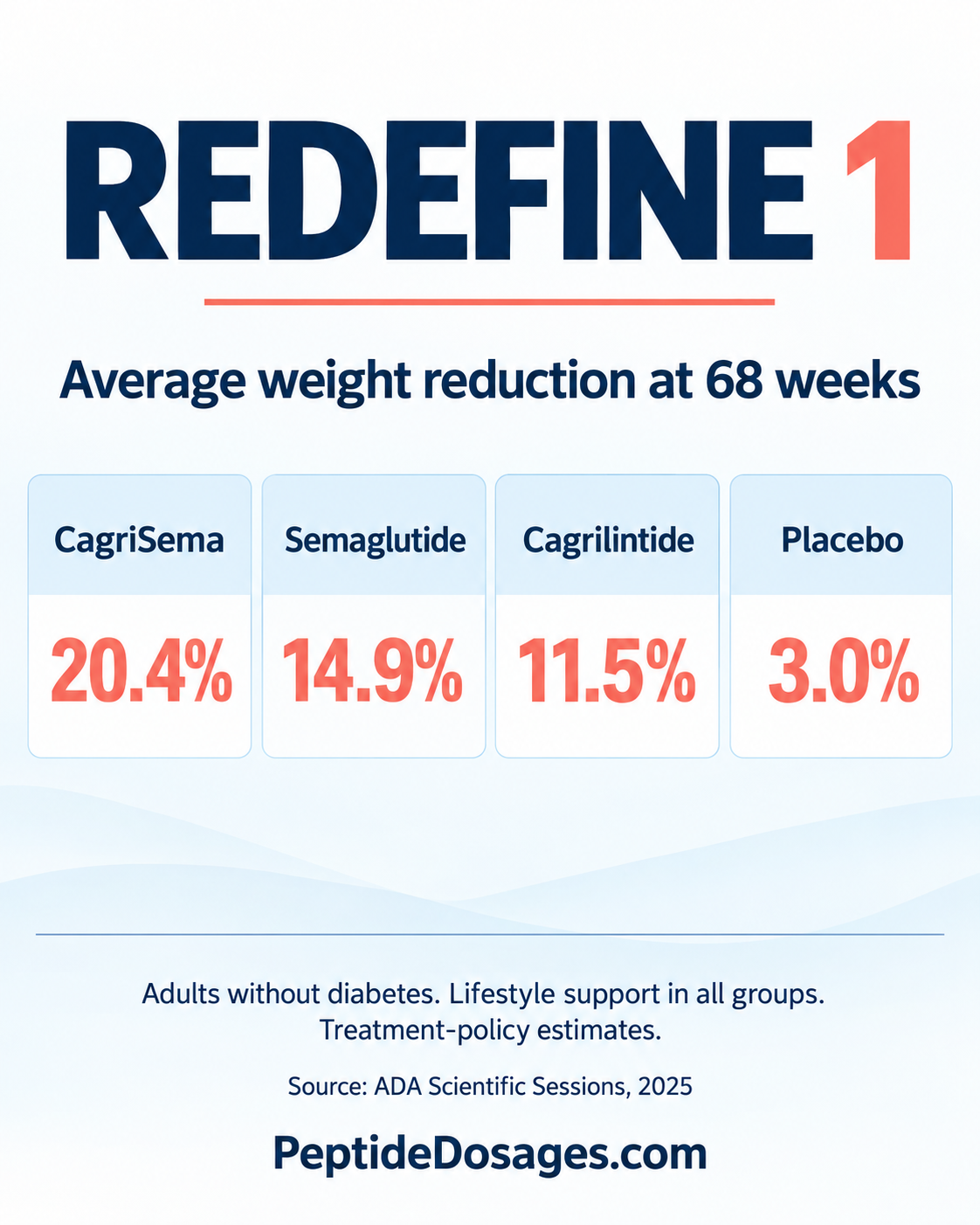
REDEFINE 1 randomized 3,417 adults with overweight or obesity who did not have diabetes. At 68 weeks, estimated average weight change was −20.4% with the combination and −3.0% with placebo. All groups received lifestyle support. This analysis included outcomes regardless of treatment discontinuation.2
The same trial also compared the individual components. The American Diabetes Association’s trial report summarizes the treatment-policy estimates below.3
| REDEFINE 1 group | Average weight change at 68 weeks |
|---|---|
| Cagrilintide + semaglutide | −20.4% |
| Semaglutide alone | −14.9% |
| Cagrilintide alone | −11.5% |
| Placebo | −3.0% |
Adults without diabetes; all groups received lifestyle intervention. Treatment-policy estimates, not a prediction for an individual.3
Why do different headlines show different percentages?
A trial can ask more than one statistical question. A treatment-policy estimate considers the assigned treatment strategy even when people stop treatment. An efficacy estimate addresses the effect under specified assumptions about treatment use. They are not competing versions of the same number.
Before comparing a headline, check the population, follow-up, doses studied and analysis method. A larger percentage from a different analysis does not necessarily mean a better result.
What about people with type 2 diabetes?
REIMAGINE 1 studied 189 adults whose diabetes was inadequately controlled by diet and exercise. At 40 weeks, the higher-dose combination group had an estimated HbA1c reduction of 1.8 percentage points, compared with 0.1 with placebo, using the efficacy analysis.4
That is a blood-glucose outcome in a different population. It should not be inserted into the weight-loss comparison above as though the participants or endpoints were the same.
How does it compare with tirzepatide?
There is no useful answer without naming the trial and doses. In September 2026, Novo Nordisk reported REIMAGINE 5 topline findings: CagriSema 1.0 mg/1.0 mg produced a 12.4% estimated weight reduction at 60 weeks versus 9.1% with tirzepatide 5 mg in adults with type 2 diabetes.1
The finding came from a sponsor announcement. A comparison with 5 mg tirzepatide doesn’t establish superiority over its higher doses or in every population. Full peer-reviewed reporting is needed to assess the methods, tolerability and missing data.
Side effects and tolerability
In REDEFINE 1, gastrointestinal adverse events occurred in 79.6% of combination recipients and 39.9% of placebo recipients. They were generally transient and mild or moderate, with nausea, vomiting, diarrhea, constipation and abdominal pain reported.2
“Generally mild or moderate” does not mean trivial for every participant. For a clinician and patient, tolerability, other medicines and medical history matter alongside average weight change. A research product should not be added to prescribed semaglutide without medical oversight.
Is CagriSema approved?
Novo Nordisk still described CagriSema as investigational in its September 2026 update. The company reported submitting its US weight-management application in December 2025.1 Regulatory status can change; an application is not an approval, and an approval for one product would not validate unrelated mixtures.
CagriSema versus a cagrilintide/semaglutide research blend
Matching ingredient names or a nominal ratio does not establish equivalent manufacturing, stability, delivery or clinical performance. The trial’s conclusions belong to its actual intervention.
The 10 mg blend research reference is a separate preparation context. It is not the prescribing information for CagriSema and does not turn a laboratory vial into the trial product.
Frequently asked questions
Is cagrilintide another GLP-1?
No. Cagrilintide targets the amylin pathway. Semaglutide supplies the GLP-1 receptor activity in this pairing.
Can the trial schedule be copied to a research vial?
No. A study schedule is tied to a defined formulation, eligibility criteria and clinical monitoring. Reconstitution arithmetic cannot establish an equivalent treatment.
Does more weight loss always mean the better option?
Not necessarily. Benefit, side effects, contraindications, access and a person’s treatment goals all belong in a clinical decision.
References
- Novo Nordisk. REIMAGINE 5 and REDEFINE 9 topline update. September 21, 2026. Sponsor report.
- Garvey WT, et al. Coadministered cagrilintide and semaglutide in adults with overweight or obesity. New England Journal of Medicine. 2025.
- American Diabetes Association. REDEFINE trial results presented at the 2025 Scientific Sessions.
- REIMAGINE 1 randomized phase 3a study in adults with type 2 diabetes. 2026.