

Eloralintide is an investigational amylin receptor agonist being developed for obesity. It is not a GLP-1 medicine. Human trials have reported substantial average weight reductions, and phase 3 research is underway, but eloralintide remains investigational as of October 2026.1
You’ll see results for eloralintide alone and for eloralintide combined with tirzepatide. Keep the treatment groups separate: a result for the combination isn’t a result for eloralintide alone.
What is eloralintide?
Previously known as LY3841136, eloralintide is Lilly’s selective amylin receptor agonist. It is being studied as a once-weekly injectable treatment. Its intended effect includes reducing calorie intake through satiety, the feeling of fullness.1
Amylin is a hormone involved in appetite regulation. Targeting this pathway offers a different research approach from GLP-1-based treatment. It does not establish that eloralintide will be more effective, safer or better tolerated for every person.
How much weight loss did the phase 2 trial show?
The published 48-week study randomized 263 adults with obesity, or overweight plus a weight-related condition, without type 2 diabetes. Average baseline weight was 109.1 kg, and 78% of participants were women.2
Lilly’s report gave the following average reductions using the efficacy estimand, an analysis estimating results if participants remained on the study intervention under the specified rules:3
| Trial group | Average weight reduction at 48 weeks |
|---|---|
| Eloralintide 1 mg | 9.5% |
| Eloralintide 3 mg | 12.4% |
| Eloralintide 6 mg | 17.6% |
| Eloralintide 9 mg | 20.1% |
| Eloralintide 6-to-9 mg escalation group | 19.9% |
| Eloralintide 3-to-6-to-9 mg escalation group | 16.4% |
| Placebo | 0.4% |
These amounts identify randomized research groups, not an approved dose or a self-directed schedule. The figures come from one trial and one analysis approach.3
“Up to 20.1%” means the average in one treatment arm. It is not the average across everyone taking eloralintide, and it is not a prediction for an individual. The trial also cannot establish what happens after many years of treatment.
Side effects and tolerability
Gastrointestinal symptoms and fatigue were the most common adverse events in the sponsor’s phase 2 report. They occurred more often in higher-dose groups, while slower escalation was associated with fewer events. Most were described as mild to moderate.3
That last phrase needs context. A symptom can be classified as non-serious and still interfere with someone’s daily life. A useful treatment assessment looks at symptom burden, discontinuations and benefits together, not weight reduction alone.
The original trial was comparatively small, and its participants did not have type 2 diabetes.2 Rare adverse effects and safety in other populations need larger, longer studies. No approved prescribing label yet defines routine contraindications, monitoring or a standard treatment schedule.
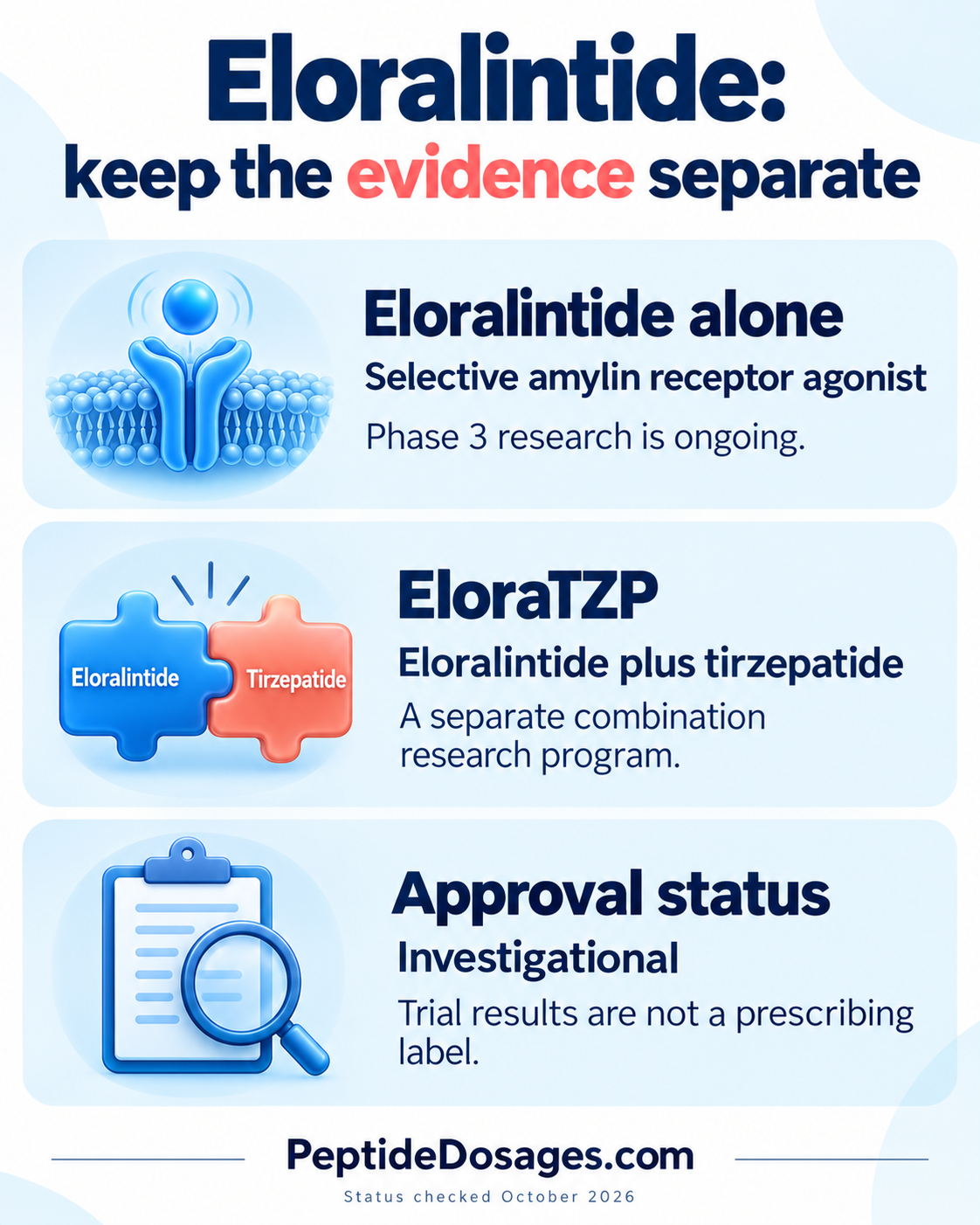
Eloralintide plus tirzepatide: what is EloraTZP?
EloraTZP is the investigational combination of eloralintide and tirzepatide. A September 2026 sponsor announcement described a 48-week phase 2b trial in 367 adults with obesity or overweight and type 2 diabetes.4
The highest combination arm reported 23.3% average weight reduction, compared with 14.8% for tirzepatide 15 mg, using the efficacy estimand. These are results in a diabetes population and should not be substituted for the single-agent results above.4
Treatment discontinuation because of adverse events ranged from 10.8% to 27.0% across combination arms, compared with 2.9% for tirzepatide. The trial used separate injections; Lilly planned phase 3 research on a co-formulated product by the end of 2026.4
This supports further research. It is not a recipe for combining research products independently, nor proof that an online premixed vial reproduces the studied formulation.
Phase 3 trials and approval status
ENLIGHTEN-1 is a phase 3 study evaluating eloralintide in adults with obesity or overweight without type 2 diabetes. Its registry identifier is NCT07321886.5 Another trial, ENLIGHTEN-3, is studying obstructive sleep apnea in adults with obesity or overweight.6
These programs are investigating additional questions, not reporting results simply by being listed. Recruiting sites, eligibility and dates can change. Check the linked sponsor pages for current details and ask the trial team about eligibility.
As of this review, there is no approved U.S. eloralintide prescription product or confirmed retail prescription price. A research supplier’s listing does not establish regulatory approval.1
Eloralintide versus GLP-1 medicines
The distinction is the target: eloralintide acts at amylin receptors, while tirzepatide acts at GIP and GLP-1 receptors.4 Read our separate tirzepatide overview for that medicine’s evidence.
Comparing the largest percentage from unrelated studies is not a reliable ranking. First check whether participants had diabetes, how long follow-up lasted, what happened when treatment was stopped, and which statistical analysis produced the number. A direct comparison and a cross-trial comparison are not the same thing.
Frequently asked questions
Is eloralintide a GLP-1?
No. It is a selective amylin receptor agonist. Its combination with tirzepatide adds GIP and GLP-1 activity through a separate molecule.1,4
Is there an approved eloralintide dose?
No approved U.S. prescribing schedule exists as of October 2026. Trial group labels should not be treated as instructions for starting or escalating treatment.1
The site’s Eloralintide 10 mg research reference is separate from the clinical development program. A research-vial presentation should not be assumed equivalent to the investigational products used in these trials.
Does less nausea mean it is safer?
Not on its own. Tolerability is one part of safety, and different trials may collect or report symptoms differently. Larger studies are needed to clarify the full benefit-risk profile.
What is the practical takeaway?
Eloralintide has encouraging human evidence, but it remains under investigation. Keep single-agent and combination results separate, and discuss approved weight-management options or legitimate trial participation with a qualified clinician.
Related Eloralintide dosage protocols
Continue with the vial-strength-specific research protocol that matches the material being evaluated. Each page keeps its own concentration, reconstitution, and syringe-unit calculations.
Practical measurement and handling guides
References
- Eli Lilly and Company. What to know about eloralintide. Developer overview; checked October 2026.
- Billings LK, et al. Eloralintide, a selective amylin receptor agonist for the treatment of obesity: a 48-week phase 2 trial. Lancet. 2025.
- Eli Lilly and Company. Eloralintide phase 2 results. Sponsor announcement, November 6, 2025.
- Eli Lilly and Company. EloraTZP phase 2b results. Sponsor announcement, September 30, 2026.
- Lilly Clinical Trials. ENLIGHTEN-1: eloralintide in obesity or overweight without type 2 diabetes. NCT07321886.
- Lilly Clinical Trials. ENLIGHTEN-3: eloralintide in obstructive sleep apnea and obesity or overweight.