
Selank Dosage Chart for a 5 mg Vial
This Selank dosage chart explains how a 5 mg vial can be calculated for intranasal research with a verified 0.10 mL metered actuator. Published human Selank studies primarily used intranasal drops or measured intranasal solution. A measured 5 mL final volume provides 100 mcg per spray, while a measured 10 mL final volume provides 50 mcg per spray.
- Primary human research route: Intranasal drops or measured intranasal solution.
- 5 mL final volume: 1 mg/mL, 100 mcg per verified 0.10 mL spray, and 50 nominal sprays.
- 10 mL final volume: 0.5 mg/mL, 50 mcg per verified 0.10 mL spray, and 100 nominal sprays.
- Device check: Confirm the pump output and follow its priming instructions before using the calculation.
- Research context: Human studies used different amounts, durations, and manufactured drop formulations.
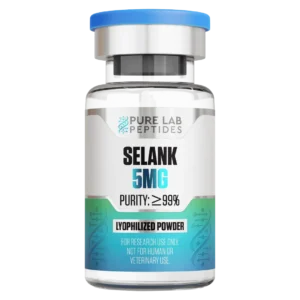
Selank is a synthetic heptapeptide based on the naturally occurring tuftsin sequence. Human research has evaluated intranasal Selank in adults with generalized anxiety disorder, neurasthenia, and in acute neuroimaging experiments[1][2][4]. The calculations below use the entire 5 mg vial and keep published study protocols separate from worked preparation examples.
Research context: For evidence on mechanisms, human and preclinical research, limitations, and safety, read Selank Peptide: Benefits, Uses, Side Effects, Dosage, and Research.
Dosing & Reconstitution Guide
Selank 5 mg intranasal research calculations for 5 mL and 10 mL final volumes
Selank 5 mg Nasal Spray Calculations
Both options begin with 3.0 mL in the peptide vial. Transfer the complete solution, then add enough vehicle to reach the measured final volume.
| Measured Final Volume | Vehicle Added After Transfer | Final Concentration | Per Verified 0.10 mL Spray |
|---|---|---|---|
| 5.0 mL | About 2.0 mL | 1,000 mcg/mL | 100 mcg 50 nominal sprays |
| 10.0 mL | About 7.0 mL | 500 mcg/mL | 50 mcg 100 nominal sprays |
Calculation basis: Each row uses the full 5 mg vial and a pump verified to release 0.10 mL per complete actuation. Nominal spray counts are calculated before priming and normal residual hold-up.
How to Prepare the 5 mL or 10 mL Research Bottle
- Confirm the 5 mg vial, selected sterile research vehicle, actuator bottle capacity, and documented pump output.
- Add 3.0 mL of compatible sterile vehicle to the vial with aseptic transfer technique.
- Gently swirl until the contents are dissolved. Do not shake.
- Transfer the complete 3.0 mL solution into a sterile 5 mL or 10 mL nasal actuator bottle.
- Add enough vehicle to reach a measured final volume of exactly 5.0 mL or 10.0 mL. The theoretical additions are approximately 2.0 mL and 7.0 mL.
- Secure the pump and label the bottle with the peptide amount, final volume, concentration, pump output, and preparation date.
- Prime the pump according to the actuator instructions and record the priming sprays in the research log.
Vehicle context: The worked example can use sterile 0.9% saline as a research vehicle. The registered 0.15% Selank product contains 1.5 mg/mL Selank in purified water with methylparaben, so the saline example is not the same as the manufactured multidose drop formulation[5].
Mathematical Actuator Equivalents
| Literature Amount | 5 mL Option 100 mcg per Spray |
10 mL Option 50 mcg per Spray |
|---|---|---|
| 300 mcg | 3 sprays | 6 sprays |
| 900 mcg | 9 sprays | 18 sprays |
| 2,700 mcg | 27 sprays | 54 sprays |
These rows are concentration conversions, not a universal schedule. The larger actuation counts show why amounts reported with a manufactured drop formulation should not be treated as direct generic-pump instructions.
Published Human Intranasal Selank Research
Human Selank research has primarily used the intranasal route. The studies below show the reported amount, formulation, and research setting so visitors can compare the literature without treating different protocols as interchangeable.
| Source | Research Context | Published Intranasal Amount and Formulation |
|---|---|---|
| Zozulia et al., 2008[1] | 62 adults with generalized anxiety disorder or neurasthenia | Selank 0.15% nasal drops at 2.7 mg per day, reported as 36 drops divided across three administrations, with outcomes followed through day 14. |
| Syunyakov et al., 2012[2] | 20 adults with generalized anxiety disorder | 2,700 mcg per day intranasally. The pharmaco-EEG analysis also examined a single 900 mcg exposure. |
| Panikratova et al., 2020[4] | Healthy-volunteer functional connectivity study | One intranasal exposure using 0.15% Selank solution, 60 microliters per nostril, described as a 0.2 mg total amount. |
The current manufacturer instruction describes a 0.15% nasal-drop product at 1.5 mg/mL, with two drops placed in each nasal passage three times daily for 14 days[5]. Those drop counts belong to the registered bottle and finished formulation. They are not direct equivalents to a different metered pump.
Reference concentration: Mathematically, 5 mg brought to about 3.33 mL equals 1.5 mg/mL. A verified 0.10 mL actuation at that concentration contains 150 mcg. This is a concentration comparison, not a reproduction of the registered preserved drop product.
Nasal Spray Actuator Math
A 0.10 mL actuator is a common nasal pump configuration, but pump output is not universal. Pharmaceutical literature reports pump volumes from approximately 0.025 mL to 0.20 mL per spray[6]. Use the manufacturer specification or a validated measurement for the exact device.
Core Formula
mcg per spray = (5,000 mcg / final volume in mL) x verified mL per spray
nominal sprays = final volume in mL / verified mL per spray
| Verified Actuator Output | 5 mL Option 1,000 mcg/mL |
10 mL Option 500 mcg/mL |
|---|---|---|
| 0.05 mL | 50 mcg | 25 mcg |
| 0.10 mL | 100 mcg | 50 mcg |
| 0.13 mL | 130 mcg | 65 mcg |
Actuator Checks Before Recording a Result
- Confirm the stated volume per full actuation for the specific pump.
- Follow the documented priming and repriming procedure.
- Record residual volume and tail-off near bottle exhaustion when estimating usable sprays.
- Keep pump orientation and actuation stroke consistent during the research procedure.
FDA nasal spray guidance treats pump delivery, priming, dose uniformity, and bottle exhaustion as product performance variables[7].
Supplies Needed
Use one complete set of measured and sterile research supplies for each prepared Selank 5 mg nasal bottle.
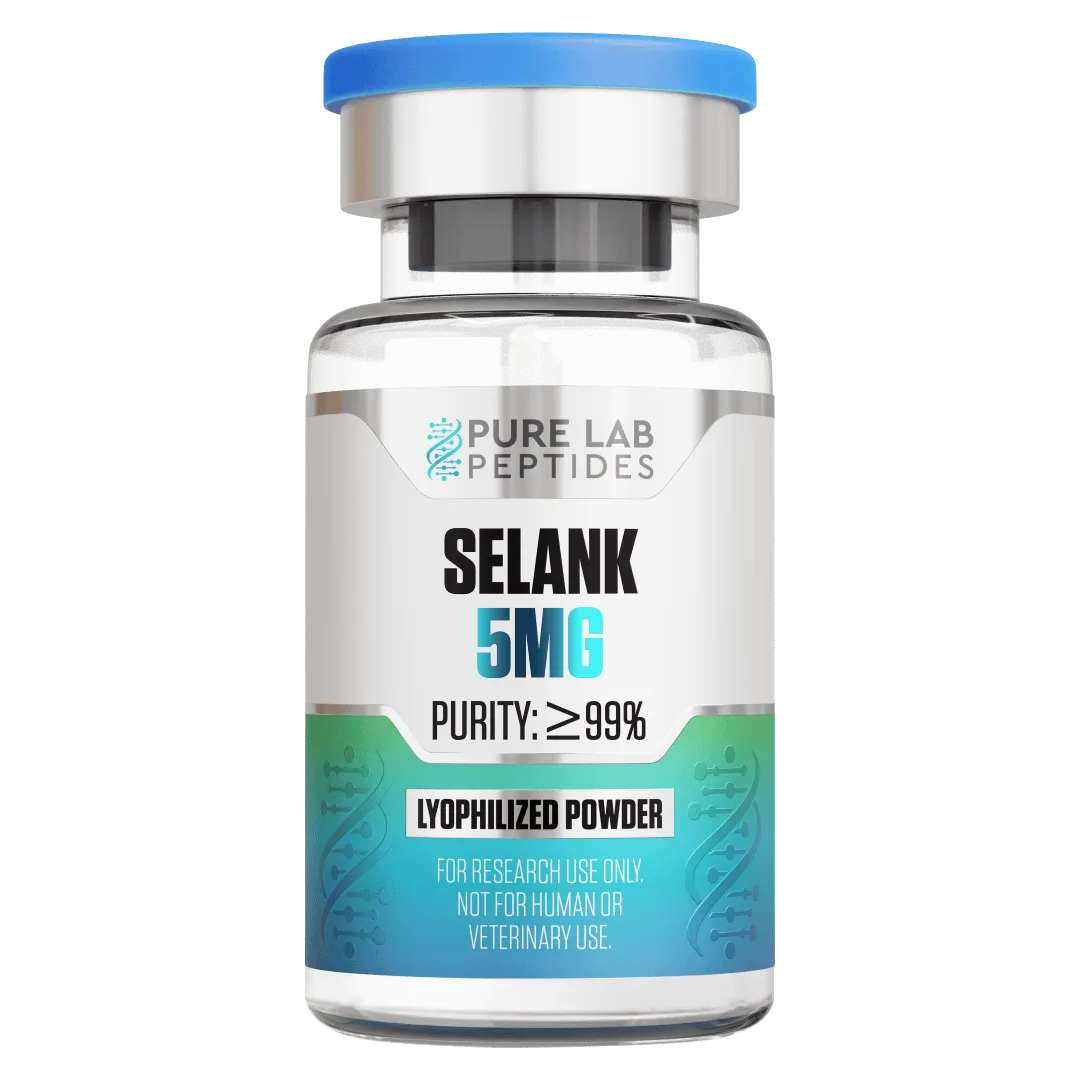
- Selank 5 mg research vial: One vial per prepared bottle, with lot-specific identity, purity, and assay documentation. The supplier card below links to the existing Selank 5 mg product page.
- Sterile research vehicle: Single-use sterile 0.9% sodium chloride for the worked saline example, or another validated sterile nasal research vehicle.
- Sterile nasal actuator bottle: One 5 mL or 10 mL bottle intended for single-user research.
- Metered pump: A compatible actuator documented or verified at 0.10 mL per complete spray.
- Calibrated transfer tools: Sterile syringes or pipettes that can measure the initial 3.0 mL and the exact 5.0 mL or 10.0 mL final volume.
- Sterile transfer needle: Required when the peptide vial uses a rubber septum.
- Clean handling supplies: Alcohol preparation pads, clean gloves, and a disinfected work surface.
- Label and research log: Record the peptide amount, final volume, concentration, pump output, preparation date, priming sprays, and actuation count.
- Storage materials: Light-protective, temperature-controlled storage appropriate to the validated formulation.
- Sharps container: Use when transfer needles are part of the preparation workflow.
Research Protocol Overview
Quick reference for the intranasal Selank 5 mg calculation.
- Human research route: Intranasal drops or solution.
- Peptide amount: 5,000 mcg total in the vial.
- 5 mL option: 1,000 mcg/mL and 100 mcg per verified 0.10 mL spray.
- 10 mL option: 500 mcg/mL and 50 mcg per verified 0.10 mL spray.
- Final-volume rule: Bring the transferred solution to an exact measured final volume.
Research Amount Calculator
Mathematical equivalents for a verified 0.10 mL actuator.
- 300 mcg: 3 sprays at 5 mL or 6 sprays at 10 mL.
- 900 mcg: 9 sprays at 5 mL or 18 sprays at 10 mL.
- 2,700 mcg: 27 sprays at 5 mL or 54 sprays at 10 mL.
- Whole vial: 50 nominal sprays at 5 mL or 100 nominal sprays at 10 mL.
- Interpretation: Match each amount to its original study, dropper, and formulation context.
Storage Instructions
Storage depends on the complete formulation, container, and handling method.
- Registered 0.15% product: Protected from light, stored at no more than 10 degrees C, and not frozen[5].
- Opened registered product: The manufacturer permits storage at no more than 25 degrees C for up to 15 days[5].
- Custom research preparation: Use formulation-specific stability and microbiological controls rather than transferring the finished-product shelf life.
- Labeling: Record preparation date, final volume, concentration, vehicle, and storage conditions.
Important Notes
Small measurement and device details can materially change the amount delivered per spray.
- Use a measured final volume, not the bottle capacity mark alone.
- Verify that the actuator releases 0.10 mL per full stroke before applying the main table.
- Prime and reprime exactly as specified for the pump, then record those actuations.
- Keep the bottle upright and use a complete, consistent stroke for each recorded spray.
- Treat the theoretical 50 or 100 sprays as nominal counts because priming and residual hold-up consume part of the volume.
- A 5 mg vial contains 5,000 mcg total. Calculate the complete peptide requirement before modeling any multi-day published protocol.
- Use a validated laboratory handling and stability plan for any custom multidose preparation.
How Intranasal Selank Research Works
Selank is a synthetic heptapeptide based on the tuftsin sequence. Human studies have examined anxiety-related clinical measures, leu-enkephalin metabolism, EEG response patterns, and functional brain connectivity after Selank exposure[1][2][4]. Intranasal drops or solution are the delivery methods reported in the primary human research summarized on this page.
The vial calculation is concentration based. Dividing 5,000 mcg by the measured final volume gives mcg per mL. Multiplying that concentration by the verified pump output gives mcg per spray.
Human Research Findings and Observations
Selank findings should be read together with the population, amount, formulation, and study design.
- The 2008 comparative study reported similar anxiety-related effects for Selank and medazepam, with additional anti-asthenic and psychostimulant observations in the Selank group[1].
- In the 2012 GAD study, 40% of participants were classified as rapid responders during days 1 to 3, while 60% showed a gradual response pattern through day 14[2].
- The healthy-volunteer neuroimaging study examined functional connectivity after one intranasal Selank exposure rather than a repeated clinical course[4].
- The current manufacturer instruction lists unpleasant taste sensations and possible allergic reactions among reported adverse effects[5].
- Pump output, formulation, nasal condition, and administration technique can affect the delivered amount and deposition pattern[6][7].
Research Controls That Affect Nasal Delivery
Consistent technique improves the value of recorded research observations.
- Pump specification: Record the stated or measured mL per actuation.
- Priming status: Document first use, repriming, and any missed sprays.
- Actuation technique: Keep bottle orientation, stroke length, and stroke force consistent.
- Nasal condition: Record congestion, irritation, or other conditions that could affect deposition.
- Formulation details: Record the vehicle, final volume, concentration, container, and storage conditions.
- Actuation count: Track sprays from priming through final use to identify tail-off and residual volume.
Nasal Actuator Technique
Use a standardized device procedure so the recorded amount remains consistent across research observations.
- Inspect the labeled concentration and confirm the actuator output before use.
- Prime or reprime the pump according to the manufacturer instructions.
- Keep the bottle in the specified orientation and use one complete, smooth stroke.
- Record each actuation immediately, including priming sprays.
- Wipe the nozzle with a clean material appropriate for the device and replace the cap.
- Return the bottle to its documented storage condition after the research procedure.
Important Note
This content is intended for therapeutic educational purposes only and does not constitute medical advice, diagnosis, or treatment. Selank is for research use only and not intended for human consumption. Always consult qualified healthcare professionals before considering any peptide therapy.
References
-
Zozulia et al. (2008)
Human comparative study of Selank in adults with generalized anxiety disorder or neurasthenia. The full text reports the 0.15% nasal-drop protocol and 2.7 mg daily amount. -
Syunyakov et al. (2012)
Rapid and slow response during treatment of generalized anxiety disorder with peptide anxiolytic Selank. Reports 2,700 mcg per day intranasally and a 900 mcg pharmaco-EEG exposure. -
Panikratova et al. (2020)
Functional connectomic study of acute intranasal Selank exposure in healthy volunteers. -
Official Selank Instructions
Current registered 0.15% nasal-drop formulation, composition, administration directions, and storage conditions from the manufacturer. -
Trows et al. (2014)
Analytical challenges and regulatory requirements for nasal drug products in Europe and the United States. Reviews pump output and device variables. -
U.S. Food and Drug Administration
Nasal Spray and Inhalation Solution, Suspension, and Spray Drug Products. CMC guidance covering pump delivery, priming, dose uniformity, and product performance.
Additional Research and Background
These sources provide related context and are not presented as support for a specific statement above.
-
Medvedev et al. (2014)
Randomized human comparison of Selank and phenazepam in anxiety-spectrum disorders. Reports Selank at 2.7 mg per day for 14 days.
Related research, protocols, and guides
Explore the available research context, protocol variants or comparisons, and practical guides. When vial-size variants exist, they remain separate because vial strength, concentration, and syringe-unit calculations can differ. Related compounds and blends are comparisons only, not interchangeable.
Research overview
Other vial-size protocols
Related protocols and comparisons