
TB-500 is often described as a recovery peptide, but the human evidence does not establish it as an effective treatment for tendon injuries or other soft-tissue problems. The first thing to check is the molecule itself. TB-500 commonly refers to a short, modified fragment of thymosin beta-4, not the full-length peptide used in many of the studies cited to support it.[1][2]
Related dosage pages: For vial-specific concentration, reconstitution, and measurement examples, see TB-500 (5 mg Vial) Dosage Protocol and TB-500 (10 mg Vial) Dosage Protocol. Each linked protocol remains a separate reference because vial strength changes concentration and syringe-unit calculations.
What is TB-500, and is it the same as thymosin beta-4?
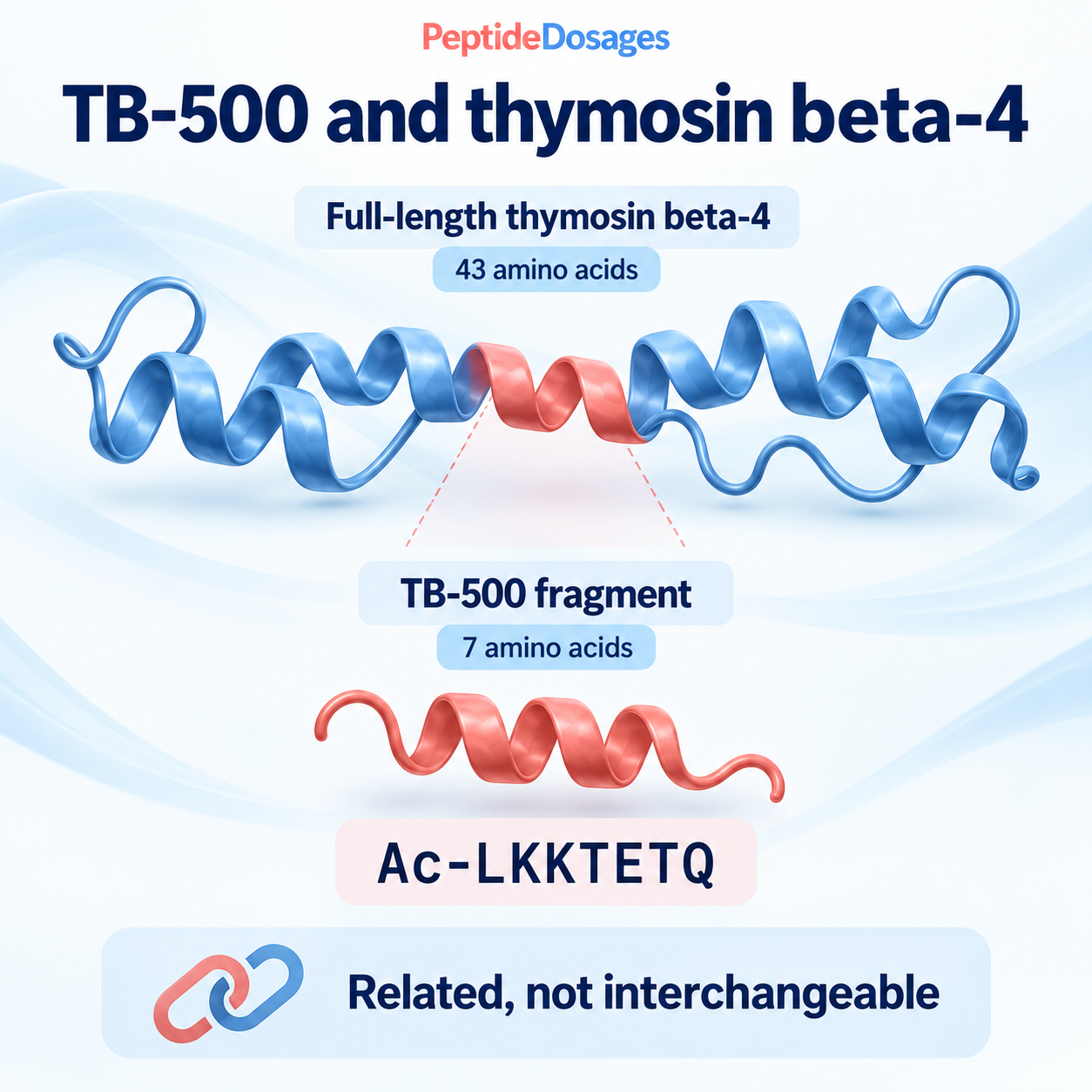
Full-length thymosin beta-4, often written Tβ4, contains 43 amino acids. The TB-500 fragment identified in analytical research contains seven amino acids, LKKTETQ, with an acetyl group attached at one end. It corresponds to positions 17 to 23 within the larger peptide.[1]
The distinction affects how the evidence can be used. A study of full-length thymosin beta-4 can’t establish how its fragment behaves, what dose it would require or whether it’s safe.
| Name in a paper or product description | What to check |
|---|---|
| Thymosin beta-4 / Tβ4 | The full-length, 43-amino-acid peptide. Some animal studies and early human trials investigate this molecule.[3][4] |
| TB-500 / Ac-LKKTETQ | The N-acetylated seven-amino-acid fragment identified in TB-500 analytical studies.[1] |
| LKKTETQ without acetylation | A related but chemically different fragment. Its activity should not be assumed to establish the activity of acetylated TB-500.[6] |
Commercial use of the TB-500 name is inconsistent. FDA’s 2026 review describes products with different salts, derivatives and even different active molecules sold under that name. A label saying “TB-500” therefore does not settle chemical identity.[2]
Why is TB-500 associated with wound healing and recovery?
Much of the interest starts with full-length thymosin beta-4 research. In a 1999 rat study, treatment of skin wounds with Tβ4 was associated with faster re-epithelialization, increased collagen deposition and new blood-vessel formation. Researchers also studied movement of keratinocytes, the cells that help rebuild the skin surface.[3]
These findings concern animal wounds and laboratory cell behavior. They do not demonstrate that injecting a TB-500 product heals a human tendon, relieves chronic back pain or shortens recovery after surgery. “Tissue repair” is a broad category: closing a skin wound and restoring a load-bearing tendon are different outcomes.
What does the actual research show?
A useful way to read this literature is to keep three questions together: which molecule, which population and which outcome?
| Research | Finding and what it cannot establish |
|---|---|
| Full-length Tβ4 in rat skin wounds | Improved several wound-healing measurements. This is preclinical evidence, not a human TB-500 treatment trial.[3] |
| Tβ4 eye drops in 72 people with dry eye | The 28-day phase II trial did not meet its two primary endpoints. Some secondary measures improved. Eye-drop findings do not establish injectable TB-500 efficacy for musculoskeletal injuries.[4] |
| Recombinant full-length Tβ4 in healthy volunteers | A phase I study included 54 participants in the single-dose part and 30 in the multiple-dose part. No serious adverse events or dose-limiting toxicities were reported. It studied intravenous NL005, not the TB-500 fragment or long-term injury treatment.[5] |
| TB-500 and its breakdown products in laboratory experiments | In a 2024 fibroblast wound-closure assay, a metabolite called Ac-LKKTE showed significant activity; parent TB-500 did not. This does not establish whether either compound helps a person heal.[6] |
The negative and mixed findings matter. The dry-eye trial is sometimes presented as a straightforward success, but improvement in selected secondary measures is different from meeting the study’s primary endpoints. Its authors also reported no adverse events, which should not be generalized into a safety claim for a different product or route.[4]
Likewise, the 2024 experiment suggests that metabolism may matter. It does not validate the idea that TB-500 is a proven “prodrug” for human healing, identify a useful clinical dose or demonstrate a predictable recovery timetable.[6]
Quick check: does a Tβ4 study prove a TB-500 claim?
Not by itself. Check the amino-acid sequence, formulation, route, participants and outcome. A study of full-length Tβ4 eye drops is not a study of a seven-amino-acid injection for a tendon injury. Similar names are not interchangeable evidence.
TB-500 side effects: what remains unknown?
Reliable rates of common or serious adverse effects have not been established for the fragment in humans. FDA’s review found no clinical studies adequate to characterize its use in people and identified concerns about immune responses, peptide aggregation and impurities. Missing safety data are not evidence of safety.[2][8]
The healthy-volunteer Tβ4 study provides only limited reassurance about its own product and setting. Participants were monitored over a short period, and the repeated-dose part lasted ten days. Those conditions cannot resolve the risks of months of TB-500 use, combinations with other peptides or products of uncertain identity.[5]
Claims about specific side effects on forums can generate questions, but they cannot establish how often an effect occurs or whether the peptide caused it. The opposite mistake is treating an absence of reports as proof that nothing goes wrong.
Anyone experiencing a concerning reaction after an unapproved product should seek medical assessment and tell the clinician what was used. Bring the packaging and any available ingredient information. Do not assume an unexpected reaction is a sign that tissue repair is occurring.
TB-500 versus BPC-157: is combining them better?
BPC-157 and TB-500 are frequently promoted together as a “Wolverine stack.” A nickname is not evidence of added benefit. The TB-500 evidence reviewed here does not establish an effective combination, a safer combination or a validated schedule for human injury recovery.[2]
Claims that one ingredient acts “locally” and another “systemically” aren’t a controlled recovery comparison. A useful trial would compare the combination with each ingredient alone and with appropriate standard care.
Is there an established TB-500 dosage or recovery timeline?
No clinically validated human dose or duration can be established from the sources reviewed here. A seller’s cycle chart, an animal dose and a full-length Tβ4 trial are not interchangeable starting points. Published analytical work that detects TB-500 in equine blood or urine was designed for drug testing, not to develop a human treatment schedule.[1]
The same problem applies to promises such as “noticeable healing in two weeks.” Without an appropriate clinical trial, there is no reliable timetable to quote. Pain improvement alone also does not answer whether an injured structure has recovered enough for a return to activity.
Is TB-500 FDA-approved or banned in sport?
TB-500 is not an ingredient in an FDA-approved medicine. The agency reviewed it for possible use in compounding at a July 2026 advisory meeting; that process is not drug approval. The briefing document is an agency evaluation and proposal, not by itself a final legal determination.[2]
For athletes subject to World Anti-Doping Agency rules, the position is clearer: the 2026 Prohibited List includes thymosin beta-4 and its derivatives, including TB-500, under S2.3. They are prohibited both in and out of competition. Being prohibited in sport does not prove clinical effectiveness.[7]
How to evaluate a recovery claim
- Identify the molecule. Does the study match the product’s exact ingredient?
- Identify the outcome. Is it cell movement, wound closure, pain relief or actual return to function?
- Check the comparison. Was there a control group and an appropriate follow-up period?
- Read the primary result. Do not rely only on a positive secondary finding or the paper’s concluding sentence.
- Look for safety follow-up. A short study of another formulation cannot establish long-term safety.
Bottom line: Interesting thymosin beta-4 biology should not be flattened into a claim that TB-500 reliably repairs human injuries. For a tendon, wound or postoperative problem, assessment and a condition-specific recovery plan are more useful than an unverified peptide timetable.
References
- Ho et al. Doping control analysis of TB-500 in equine urine and plasma. 2012.
- FDA: TB-500-related bulk drug substances, July 2026 advisory committee briefing.
- Malinda et al. Thymosin beta4 accelerates wound healing. 1999.
- Sosne and Ousler. Thymosin beta 4 ophthalmic solution in dry eye: phase II trial. 2015.
- Wang et al. Recombinant human thymosin beta4: phase I safety and pharmacokinetics. 2021.
- Rahaman et al. TB-500 metabolites and laboratory wound-healing activity. 2024.
- WADA: 2026 Prohibited List, section S2.3.
- FDA: bulk drug substances that may present significant safety risks.
Related dosage protocols and research
Explore related research, dosage references and guides below. Vial strengths have separate references because concentration and syringe-unit calculations differ. A comparison does not mean the compounds are interchangeable.
Matching dosage protocols
Related protocols and comparisons
Further research context