If you’re asking what is AOD-9604, you’re probably seeing it marketed as a “fat-loss peptide” and wondering how real the evidence is—especially compared with appetite-focused options like GLP‑1 receptor agonists. This guide explains what AOD‑9604 is, what research actually shows, what it’s not, and how to evaluate it safely and realistically (educational only, not medical advice).
Fast Answer / Executive Summary
AOD‑9604 is a synthetic 16‑amino‑acid peptide based on the fat‑metabolism domain of human growth hormone (hGH 177–191, with an added N‑terminal tyrosine), studied for effects on lipolysis and lipogenesis without activating the hGH/IGF‑1 growth pathway. Human obesity trials showed modest short-term weight changes and later failed to produce meaningful results at scale, and AOD‑9604 is not an FDA‑approved drug. [1]
Core Concepts & Key Entities
AOD‑9604 is a modified fragment of human growth hormone designed to isolate “fat signaling” without “growth signaling.” In the literature, it’s often described as the C‑terminal fragment of hGH (amino acids 177–191) with an additional tyrosine at the N‑terminus—hence “hexadecapeptide” (16 amino acids). [2]
What AOD‑9604 is
AOD‑9604 is a research peptide derived from the fat-regulating region of growth hormone. It was developed in the context of obesity drug research as an attempt to capture GH’s lipolytic (“fat breakdown”) activity while avoiding GH’s unwanted endocrine effects (like raising IGF‑1 or worsening glucose tolerance in some contexts). [3]
AOD‑9604 was developed by Metabolic Pharmaceuticals Limited[4] and later discussed in peer-reviewed anti-obesity pharmacotherapy reviews as a discontinued candidate after larger trials failed to show meaningful weight-loss efficacy. [5]
What AOD‑9604 is not
AOD‑9604 is not a GLP‑1 drug, and it’s not primarily an appetite suppressant. GLP‑1 receptor agonists reduce weight largely by changing appetite/food intake and slowing gastric emptying; AOD‑9604’s development rationale focused on fat tissue metabolism instead. [6]
AOD‑9604 is also not “growth hormone.” Multiple lines of evidence suggest it does not meaningfully activate the classic growth hormone receptor (GHR) pathway the way intact hGH does. For example, the peptide lacks key receptor-binding features needed for receptor activation and shows no clinically relevant change in IGF‑1 in the human safety trials summarized in the literature. [7]
The key biology, translated
Here are the core terms you’ll see on top-ranking pages—and what they mean in plain English:
- Lipolysis: the process of breaking triglycerides in fat cells into fatty acids and glycerol (mobilizing stored fat).
- Lipogenesis: the process of creating/storing fat; many “fat loss peptide” claims imply reduced lipogenesis.
- Adipocyte: a fat cell; many AOD‑9604 claims focus on signaling in adipose tissue.
- β3‑adrenergic receptor (β3‑AR): a receptor involved in fat-cell lipolysis signaling; in mice, the β‑adrenergic system appears relevant to the lipolytic phenotype observed with AOD‑9604 in animal models. [8]
- IGF‑1 (insulin-like growth factor 1): a hormone downstream of growth hormone signaling; IGF‑1 elevation is one reason long-term GH exposure is treated cautiously. AOD‑9604 trials summarized in the literature report no significant IGF‑1 change across treatment groups. [9]
- Incretins (GLP‑1 and GIP): gut hormones that influence insulin and appetite; important because many searchers compare any “weight loss peptide” to GLP‑1 therapies. GLP‑1 stimulates insulin secretion in a glucose-dependent manner, suppresses glucagon, slows gastric emptying, and reduces food intake. [10]
What research suggests about AOD‑9604’s mechanism
AOD‑9604 is proposed to influence fat loss by shifting fat-cell signaling, not by directly “turning on” GH growth signaling. In obese mouse models, chronic AOD‑9604 exposure was associated with changes consistent with increased fat oxidation and altered lipolytic sensitivity, with β‑adrenergic pathways implicated in the observed physiology. [8]
At the receptor-signaling level, a recurring claim in the clinical safety literature is that AOD‑9604 does not activate the hGH/IGF‑1 axis: it did not raise IGF‑1 and did not show the typical IGF‑1 mediated effects associated with hGH (like edema-related symptoms) in the summarized clinical experience. [7]
What human trials actually showed
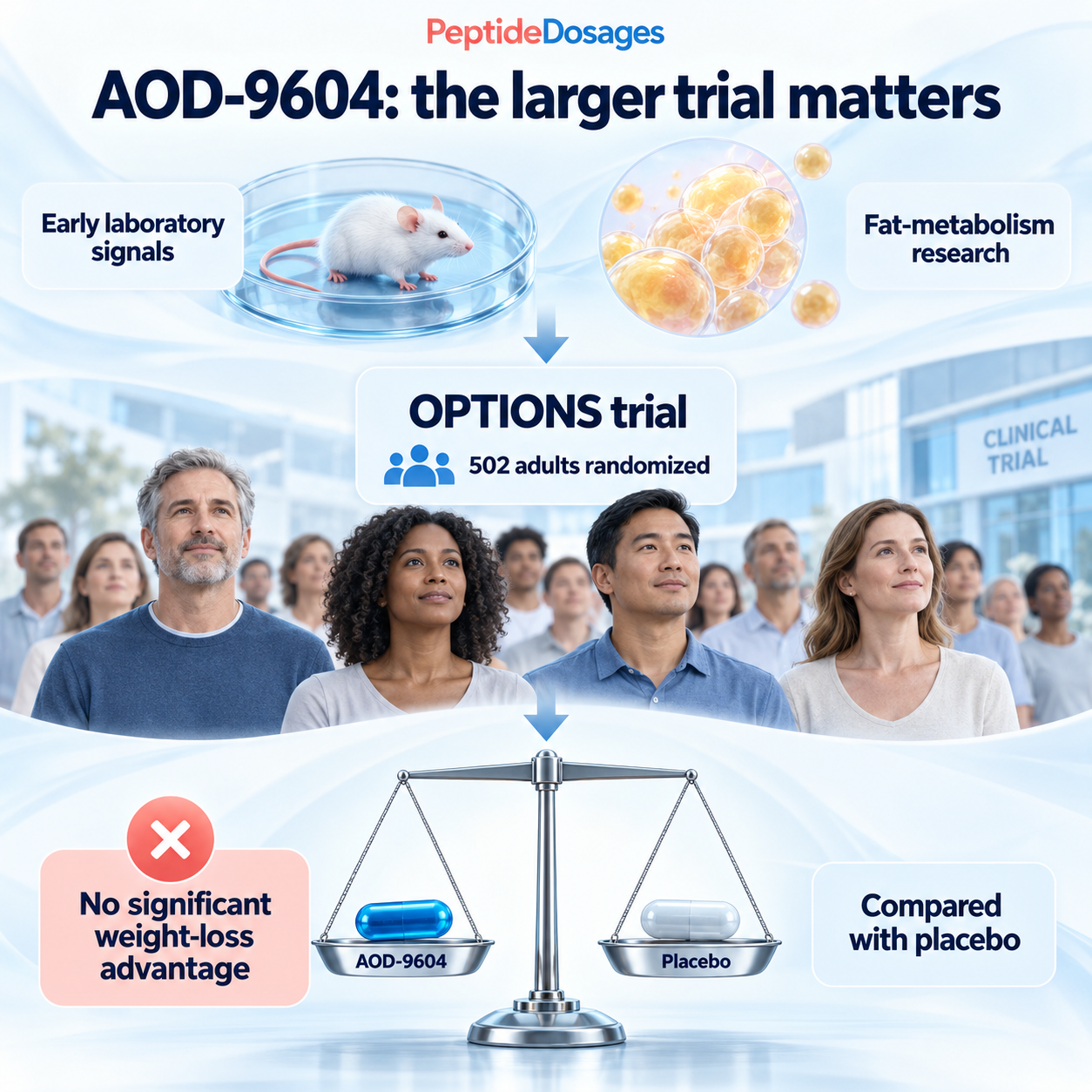
The headline truth: AOD‑9604 showed a small “signal” in an earlier 12-week trial, but it failed in a larger, longer trial. That’s the most important information gain most competing pages miss or bury.
In one 12-week randomized trial cited in peer-reviewed pharmacotherapy review literature, participants receiving AOD‑9604 at 1 mg/day lost an average of 2.6 kg, compared with 0.8 kg in the placebo group (and higher doses did not clearly perform better). [11]
However, the same review notes development was terminated after the drug failed to induce significant weight loss in a 24-week trial of 536 subjects. [11]
Separate regulatory review materials from the U.S. Food and Drug Administration[12] emphasize a similar point: AOD‑9604 “did not show a clinically meaningful weight loss outcome across the trial population,” and later discussion describes lack of evidence supporting effectiveness for obesity. [13]
Safety, approval status, and why “research-only” labeling matters
AOD‑9604 is not an FDA‑approved drug in the United States, and regulators explicitly note limited safety information for some routes of administration. The FDA includes AOD‑9604 on a list of bulk drug substances for which compounded products may present significant safety risks—citing immunogenicity risk and limited safety-related information for proposed routes. [14]
FDA advisory documents also highlight broader peptide-specific issues (aggregation, degradation, impurity characterization) and conclude the available human data are limited in scope for long-term use. [13]
Finally, many AOD‑9604 products are sold with “research/lab use only” disclaimers. For example, product pages from Pure Lab Peptides[15] state products are not intended for human or animal consumption and have not been evaluated or approved by FDA to diagnose, treat, cure, or prevent disease. [16]
Step-by-Step / How-To
The safest way to approach AOD‑9604 is to treat it as an evidence-evaluation problem first, not a “protocol” problem. The steps below are designed for peptide beginners and enthusiasts who want clarity without hype.
Step One: Define the bottleneck you’re trying to solve
Define your goal by deciding whether appetite, adherence, or metabolic signaling is the main bottleneck. If appetite and food noise are the dominant barrier, AOD‑9604’s research rationale (fat-tissue signaling) is fundamentally different from GLP‑1 therapies that reduce intake via appetite and gastric-emptying effects. [6]
Step Two: Anchor expectations to human outcomes, not mechanisms
Anchor expectations by starting with human trial outcomes, then working backward to mechanism. AOD‑9604 has a modest short-term signal in a 12-week trial citation (2.6 kg vs 0.8 kg placebo at 1 mg/day), but it failed to show significant weight loss in a larger 24-week trial of 536 subjects, prompting discontinuation. [11]
Step Three: Separate “safety signals” from “proof of safety”
Separate “no major issues observed” from “proven safe long-term,” because those are different claims. A clinical safety summary reported no clinically relevant IGF‑1 increase and no evidence of classic GH/IGF‑1 activation in the populations studied, but it also acknowledges the limits of the dataset and the need for confirmation for some metabolic claims. [9]
Step Four: Verify regulatory and sport rules before anything else
Verify whether your context prohibits AOD‑9604 before thinking about outcomes. The World Anti-Doping Agency[17] includes “growth hormone fragments, e.g. AOD‑9604 and hGH 176‑191” under prohibited peptide hormones/growth factors. [18]
WADA also states AOD‑9604 has not been approved for therapeutic use by any government health authority and is treated within anti-doping frameworks accordingly. [19]
Step Five: Evaluate sourcing claims like an auditor
Evaluate quality by looking for batch-specific documentation (COA, purity, identity testing), not marketing adjectives. Vendors may use “research-only” positioning; note that “research-only” labels do not equal verified quality or clinical suitability, and regulators have raised concerns about unknown quality products marketed with misleading claims in adjacent peptide markets. [20]
Step Six: If you’re considering real-world use, involve a qualified clinician
Involve a licensed clinician if there is any intent for human use because this is not an approved obesity medication. Educational content can explain what studies and regulators say, but only a clinician can weigh individual risk factors, interactions, and monitoring needs.
Comparison / Alternatives (“X vs Y”)
AOD‑9604 differs from GLP‑1 pharmacotherapy in both mechanism and real-world magnitude of effect in humans. If you want to “compare apples to apples,” compare outcomes first, then mechanism.
AOD‑9604 vs GLP‑1 vs GIP/GLP‑1 dual agonism vs lifestyle
The decisive difference is that modern GLP‑1-based therapies have large, replicated weight-loss effects in large RCTs, while AOD‑9604’s human efficacy signal is modest and inconsistent. [21]
| Dimension | AOD‑9604 | GLP‑1 receptor agonist (example: semaglutide 2.4 mg) | GIP/GLP‑1 dual agonist (example: tirzepatide) | Nutrition + training (structured) |
| What it is | hGH fragment analog (fat-metabolism domain) | Incretin-mimetic therapy | Dual incretin receptor agonism | Behavior + environment + physiology |
| Dominant lever | Fat-cell signaling (lipolysis/lipogenesis focus) | Appetite + gastric emptying + glycemic signaling | Appetite + glycemic signaling via two incretins | Energy balance + adherence + muscle retention |
| Typical magnitude in human obesity trials | Modest short-term signal; later larger trial failed | Large mean weight reduction at 68 weeks vs placebo | Large sustained weight reductions reported in RCTs | Highly variable; can rival drugs with intensive support |
| Example outcome metric | 12-week trial citation: 2.6 kg vs 0.8 kg placebo; not dose-dependent | Mean change at 68 weeks: −14.9% vs −2.4% placebo | 72-week trial: substantial reductions across doses | Depends on baseline, structure, and consistency |
| Approval status | Not FDA-approved; limited evidence of efficacy at scale | FDA-approved for chronic weight management (by labeling) | FDA-approved for weight management (by product labeling history) | N/A |
| Key tradeoffs | Limited clinical certainty; regulatory safety notes for compounding | GI effects common; requires medical oversight | GI effects common; medical oversight | Harder adherence; benefits broader health markers |
The AOD‑9604 weight change and discontinuation context comes from peer-reviewed anti-obesity pharmacotherapy literature. [11]
The semaglutide and tirzepatide outcomes come from large randomized trials in obesity populations. [22]
GLP‑1’s incretin physiology (insulin/glucagon, gastric emptying, appetite) is well described in clinical reviews. [10]
The “Expectation Match” rule (information gain)
If appetite is the bottleneck, choose an appetite lever; if fat-cell signaling is the hypothesis, choose a fat-cell lever—but don’t expect the appetite-level magnitude. That one rule prevents most disappointment in peptide research conversations.
AOD‑9604 is repeatedly framed as “appetite-neutral” because it was never designed as a central appetite drug. GLP‑1 therapies, by contrast, commonly reduce intake by affecting satiety and gastrointestinal signaling. [6]
Templates / Checklist / Example
Use the checklist below to evaluate AOD‑9604 claims and reduce the chance you’re acting on marketing instead of evidence. Copy/paste it into a notes app and score each item as “Yes / No / Unknown.”
Copy-ready AOD‑9604 evaluation checklist
- Clarify the goal (fat loss vs appetite control vs metabolic markers).
- Compare expected magnitude to human RCT outcomes, not mouse data. [11]
- Confirm whether the larger 24-week trial failure changes your expectations. [11]
- Check whether the compound is prohibited for your sport or organization. [18]
- Verify whether any claim implies FDA approval (it should not). [23]
- Request batch-specific COA and identity/purity testing from the supplier.
- Inspect the COA for identity method (e.g., mass spec), purity %, and impurities.
- Avoid products that include dosing instructions while claiming “not for human consumption,” because regulators highlight misleading marketing patterns in adjacent unapproved markets. [24]
- Prioritize safety facts: IGF‑1 and glucose tolerance effects are central to the “GH fragment” claim. [9]
- Document baseline metrics (waist, weight trend, training, intake) before drawing conclusions.
- Track confounders (sleep, calories, alcohol, sodium, training volume).
- Decide a stop rule (what data would make you abandon the hypothesis).
A simple evidence framework you won’t see on most competitor pages
Use the “Signal → Scale → Status” filter:
Signal: Did any human trial show an effect?
Yes—an early 12-week trial citation suggests a modest placebo-adjusted weight difference, and dose-response was not straightforward. [11]
Scale: Did it hold up in larger, longer trials?
No—the candidate was terminated after failing to induce significant weight loss in a 24-week trial of 536 subjects. [5]
Status: What do regulators and sport authorities do with it?
Regulators note limited safety information and raise concerns for compounded use, and sport rules list “growth hormone fragments” including AOD‑9604 as prohibited. [25]
Where PeptideDosages.com fits in
If you want dosing math and vial-based measurement education, use PeptideDosages.com as a reference library, not a prescription. Their AOD‑9604 dosage protocol pages are explicitly framed as educational and include vial-specific reconstitution math and measurement guidance (with clear disclaimers). [26]
- AOD‑9604 2 mg vial dosage protocol
- AOD‑9604 5 mg vial dosage protocol
- AOD‑9604 10 mg vial dosage protocol
FAQs
What is AOD‑9604 used for?
What is AOD‑9604 used for? AOD‑9604 is used in research contexts to study fat metabolism signaling associated with the C‑terminal region of human growth hormone. Historically it was developed as an obesity drug candidate, but later larger studies failed to show meaningful weight-loss efficacy, and development was discontinued in that context. [5]
Is AOD‑9604 the same as HGH fragment 176–191?
Is AOD‑9604 the same as HGH fragment 176–191? AOD‑9604 is closely related but not identical, because it is commonly described as the 177–191 fragment with an added N‑terminal tyrosine (“Tyr‑hGH 177–191”). That modification is one reason the names are sometimes used loosely online, even though precision matters in scientific and regulatory discussions. [2]
Does AOD‑9604 increase IGF‑1 or cause “growth hormone side effects”?
Does AOD‑9604 increase IGF‑1? AOD‑9604 did not significantly change circulating IGF‑1 levels in the summarized human trials, which supports the claim that it does not activate the classic hGH/IGF‑1 growth pathway in the same way intact growth hormone does. That said, “no IGF‑1 increase” is not the same as “proven safe long-term.” [7]
Is AOD‑9604 FDA-approved?
Is AOD‑9604 FDA‑approved? AOD‑9604 is not an FDA‑approved drug product for weight management, and FDA materials emphasize limited evidence of effectiveness and limited safety information for certain routes of administration. FDA also lists AOD‑9604 among bulk substances where compounded products may present significant safety risks. [27]
Is AOD‑9604 banned in sports?
Is AOD‑9604 banned in sports? AOD‑9604 is listed under prohibited peptide hormones/growth factors as a growth hormone fragment (examples include AOD‑9604 and hGH 176‑191), meaning it is prohibited under anti-doping rules. If you compete, treat this as a hard stop unless your governing body states otherwise in writing. [28]
Where can I buy AOD‑9604?
Where can I buy AOD‑9604? AOD‑9604 is commonly sold online as a “research use only” product, and reputable sellers should include batch documentation and clear disclaimers. For example, Pure Lab Peptides’ product pages state the products are for research/lab use only, not for human or animal consumption, and not FDA-approved to diagnose, treat, cure, or prevent disease. [16]
External purchase pages (research/lab use disclaimers apply):
– Pure Lab Peptides — AOD‑9604 2 mg [16]
– Pure Lab Peptides — AOD‑9604 5 mg [29]
– Pure Lab Peptides — AOD‑9604 10 mg [30]
Next Steps
The most important takeaway is that AOD‑9604 is a GH-fragment obesity drug candidate with limited and inconsistent human efficacy, not a GLP‑1-like appetite solution. [31]
If your goal is to understand AOD‑9604 clearly and avoid hype: 1. Start with the Signal → Scale → Status filter above (that’s where most online content fails). 2. If you need appetite control and clinically large outcomes, study GLP‑1 or GLP‑1/GIP outcomes as your reference benchmark for what “proven weight loss at scale” looks like. [22] 3. If you’re building a peptide knowledge base, use PeptideDosages.com’s vial-specific protocol pages as educational references, and keep all decisions in clinician-supervised territory where appropriate. [26]
Helpful internal resources from PeptideDosages.com[32]:
– AOD‑9604 2 mg vial dosage protocol [33]
– AOD‑9604 5 mg vial dosage protocol [34]
– AOD‑9604 10 mg vial dosage protocol
[1] Safety and Tolerability of the Hexadecapeptide AOD9604 …
https://www.jofem.org/index.php/jofem/article/view/157/194?utm_source=chatgpt.com
[2] [4] [7] [9] Safety and Tolerability of the Hexadecapeptide AOD9604 in Humans | Stier | Journal of Endocrinology and Metabolism
https://www.jofem.org/index.php/jofem/article/view/157/194
[3] [5] [11] [15] [21] [31] Central and Peripheral Molecular Targets for Anti-Obesity Pharmacotherapy – PMC
https://pmc.ncbi.nlm.nih.gov/articles/PMC3136748/
[6] [10] Glucagon-like peptide 1 (GLP-1)
https://pmc.ncbi.nlm.nih.gov/articles/PMC6812410/?utm_source=chatgpt.com
[8] The effects of human GH and its lipolytic fragment (AOD9604) on lipid metabolism following chronic treatment in obese mice and beta(3)-AR knock-out mice – PubMed
https://pubmed.ncbi.nlm.nih.gov/11713213/
[12] [16] [20] Buy AOD-9604 Peptide | Fat Loss Targeting Visceral Fat
https://purelabpeptides.com/buy-peptides/buy-aod-9604/
[13] [17] [27] [32] December 4, 2024 Pharmacy Compounding Advisory Committee (PCAC) Meeting
https://www.fda.gov/media/183584/download
[14] [23] [25] Certain Bulk Drug Substances for Use in Compounding …
[18] [28] images.icc-cricket.com
https://images.icc-cricket.com/image/upload/prd/emrdebmzmhxbxmunk7vw.pdf
[19] WADA statement on substance AOD-9604
https://www.wada-ama.org/en/news/wada-statement-substance-aod-9604?utm_source=chatgpt.com
[22] Once-Weekly Semaglutide in Adults with Overweight or …
https://www.nejm.org/doi/full/10.1056/NEJMoa2032183?utm_source=chatgpt.com
[24] FDA Intends to Take Action Against Non-FDA-Approved …
[26] [33] AOD-9604 2mg Dosage Protocol | PeptideDosages.com
https://peptidedosages.com/single-peptide-dosages/aod-9604-2-mg-vial-dosage-protocol/
[29] Buy AOD-9604 5mg Peptide | Fat Loss Targeting Visceral Fat
https://purelabpeptides.com/buy-peptides/buy-aod-9604-5mg/
[30] Buy AOD9604 Online | Advanced Fat-Loss Research Peptide
https://purelabpeptides.com/buy-peptides/buy-aod9604-10mg/
[34] AOD-9604 5mg Dosage Protocol | PeptideDosages.com
https://peptidedosages.com/single-peptide-dosages/aod-9604-5-mg-vial-dosage-protocol/