
If you’re searching “What is SS-31”, you’re probably looking for a clear explanation of a mitochondria‑focused peptide that shows up in anti‑aging discussions and mitochondrial‑disease research. Unlike GLP‑1 drugs used for appetite and blood‑sugar control, SS‑31 is not an incretin or a weight‑loss drug. It’s a cardiolipin‑binding mitochondrial peptide (also called elamipretide) with human trial data—and a major FDA milestone. [1]
Fast Answer / Executive Summary
Fast Answer: SS‑31 is a mitochondria‑targeting tetrapeptide (generic name elamipretide) designed to bind cardiolipin in the inner mitochondrial membrane, helping stabilize mitochondrial structure and improve bioenergetic function. In September 2025, the U.S. Food and Drug Administration[2] granted accelerated approval to Forzinity (elamipretide) for Barth syndrome in patients ≥30 kg. [3]
Educational note (not medical advice): SS‑31 exists in two very different real‑world contexts: (1) a regulated prescription drug with a specific indication and label, and (2) “research‑use” vials sold online that are not approved as medicines. Treat those as different worlds, and don’t swap dosing or safety assumptions between them. [4]
Core Concepts & Key Entities
SS‑31 definition in one sentence
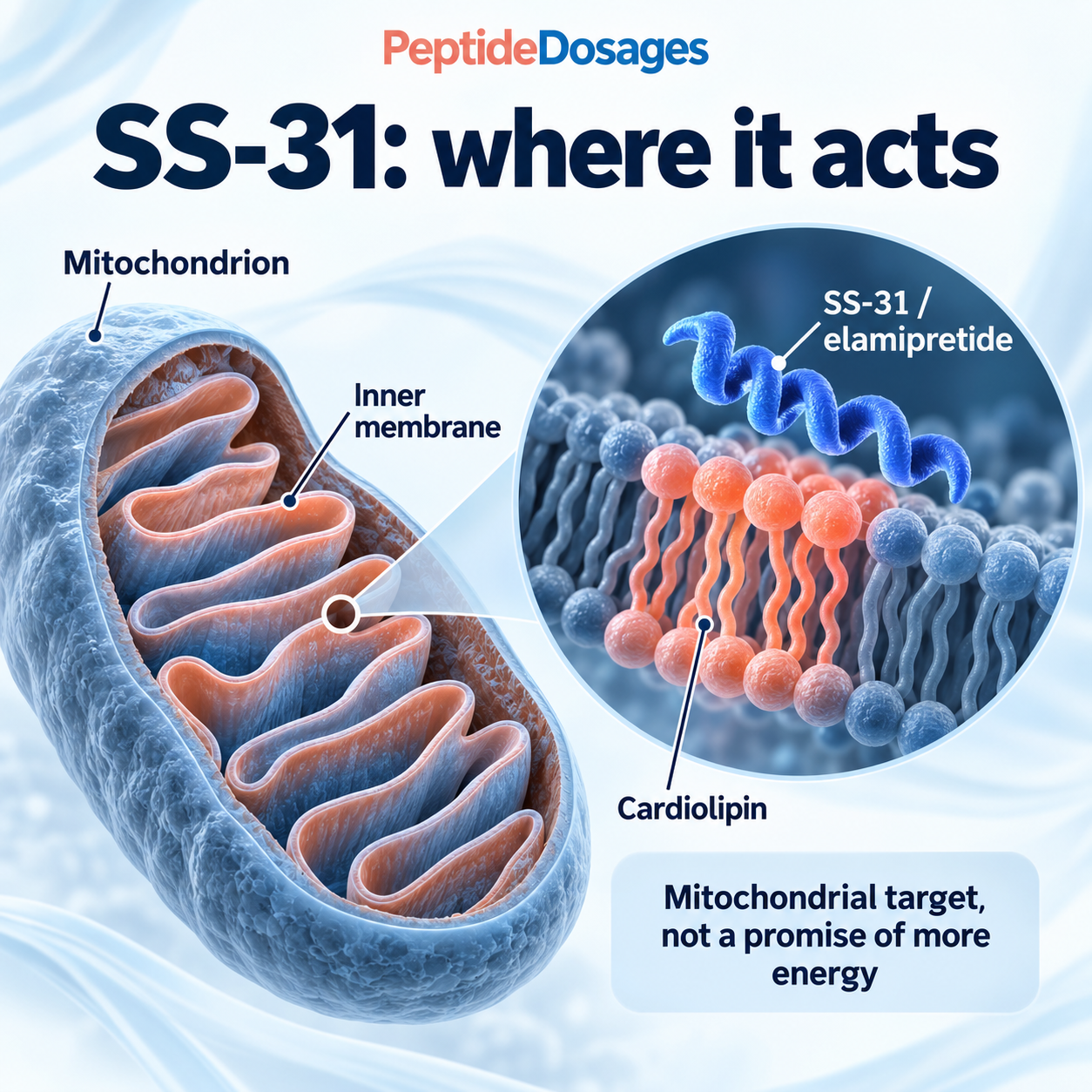
SS‑31 is a small, cell‑permeable tetrapeptide that targets the inner mitochondrial membrane by binding cardiolipin, with the goal of improving mitochondrial efficiency (ATP production) and reducing damaging oxidative stress. [5]
You may see SS‑31 described as an “SS peptide” or an “aromatic‑cationic peptide,” reflecting its design: alternating aromatic and positively charged residues that help it interact with negatively charged mitochondrial membrane lipids. [6]
One more clarity point: in the biotech and medical literature, SS‑31 refers to elamipretide, and that is the meaning used throughout this article—and you may also encounter older names like MTP‑131 or Bendavia in papers. [7]
SS‑31, elamipretide, MTP‑131, Bendavia, Forzinity
SS‑31 and elamipretide refer to the same active peptide across its development history (older names include MTP‑131 and Bendavia). [8]
Forzinity is the U.S. prescription brand of elamipretide injection approved under accelerated approval to improve muscle strength in people with Barth syndrome who weigh at least 30 kg. [9]
Why this matters for search intent: many blog posts use “SS‑31” to mean a research vial. But the FDA label describes a specific sterile injection product (ingredients, concentration, warnings, pharmacokinetics, dose adjustments). If you want evidence‑based clarity, anchor your understanding in the label and peer‑reviewed trials—not vendor copy. [10]
What mitochondria are and why “inner membrane” biology matters
Mitochondria are the cell’s energy‑generating organelles. The electron transport chain (ETC) in the inner mitochondrial membrane drives oxidative phosphorylation, producing ATP from nutrients and oxygen. When the ETC becomes inefficient, cells can make less ATP and leak more reactive oxygen species (ROS), especially in energy‑hungry tissues like heart and skeletal muscle. [11]
SS‑31’s key idea is not “more mitochondria.” It’s “better‑working mitochondria,” with a direct focus on the inner membrane where ETC proteins and lipids interact. [12]
Cardiolipin: the “signature lipid” SS‑31 is built around
Cardiolipin is a specialized phospholipid found mainly in the inner mitochondrial membrane. It helps shape cristae (the folded membrane structure) and supports the organization and stability of ETC complexes into higher‑order assemblies (“supercomplexes”) that make electron transfer more efficient. [13]
When cardiolipin is oxidized or abnormal, mitochondrial respiration can suffer. That’s one reason cardiolipin is often discussed as a feasible “handle” for mitochondria‑targeted therapeutics. [14]
Why Barth syndrome keeps coming up with SS‑31
Barth syndrome is an ultra‑rare, X‑linked disorder (mostly affecting males) characterized by cardiomyopathy, skeletal myopathy, and neutropenia. It is caused by variants in the TAFAZZIN gene, which is required for normal cardiolipin remodeling. [15]
Biochemically, Barth syndrome is often described as a cardiolipin/monolysocardiolipin imbalance (deficiency of mature cardiolipin and accumulation of monolysocardiolipin). That makes Barth syndrome unusually “on‑target” for cardiolipin‑focused therapies like elamipretide. [16]
How SS‑31 gets to mitochondria
SS‑31 belongs to the SS peptide family. A notable observation from the SS‑peptide literature is that these small peptides can be cell‑permeable and localize to mitochondria (especially the inner membrane) without relying on the mitochondrial membrane potential the way some lipophilic cations do. [6]
In experimental descriptions, SS‑31 binds cardiolipin and has been reported to accumulate 1000‑ to 5000‑fold in mitochondria; mitochondrial uptake is described as not dependent on the transmembrane electric potential. [17]
What SS‑31 does after binding cardiolipin: the “cytochrome c switch”
A practical way to understand SS‑31’s mechanism is through cytochrome c. Cytochrome c normally shuttles electrons in the ETC, but when it binds cardiolipin tightly (often under stress), it can shift toward peroxidase activity that promotes cardiolipin peroxidation—worsening inner membrane damage and impairing ATP synthesis. [18]
SS‑31 binds cardiolipin and has been shown to inhibit cytochrome c/cardiolipin peroxidase activity while preserving cytochrome c’s electron‑carrier role. This is the core “protect the membrane → improve electron flow” story behind claims of improved mitochondrial bioenergetics. [19]
Mechanistic papers and animal models also report related effects, including improved cristae network integrity after ischemia‑reperfusion injury and improved bioenergetic function in stressed mitochondria. [20]
Mechanism nuance: cardiolipin is central, but protein interactions may matter too
A newer mechanistic angle is that elamipretide may also interact with cardiolipin‑associated proteins and the ADP/ATP transport machinery.
For example, a mechanistic study (preprint version available in PMC) describes elamipretide binding directly to the adenine nucleotide translocator (ANT) and ATP synthase, improving ADP sensitivity and mitochondrial function in aged mouse muscle mitochondria, with results discussed as linking ADP transport dynamics to ATP production efficiency. [21]
This is not “human efficacy” evidence. But it is useful information gain: it helps explain why elamipretide can show rapid bioenergetic effects in some models without necessarily changing cardiolipin quantity, focusing instead on how inner‑membrane systems behave under stress or age‑related redox modifications. [22]
Chemical and pharmacology snapshot: what SS‑31 is on paper
In review literature, elamipretide is described as a synthetic tetrapeptide with the sequence D‑Arg‑Dmt‑Lys‑Phe‑NH₂ (Dmt = 2′,6′‑dimethyl‑tyrosine). [23]
The FDA label for Forzinity identifies the peptide sequence as D‑Arg‑2,6‑dimethyl‑Tyr‑Lys‑Phe‑NH₂ and notes the marketed product is elamipretide hydrochloride in a ready‑to‑use sterile solution. [24]
Forzinity’s label provides pharmacology details that are often missing from “peptide community” summaries—such as: – Peak concentrations at ~0.5–1 hour after subcutaneous dosing. – Approximately 92% absolute bioavailability after subcutaneous dosing. – Volume of distribution about 0.5 L/kg. – Plasma protein binding approximately 39%. [24]
Elamipretide and its metabolites are excreted in urine; the label notes near‑complete recovery of dose in urine as elamipretide or metabolites over 48 hours in normal renal function, and increased exposure in renal impairment. [25]
Dosing and administration: what’s known (and what isn’t)
For the FDA‑approved product Forzinity, the label lists a recommended dosage of 40 mg subcutaneously once daily for patients weighing at least 30 kg, with a dose reduction (suggested 20 mg daily) for adults with severe renal impairment not on dialysis. [26]
Across multiple clinical programs, “40 mg once daily” appears repeatedly because it was used in Barth syndrome studies, MMPOWER‑3 (PMM), and ReCLAIM‑2 (dry AMD), while PROGRESS‑HF (HFrEF) tested both 4 mg and 40 mg daily. [27]
What is not known (and often overstated online): whether any “anti‑aging” or “performance” benefit exists in healthy populations. The largest, most rigorous trials evaluated specific medical conditions with defined endpoints—not generalized wellness. [28]
Formulation differences: why “40 mg” can be confusing in the peptide world
A common source of confusion is that many major studies used “40 mg daily,” and peptide vendors and forums repeat that number without context. But the regulated product is not a dry vial you reconstitute at home—it’s a ready‑to‑use sterile solution with a defined concentration and excipients. [29]
For example, the Forzinity label states that each 0.5 mL dose contains 40 mg of elamipretide (and the product contains benzyl alcohol as a preservative). That implies a highly concentrated formulation compared with many research‑vial reconstitutions. [30]
By contrast, research‑market SS‑31 is commonly sold as lyophilized powder with user‑defined reconstitution volumes and storage practices (freeze before reconstitution; refrigerate after), which changes concentration and measurement conventions from lab to lab. [31]
Takeaway: when you see a dosing claim, ask “40 mg of what formulation, at what concentration, with what measurement method, in what population?” That single question prevents most SS‑31 dosing misunderstandings.
Pharmacokinetics and interactions: the “boring details” that protect you from bad assumptions
The Forzinity label describes elamipretide being metabolized by sequential C‑terminal degradation to M1 and M2 metabolites that do not have pharmacological activity. [24]
It also notes that elamipretide and metabolites are excreted in urine, and that renal impairment increases exposure (AUC) to elamipretide and substantially increases exposure to metabolites M1 and M2—one reason dose reductions are recommended for severe renal impairment in adults. [25]
On drug interactions, the label reports that elamipretide does not inhibit multiple common CYP enzymes in vitro and does not induce metabolism by key CYP pathways, and it summarizes specific interaction studies (e.g., aspirin, clopidogrel, unfractionated heparin) that did not show meaningful impacts on pharmacokinetics or antiplatelet/antithrombotic activity. [24]
These details matter because the peptide community often assumes “peptides don’t interact.” The label doesn’t support that simplification—it supports “interactions were evaluated in specific ways, and some pathways look low‑risk.” [24]
What the human evidence actually says: trial-by-trial
SS‑31 has a plausible, well‑documented mitochondrial mechanism. But clinical outcomes vary by disease biology, endpoint, and trial design.
SS‑31 human studies at a glance
If you only remember one thing about SS‑31, remember this: it’s a real, clinically studied mitochondrial medicine candidate with mixed results—positive enough in Barth syndrome to earn accelerated approval, but not a universal “mitochondrial fix.” [32]
| Study/program | Population | Design | N (approx.) | Dose & duration | Primary endpoint story |
| Barth syndrome development program (Forzinity label summary) | Genetically confirmed Barth syndrome | Placebo-controlled crossover + open-label extension | 12 in randomized crossover; 10 entered extension | 40 mg subcutaneous daily; 12-week crossover periods; extension up to ~192 weeks | Primary endpoints (6MWT, fatigue) not superior in randomized crossover; strength improvements observed in extension supported accelerated approval. |
| TAZPOWER open-label extension (peer-reviewed) | Barth syndrome | Long-term open-label extension | 10 entered; 8 reached week 168 | 40 mg subcutaneous daily; up to 168 weeks reported | 6MWT improved over time in extension (reported 96.1 m improvement at week 168 vs extension baseline). |
| MMPOWER‑3 | Primary mitochondrial myopathy | Phase 3 randomized, double-blind, placebo-controlled | 218 | 40 mg subcutaneous daily; 24 weeks | No significant improvement in 6MWT or fatigue at week 24 in the overall population. |
| PROGRESS‑HF | Heart failure with reduced EF | Phase 2 randomized, placebo-controlled | 71 | Placebo vs 4 mg vs 40 mg daily; 28 days | Well tolerated; no improvement in LV end-systolic volume at 4 weeks. |
| ReCLAIM‑2 | Dry AMD with geographic atrophy | Phase 2 randomized, placebo-controlled, double-masked | 176 | 40 mg daily; 48 weeks | Primary endpoints (low-luminance BCVA, GA growth) were not statistically different; some categorical/exploratory findings discussed. |
These figures are summarized from the FDA prescribing information and the primary trial publications. [33]
Barth syndrome: FDA approval + long-term functional signal
Forzinity (elamipretide) received accelerated approval for Barth syndrome on September 19, 2025. The FDA press announcement notes approval was based on improved knee extensor muscle strength as an intermediate endpoint and requires a confirmatory trial to verify clinical benefit. [3]
In the long‑term open‑label extension results of TAZPOWER, patients continued elamipretide 40 mg subcutaneous daily. Ten patients entered the extension; eight reached week 168. The publication reports significant improvement in 6‑minute walk test distance from extension baseline at all time points, with a cumulative 96.1‑meter improvement at week 168 (P=.003), and injection‑site reactions as the most common adverse events. [34]
The Forzinity label also summarizes a key nuance: in the randomized crossover portion, Forzinity was not superior to placebo on primary endpoints (6‑minute walk test distance and fatigue), while knee extensor strength improvements were observed in the extension. This is a reminder that the same program can yield different “answers” depending on timeframe and endpoint. [24]
Primary mitochondrial myopathy: Phase 3 trial negative overall
MMPOWER‑3 (phase 3, randomized, double‑blind, placebo‑controlled) randomized participants 1:1 to 40 mg/day subcutaneous elamipretide or placebo for 24 weeks. The trial (N=218) did not improve the 6‑minute walk test or fatigue scores versus placebo at week 24, though it reported good tolerability. [35]
PMM subgroups: genotype may matter more than the broad label
A post hoc analysis of MMPOWER‑3 reported that the prespecified nuclear‑DNA pathogenic variant subgroup showed improvement on the 6‑minute walk test and suggested stronger signals in certain mtDNA maintenance (“replisome”) subgroups. [36]
Information gain insight: Many SS‑31 articles treat “mitochondrial dysfunction” as one big bucket. The trial record suggests response may be genotype‑specific, which is exactly the kind of nuance that separates a research‑grade explanation from marketing. [37]
Heart failure (HFrEF): tolerated, but primary imaging endpoint not improved
In PROGRESS‑HF (phase 2), 71 patients with HFrEF were randomized to placebo, 4 mg, or 40 mg elamipretide once daily for 28 days. The published conclusion states it was well tolerated but did not improve left ventricular end‑systolic volume at 4 weeks versus placebo. [38]
Dry AMD with geographic atrophy: null primary endpoints, some categorical findings
ReCLAIM‑2 randomized 176 patients (2:1) to 40 mg elamipretide or placebo for 48 weeks. [39]
The trial did not meet its primary endpoints: change in low‑luminance best‑corrected visual acuity and change in square‑root transformed GA area were not statistically different between elamipretide and placebo at week 48. [39]
The paper also discusses categorical visual function findings and ellipsoid zone integrity measures, illustrating how an intervention can show “signals” in some measures while failing primary endpoints. [40]
Safety: what’s consistent across the evidence
Across the Barth syndrome clinical development data summarized in the Forzinity label, injection‑site reactions were the most common adverse reactions and occurred at high frequency (for example, injection site erythema reported in all treated subjects in the crossover study). [41]
The label also highlights: – Hypersensitivity reactions (including serious allergic reactions) and guidance to discontinue and treat if serious reactions occur. [42]
– A benzyl alcohol toxicity warning relevant to neonates and the statement that the product is not approved for neonates. [43]
– Dose reduction guidance for adults with severe renal impairment not on dialysis, and limited information for certain renal‑impairment subgroups. [26]
What SS‑31 is not
SS‑31 is not a GLP‑1 receptor agonist, not an incretin hormone, and not a stimulant. If your goal is appetite or glycemic control, the evidence base you want is in incretin biology (GLP‑1 receptor agonists), not cardiolipin‑binding peptides. [44]
SS‑31 is also not “a generic antioxidant supplement.” Its differentiator is targeted localization and cardiolipin/cytochrome c modulation, which is a fundamentally different strategy than taking broad antioxidants that may not reach the inner mitochondrial membrane effectively. [45]
Step‑by‑Step / How‑To
Step 1: Define the outcome you want to change
Define one measurable endpoint (e.g., 6‑minute walk distance, fatigue score, knee extensor strength, low‑luminance visual acuity) instead of “more energy.” [46]
Step 2: Confirm naming and product context
Confirm that SS‑31 = elamipretide and identify whether you’re reading an FDA label, a clinical trial report, or a research‑only vendor page—because conclusions and “dosing” are not interchangeable across those sources. [47]
Step 3: Put the claim on the right evidence rung
Give the most weight to labels and randomized trials, then use mechanistic studies to understand how SS‑31 might work (not as proof of broad clinical benefit). [48]
Step 4: Check primary endpoints and timeframes first
If primary endpoints were null at the prespecified time point, interpret secondary or exploratory “signals” cautiously and track the exact timeframe tested. [28]
Step 5: Decode dosing discussions with three numbers
Every dosing discussion reduces to vial amount, reconstitution volume, and per‑day dose used in the source—if any of those are missing, the protocol isn’t interpretable. [49]
Step 6: Choose your next action based on risk, not hype
Clinical questions belong with a clinician and a regulated label; lab questions belong with documentation (COA, identity, purity) and preplanned endpoints. [4]
Comparison / Alternatives
SS‑31 is best compared to other mitochondrial‑targeted strategies, not to hormone peptides or GLP‑1 drugs. SS‑31’s unique angle is cardiolipin binding in the inner mitochondrial membrane; its limitation is that strong clinical evidence is concentrated in specific diseases, with mixed or null findings in others. [50]
| Option | Primary lever | Typical format | Human evidence (high level) | Best‑fit research questions | Key caveat |
| SS‑31 / elamipretide | Cardiolipin + inner‑membrane systems | Rx injection (Barth) or research peptide | Clear regulatory status in Barth; mixed in other settings | “Is cardiolipin dysfunction central?” | Don’t generalize rare‑disease outcomes to healthy performance. [51] |
| Membrane‑potential targeted antioxidants (MitoQ‑like) | Mitochondrial accumulation via membrane potential | Supplements/drugs vary | Varies by compound; different mechanism than SS‑31 | ROS‑centric mitochondrial questions | Uptake mechanism differs; not cardiolipin‑directed. [6] |
| CoQ10 / ubiquinol | Electron carrier + antioxidant support | Supplement | Evidence varies by population and endpoint | ETC support / deficiency contexts | Effects may be modest and non‑specific. [52] |
| NAD⁺ precursors (NR/NMN) | Cofactor availability / redox metabolism | Supplement | Consistent NAD‑metabolite engagement; heterogeneous functional outcomes | “Does raising NAD metabolites move endpoints?” | Biochemical change ≠ functional change. [53] |
| Exercise training | Biogenesis + mitochondrial quality control | Lifestyle | Strong, broad benefits | “Can habits outperform molecules?” | Requires adherence; slower but more validated. [54] |
How to choose between these options
Choose the option that matches the bottleneck you’re trying to study. SS‑31 is most “on‑target” when inner membrane cardiolipin biology is implicated. Exercise is most reliable when your goal is global mitochondrial adaptation across tissues. Supplements like CoQ10 or NAD‑precursor strategies can be reasonable research supports, but their effects are often endpoint‑specific and not cardiolipin‑directed. [55]
A practical caution if you’re comparing options (or thinking about “stacking” ideas) for research design: mitochondria‑focused interventions can converge on the same downstream readouts (ROS levels, redox state, ATP/ADP balance, or biogenesis/quality-control markers). If you change multiple variables at once, you often can’t tell whether a result came from cardiolipin protection (SS‑31), increased biogenesis signaling (exercise), or altered NAD‑metabolite pools (NR/NMN).
Best practice: change one major variable at a time and predefine 1–2 primary endpoints before you start. This is how well‑designed clinical trials avoid “storytelling” with noisy signals. [56]
Templates / Checklist / Example
SS‑31 “do I understand this peptide?” checklist
Use this checklist to avoid two big mistakes: confusing mechanism with outcomes, and ignoring product context.
- Define your endpoint (fatigue, strength, vision, exercise tolerance).
- Confirm names: SS‑31 = elamipretide (also MTP‑131/Bendavia).
- Differentiate prescription Forzinity vs research‑only vials.
- Anchor expectations in human trials, not rodent models.
- Screen label risks (hypersensitivity, benzyl alcohol warning, renal guidance).
- Demand documentation (COA + identity + purity) for lab sourcing.
- Track outcomes over time with the same test, same conditions.
Copy‑ready “claim triage” template
When you see a claim like “SS‑31 boosts ATP and fixes fatigue,” paste it into this template and fill in the blanks:
- Claim: ________
- Proposed mechanism: cardiolipin binding / cytochrome c modulation / ETC efficiency / ANT‑related ADP sensitivity (cite). [58]
- Population studied: Barth syndrome? PMM? HFrEF? AMD? Healthy adults? [59]
- Endpoint measured: 6MWT? fatigue score? knee extensor strength? imaging? [46]
- Result: positive / null / mixed—at what time point? [60]
- Regulatory status: prescription label vs research‑only product. [4]
- What’s unknown: ________
This framework forces clarity that most competing pages skip: who was studied, what improved, and what didn’t.
FAQs
Is SS‑31 the same as elamipretide? SS‑31 is the development/research name for elamipretide; you may also see older development names like MTP‑131 or Bendavia. The prescription product in the U.S. is Forzinity (elamipretide) for Barth syndrome, and it includes a defined formulation, dosing guidance, and safety labeling. [61]
What does SS‑31 do to mitochondria? SS‑31 binds cardiolipin in the inner mitochondrial membrane and can modulate cardiolipin–cytochrome c interactions, supporting more efficient electron transport and ATP synthesis while reducing peroxidase‑driven cardiolipin damage in models. Some mechanistic work also links elamipretide to improved ADP sensitivity via ANT in aged mitochondria. Human outcomes are indication‑ and endpoint‑dependent. [62]
Is SS‑31 FDA approved? SS‑31/elamipretide is FDA‑approved in the U.S. as Forzinity under accelerated approval to improve muscle strength in Barth syndrome patients weighing at least 30 kg, administered once daily by subcutaneous injection per the label. Research‑market “SS‑31 vials” are not the FDA‑approved drug product. [63]
What are the side effects of SS‑31 / elamipretide? The side effects of SS‑31 / elamipretide most commonly include injection‑site reactions such as redness, pain, itching, swelling/induration, bruising, and urticaria. The Forzinity label also describes hypersensitivity reactions, including serious allergic reactions requiring emergency intervention, and provides guidance to discontinue if serious hypersensitivity occurs. [41]
How long does SS‑31 take to work? How long SS‑31 takes to work depends on the endpoint. The Forzinity label reports peak concentrations about 0.5–1 hour after subcutaneous dosing, but clinical endpoints like strength or walking distance are assessed over weeks to months, and some programs (like TAZPOWER) report long‑term changes over years in open‑label extension follow‑up. [64]
Where can you buy SS‑31? Where you can buy SS‑31 depends on the context: Forzinity is a prescription medication for an approved indication, while many websites sell “SS‑31” labeled vials for research use and state they are not approved drugs for human consumption. If you are sourcing for lab research, prioritize suppliers that provide batch certificates and clear identity/purity testing. [4]
Next Steps
Main takeaway: SS‑31 (elamipretide) is a cardiolipin‑binding mitochondrial peptide with a credible mechanism and real human trial data—and it is FDA‑approved (as Forzinity) for a specific rare disease—so treat broad “anti‑aging” claims skeptically unless they match human endpoints. [65]
If you’re continuing your SS‑31 research, use these resources on PeptideDosages.com[66] to keep protocols organized by vial size: – SS‑31 10 mg vial dosage protocol – SS‑31 30 mg vial dosage protocol – SS‑31 50 mg vial dosage protocol
If you’re sourcing SS‑31 for laboratory research and want a vendor starting point, Pure Lab Peptides[67] lists SS‑31 pages and batch documentation (for example a certificate of analysis): – Buy SS‑31 10 mg – Buy SS‑31 30 mg – Browse SS‑31 availability
(Always verify current listings and documentation; availability changes.) [68]
[1] [5] [8] [13] [23] [44] [61] Elamipretide: A Review of Its Structure, Mechanism of Action, and Therapeutic Potential – PMC
https://pmc.ncbi.nlm.nih.gov/articles/PMC11816484/
[2] [4] [10] [24] [25] [26] [29] [30] [33] [41] [42] [43] [47] [48] [51] [57] [59] [64] [67] label
https://www.accessdata.fda.gov/drugsatfda_docs/label/2025/215244s000lbl.pdf
[3] [9] [32] [63] [65] FDA Grants Accelerated Approval to First Treatment for Barth Syndrome | FDA
[6] [11] [12] [66] Serendipity and the Discovery of Novel Compounds That Restore Mitochondrial Plasticity – PMC
https://pmc.ncbi.nlm.nih.gov/articles/PMC4267688/
[7] SS31 – The International Peptide Society
https://peptidesociety.org/_template-monographs-8/
[14] [18] [19] [50] [58] [62] https://pmc.ncbi.nlm.nih.gov/articles/PMC3976619/
https://pmc.ncbi.nlm.nih.gov/articles/PMC3976619/
[15] https://medlineplus.gov/genetics/condition/barth-syndrome/
https://medlineplus.gov/genetics/condition/barth-syndrome/
[16] [55] https://pmc.ncbi.nlm.nih.gov/articles/PMC9291596/
https://pmc.ncbi.nlm.nih.gov/articles/PMC9291596/
[17] [45] https://pmc.ncbi.nlm.nih.gov/articles/PMC4921212/
https://pmc.ncbi.nlm.nih.gov/articles/PMC4921212/
[20] The cardiolipin-binding peptide elamipretide mitigates fragmentation of cristae networks following cardiac ischemia reperfusion in rats | Communications Biology
https://www.nature.com/articles/s42003-020-1101-3
[21] [22] https://pmc.ncbi.nlm.nih.gov/articles/PMC9915686/
https://pmc.ncbi.nlm.nih.gov/articles/PMC9915686/
[27] [28] [35] [46] [60] Efficacy and Safety of Elamipretide in Individuals With Primary Mitochondrial Myopathy: The MMPOWER-3 Randomized Clinical Trial – PubMed
https://pubmed.ncbi.nlm.nih.gov/37268435/
[31] [49] [68] SS-31 10mg Dosage Protocol | PeptideDosages.com
https://peptidedosages.com/single-peptide-dosages/ss-31-10-mg-vial-dosage-protocol/
[34] Long-term efficacy and safety of elamipretide in patients with Barth syndrome: 168-week open-label extension results of TAZPOWER – PubMed
https://pubmed.ncbi.nlm.nih.gov/38602181/
[36] [37] https://pmc.ncbi.nlm.nih.gov/articles/PMC11583740/
https://pmc.ncbi.nlm.nih.gov/articles/PMC11583740/
[38] https://pubmed.ncbi.nlm.nih.gov/32068002/
https://pubmed.ncbi.nlm.nih.gov/32068002/
[39] [40] https://pmc.ncbi.nlm.nih.gov/articles/PMC11599447/
https://pmc.ncbi.nlm.nih.gov/articles/PMC11599447/
[52] https://www.frontiersin.org/journals/physiology/articles/10.3389/fphys.2018.00044/full
https://www.frontiersin.org/journals/physiology/articles/10.3389/fphys.2018.00044/full
[53] https://www.sciencedirect.com/science/article/pii/S1568163726000498
https://www.sciencedirect.com/science/article/pii/S1568163726000498