

Mazdutide is a peptide medicine that activates both GLP-1 and glucagon receptors. Human trials have found meaningful weight loss and improved blood-glucose control, but the result depends on the population, dose and study design. It is no longer accurate to describe mazdutide as experimental everywhere: its manufacturer announced Chinese approvals for weight management and type 2 diabetes in 2025. [1] [2] [3]
Which patients were studied, how often did adverse effects occur, and was the product the same as the trial medicine? Those details matter more than a yes-or-no answer to “Does it work?”
Mazdutide at a glance
- Drug type: a dual GLP-1/glucagon receptor agonist, also called IBI362 or OXM3.
- Main research areas: obesity, overweight with associated conditions, and type 2 diabetes.
- Human evidence: randomized trials in China and, more recently, the United States.
- Common trial side effects: nausea, vomiting and diarrhea.
- Key distinction: an approval in one country does not make an online research vial an approved prescription product elsewhere. [4] [5] [6]
Related dosage pages: For vial-specific concentration, reconstitution, and measurement examples, see Mazdutide (5 mg Vial) Dosage Protocol and Mazdutide (10 mg Vial) Dosage Protocol. Each linked protocol remains a separate reference because vial strength changes concentration and syringe-unit calculations.
How does mazdutide work?
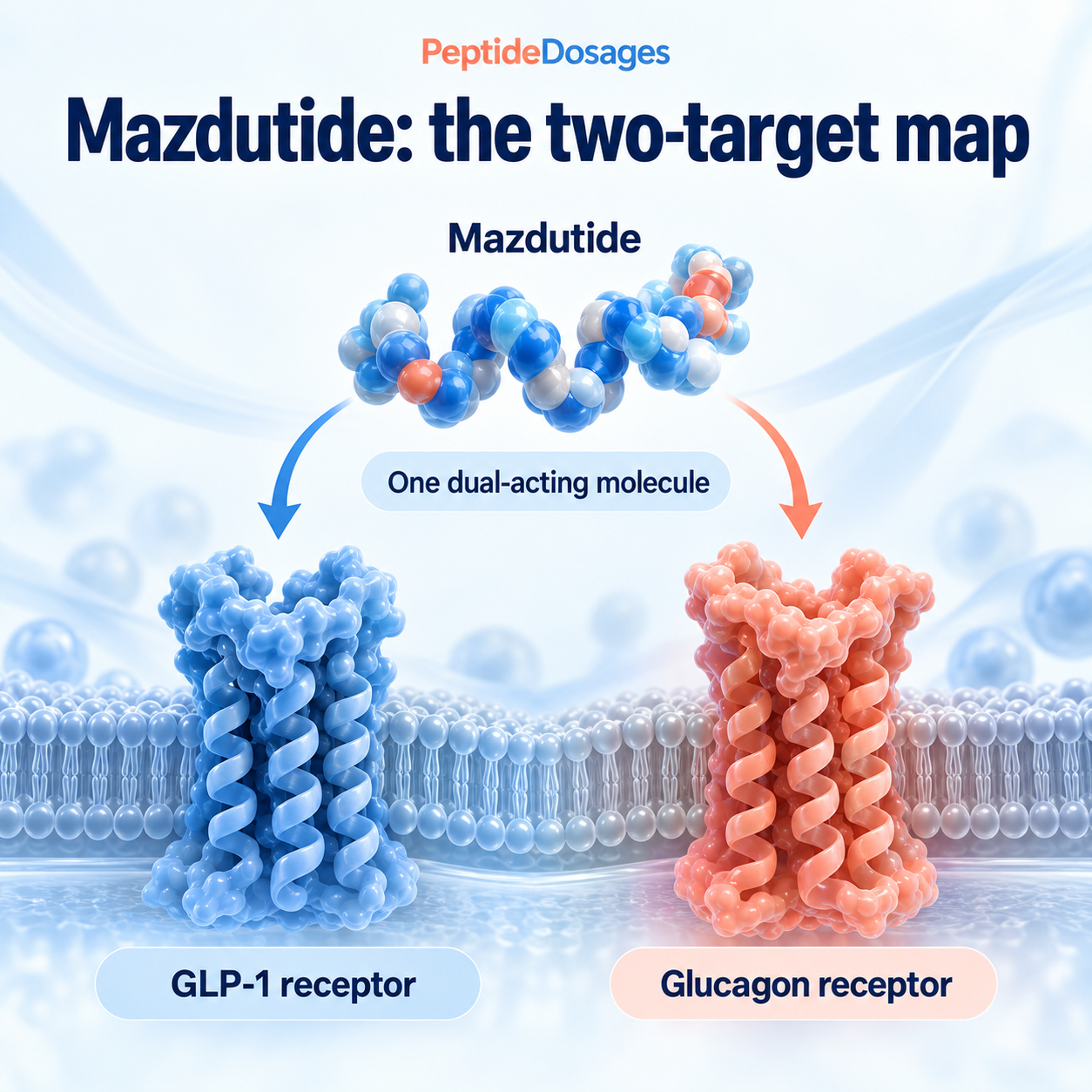
Mazdutide combines two receptor targets in one molecule. GLP-1 signaling is involved in appetite and glucose regulation. The glucagon-receptor component is intended to influence energy metabolism as well. That combination distinguishes it from a GLP-1-only drug such as semaglutide. Innovent licensed its development and commercialization in China from Eli Lilly. [4]
Receptor counts are not a ranking system. Adding another target can change both benefits and adverse effects. The useful test is what happens in adequately controlled human studies, rather than whether a mechanism sounds more advanced.
What do the weight-loss trials show?
There are several important results, and they should not be merged into one headline percentage. The table below keeps the study population and follow-up beside each finding. These are trial assignments, not a personal dosing guide.
| Trial and participants | Reported average weight change | Important context |
|---|---|---|
| GLORY-1: 610 Chinese adults with overweight or obesity | At 48 weeks: −11.00% with 4 mg and −14.01% with 6 mg, versus +0.30% with placebo. | The primary assessment was at 32 weeks. These are the later, treatment-policy results. [3] |
| GLORY-2: 462 randomized Chinese adults with BMI at least 30; 461 received treatment | At 60 weeks: −16.65% with 9 mg versus −1.50% with placebo. | Participants included people with and without type 2 diabetes; dietary and activity support accompanied treatment. [5] |
| US phase 2 trial: 179 adults without type 2 diabetes | At 32 weeks: −7.3%, −15.6% and −18.1% across the 3-to-6 mg, 10 mg and 16 mg assignments, versus −0.9% with placebo. | Used an efficacy analysis. The first group remained on 3 mg until week 32; 16 mg had more treatment discontinuations. [7] |
An average is not a promise. People in a trial can lose more, less or no weight, and some stop treatment. The studies also use different statistical approaches to account for treatment interruptions and missing data. Comparing the largest number from each paper without those details can be misleading.
Why do some reports give different percentages?
A treatment-policy analysis aims to estimate the effect of assignment to treatment, including relevant events such as stopping it. An efficacy or hypothetical analysis estimates a more specific scenario, such as continuing treatment as planned. Neither label should be silently dropped. GLORY-1 and the US phase 2 trial illustrate why the analysis and time point belong beside the percentage. [3] [7]
What about type 2 diabetes?
In DREAMS-1, 320 Chinese adults whose diabetes was inadequately controlled by diet and exercise received mazdutide or placebo. At 24 weeks, HbA1c fell by 1.57 percentage points with 4 mg and 2.15 points with 6 mg, compared with 0.14 points with placebo. HbA1c reflects longer-term blood-glucose exposure. [8]
This supports a glucose-lowering effect in the studied population. It does not mean diabetes is cured, that other medication should be stopped, or that the same response should be expected in someone with a different treatment history. The trial also reported gastrointestinal adverse events. [8]
Mazdutide versus semaglutide: is one better?
A direct comparison exists, but it needs its full label. In the DREAMS-3 results presented in 2026, mazdutide 6 mg was compared with semaglutide 1 mg in Chinese adults with type 2 diabetes and obesity. The manufacturer’s conference report gave average weight changes of −10.3% and −6.0%, respectively, at 32 weeks under its efficacy analysis. This was an open-label trial, not a blinded comparison against every semaglutide regimen. [4]
That does not answer whether mazdutide is better than semaglutide 2.4 mg for obesity, or which option is best for an individual. Nor can a placebo-controlled mazdutide trial establish superiority over tirzepatide or retatrutide. Those questions require matched comparisons, including tolerability and outcomes beyond weight.
Mazdutide side effects and safety
Digestive symptoms are a real part of the trade-off. In GLORY-2, vomiting occurred in 53.1% of participants receiving 9 mg, nausea in 46.9% and diarrhea in 39.4%. The corresponding placebo rates were 1.3%, 3.2% and 6.5%. Adverse events led 2.9% of the mazdutide group to stop treatment, versus none in the placebo group. [5]
Higher doses are not automatically a better choice. In the US phase 2 study, 20% of the 16 mg group discontinued because of adverse events, predominantly gastrointestinal problems. That trial was funded by Eli Lilly; the Chinese development studies also have manufacturer involvement. These disclosures matter when assessing the evidence. [7] [3]
A study can detect common symptoms without settling every rare or long-term risk. Suitability depends on medical history, other medicines and the locally approved product information. Persistent vomiting, dehydration or severe abdominal pain needs medical attention, not an assumption that discomfort means treatment is working.
Where is mazdutide approved?
Innovent announced NMPA approval in China for chronic weight management on June 27, 2025, followed by glycemic control in adults with type 2 diabetes on September 19, 2025. Those announcements concern defined indications and prescription products. [1] [2]
Do not read that as authorization for a US research-vial seller. In August 2026, FDA identified marketed mazdutide products among unapproved new drugs in an enforcement letter. A study result, a chemical identity and a country’s marketing approval are three different things. [6]
Can I copy a trial’s mazdutide dosage?
No trial table establishes a self-directed regimen. Study participants received controlled products, eligibility screening, dose escalation and follow-up. A vial advertised online cannot be assumed equivalent to those products. Use a healthcare professional and the applicable approved prescribing information when discussing treatment, rather than converting a headline dose into syringe markings.
Before trusting a mazdutide comparison, check these five details
- Were the participants living with diabetes, obesity or both?
- Was the comparator placebo or another medicine at a stated dose?
- At which week was the result measured?
- Which analysis handled people who stopped treatment?
- How many stopped because of adverse effects?
A useful summary answers all five, not only the weight-loss percentage.
The takeaway
Mazdutide has substantial human evidence, including phase 3 trials and Chinese approvals. That is different from a peptide supported only by laboratory experiments. It still needs careful interpretation: digestive adverse effects, country-specific approvals, trial populations and exact comparator doses all affect what the findings mean.
Related dosage protocols and research
Explore related research, dosage references and guides below. Vial strengths have separate references because concentration and syringe-unit calculations differ. A comparison does not mean the compounds are interchangeable.
Matching dosage protocols
Related protocols and comparisons
Further research context
References
- Innovent Biologics. China weight-management approval announcement. June 27, 2025. Manufacturer statement.
- Innovent Biologics. China type 2 diabetes approval announcement. September 19, 2025. Manufacturer statement.
- Once-Weekly Mazdutide in Chinese Adults with Obesity or Overweight. New England Journal of Medicine. 2025. GLORY-1.
- Innovent Biologics. DREAMS-3 results presented at the 2026 ADA Scientific Sessions. June 8, 2026. Manufacturer report of conference findings.
- Mazdutide 9 mg in Chinese adults with obesity: GLORY-2 randomized clinical trial. JAMA. 2026.
- US Food and Drug Administration. Warning letter concerning unapproved products, including mazdutide. August 24, 2026.
- Hsia SH et al. Efficacy and safety of mazdutide in adults with obesity or overweight: a US-based phase 2 randomized trial. Lancet Diabetes & Endocrinology. 2026.
- Zhu D et al. Mazdutide versus placebo in Chinese adults with type 2 diabetes. Nature. 2026. DREAMS-1.