
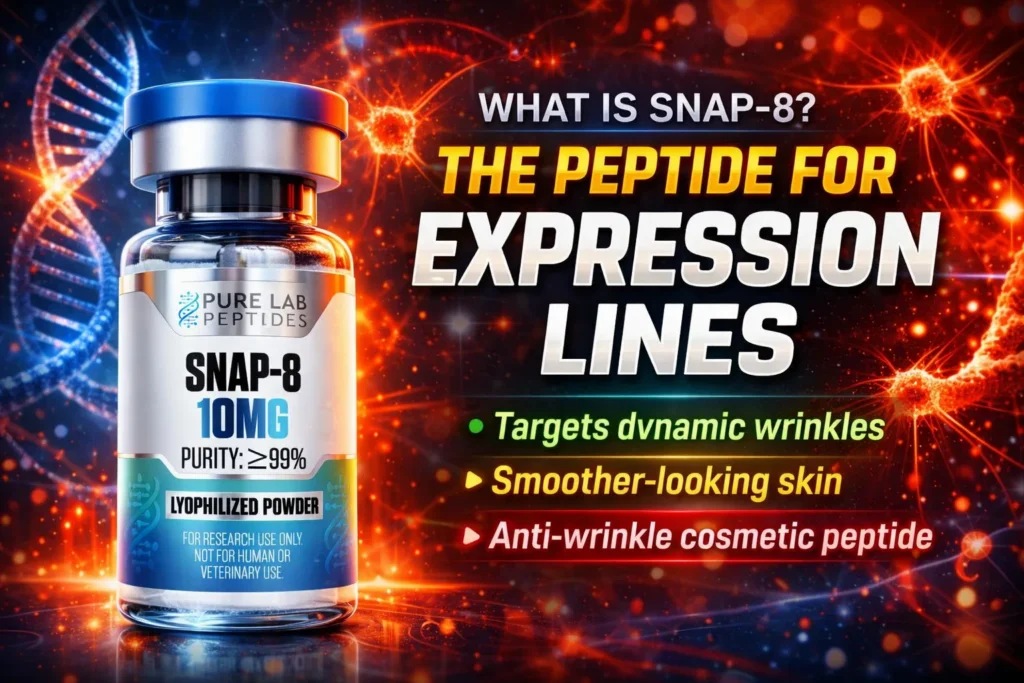
If you’re asking “what is SNAP-8,” you’re not alone—this label is confusing because it can refer to more than one thing. In peptide skincare and cosmetic research, SNAP‑8 (also written as “SNAP8”) usually means acetyl octapeptide‑3, a “botulinum-mimetic” peptide used to target expression lines.
This guide breaks down what SNAP‑8 is, how it’s supposed to work, what the research actually suggests, where the marketing gets slippery, and how to evaluate products or research materials with a clear checklist.
Fast Answer / Executive Summary
SNAP‑8 is a synthetic cosmetic peptide (acetyl octapeptide‑3) designed to reduce the look of expression lines by interfering with SNARE‑complex signaling involved in neurotransmitter release, leading to gentler “muscle relaxation” effects in topical use. It’s often compared to “Botox-like” peptides, but it’s non-invasive and heavily dependent on formulation and skin delivery. [1]
Core Concepts & Key Entities
SNAP‑8 is most commonly acetyl octapeptide‑3 in skincare science and cosmetic formulations. It is an 8–amino‑acid peptide designed as an analog of part of SNAP‑25 (a key protein involved in neurotransmitter release). [2]
Because the term “SNAP‑8” is overloaded, it’s worth a quick clarification: there is also a “SNAP‑8” in aerospace engineering, referring to a nuclear space power system described in historical technical documentation from NASA[3] and partner agencies. [4]
What SNAP‑8 is in peptides and skincare
SNAP‑8 (acetyl octapeptide‑3) is an anti-wrinkle cosmetic peptide positioned as an evolution of the earlier peptide Argireline (acetyl hexapeptide‑8). A 2024 review describes SNAP‑8 as developed by Lipotec[5] in the late 2000s and notes its sequence (Ac‑Glu‑Glu‑Met‑Gln‑Arg‑Arg‑Ala‑Asp‑NH₂). [6]
Commercial research-vial listings commonly report identifiers such as CAS 868844‑74‑0, molecular weight ~1075.2 g/mol, and the same peptide sequence. [7]
The key biological entities: SNAP‑25 and the SNARE complex
SNAP‑25 is part of the core SNARE machinery that enables vesicles to fuse with the cell membrane and release neurotransmitters. Multiple neuroscience reviews describe SNARE proteins (including SNAP‑25, syntaxin, and synaptobrevin/VAMP) as essential for regulated neurotransmitter release. [8]
SNAP‑8’s “botulinum-mimetic” positioning comes from this same neighborhood of biology: botulinum toxin type A works by cleaving SNAP‑25, blocking acetylcholine release at the neuromuscular junction, and thereby reducing muscle contraction (a mechanistic basis for its effects on dynamic wrinkles). [9]
How SNAP‑8 is intended to work
SNAP‑8 is described as competing with native SNAP‑25 for participation in the SNARE complex, disrupting SNARE assembly and modulating neurotransmitter release. This is described in peer-reviewed cosmetic science summaries and manufacturer technical materials. [10]
In a 2024 clinical microneedle-patch paper, the authors explicitly describe acetyl octapeptide‑3 (SNAP‑8™) as a botulinum toxin analog and report the peptide sequence while discussing its role in “blocking neurotransmitters and relaxing muscles to improve wrinkles.” [11]
A reality check: topical delivery is the bottleneck
Most peptides are large, hydrophilic molecules, and the stratum corneum is a major barrier—so passive topical delivery is difficult. A SNAP‑8 analytics paper states directly that polymeric compounds such as peptides “cannot pass through the stratum corneum” easily and uses microneedle patches as a delivery strategy. [12]
Independent skin-delivery research similarly notes that the stratum corneum restricts peptide/protein delivery due to high molecular weight and hydrophilicity/charge. [13]
That delivery constraint is why microneedles show up repeatedly in SNAP‑8 discussions: microneedles can bypass the stratum corneum and increase macromolecule delivery into skin layers in both foundational and modern reviews. [14]
The “peptide map” that helps you think clearly
Here’s a simple framework that clarifies what SNAP‑8 can—and cannot—reasonably be expected to do.
SNAP‑8 is primarily an “expression-line modulator,” not a “structure rebuilder.”
– Expression-line modulators aim to soften dynamic wrinkles by influencing neuromuscular signaling (SNAP‑8, Argireline). [15]
– Photoaging structure rebuilders improve fine wrinkles and texture by changing epidermal turnover and dermal signaling (retinoids) and by preventing UV-driven breakdown (sunscreen). [16]
This matters because many disappointing experiences come from expecting SNAP‑8 to behave like a retinoid, resurfacing procedure, or injectable neuromodulator.
Step‑by‑Step / How‑To
Step one: Confirm you’re talking about the peptide version of SNAP‑8
SNAP‑8 in peptide skincare refers to acetyl octapeptide‑3, not the aerospace SNAP‑8 nuclear power system. The nuclear SNAP‑8 is documented as a turboelectric space power system designed to produce ~35 kWe in historical reports, which is obviously unrelated to skincare or cosmetic peptides. [4]
If a product page mentions acetyl octapeptide‑3, SNAP‑25, SNARE complex, “expression lines,” or “anti-wrinkle,” you’re almost certainly in the peptide/cosmetic meaning. [17]
Step two: Choose the format you’re actually using
SNAP‑8 shows up in two main “real-world” formats: cosmetic ingredient solutions and research-grade powders.
1) Cosmetic ingredient solutions (common in DIY and formulation)
Some technical sheets describe SNAP‑8 as a solution with 0.05% active ingredient, intended for incorporation into skincare formulations rather than used neat. [18]
2) Lyophilized research powders (common in peptide-vial marketplaces)
Many vendors sell SNAP‑8 as lyophilized powder with specifications like CAS 868844‑74‑0, the peptide sequence, and a “research use only” disclaimer. For example, a purchase page from PureLabPeptides[19] states the product is intended solely for research/laboratory use and “not intended for human or animal consumption,” with bodily introduction prohibited. [20]
Key takeaway: Pick the safety and evidence lane that matches your use case—topical cosmetic use is the dominant evidence lane for SNAP‑8, not self-administration from research vials. [21]
Step three: Decode the “percentage trap” on labels and product claims
A “10% SNAP‑8” claim often means “10% of a pre-diluted supplier solution,” not “10% pure peptide.” This is one of the biggest sources of confusion and overhyped expectations. [22]
Here’s the practical math:
- If a supplier solution contains 05% active acetyl octapeptide‑3 [23]
- And the recommended usage is 3–10% of that solution in a formula [24]
- Then your true active peptide level becomes:
0.05% × 3% = 0.0015% active peptide
0.05% × 10% = 0.005% active peptide
That exact “10% solution equals 0.005% pure peptide” idea is also echoed in ingredient analysis discussions that cite manufacturer comparisons. [25]
Key takeaway: When comparing products, compare the estimated true active peptide level—not the marketing percentage. [18]
Step four: Set expectations using the best-available human evidence
The most defensible expectation for SNAP‑8 is gradual softening of expression-line appearance over weeks, not an instant “frozen” effect. A 2024 review reports clinical indications of up to ~38% wrinkle-depth reduction within 28 days in studied contexts. [26]
Some manufacturer-facing materials cite stronger outcomes (for example, “up to 63%” in certain measurements), but these are best treated as promotional maxima rather than guaranteed results across users and formulations. [27]
A more conservative (and practical) way to think about it:
- Most likely: subtle-to-moderate smoothing of dynamic lines in high-movement zones (crow’s feet, forehead)
- Less likely: meaningful change in deep static folds caused by volume loss, sun damage, or laxity
This aligns with how dynamic wrinkles are generally defined: they arise from repeated facial muscle movement and tend to appear first around eyes/forehead. [28]
Step five: Use SNAP‑8 in a routine that doesn’t sabotage results
If you’re using SNAP‑8 topically, daily UV protection is the highest-leverage “multiplier” for any anti-aging routine. A randomized trial found daily sunscreen users had 24% less skin aging progression than discretionary users over 4.5 years. [29]
If your goal is visible wrinkle change (not just prevention), topical retinoids remain the clinical gold standard for photoaging-focused fine wrinkle improvement in dermatology reviews. [30]
SNAP‑8 fits best as a “dynamic wrinkle add-on,” not the entire plan.
Step six: If you’re evaluating microneedle patches, look for human data and safety reporting
Microneedle delivery is one of the most evidence-consistent ways to improve peptide delivery past the stratum corneum. [14]
A 2024 comparative clinical study evaluated a dissolving microneedle patch containing hyaluronic acid plus acetyl octapeptide‑3 and other actives in 24 subjects aged 30–65; the patch was applied repeatedly over 28 days with scheduled assessments including wrinkle measures, TEWL, and adverse effects. [31]
The authors report improved eye-wrinkle measures versus placebo microneedles and note no adverse effects in the reported outcomes. [32]
Comparison / Alternatives
SNAP‑8 is best compared to other “expression line” options first (Argireline, neuromodulator approaches), and then to broader anti‑aging staples (retinoids and sunscreen). [33]
| Option | What it targets | Evidence snapshot | Practical pros | Practical trade‑offs |
| SNAP‑8 (Acetyl Octapeptide‑3) | Dynamic lines via SNARE-complex modulation | Review reports up to ~38% wrinkle-depth reduction in 28 days in studied settings; delivery is a known constraint [34] | Non-invasive; “expression line” focus | Fewer independent trials than older peptides; results depend heavily on delivery/formulation [35] |
| Argireline (Acetyl Hexapeptide‑8) | Similar “botulinum-mimetic” signaling approach | Small human study: up to ~30% wrinkle-depth reduction after 4 weeks with 10% formulation; no toxicity observed in that trial [36] | More published human data; often easier to find in mainstream skincare | Same topical penetration bottleneck; benefit tends to be subtle and expression-line specific [37] |
| Botulinum toxin injections (e.g., Botox) | Dynamic lines via SNAP‑25 cleavage → blocks ACh release at NMJ | Mechanism is well-established; clinical use is widespread [9] | Strongest effect for dynamic lines | Medical procedure; cost, contraindications, potential adverse effects; not a DIY option [38] |
| Topical retinoids (tretinoin/retinoid therapy) | Photoaging signs (fine wrinkles, texture, pigment) via epidermal/dermal changes | Systematic reviews show improvements in photodamage signs including fine wrinkles over weeks to months [39] | Best-supported topical for visible photoaging change | Irritation is common; consistent sunscreen use is non-negotiable [40] |
| Daily broad-spectrum sunscreen | Prevents UV-driven collagen breakdown and “locking in” lines | RCT shows 24% less aging progression with daily use over 4.5 years [29] | Highest ROI for prevention; improves outcomes of any active | Not a quick fix; requires consistency and proper application [41] |
Key takeaway: SNAP‑8 is most rational as a targeted add-on for expression lines—while sunscreen + (often) retinoids do the heavy lifting for overall photoaging. [42]
Templates / Checklist / Example
Use this checklist to avoid the three most common SNAP‑8 mistakes: confusing the acronym, misreading concentrations, and expecting Botox-level results from a topical peptide. [43]
SNAP‑8 evaluation checklist
- Confirm the ingredient identity: look for “Acetyl Octapeptide‑3” (SNAP‑8) rather than unrelated “SNAP‑8” engineering references. [44]
- Check whether the label reports a solution percentage or a true active percentage (the “percentage trap”). [45]
- Estimate true active peptide level using: supplier active % × formula use %. [23]
- Prioritize delivery-supporting formats if you’re serious about results (e.g., well-designed patches/microneedles with human data). [46]
- Patch-test and stop if you develop irritation; avoid use on compromised skin. (Educational only—no medical advice.)
- Track progress with standardized photos (same lighting, angle, expression) at day 0 and day 28. [26]
- Anchor your routine with daily sunscreen; it prevents new damage while actives work. [47]
- Verify vendor quality signals if purchasing research materials: COA availability, identity/purity reporting, and clear “research use only” statements. [20]
Copy-ready “percentage reality check” example
If a supplier technical sheet or dossier states “0.05% active ingredient” and recommends use at “3–10%,” your formula’s true active range is approximately 0.0015–0.005% acetyl octapeptide‑3. [18]
Write this into your notes so you can compare products honestly:
- Product A: “10% SNAP‑8 solution” → likely ~0.005% active
- Product B: “3% SNAP‑8 solution” → likely ~0.0015% active
That difference can matter more than most “premium vs budget” branding.
FAQs
What is SNAP‑8 in skincare?
What is SNAP‑8 in skincare? SNAP‑8 in skincare is acetyl octapeptide‑3, a synthetic peptide designed to reduce the appearance of expression lines by modulating SNARE‑complex signaling involved in neurotransmitter release. It’s often described as a topical “Botox-like” or botulinum-mimetic peptide, but outcomes depend on delivery through the skin barrier and consistent use. [48]
Is SNAP‑8 the same as Argireline?
Is SNAP‑8 the same as Argireline? SNAP‑8 is not the same as Argireline, but it is closely related in concept. Argireline is acetyl hexapeptide‑8, while SNAP‑8 is acetyl octapeptide‑3 and is described as an extended sequence designed to enhance SNARE‑complex disruption compared with Argireline. Both are positioned for expression-line smoothing rather than deep structural remodeling. [49]
How long does SNAP‑8 take to work?
How long does SNAP‑8 take to work? SNAP‑8 is typically discussed in “weeks” rather than “days,” with reports of measurable wrinkle-depth changes around the 28‑day mark in some clinical contexts. A 2024 review summarizes reports of up to ~38% wrinkle-depth reduction within 28 days, but results can vary widely depending on concentration, delivery, and baseline wrinkle type (dynamic vs static). [50]
What percentage of SNAP‑8 should be in a serum?
What percentage of SNAP‑8 should be in a serum? The most important point is whether the percentage refers to a supplier solution or pure peptide. Some technical materials describe a SNAP‑8 solution containing 0.05% active peptide, with recommended formulation use around 3–10%—which translates to roughly 0.0015–0.005% true active. Always interpret percentages in that context before comparing products. [51]
Is SNAP‑8 safe?
Is SNAP‑8 safe? SNAP‑8 safety for topical use appears generally acceptable in the limited human data that is publicly described, but the evidence base is smaller than for many mainstream skincare actives. For example, a 2024 clinical microneedle study using acetyl octapeptide‑3 in an eye-area patch reported no adverse effects in the reported outcomes. That said, “safe” still depends on formulation, use pattern, and individual sensitivity. [32]
Can you inject SNAP‑8?
Can you inject SNAP‑8? SNAP‑8 is widely positioned and studied as a topical cosmetic peptide, and many commercial research products explicitly state they are not approved for human or animal use and prohibit bodily introduction. If you see dosing discussions online, treat them as non-medical, non-authoritative content; for safety and legality, follow labeled constraints and consult a qualified clinician for medical procedures. [52]
Next Steps
SNAP‑8 is best viewed as a targeted “expression line” peptide with results that depend on realistic expectations, correct concentration interpretation, and delivery through the skin barrier. [53]
If you want the shortest path to better outcomes, keep the basics locked in first (daily sunscreen, proven anti-photoaging actives if appropriate), then add SNAP‑8 as a focused supplement for dynamic wrinkle zones. [54]
For PeptideDosages.com readers who want deeper context on SNAP‑8 research materials and protocols, see the internal guide here: SNAP‑8 (10 mg vial) dosage protocol. [55]
If you’re sourcing for laboratory research, the referenced purchase page is here: SNAP‑8 10mg (research use) on PureLabPeptides. [20]
Educational content only. This is not medical advice, and it does not prescribe or recommend any medical treatment.
[1] [2] [6] [10] [15] [19] [21] [26] [33] [34] [48] [49] [50] [53] Sustainable Dynamic Wrinkle Efficacy: Non-Invasive Peptides as the Future of Botox Alternatives | MDPI
https://www.mdpi.com/2079-9284/11/4/118
[3] [12] [37] Method development for acetyl octapeptide-3 analysis by liquid chromatography-tandem mass spectrometry | Journal of Analytical Science and Technology | Springer Nature Link
https://link.springer.com/article/10.1186/s40543-020-00232-8
[4] ntrs.nasa.gov
https://ntrs.nasa.gov/api/citations/19670000944/downloads/19670000944.pdf
[5] [17] [18] [22] [23] [24] [27] [43] [44] [45] [51] cossma.com
https://www.cossma.com/fileadmin/all/cossma/Archiv/ProductInfo/COS1005_14_ProdSnap8.pdf
[7] [20] [52] Buy SNAP-8 Peptide | Advanced Anti-Wrinkle Research Solution
https://purelabpeptides.com/buy-peptides/buy-snap-8-10mg/
[8] Molecular Mechanisms Underlying Neurotransmitter Release
https://pmc.ncbi.nlm.nih.gov/articles/PMC9490555/?utm_source=chatgpt.com
[9] [38] The mechanisms of action and use of botulinum neurotoxin …
https://pmc.ncbi.nlm.nih.gov/articles/PMC7693297/?utm_source=chatgpt.com
[11] [31] [32] [46] :: AD :: Annals of Dermatology
https://anndermatol.org/DOIx.php?id=10.5021%2Fad.23.136
[13] [35] Enhanced Skin Permeation of Anti-wrinkle Peptides via …
https://www.nature.com/articles/s41598-017-18454-z?utm_source=chatgpt.com
[14] Microneedles for transdermal drug delivery
https://pubmed.ncbi.nlm.nih.gov/15019747/?utm_source=chatgpt.com
[16] [30] [42] Skin ageing and topical rejuvenation strategies
https://academic.oup.com/bjd/article/189/Supplement_1/i17/7333865?utm_source=chatgpt.com
[25] Acetyl Octapeptide-3 (Explained + Products)
https://incidecoder.com/ingredients/acetyl-octapeptide-3?utm_source=chatgpt.com
[28] Expression Lines & Dynamic Wrinkles
https://www.skinceuticals.com/skincare-advice/what-are-expression-lines.html?utm_source=chatgpt.com
[29] [47] [54] Sunscreen and prevention of skin aging: a randomized trial
https://pubmed.ncbi.nlm.nih.gov/23732711/?utm_source=chatgpt.com
[36] Investigating the effects of Argireline in a skin serum containing hyaluronic acids on skin surface wrinkles using the Visia® Complexion Analysis camera system for objective skin analysis – PMC
https://pmc.ncbi.nlm.nih.gov/articles/PMC10665711/
[39] [40] Topical tretinoin for treating photoaging: A systematic review …
https://pmc.ncbi.nlm.nih.gov/articles/PMC9112391/?utm_source=chatgpt.com
[41] Sunscreens and Photoaging: A Review of Current Literature
https://pmc.ncbi.nlm.nih.gov/articles/PMC8361399/?utm_source=chatgpt.com
[55] SNAP-8 Dosage Protocol | PeptideDosages.com
https://peptidedosages.com/single-peptide-dosages/snap-8-10-mg-vial-dosage-protocol/