What is PT-141 is one of the most common questions in peptide communities because PT‑141 sits at the intersection of “brain signaling” and “sexual desire”—two topics that get a lot of hype and a lot of confusion. PT‑141 (also called bremelanotide) is a melanocortin receptor agonist studied and used in a very specific clinical context, with clear safety constraints and labeling. [1]

In this guide, you’ll learn what PT‑141 is, how it works (in plain English), what the best evidence actually supports, what risks matter most, and how to evaluate products and claims without falling for marketing. Educational only—not medical advice. [2]

Fast Answer / Executive Summary

PT‑141 is a synthetic peptide (bremelanotide) that activates melanocortin receptors, especially MC4R pathways in the brain, and is FDA‑approved (as Vyleesi) for acquired, generalized hypoactive sexual desire disorder (HSDD) in premenopausal women. It is taken “as needed” by injection in the prescription form, with strict frequency limits due to nausea, blood pressure effects, and pigmentation risk. [3]

Core Concepts & Key Entities and How PT-141 Works

PT‑141 is bremelanotide—two names for the same active molecule in the context most people mean online. “PT‑141” is common in peptide purchasing and research discussions, while “bremelanotide” is the generic name used in clinical literature and prescription labeling. [4]

What PT-141 actually is (molecular category, not hype)

PT‑141 (bremelanotide acetate) is a synthetic, cyclic heptapeptide. In FDA labeling, it’s described structurally as a 7‑amino‑acid cyclic peptide with a defined sequence and acetate counterion range, along with a molecular weight and formula. That matters because it anchors PT‑141 in a specific chemical identity—not a vague “libido peptide.” [5]

In its FDA‑approved form (Vyleesi), bremelanotide is supplied as a sterile solution in a single‑dose autoinjector (1.75 mg/0.3 mL). That is a different product format than the “lyophilized powder” vials sold for research use, which can vary in handling requirements and quality signals. [6]

The clinical indication people should understand first

In the approval documents for Vyleesi, the U.S. Food and Drug Administration[7] defines the indication narrowly: premenopausal women with acquired, generalized HSDD, characterized by low desire that causes distress or interpersonal difficulty and is not better explained by another condition, relationship issues, or substances/medications. [4]

That same labeling also states limitations of use: not indicated for postmenopausal women or men, and not indicated to enhance sexual performance. This doesn’t mean “no one else will ever discuss it,” but it does define what has been reviewed for approval and what safety constraints are emphasized. [8]

The mechanism in plain English (and what is known vs unknown)

PT‑141 is a melanocortin receptor (MCR) agonist that nonselectively activates multiple receptor subtypes, with binding to MC1R and MC4R considered most relevant at therapeutic levels. MC4R‑expressing neurons are widely distributed in the central nervous system, which is why PT‑141 is generally framed as “centrally acting” (brain‑pathway focused). [9]

The FDA label is also transparent about uncertainty: the exact mechanism by which Vyleesi improves HSDD is unknown. In other words, receptor binding and neurobiology provide strong hypotheses, but the full causal chain in humans is not “solved.” [10]

A detailed neurobiology review in CNS Spectrums adds the commonly cited working model: MC4R activity in hypothalamic regions (notably the medial preoptic area) may increase dopamine signaling tied to sexual motivation and desire. This is one reason PT‑141 is often contrasted (appropriately) with blood‑flow–focused approaches. [11]

Why pigmentation keeps showing up in warnings

One of the more “surprising” effects for beginners is pigmentation risk, and it’s not random: MC1R is expressed on melanocytes, and receptor binding increases melanin expression (pigmentation). That mechanistic detail directly explains why frequent exposure can increase pigment‑related adverse events. [12]

Main Uses, Research Interest, and Why People Look It Up

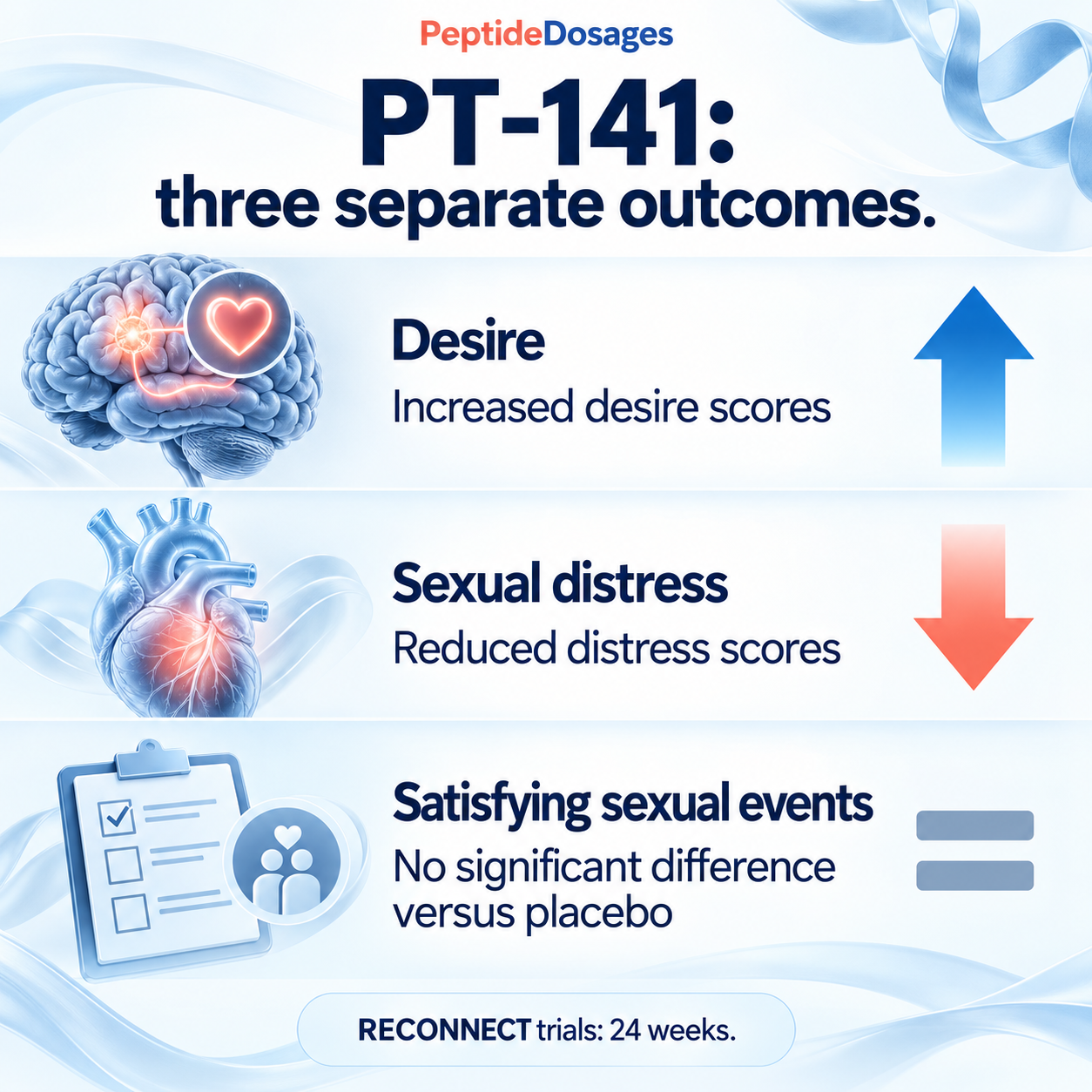
People look up PT‑141 primarily because it’s positioned as a desire‑pathway peptide rather than a “performance mechanics” compound. In the clinical frame, it’s connected to HSDD: low sexual desire paired with distress. [13]

What the best human evidence is actually about

The most defensible “benefit statement” is the narrow one: in clinical trials and labeling, bremelanotide is intended to improve symptoms of acquired, generalized HSDD in premenopausal women when used as directed and when appropriate diagnostic criteria are met. The approval package and prescribing information define that intended use and the boundaries around it. [4]

A broader safety analysis across the clinical development program (thousands of subjects) supports two practical takeaways:
1) the most common adverse events are predictable and frequent (especially nausea), and
2) pigmentation and blood‑pressure effects become more relevant as dosing frequency increases. [14]

Why “desire vs arousal vs performance” is the key distinction most pages miss

Here’s the decision clarity most people don’t get from competing pages: PT‑141 is best understood as a “desire‑pathway modulator,” not a “blood‑flow amplifier.” If someone’s main issue is erection biomechanics, lubrication, pain with sex, relationship distress, or stress overload, the causal bottleneck may not be the melanocortin/dopamine pathway. [15]

The International Society for the Study of Women’s Sexual Health[16] process‑of‑care framework for HSDD emphasizes a biopsychosocial assessment and distinguishing generalized acquired HSDD from other patterns of low desire—because “low desire” is not a single‑cause problem. [17]

Why researchers care about PT-141 beyond “libido talk”

Even if you strip out consumer marketing, PT‑141 is scientifically interesting because it is a tool compound for melanocortin signaling—especially MC4R‑linked neural processing. A clinical research paper in JCI reports that MC4R agonism changed sexual brain processing measures in women with HSDD (e.g., reduced self‑consciousness and increased sexual imagery in the study context), reinforcing why PT‑141 is discussed as a central pathway agent. [18]

Step-by-Step / How-To: How to Evaluate PT-141 Without Getting Misled

The safest way to approach PT‑141 is to evaluate it on three tracks: identity (what it is), evidence (what it can realistically do), and risk (what can go wrong). This section gives you a practical sequence you can follow—even if you’re brand new. [19]

Clarify what “PT-141” means in your context

PT‑141 can refer to a prescription autoinjector product (bremelanotide solution) or to research‑grade lyophilized powder sold online. The prescription product has controlled manufacturing and an FDA‑reviewed label; research vials vary by vendor quality signals and are typically sold with “research use only” framing. [20]

If your goal is understanding the clinically reviewed reality, start with labeling facts (indication, contraindications, dosing limits, and adverse event rates). If your goal is laboratory research or educational peptide math, be explicit about that—and keep the clinical safety constraints in mind anyway, because the molecule doesn’t change. [21]

Anchor your expectations to the labeled use case

The FDA‑reviewed indication is not “general sexual enhancement”; it is acquired, generalized HSDD in premenopausal women with distress. That definition matters because it filters out a lot of situations where PT‑141 is unlikely to match the real bottleneck (for example, situational stress, relationship conflict, or medication‑induced changes). [13]

If you want a practical tool here, use this quick “fit check” borrowed from how clinicians think:

  • Acquired: did low desire develop after a prior baseline of normal desire?
  • Generalized: does it occur across partners/situations/stimulation types?
  • Distress: is there meaningful distress or interpersonal difficulty? [4]

Know the big safety constraints before you go further

Bremelanotide is contraindicated in uncontrolled hypertension or known cardiovascular disease. The label also notes it’s not recommended for patients at high cardiovascular risk, because it can transiently raise blood pressure after each dose. [22]

The actual measured signal in the label is specific: maximal increases around 6 mmHg systolic and 3 mmHg diastolic, peaking 2 to 4 hours post‑dose, usually returning to baseline within 12 hours, with heart rate reduction up to 5 bpm. That’s not “nothing,” and it’s a reason the label is strict about dosing frequency. [23]

Understand the adverse events people most often underestimate

Nausea is the headline adverse event for PT‑141 in clinical trials—reported around 40% with dosing up to eight times per month in phase 3 trials. The label also notes anti‑emetic use in a subset and discontinuation in some patients, and that nausea often improves by the second dose for many. [24]

Pigmentation is the sleeper issue: in phase 3 trials, focal hyperpigmentation was reported in about 1% of patients using up to eight doses per month, but with daily dosing, a separate study cited in labeling observed much higher rates (over one‑third). This is a “frequency‑sensitive” risk, not just a random rare event. [24]

Use labeling limits as a reality filter (even if you’re just learning)

Prescription labeling is clear on guardrails: no more than one dose within 24 hours, and more than eight doses per month is not recommended. The label directly links higher frequency to increased pigmentation risk and longer total time per month with elevated blood pressure. [22]

It also includes a built‑in “stop rule”: discontinue after eight weeks if there is no symptom improvement. That’s not a magic number for everyone, but it is a psychologically useful guardrail against endless experimenting. [25]

Check interactions that matter more than people expect

Bremelanotide can slow gastric emptying, which can affect the absorption timing of certain oral medications. The label highlights avoiding use with oral drugs where threshold concentrations are critical (the label gives antibiotics as an example) and being cautious when a quick onset is desired (the label cites indomethacin as an example). [26]

One interaction is called out as especially important: bremelanotide may significantly decrease systemic exposure to orally administered naltrexone, and the label advises avoiding the combination due to the severe consequence of treatment failure. [27]

Evaluate vendor and product signals like a skeptic

If you are evaluating research-only PT‑141 vials, quality signals matter more than branding. Look for lot‑linked documentation (COA), identity/assay methods, and clear “research use” positioning rather than medical promises. [28]

For example, the vendor Pure Lab Peptides[29] states that its products are intended for professional research use only and that it adheres to regulations governing research-grade peptides. That’s not proof of quality by itself, but it is a baseline signal you can verify and compare across vendors. (Purchase page provided: https://purelabpeptides.com/buy-peptides/buy-pt-141-10mg/) [30]

Comparison / Alternatives / Important Distinctions

The most relevant same-lane comparison for PT‑141 is flibanserin, because both are FDA‑approved, non‑hormonal options for acquired, generalized HSDD in premenopausal women—but they differ fundamentally in dosing pattern and risk profile. PDE5 inhibitors (like sildenafil) are also commonly compared because many people assume “sexual function” equals “blood flow,” even though the target problem is different. [31]

PT‑141 vs Addyi vs PDE5 inhibitors (quick decision table)

Option Primary target Best-fit purpose Dosing pattern (label-level summary) What people usually notice first Key risks / constraints
PT‑141 (bremelanotide / Vyleesi) Melanocortin receptors; MC4R pathways in CNS Desire/interest symptoms consistent with acquired, generalized HSDD (premenopausal women in FDA labeling) As-needed injection; not more than once per 24 hours; more than eight doses/month not recommended; stop after eight weeks if no improvement Nausea can be prominent; effects are discussed as “central” (brain pathway) Contraindicated in uncontrolled hypertension or known CVD; transient BP increase; focal hyperpigmentation risk rises with frequency; slows gastric emptying; avoid oral naltrexone combination [32]
Flibanserin (Addyi) Serotonin receptor modulation with downstream dopamine/norepinephrine effects Same-lane HSDD indication (women under 65 in labeling) Daily oral dosing at bedtime; strict alcohol timing rules; multiple contraindications (hepatic impairment, CYP3A4 inhibitors) Sedation/somnolence and hypotension risks shape real-world use Boxed warning for hypotension/syncope in certain settings; alcohol timing constraints; multiple drug interactions; not indicated in men or for performance enhancement [33]
PDE5 inhibitors (e.g., sildenafil class) NO–cGMP pathway in smooth muscle; vasodilation Mechanical erectile response support (primarily ED) rather than “desire” On-demand oral use (varies by agent) Easier mental model (“blood flow”) but wrong target for many desire problems Best evidence and first-line role are in ED; mechanism is peripheral vasodilation via NO/cGMP signaling; different risk set and contraindications depending on cardiovascular meds [34]

Key takeaway: PT‑141 is most appropriately framed as a “desire-pathway” tool, while PDE5 inhibitors are “blood-flow pathway” tools, and Addyi is a “daily neuromodulation” tool—so the right choice depends on the bottleneck, not the buzz. [35]

Checklist / Template / Example

Use this checklist to evaluate PT‑141 claims, products, and fit in under five minutes. It is designed for peptide beginners, but it’s strict enough for experienced buyers to use as a sanity check. [36]

PT-141 evaluation checklist (copy-ready)

  • Define whether the goal is desire/interest (central) or mechanical arousal response (peripheral), because PT‑141 is primarily framed as a central melanocortin pathway agent. [11]
  • Confirm the intended context matches the evidence (acquired, generalized HSDD in premenopausal women is the FDA‑reviewed indication). [4]
  • Screen for cardiovascular red flags, because bremelanotide is contraindicated in uncontrolled hypertension or known cardiovascular disease. [22]
  • Expect nausea as a realistic possibility, not a rare edge case (around 40% in phase 3 labeling summaries). [24]
  • Respect frequency-based risk: increased use raises exposure time to blood-pressure effects and increases hyperpigmentation risk signals. [24]
  • Check drug interaction sensitivity, including slowed gastric emptying and the specific warning about oral naltrexone exposure reduction. [26]
  • Prefer clear sourcing signals (lot-linked COA, assay/identity methods, “research use only” language instead of medical promises). [28]
  • Track outcomes and set an exit criterion (the label’s eight-week “no improvement” discontinuation rule is a strong guardrail against endless experimentation). [25]

Where to find a dosing and vial math reference (educational)

If your goal is educational “vial math” and protocol-style reference (not medical advice), PeptideDosages.com[37] publishes a PT‑141 10 mg vial dosing protocol. Use it as a reference point while keeping FDA labeling constraints firmly in mind, especially around frequency-related risk. https://peptidedosages.com/single-peptide-dosages/pt-141-10-mg-vial-dosage-protocol/ [38]

FAQs

Is PT‑141 the same as bremelanotide?

Is PT‑141 the same as bremelanotide? PT‑141 is the name commonly used in peptide and research contexts, while bremelanotide is the generic name used in clinical labeling and publications. The FDA-approved product labeling describes bremelanotide acetate as a synthetic cyclic heptapeptide and outlines its indication and safety limits. [39]

What is PT‑141 used for?

What is PT‑141 used for? PT‑141 (bremelanotide) is FDA‑approved (as Vyleesi) for acquired, generalized hypoactive sexual desire disorder (HSDD) in premenopausal women when low desire causes marked distress or interpersonal difficulty and isn’t due to other causes. The label also states it is not indicated in men and not indicated to enhance sexual performance. [40]

How does PT‑141 work?

How does PT‑141 work? PT‑141 works by activating melanocortin receptors, with MC4R pathways in the central nervous system viewed as especially relevant at therapeutic levels. The FDA label notes the exact mechanism for improving HSDD is unknown, while neurobiology reviews suggest MC4R activation in hypothalamic circuits may increase dopamine signaling linked to sexual desire. [41]

What are the most common PT‑141 side effects?

What are the most common PT‑141 side effects? The most common PT‑141 side effect signal in FDA labeling and safety analyses is nausea, reported around 40% in phase 3 data summaries, with flushing, headache, and injection-site reactions also reported. The label also highlights transient blood pressure increases and focal hyperpigmentation risk that rises with more frequent dosing. [24]

Can PT‑141 raise blood pressure?

Can PT‑141 raise blood pressure? PT‑141 can transiently raise blood pressure after each dose, and the FDA label reports maximal increases of about 6 mmHg systolic and 3 mmHg diastolic, peaking 2 to 4 hours post-dose and usually resolving within 12 hours. Because of this, it is contraindicated in uncontrolled hypertension or known cardiovascular disease. [22]

PT‑141 vs Addyi: which is “better”?

PT‑141 vs Addyi: which is “better”? PT‑141 and Addyi are both FDA‑approved, non‑hormonal options for acquired, generalized HSDD, but they are different tools. PT‑141 is an as‑needed injection with nausea and blood-pressure/pigmentation constraints, while Addyi is a daily bedtime tablet with boxed warning–level hypotension/syncope risks in certain settings and strong interaction constraints. “Better” depends on fit and risk tolerance. [42]

Next Steps

The best next step is to treat PT‑141 as a specific, clinically constrained molecule—then decide if your goal matches its strongest evidence lane. Start by anchoring to FDA labeling: indication (acquired, generalized HSDD in premenopausal women), contraindications (uncontrolled hypertension/known cardiovascular disease), and the frequency-linked risks (nausea, blood pressure effects, hyperpigmentation). [43]

If you want an educational reference for research-only vial math and protocol formatting, use the internal PT‑141 vial guide linked above. If you’re evaluating a research supplier, the external purchase link you provided is one option (with vendor-stated research-use positioning): https://purelabpeptides.com/buy-peptides/buy-pt-141-10mg/. Keep comparisons vendor-to-vendor, and let documentation quality—not marketing—drive the decision. [44]

For more peptide education and evidence-first breakdowns, explore peptidedoses.com. PT‑141 is most useful when you’re solving a “desire-pathway” problem—not when you’re chasing a vague promise. [45]

PUBLISHING FIELDS

  • SEO Title (≤ 60 chars): What Is PT-141? How It Works, Risks & What to Know
  • Meta Description (140 to 160 chars): What is PT-141? Learn what bremelanotide is, how it works, key risks (BP, nausea, pigmentation), comparisons, and FAQs—evidence-first.
  • URL Slug (kebab-case, short, no stopwords): pt-141-bremelanotide-guide

[1] [2] [3] [5] [6] [8] [9] [10] [12] [16] [19] [20] [21] [22] [23] [24] [25] [26] [27] [29] [31] [32] [36] [37] [39] [41] [42] LABEL

https://www.accessdata.fda.gov/drugsatfda_docs/label/2019/210557s000lbl.pdf

[4] [13] [40] [43] Approval Package

https://www.accessdata.fda.gov/drugsatfda_docs/nda/2019/210557Orig1s000Approv.pdf

[7] [28] [30] [44] Buy PT-141 Peptide Online | Enhances Sexual Performance

https://purelabpeptides.com/buy-peptides/buy-pt-141-10mg/

[11] [15] [35] [45] The neurobiology of bremelanotide for the treatment of hypoactive sexual desire disorder in premenopausal women | CNS Spectrums | Cambridge Core

https://www.cambridge.org/core/journals/cns-spectrums/article/neurobiology-of-bremelanotide-for-the-treatment-of-hypoactive-sexual-desire-disorder-in-premenopausal-women/CB2718A94BC8F52E562867A0F1689B15

[14] Safety Profile of Bremelanotide Across the Clinical Development Program – Anita H. Clayton, Sheryl A. Kingsberg, David Portman, Amama Sadiq, Julie Krop, Robert Jordan, Johna Lucas, James A. Simon, 2022

https://journals.sagepub.com/doi/full/10.1089/jwh.2021.0191

[17] The International Society for the Study of Women’s Sexual Health Process of Care for Management of Hypoactive Sexual Desire Disorder in Women – ScienceDirect

https://www.sciencedirect.com/science/article/pii/S0025619617307991

[18]  JCI – Melanocortin 4 receptor agonism enhances sexual brain processing in women with hypoactive sexual desire disorder

https://www.jci.org/articles/view/152341

[33] ADDYI

https://www.accessdata.fda.gov/drugsatfda_docs/label/2025/022526s013lbl.pdf

[34]  PDE5 inhibitors – pharmacology and clinical applications 20 years after sildenafil discovery – PMC

https://pmc.ncbi.nlm.nih.gov/articles/PMC6003652/

[38] PT-141 Dosage Protocol | PeptideDosages.com

https://peptidedosages.com/single-peptide-dosages/pt-141-10-mg-vial-dosage-protocol/