
If you’re searching “What is Retatrutide,” you’re probably trying to separate hype from science in the GLP‑1 space. You may also see “GLP1” online; the standard scientific term is GLP‑1 (with a hyphen). Retatrutide is early—but important—because it targets three metabolic hormone receptors in one molecule, and trials show unusually large average weight-loss results. [1]

Fast Answer / Executive Summary

Retatrutide is an investigational, once‑weekly injectable “triple agonist” peptide that activates GLP‑1, GIP, and glucagon receptors to reduce appetite and improve metabolic control. In a 48‑week phase 2 obesity trial, higher doses produced about 23–24% average weight loss, but it is not FDA‑approved and is legally available only in clinical trials.

Educational note: This article explains published research and public trial updates. It is not medical advice or a prescription. [2]

Core Concepts & Key Entities

Retatrutide is a single peptide-based drug candidate (also called LY3437943) designed to mimic and amplify gut-hormone signaling involved in appetite, glucose regulation, and energy balance. [2]

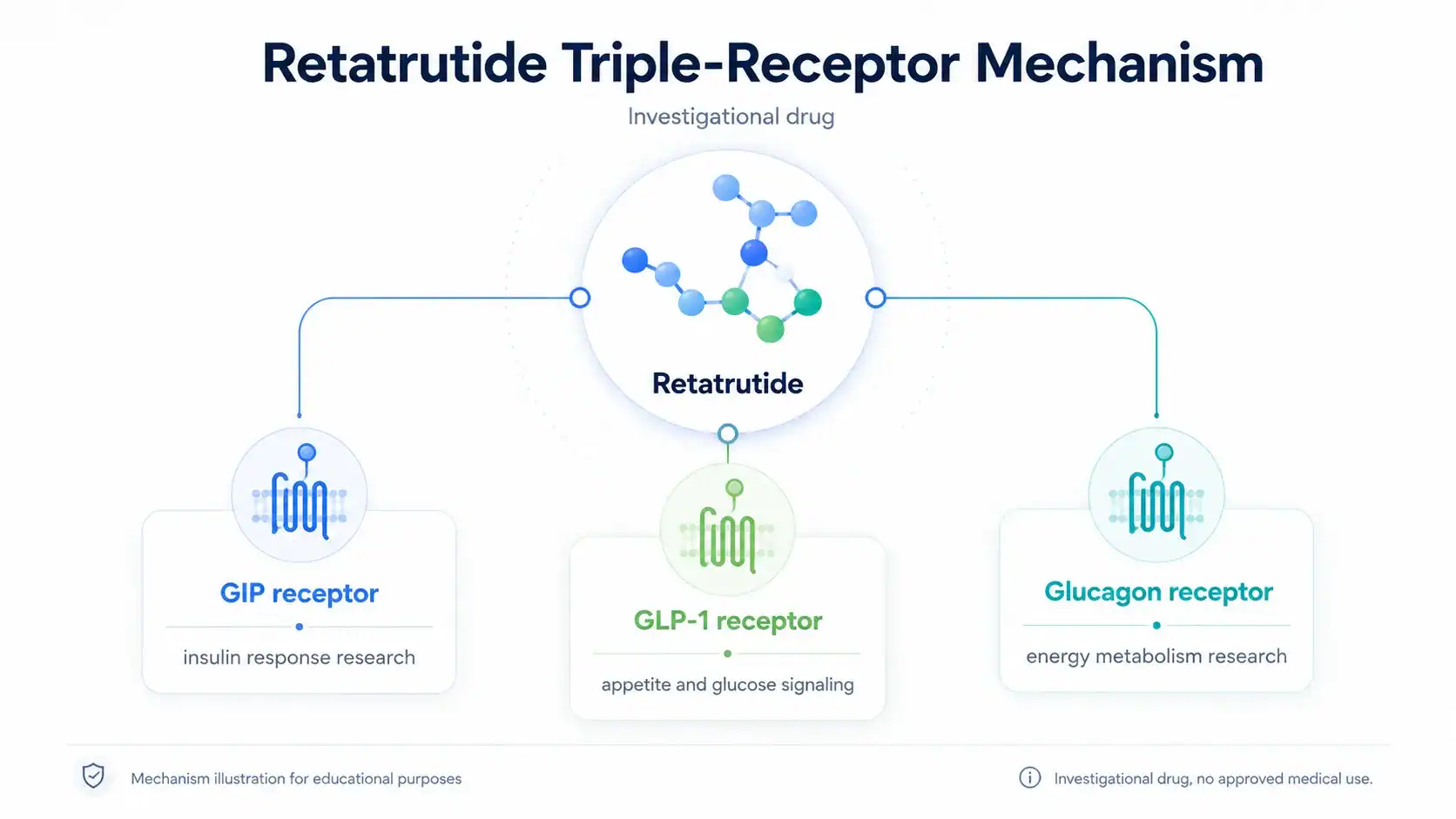
It is also described as a triple hormone receptor agonist, meaning one molecule activates three receptors: GLP‑1, GIP, and glucagon. [2]

What retatrutide is in one sentence

Retatrutide is an investigational, once‑weekly subcutaneous injectable triple agonist that targets GLP‑1, GIP, and glucagon receptors to drive large reductions in body weight and improve metabolic markers in clinical trials. [3]

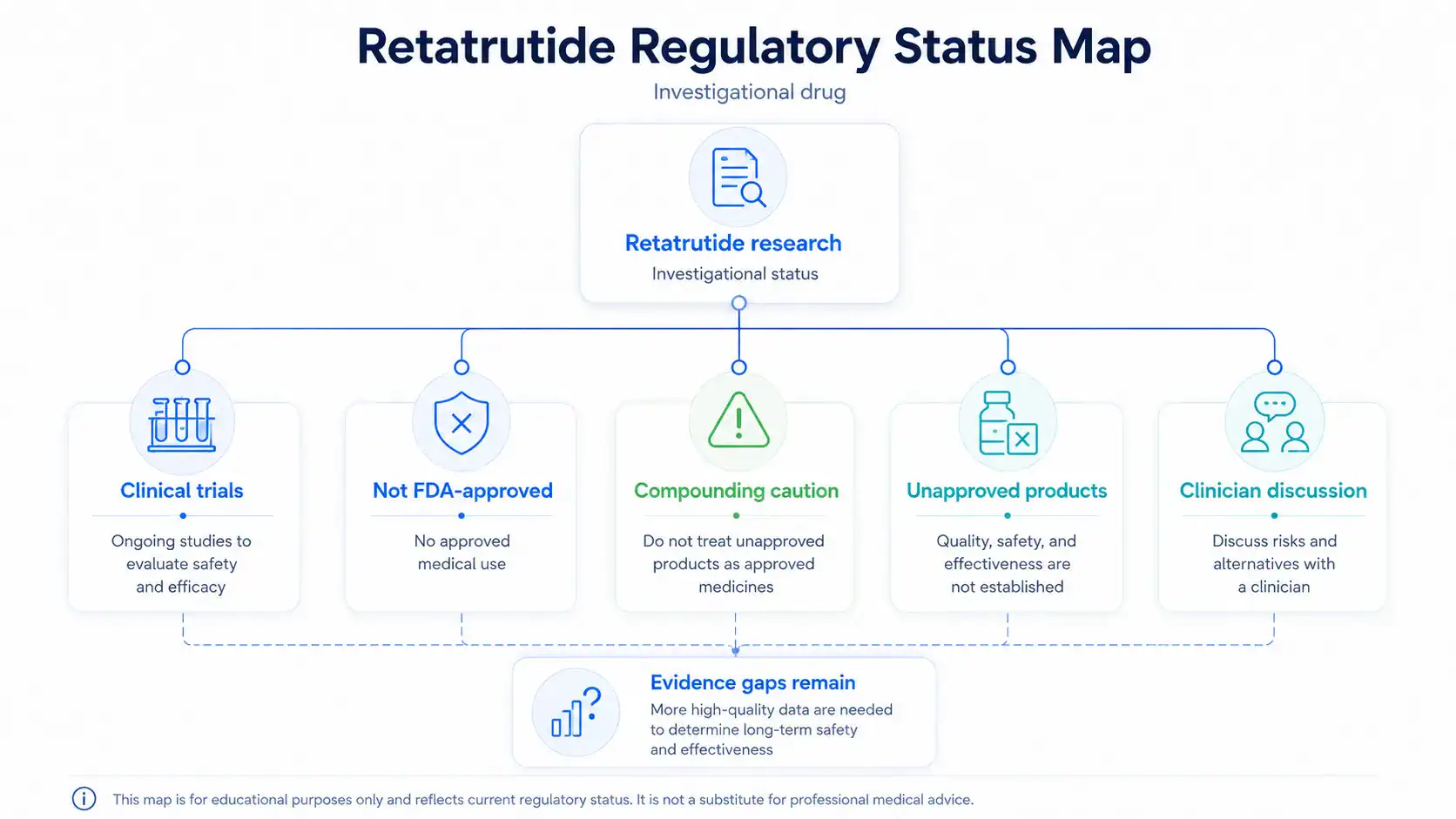
Retatrutide is being developed by Eli Lilly and Company[4] and (as of March 2026) is not approved for public use; the company states it is legally available only to participants in its clinical trials. [5]

What GLP‑1 is and why it matters here

GLP‑1 (glucagon-like peptide‑1) is an “incretin” hormone released from the gut after eating that helps regulate glucose and appetite. GLP‑1 increases glucose-dependent insulin secretion, slows gastric emptying, and reduces food intake through central and peripheral pathways—one reason GLP‑1 receptor agonists can produce clinically meaningful weight loss. [6]

Retatrutide includes GLP‑1 receptor activity, so many people lump it into the “GLP‑1” category. That’s partly true, but incomplete. [7]

What GIP is and why it’s paired with GLP‑1

GIP (glucose-dependent insulinotropic polypeptide) is the other major incretin hormone, released from intestinal K cells in response to nutrients. GIP contributes to glucose-dependent insulin secretion and has additional effects across tissues (including adipose and bone), which is why “dual” incretin therapies target both GLP‑1 and GIP. [8]

This matters because today’s most common “next step” beyond GLP‑1 alone is dual GIP/GLP‑1 agonism (for example, tirzepatide). Retatrutide goes one receptor beyond that. [9]

What glucagon is and why it’s the “third lever”

Glucagon is a pancreatic hormone that raises blood glucose by stimulating hepatic glycogenolysis and gluconeogenesis, especially during fasting. In obesity drug development, carefully balanced glucagon receptor agonism is being explored because it may increase energy expenditure and influence substrate utilization—potentially helping weight loss go further than appetite suppression alone. [10]

Retatrutide’s design includes glucagon receptor activity, which is one reason it’s often described as “next-generation” compared with therapies that target GLP‑1 alone or GLP‑1+GIP. [11]

What “incretin” means (and why people keep saying it)

The incretin effect is the phenomenon where oral glucose produces a greater insulin response than intravenous glucose, largely due to gut hormones like GLP‑1 and GIP. This is the physiologic foundation that incretin-based therapies build on. [12]

When you see retatrutide described as an “incretin-based therapy,” it’s shorthand for “it uses the body’s gut–pancreas signaling system to influence glucose and appetite.” [13]

“GLP‑3” and “triple‑G” are nicknames, not scientific categories

Some media and social posts call retatrutide “GLP‑3” or “triple‑G.” The accurate, scientific description is “triple agonist” (GLP‑1 + GIP + glucagon receptor agonist). Lilly explicitly notes “GLP‑3” is not a scientifically accurate label. [5]

What retatrutide has actually shown so far in humans

Retatrutide’s published and publicly reported outcomes fall into three buckets: obesity/weight loss, type 2 diabetes, and “obesity‑plus” conditions (like fatty liver disease and knee osteoarthritis). [14]

Obesity phase 2 trial results

In a 48‑week, randomized phase 2 trial (adults with obesity or overweight with a weight-related condition), the least-squares mean body-weight change at 48 weeks ranged from about −8.7% (lowest dose group) to −24.2% (highest dose group), versus −2.1% with placebo. [15]

At 48 weeks, high proportions of participants hit clinically meaningful weight-loss thresholds (≥5%, ≥10%, ≥15%), especially at higher doses. [15]

That trial was published in the New England Journal of Medicine[16]. [17]

Obesity phase 3 topline results

In the phase 3 TRIUMPH‑4 trial (people with obesity/overweight and knee osteoarthritis), Lilly reported retatrutide 12 mg achieved up to an average of 28.7% body weight reduction at 68 weeks (about 71.2 lbs on average in that arm, per the company’s topline release). [18]

Because these are topline (press-release) results, the most precise interpretation will come from full peer-reviewed publication and detailed subgroup reporting. [19]

Type 2 diabetes results (phase 2 and phase 3 topline)

A phase 2 trial in type 2 diabetes (36 weeks) found retatrutide improved glycemic control and reduced body weight, with a safety profile described as consistent with incretin-based drug classes. [20]

In March 2026, Lilly announced phase 3 topline results (TRANSCEND‑T2D‑1): A1C reductions of about 1.7% to 2.0% at 40 weeks (dose-dependent), and body-weight reductions of about −11.5% to −16.8% (efficacy estimand). [21]

Fatty liver (MASLD) outcomes

In a randomized trial published in Nature Medicine[22], a substudy of participants with metabolic dysfunction-associated steatotic liver disease (MASLD) showed large reductions in liver fat at 24 weeks (for example, about −82% relative liver-fat change in the 12 mg group), with many participants reaching “normal” liver fat thresholds. [23]

This is one of the more distinct “information gain” areas for retatrutide: it’s not only a weight-loss story—its mechanism and early data suggest multi-system metabolic effects that researchers are actively testing. [24]

Safety and tolerability signals that keep coming up

Across incretin-based therapies, the dominant tolerability theme is gastrointestinal side effects during dose escalation. In the retatrutide obesity phase 2 trial, the most common adverse events were gastrointestinal and were dose-related; the paper also notes dose-dependent increases in heart rate that peaked around 24 weeks and declined thereafter. [25]

The same phase 2 trial reported asymptomatic increases in amylase/lipase levels (with one acute pancreatitis event noted as a serious adverse event) and no reported medullary thyroid cancer or C-cell hyperplasia in that trial. [26]

In TRIUMPH‑4 (topline + sponsor medical info), nausea, diarrhea, constipation, and vomiting were frequent, and an altered sensation event category (dysesthesia) was highlighted, with discontinuations due to adverse events higher in active arms than placebo in sponsor-reported summaries. [19]

Step-by-Step / How-To

You don’t need a biology degree to evaluate retatrutide claims. You need a repeatable process that filters out misinformation and keeps you inside the boundaries of legitimate, evidence-based use. [27]

Here’s a practical workflow you can follow every time you see a new retatrutide claim, video, or “protocol.”

Confirm the regulatory reality first

Retatrutide is not approved by the U.S. Food and Drug Administration[28], and Lilly states it is legally available only to participants in its clinical trials. [5]

That means any “for sale” retatrutide marketed to consumers is outside the standard regulatory prescription pathway—and may be mislabeled, counterfeit, contaminated, or dosed incorrectly. [29]

Separate clinical-trial dosing from internet dosing

Clinical trials use tightly controlled manufacturing, cold-chain handling, and supervised titration schedules. Internet “protocols” are not a substitute for that environment. [30]

If a post blurs this line (“research peptide” language but human-use instructions), treat it as a red flag—not a biohack. [31]

Read the evidence like a scoreboard, not a headline

The most common misunderstanding in GLP‑1/triple‑agonist content is “bigger number = better drug.” A better framework is: population + timepoint + comparator + endpoint. [32]

Example: Retatrutide’s phase 2 obesity results are reported at 24 and 48 weeks, while semaglutide and tirzepatide landmark obesity trials often report primary outcomes at 68 or 72 weeks. Those are not apples-to-apples timelines. [33]

Track safety signals that have real-world consequences

GI side effects are common across the class, but retatrutide’s triple mechanism raises extra attention on heart rate and tolerability at higher doses. [34]

Also understand that FDA-approved GLP‑1/GIP agents carry specific warnings (for example thyroid C-cell tumor risk in rodents, pancreatitis and gallbladder warnings, and guidance on coadministration). Even if retatrutide eventually earns approval, its final label may include similar class-related warnings. [35]

Choose the safest “next best step”

If your intent is weight loss or metabolic health today, the safest legitimate path is discussing FDA-approved options and lifestyle structure with a licensed clinician—not sourcing an unapproved compound. [36]

If your intent is to follow retatrutide specifically, look for legitimate trial participation pathways through sponsor listings and ClinicalTrials.gov[37]. [38]

Comparison / Alternatives

Retatrutide sits “one generation ahead” mechanistically (GLP‑1 + GIP + glucagon), but it sits “one generation behind” in availability because it’s investigational. That single sentence explains most of the SERP confusion. [39]

Retatrutide vs tirzepatide vs semaglutide at a glance

Feature Retatrutide Tirzepatide (Zepbound/Mounjaro) Semaglutide (Wegovy/Ozempic)
Targets GLP‑1 + GIP + glucagon receptors GLP‑1 + GIP receptors GLP‑1 receptor
Status (US) Investigational (clinical trials) FDA-approved for chronic weight management (Zepbound) FDA-approved for chronic weight management (Wegovy)
Dosing in studies Once-weekly subcutaneous (trial-controlled) Once-weekly subcutaneous Once-weekly subcutaneous
Weight-loss outcomes (headline trials) ~24% at 48 weeks (phase 2); up to ~28.7% at 68 weeks (TRIUMPH‑4 topline) Up to ~20.9% at 72 weeks (SURMOUNT‑1); FDA summary reports ~18% average loss at highest approved dose in a pivotal trial ~14.9% at 68 weeks (STEP 1)
Typical tolerability theme GI events; heart-rate increases observed; evolving data GI events; labeled warnings (pancreatitis, gallbladder, thyroid C-cell tumors in rodents, etc.) GI events; labeled warnings (pancreatitis, gallbladder, thyroid C-cell tumors in rodents, etc.)
Best fit (today) Research/clinical-trial context only People eligible for approved dual incretin therapy People eligible for approved GLP‑1 therapy

The retatrutide phase 2 obesity trial reported ~−24.2% mean body-weight change at 48 weeks in the highest-dose group, versus ~−2.1% with placebo. [15]

TRIUMPH‑4 topline results reported up to ~28.7% mean weight loss at 68 weeks (in obesity/overweight with knee osteoarthritis). [19]

For semaglutide 2.4 mg (STEP 1), PubMed’s abstract reports ~−14.9% mean weight change at 68 weeks (vs ~−2.4% placebo). [40]

For tirzepatide, multiple sources summarize ~20.9% mean weight reduction at 72 weeks in SURMOUNT‑1 (with additional FDA trial summaries reporting ~18% loss at the highest approved dose in a pivotal trial). [41]

The decisive comparison point most pages miss

Retatrutide’s “wow” numbers come from a different receptor stack and different timelines, so you should compare drugs by timepoint and population—not by the biggest percent you saw in a screenshot. [42]

A practical way to do this is to ask: “What percent weight loss happened by about 6 months, 12 months, and after stopping?” Many viral summaries only show the best single number and hide the context. [43]

“Alternative” doesn’t always mean “another injection”

Depending on your goal, alternatives can also mean: – Approved GLP‑1 or dual incretin therapy (clinician-directed, regulated supply chain). [44]Lifestyle intervention with resistance training and sufficient protein to preserve lean mass during weight loss (important with any rapid weight reduction). [45]Clinical trial participation if you want access to investigational options under proper oversight. [38]

Templates / Checklist / Example

If you only take one thing from this article, take this: The riskiest part of “peptide culture” isn’t curiosity—it’s skipping the verification step. [46]

Copy-ready retatrutide evaluation checklist

  • Verify whether the product is FDA-approved or investigational; if investigational, assume it is trial-only. [5]
  • Confirm the exact study being quoted (phase, population, weeks, comparator, endpoint). [47]
  • Compare results at the same timepoint (don’t compare 48-week results to 72-week results without saying so). [48]
  • Check whether “percent weight loss” is absolute or placebo-corrected. [49]
  • Scan adverse events and discontinuation rates (especially GI effects, heart rate, and any rare serious events). [50]
  • Avoid anything sold as “research use only” that is clearly marketed for human weight loss. [31]
  • Refuse unit-conversion “DIY dosing” for injectable drugs; the FDA has documented dosing errors and harms in compounded GLP‑1 contexts, especially when people convert milligrams to other units across varying vial concentrations. [51]
  • Ask a licensed clinician about approved options if your goal is treatment now. [44]

A simple framework for “information gain”: the Three-Dial Model

Most articles treat retatrutide like “just another GLP‑1.” A cleaner way to understand it is to imagine three dials:

Dial one: Appetite (GLP‑1). This is the familiar satiety pathway. [52]
Dial two: Incretin amplification (GIP + GLP‑1). This influences insulin dynamics and post-meal regulation. [53]
Dial three: Energy output (glucagon). This is the differentiator—it’s why researchers think triple agonists may push weight loss further, but it’s also why monitoring tolerability and cardiovascular signals matters. [54]

That “three-dial” lens makes the SERP clearer: retatrutide isn’t only suppressing intake; it is designed to influence multiple metabolic pathways at once. [7]

FAQs

What is retatrutide?

What is retatrutide? Retatrutide is an investigational triple hormone receptor agonist (LY3437943) that activates GLP‑1, GIP, and glucagon receptors and is studied as a once-weekly subcutaneous injection. It has shown large weight loss and metabolic improvements in clinical trials, but it is not approved for public use. [7]

Is retatrutide FDA approved?

Is retatrutide FDA approved? Retatrutide is not currently approved by the FDA and is considered investigational. Lilly states retatrutide is legally available only to participants in its clinical trials, and it should not be taken outside of a Lilly-sponsored trial because safety and efficacy are still being evaluated. [27]

How does retatrutide work?

How does retatrutide work? Retatrutide works by activating three hormone receptors—GLP‑1, GIP, and glucagon—that influence appetite, glucose control, and energy balance. GLP‑1 activity tends to reduce appetite and slow gastric emptying; GIP and GLP‑1 together amplify incretin signaling; and glucagon receptor activity is explored for potential effects on energy expenditure. [55]

How much weight have people lost on retatrutide in research?

How much weight have people lost on retatrutide in research? In a 48‑week phase 2 obesity trial, the highest-dose retatrutide group had about −24.2% mean body-weight change, versus about −2.1% with placebo. In a phase 3 trial in obesity/overweight with knee osteoarthritis (TRIUMPH‑4), topline results reported up to ~28.7% mean weight loss at 68 weeks. [56]

What are the common side effects of retatrutide?

What are the common side effects of retatrutide? Commonly reported side effects in early trials are gastrointestinal, such as nausea, vomiting, diarrhea, and constipation, often occurring during dose escalation. The phase 2 obesity trial also reported dose-dependent increases in heart rate that peaked mid-trial and declined later, and noted rare serious events requiring careful interpretation. [57]

Can you buy retatrutide online?

Can you buy retatrutide online? You may see products marketed as retatrutide online, but Lilly states genuine retatrutide is legally available only in its clinical trials and is not approved for public purchase. Separately, the FDA has taken enforcement and issued warnings related to unapproved GLP‑1 drug sales and counterfeit products in this broader category, which reinforces the real risk of mislabeled or unsafe supply. [58]

Next Steps

Retatrutide is best understood as a clinical-trial-stage “triple agonist” designed to push beyond GLP‑1-only weight loss by adding GIP and glucagon receptor activity—while still carrying open questions that only phase 3 publications and regulators can answer. [59]

If your immediate goal is practical decision-making: – If you want options today, discuss FDA-approved therapies and risk/benefit with a licensed clinician. [44]
– If you want retatrutide specifically, follow legitimate trial information and sponsor updates rather than marketplace claims. [60]

If you’re learning the terminology and “vial math” used across peptide discussions for educational purposes, PeptideDosages.com[61] has internal reference pages you can bookmark: – Retatrutide 5 mg vial protocol (educational)
Retatrutide 10 mg vial protocol (educational)
Retatrutide 20 mg vial protocol (educational)
Retatrutide 30 mg vial protocol (educational)

Key takeaway: Retatrutide is promising, but until it’s approved and labeled, the only evidence-based way to access it is through regulated clinical trials—not the open market. [29]

[1] [2] [15] [17] [25] [26] [28] [30] [32] [33] [34] [42] [43] [47] [48] [49] [50] [56] [57] mediacenteratypon.nejmgroup-production.org

https://mediacenteratypon.nejmgroup-production.org/NEJMoa2301972.pdf

[3] [5] [7] [27] [29] [37] [39] [58] [59] [60] What to know about retatrutide

https://www.lilly.com/news/stories/what-to-know-about-retatrutide

[4] [31] US FDA warns online vendors selling unapproved weight-loss drugs

https://www.reuters.com/business/healthcare-pharmaceuticals/us-fda-warns-online-vendors-selling-unapproved-weight-loss-drugs-2024-12-17/?utm_source=chatgpt.com

[6] [22] [52] [55] Glucagon-like peptide 1 (GLP-1)

https://pmc.ncbi.nlm.nih.gov/articles/PMC6812410/?utm_source=chatgpt.com

[8] [13] [53] GIP and GLP‐1, the two incretin hormones – PMC – NIH

https://pmc.ncbi.nlm.nih.gov/articles/PMC4020673/?utm_source=chatgpt.com

[9] [36] [44] FDA Approves New Medication for Chronic Weight Management | FDA

https://www.fda.gov/news-events/press-announcements/fda-approves-new-medication-chronic-weight-management

[10] Physiology, Glucagon – StatPearls – NCBI Bookshelf

https://www.ncbi.nlm.nih.gov/books/NBK537082/?utm_source=chatgpt.com

[11] [54] [61] Retatrutide, a GIP, GLP-1 and glucagon receptor agonist, for people with type 2 diabetes: a randomised, double-blind, placebo and active-controlled, parallel-group, phase 2 trial conducted in the USA – ScienceDirect

https://www.sciencedirect.com/science/article/abs/pii/S014067362301053X?utm_source=chatgpt.com

[12] Incretin effect: GLP-1, GIP, DPP4

https://pubmed.ncbi.nlm.nih.gov/21864749/?utm_source=chatgpt.com

[14] [38] What retatrutide clinical trials are being conducted in people with obesity or overweight?

https://medical.lilly.com/us/products/answers/what-retatrutide-clinical-trials-are-being-conducted-in-people-with-obesity-or-overweight-229656

[16] [35] WEGOVY (semaglutide) injection, for subcutaneous use

https://www.accessdata.fda.gov/drugsatfda_docs/label/2025/215256s024lbl.pdf?utm_source=chatgpt.com

[18] [19] Lilly’s triple agonist, retatrutide, delivered weight loss of up …

https://investor.lilly.com/news-releases/news-release-details/lillys-triple-agonist-retatrutide-delivered-weight-loss-average?utm_source=chatgpt.com

[20] Retatrutide, a GIP, GLP-1 and glucagon receptor agonist, …

https://pubmed.ncbi.nlm.nih.gov/37385280/?utm_source=chatgpt.com

[21] Lilly’s triple agonist, retatrutide, demonstrated significant reductions in A1C and weight in first Phase 3 trial for treatment of type 2 diabetes | Eli Lilly and Company

https://lilly.gcs-web.com/news-releases/news-release-details/lillys-triple-agonist-retatrutide-demonstrated-significant

[23] [24] Triple hormone receptor agonist retatrutide for metabolic dysfunction-associated steatotic liver disease: a randomized phase 2a trial | Nature Medicine

https://www.nature.com/articles/s41591-024-03018-2

[40] Once-Weekly Semaglutide in Adults with Overweight or …

https://pubmed.ncbi.nlm.nih.gov/33567185/?utm_source=chatgpt.com

[41] Tirzepatide Once Weekly for the Treatment of Obesity

https://www.ovid.com/journals/nejm/fulltext/10.1056/nejmoa2206038~tirzepatide-once-weekly-for-the-treatment-of-obesity?utm_source=chatgpt.com

[45] Effects of retatrutide on body composition in people with …

https://pubmed.ncbi.nlm.nih.gov/40609566/?utm_source=chatgpt.com

[46] FDA Intends to Take Action Against Non-FDA-Approved …

https://www.fda.gov/news-events/press-announcements/fda-intends-take-action-against-non-fda-approved-glp-1-drugs?utm_source=chatgpt.com

[51] FDA alerts health care providers, compounders of dosing …

https://www.fda.gov/drugs/human-drug-compounding/fda-alerts-health-care-providers-compounders-and-patients-dosing-errors-associated-compounded?utm_source=chatgpt.com