

IGF-1 LR3 is a modified version of insulin-like growth factor 1 used in laboratory research. It is biologically active, but that does not make the muscle-building, recovery and anti-aging claims attached to it established medical benefits.
Cell and animal experiments aren’t trials showing that IGF-1 LR3 safely improves muscle or recovery in people. It also differs from mecasermin, the prescription IGF-1 medicine used for specific childhood growth disorders. [1] [2]
What is IGF-1 LR3?
The name is also written Long R3 IGF-I or Long Arg3 IGF-I. Compared with native IGF-1, the analogue has a 13-amino-acid extension at one end and an arginine substitution at position 3. These changes affect its interaction with IGF-binding proteins, which influence how the growth factor behaves in a biological system. [1]
That mechanism helps explain why researchers use it to study growth-factor signaling. It does not, by itself, tell us how much a person should use, how long an effect will last or whether a desired outcome outweighs the risks.
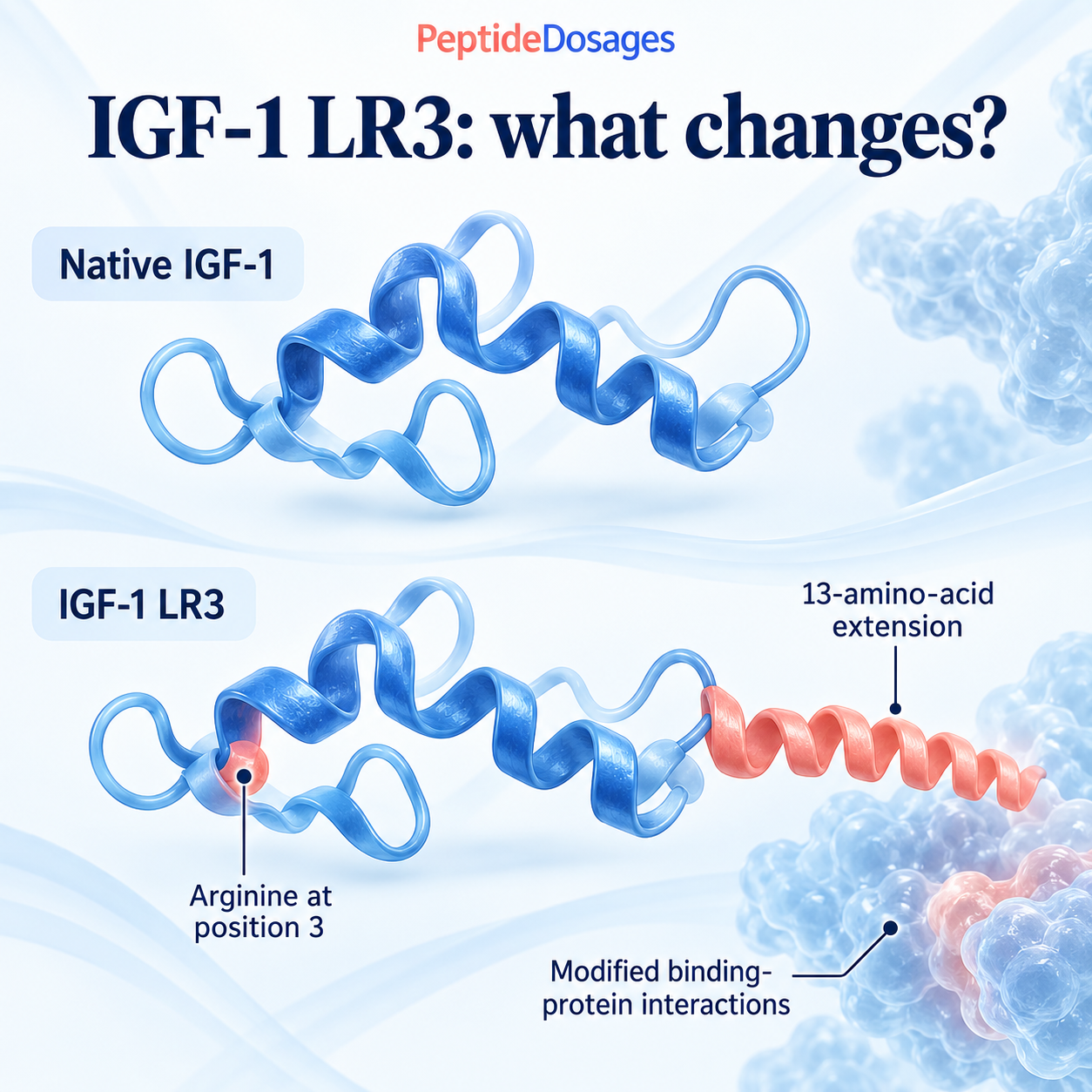
Mechanism of action: why “more potent” needs context
The original recombinant-analogue research compared biological activity in different cell systems. Long Arg3 IGF-I stimulated protein and DNA synthesis more strongly than native IGF-I in rat muscle-cell cultures. Yet it was less potent in chicken embryo fibroblasts that did not release detectable IGF-binding proteins. [1]
So “more potent” was conditional, not a universal multiplier. A result from one cell assay cannot be translated into a promise of a certain amount of muscle growth, or into a claim that every human dose will be proportionally stronger.
What the research actually shows
| Study setting | Finding | Important limit |
|---|---|---|
| Cell cultures, 1992 | Biological activity differed by cell system and binding-protein context. [1] | Not a clinical trial or a measurement of muscle gain in people. |
| Guinea pigs, seven-day infusion | No significant overall weight-gain or carcass-composition change; the relative size of several organs increased. [3] | Organ effects are not equivalent to desirable skeletal-muscle growth. |
| Pigs, four-day infusion | LR3 reduced food intake and daily weight gain under the tested conditions. [4] | Animal findings do not support a simple “growth factor always means more growth” claim. |
| Prescription mecasermin | Approved treatment for defined pediatric growth conditions. [2] | Different product, indication and monitoring; not proof that LR3 treats adult muscle loss. |
Does IGF-1 LR3 build muscle or improve recovery?
The laboratory findings provide reasons to investigate those questions. They do not answer them clinically. Protein synthesis in cultured cells is a biological measurement; improved strength, physical function and injury recovery are outcomes that need their own human studies.
The guinea-pig experiment illustrates the gap. Despite changes in organ size relative to body weight, the researchers did not find a significant change in overall body-weight gain or carcass composition. [3] In the pig study, the direction of the weight-gain result was the opposite of what many promotional descriptions imply. [4]
The sources reviewed here do not establish a controlled human treatment benefit for bodybuilding, injury repair or fat loss with LR3. Before-and-after photographs and reports from people using multiple substances cannot show which factor caused a change.
Half-life claims and dosage schedules
A reduced interaction with binding proteins does not automatically establish a particular half-life in humans. Claims of a 20- to 30-hour duration need a human pharmacokinetic study identifying the exact analogue, route, measurement method and participants. The cell and animal experiments discussed above do not establish that commonly repeated estimate.
The same problem applies to a fixed cycle or injection schedule. An amount used in an animal infusion experiment is not a validated human dose. Neither a seller’s suggested schedule nor a mathematically correct reconstitution calculation supplies the missing safety and outcome data.
When reviewing a protocol, separate two questions: “Does the arithmetic match the vial?” and “Is there evidence for this use?” They require different kinds of evidence. A concentration chart can answer the first without answering the second.
Related dosage pages: For vial-specific concentration, reconstitution, and measurement examples, see IGF-1 LR3 (1 mg Vial) Dosage Protocol. Each linked protocol remains a separate reference because vial strength changes concentration and syringe-unit calculations.
Side effects: what is known, and what is being inferred?
It is misleading to present a precise LR3 side-effect rate when the supporting study tested another compound or population. But a lack of reliable rates is not reassurance that the risks are small.
The mecasermin label warns about low blood glucose, including severe episodes with seizures, allergic reactions, raised pressure inside the skull, lymphoid-tissue growth and neoplasia. These are important reasons to take IGF-related signaling seriously. They are not measured rates for an LR3 product or proof that its risk profile is identical. [2]
Confusion, collapse, seizure or breathing difficulty after any injected substance requires urgent medical help. Tell the treating team exactly what was used and bring the packaging if available. Do not rely on a website’s cycle advice to assess an acute reaction.
Why mecasermin is not an interchangeable substitute
Increlex contains mecasermin and is indicated for children aged two or older with severe primary IGF-1 deficiency, or certain growth-hormone gene deletions with neutralizing antibodies. It is not an approval for LR3, general adult muscle building or routine anti-aging treatment. Its prescribing information cannot simply be copied onto another analogue. [2]
Product quality, approval and sport
An FDA warning letter in 2020 specifically identified IGF-1 LR3 as not being a component of an FDA-approved drug at that time. This is a dated regulatory finding, not a complete current search of every approval record. It does show why the existence of an approved IGF-1 medicine should not be used to imply that LR3 shares that approval. [5]
Compounding does not confer FDA approval either. The FDA explains that compounded drugs do not undergo its premarket verification of safety, effectiveness and quality. A product described as compounded or research-only therefore needs more scrutiny, not less. [6]
For athletes, the 2026 World Anti-Doping Agency list prohibits IGF-1 and its analogues in and out of competition. LR3 is an IGF-1 analogue; calling it a research peptide does not remove that issue. [7]
Quick check: does a study support the claim you are reading?
- Does the paper identify LR3, rather than native IGF-1 or mecasermin?
- Was it conducted in people, animals or isolated cells?
- Did it measure the promised outcome, such as strength or recovery?
- Was there a relevant comparison group and adequate follow-up?
- Does the article report unfavorable findings as well as positive ones?
If these details are missing, the claim is more confident than the evidence shown.
Common questions
Is IGF-1 LR3 growth hormone?
No. LR3 is an analogue of insulin-like growth factor 1, not human growth hormone. Related roles in growth biology do not make the substances interchangeable.
Does it increase testosterone?
The studies reviewed here do not establish LR3 as a treatment for low testosterone. A growth-factor mechanism is not evidence of a reliable testosterone increase or improvement in symptoms.
Can a purity certificate prove that it is safe?
No. A laboratory result about a sample answers only the question that was tested. It does not establish a safe human dose, long-term outcomes or the benefit of injecting it. Product testing and clinical evidence are separate requirements.
The bottom line
IGF-1 LR3 has biological effects in experimental models. Convincing human evidence for its advertised fitness and anti-aging benefits is still missing. Unexplained weakness, poor recovery or possible hormone deficiency needs clinical evaluation; a laboratory mechanism isn’t a diagnosis.
Related dosage protocols and research
Explore related research, dosage references and guides below. Vial strengths have separate references because concentration and syringe-unit calculations differ. A comparison does not mean the compounds are interchangeable.
Matching dosage protocols
Further research context
References
- Francis and colleagues. Novel recombinant fusion protein analogues of IGF-I and the importance of binding-protein and receptor interactions, 1992.
- DailyMed. Increlex (mecasermin) prescribing information.
- Long Arg3 IGF-I infusion and tissue responses in guinea pigs, 1995.
- Long Arg3 IGF-I infusion and growth-hormone effects in pigs, 1997.
- FDA. Tailor Made Compounding warning letter, April 1, 2020.
- FDA. Compounding and the FDA: questions and answers.
- World Anti-Doping Agency. 2026 Prohibited List, section S2.