If you’re searching “What is GHRP-6”, you’re probably trying to understand what it does, what it’s used for, and whether it’s worth paying attention to. You may also be comparing it to popular metabolic peptides like GLP‑1 drugs—but GHRP‑6 works in the opposite direction for appetite. This guide explains the mechanism, key effects, safety realities, and smarter alternatives—without fluff.

Fast Answer / Executive Summary

GHRP‑6 (Growth Hormone Releasing Peptide‑6) is a synthetic “ghrelin‑mimetic” peptide that activates the ghrelin (GHS‑R1a) receptor to trigger pulsatile growth hormone release and commonly increases appetite. It is not an FDA‑approved drug, and safety data in humans are limited; studies and regulatory notes raise concerns about cortisol effects and glucose/insulin sensitivity. [1]

Core Concepts & Key Entities

What GHRP‑6 is in plain English

GHRP‑6 is a short synthetic peptide (“hexapeptide”) originally developed to stimulate the body’s own growth hormone (GH) pulses. In the literature, it’s often discussed as a growth hormone secretagogue—meaning it coaxes GH release rather than supplying GH from the outside. [2]

A commonly cited amino‑acid sequence for GHRP‑6 is His‑D‑Trp‑Ala‑Trp‑D‑Phe‑Lys‑NH₂, which highlights why it’s sometimes described as containing D‑amino acids (a “non‑standard” form compared with typical dietary amino acids). [3]

The receptor that matters: the ghrelin receptor (GHS‑R1a)

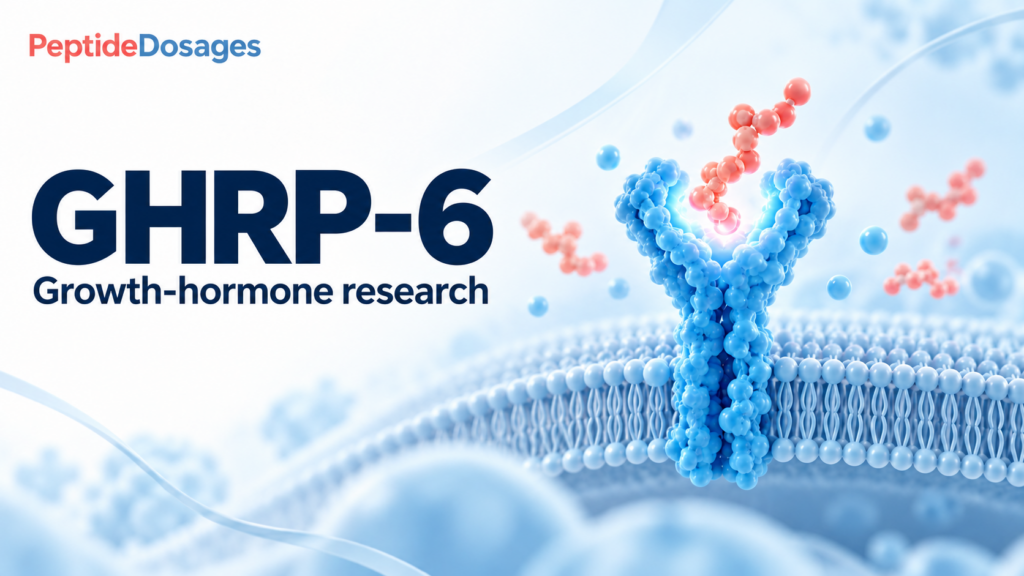
GHRP‑6 works primarily by activating the growth hormone secretagogue receptor (GHS‑R), also called the ghrelin receptor (GHS‑R1a). Ghrelin—the body’s own ligand for that receptor—is widely known for stimulating hunger/appetite and also for stimulating GH release. [4]

This is the core reason GHRP‑6 feels “different” from many other peptides people talk about online:

  • Ghrelin‑pathway agonists tend to be orexigenic (appetite‑increasing). [4]
  • Incretin‑pathway drugs like GLP‑1 receptor agonists tend to be anorexigenic (appetite‑decreasing) and can slow gastric emptying. [5]

Practical implication: if someone’s “main goal” is fat loss and appetite control, GHRP‑6 is often a mismatched tool—because its signature effect is frequently more hunger, not less. [6]

GH and IGF‑1: what GHRP‑6 is trying to influence

Growth hormone (GH) is produced in the pituitary gland and acts both directly and indirectly (in part via insulin‑like growth factor‑1, IGF‑1). The liver is a major source of circulating IGF‑1, but other tissues contribute, and GH–IGF‑1 signaling is regulated by feedback loops. [7]

Why that matters for understanding GHRP‑6:

  • GHRP‑6 aims to stimulate endogenous (internal) GH pulses rather than bypassing the body’s control mechanisms with external GH. [8]
  • Growth hormone secretagogues are often described as promoting pulsatile GH release that remains subject to feedback—though long‑term, high‑quality human safety studies are still limited. [9]

GHRP‑6 is not “HGH” and it’s not “GLP‑1”

GHRP‑6 is not human growth hormone (HGH). HGH is the hormone itself; GHRP‑6 is a signaling peptide intended to stimulate release of GH through the ghrelin receptor pathway. [10]

GHRP‑6 is also not GLP‑1. GLP‑1 is an incretin hormone released after eating and involved in glucose regulation and satiety; GLP‑1 receptor agonists (like semaglutide) are FDA‑approved for specific indications and are explicitly characterized as GLP‑1 receptor agonists in FDA labeling. [11]

What human studies suggest GHRP‑6 can change (and why that’s a safety flag)

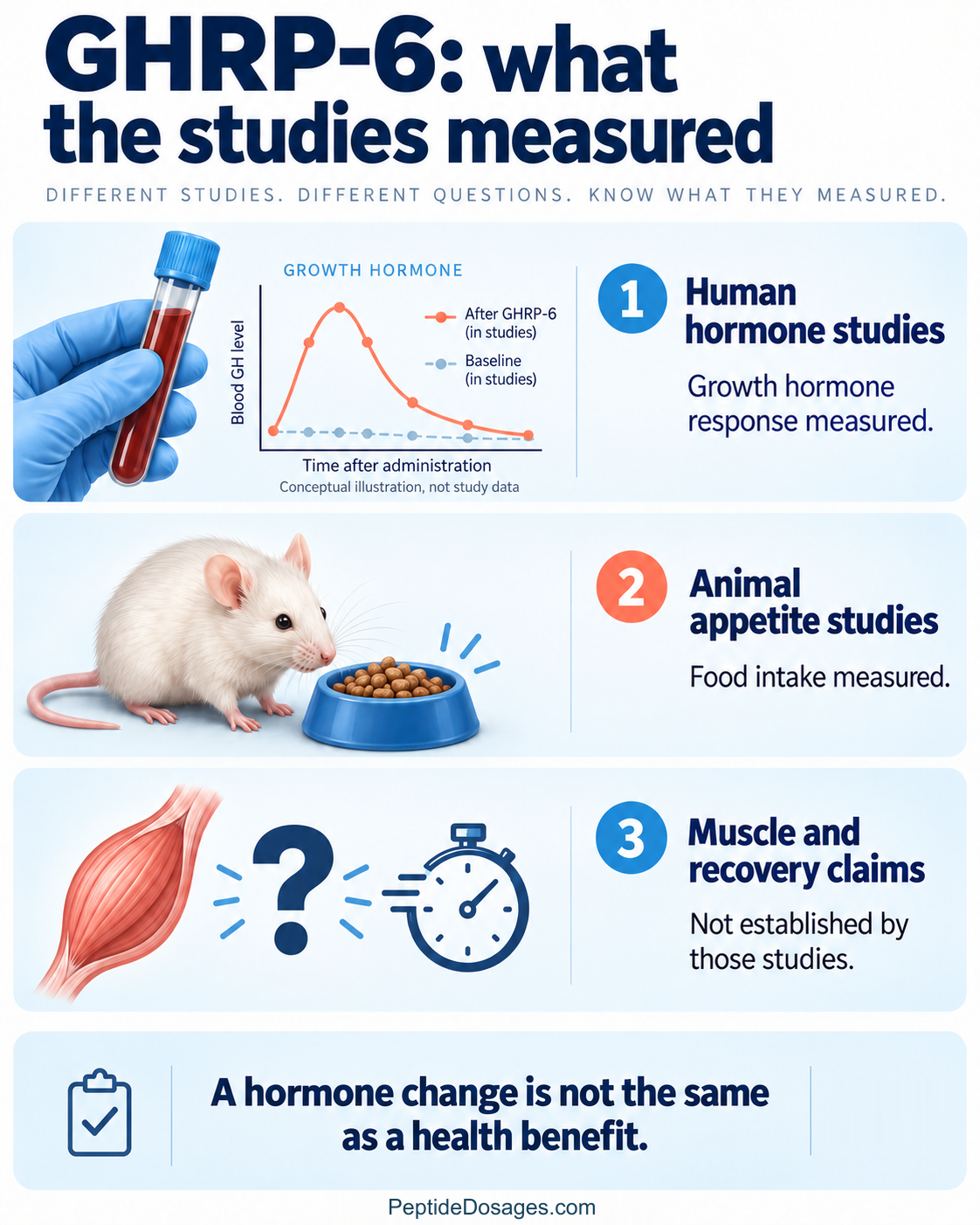
In human endocrine research, GH secretagogues in the GHRP family have been observed to increase GH and can also increase other pituitary/adrenal hormones depending on the compound.

For example, studies comparing GHRP‑class agents report that some can increase prolactin (PRL) and ACTH/cortisol in humans. [12]

That matters because:

  • Cortisol elevation (or frequent stimulation) is not a cosmetic “side effect”—it can affect sleep, mood, recovery, glucose regulation, and other systems. [13]
  • Regulatory commentary has specifically flagged potential cortisol effects and blood glucose/insulin‑sensitivity concerns for compounded GHRP‑6 preparations. [14]

Regulatory reality check

GHRP‑6 is not an FDA‑approved drug for self‑treatment or OTC use. (And more broadly, peptide hormones are not “supplements” in the way many online sellers imply.) [15]

The U.S. Food and Drug Administration[16] has also warned that compounded drug products containing GHRP‑6 may pose immunogenicity risks tied to aggregation/peptide impurities and notes limited safety information with concerns including cortisol effects and increased blood glucose due to decreased insulin sensitivity. [14]

Sports testing: GHRP‑6 is prohibited in anti‑doping rules

If you compete in tested sports, the most important practical point is simple:

GHRP‑6 is listed among GH‑releasing peptides (GHRPs) as prohibited under anti‑doping prohibited list categories. [17]

In other words, even if someone believes they’re using it “for recovery,” the anti‑doping framework classifies the entire category as prohibited, and athletes remain responsible for what’s in their system. [18]

Information gain: the “Appetite Tradeoff” framework (why people misjudge GHRP‑6)

Most competing pages treat GHRP‑6 as a single‑dimension tool: “more GH = better.” That’s incomplete.

Here’s a more useful way to think about it:

GHRP‑6 has a built‑in tradeoff: the same ghrelin‑pathway activation that can stimulate GH is also strongly linked to appetite signaling. [4]

So ask one decisive question early:

  • If increased appetite helps your goal (e.g., you struggle to eat enough, or a research model requires orexigenic signaling), GHRP‑6’s profile may be relevant. [4]
  • If appetite control is your bottleneck (fat loss, binge tendencies, metabolic health), GHRP‑6 can work against you—and GLP‑1–pathway options typically move appetite the other way. [19]

That simple “Appetite Tradeoff” filter prevents wasted time, money, and unrealistic expectations.

Step-by-Step / How-To

Step 1: Define what you’re actually trying to change

Clarify whether your goal is appetite, GH/IGF‑1 signaling, recovery/sleep, or GI motility before you choose any peptide. Ghrelin‑pathway agonism tends to push hunger upward, while GLP‑1 pathways tend to push appetite downward and slow gastric emptying. [20]

Step 2: Decide whether “ghrelin-mimetic” effects are a feature or a bug

GHRP‑6 is a ghrelin‑receptor pathway tool, so appetite effects are not incidental—they are central to the mechanism. Ghrelin signaling is known for stimulating food intake and energy storage tendencies in multiple models. [21]

Step 3: Check legality, compounding status, and testing risk first

Confirm regulatory and anti‑doping implications before you consider anything else. The U.S. Food and Drug Administration[16] highlights safety concerns and limited safety data for compounded GHRP‑6, and the Jamaica Anti-Doping Commission[22] document reflecting the 2026 prohibited list framework includes GHRP‑6 among prohibited GH‑releasing peptides. [23]

Step 4: Prefer “cleaner signal” alternatives when you want GH-axis selectivity

If you want a more GH‑selective research signal (less ACTH/cortisol spillover), ipamorelin is described in research as more selective than GHRP‑6 for GH release. In comparative work, ipamorelin did not increase ACTH/cortisol in the same way GHRP‑6 did, while maintaining GH‑releasing activity. [24]

Step 5: If sourcing for research, validate quality like a lab—not like a shopper

Verify identity, purity claims, and handling requirements using documentation (e.g., COAs) and risk controls appropriate for peptides. Regulatory discussions emphasize that peptide impurities/aggregation can influence immunogenicity risk, and FDA explicitly flags immunogenicity concerns for compounded GHRP‑6. [25]

Step 6: Use vial-specific protocols for math, not as medical instructions

If you’re looking for vial math and protocol structuring, use standardized calculators and clearly-labeled educational protocols rather than improvising. For example, PeptideDosages.com[26] hosts vial-specific educational pages you can reference for structure: – GHRP‑6 (2 mg): https://peptidedosages.com/single-peptide-dosages/ghrp-6-2-mg-vial-dosage-protocol/ [27]
– GHRP‑6 (5 mg): https://peptidedosages.com/single-peptide-dosages/ghrp-6-5-mg-vial-dosage-protocol/ [28]
– GHRP‑6 (10 mg): https://peptidedosages.com/single-peptide-dosages/ghrp-6-10-mg-vial-dosage-protocol/ [29]

Comparison / Alternatives (“GHRP‑6 vs …”)

GHRP‑6 is best viewed as an appetite-forward, short‑acting ghrelin‑receptor GH secretagogue—so alternatives should be compared by (1) receptor target, (2) appetite direction, (3) hormonal spillover (ACTH/cortisol/PRL), and (4) duration. [30]

Quick comparison table

Option Primary pathway Appetite direction GH/IGF‑1 pattern Notable concerns (high-level) Regulatory/testing reality
GHRP‑6 Ghrelin receptor (GHS‑R1a) secretagogue pathway Often increases hunger Pulsatile GH stimulation; short elimination half-life reported ~2.5h in human PK Possible ACTH/cortisol and PRL spillover; glucose/insulin sensitivity concerns flagged by FDA for compounding Not FDA‑approved; prohibited in anti‑doping categories as a GHRP
Ipamorelin Ghrelin receptor agonist (more GH-selective in research comparisons) Typically less orexigenic in positioning GH‑releasing activity comparable to GHRP‑6 in animal comparisons; reported less ACTH/cortisol response Human long‑term outcomes still limited; safety depends on route/product quality Not FDA‑approved; likewise implicated in prohibited categories as a GHS/GHRP-class agent
CJC‑1295 (GHRH analog) GHRH pathway analog (stimulates GH release via GHRH signaling) Appetite-neutral for many Sustained increases in GH/IGF‑1 shown in healthy adults; long half-life in study Endocrine manipulation risks; quality/oversight issues if sourced outside medical use Not OTC; anti‑doping rules prohibit GH releasing factors broadly
MK‑677 (ibutamoren) Oral ghrelin mimetic (non-peptide GHS) Can increase appetite Raises GH/IGF‑1 axis in studies; oral exposure Glucose/insulin sensitivity concerns noted for GHS class Not FDA‑approved; prohibited under GH secretagogue categories
Semaglutide (GLP‑1 RA) GLP‑1 receptor agonism Decreases appetite; increases satiety; slows gastric emptying Not a GH peptide; weight-management mechanism is metabolic/incretin GI side effects; contraindications/boxed warnings per labeling FDA‑approved Rx for specific indications per label

What this table should change for you: The biggest “fork in the road” is appetite direction—GHRP‑6 and GLP‑1 therapies move hunger in opposite directions. [31]

Source notes for the table:
– GHRP‑6 human PK half-life and sequence are reported in a pharmacokinetic study in healthy volunteers. [32]
– FDA flags compounding safety concerns for GHRP‑6 including cortisol and blood glucose/insulin sensitivity. [33]
– Ipamorelin’s relative GH selectivity (less ACTH/cortisol) versus GHRP‑6 is described in comparative research. [34]
– CJC‑1295 increased GH and IGF‑1 over days in healthy adults in controlled trials. [35]
– GLP‑1 roles in appetite/satiety and gastric emptying are described in clinical literature; semaglutide as a GLP‑1 RA is described in FDA labeling. [11]
– Anti‑doping listing includes GHRP‑6 among GH‑releasing peptides. [17]

Templates / Checklist / Example

The GHRP‑6 decision checklist (copy/paste)

Use this as a quick “do I even belong on this topic?” filter. It’s designed for peptide beginners and enthusiasts who want fewer regrets.

  • Define your primary objective (appetite support, GH-axis signaling, recovery, GI motility, or pure curiosity). [4]
  • Decide whether increased appetite helps or harms your goal (GHRP‑6 tends to align with hunger signaling). [4]
  • Verify whether you are drug‑tested; if yes, treat GHRP‑6 as a prohibited‑category risk. [18]
  • Confirm you understand GHRP‑6 is not FDA‑approved for self-treatment and has limited long‑term human safety data. [14]
  • Screen “watchouts” you’d want to discuss with a clinician (glucose control, cortisol stress load, prolactin sensitivity). [36]
  • Prefer more selective GH-axis tools when endocrine spillover matters (e.g., ipamorelin’s selectivity is described in comparative research). [34]
  • Demand documentation (identity/purity) if sourcing for research; peptides have impurity/aggregation risks that can drive immune reactions. [25]
  • Use standardized vial calculators/protocol templates instead of improvising. [37]
  • Stop if your plan depends on “internet dosing lore” rather than monitored, supervised decision-making. [38]
  • Document your baseline and decision rationale (what you’re trying to change, what you’re avoiding, and why). [8]

Example: when GHRP‑6 is the wrong “mental model”

A common beginner mistake is thinking “GHRP‑6 = fat loss peptide.”

A better mental model is: GHRP‑6 is a ghrelin‑pathway signal that can drive hunger while stimulating GH pulses. If your fat loss bottleneck is appetite, you’re likely chasing the wrong lever—because GLP‑1 physiology and GLP‑1 receptor agonism are designed around satiety and gastric emptying changes, not hunger stimulation. [6]

FAQs

What is GHRP‑6 used for?

What is GHRP‑6 used for? GHRP‑6 is used in research contexts to study ghrelin‑receptor signaling, appetite regulation, and growth-hormone secretagogue effects. It is commonly discussed online for “GH boosting,” recovery, and appetite, but it is not an FDA‑approved self‑treatment product, and regulators note limited safety data and potential metabolic/hormonal concerns. [39]

Is GHRP‑6 the same as HGH?

Is GHRP‑6 the same as HGH? GHRP‑6 is not HGH; HGH is the growth hormone itself, while GHRP‑6 is a peptide that stimulates GH release through the ghrelin (GHS‑R) receptor pathway. Growth hormone secretagogues are discussed as promoting pulsatile GH release that remains under feedback regulation, but long‑term human outcomes and safety data are still limited. [40]

Does GHRP‑6 increase appetite?

Does GHRP‑6 increase appetite? GHRP‑6 is widely understood as a ghrelin‑mimetic signal, and ghrelin signaling is strongly associated with increased appetite and food intake. Since GHRP‑6 acts via the ghrelin receptor pathway, appetite stimulation is a mechanism‑consistent outcome—not an odd side effect. If you want appetite suppression, GLP‑1 physiology typically moves in the opposite direction. [6]

What are the main side effects and risks people worry about with GHRP‑6?

What are the main side effects and risks people worry about with GHRP‑6? GHRP‑6 risk discussions often focus on appetite increase, possible cortisol/ACTH and prolactin spillover, and metabolic effects involving glucose/insulin sensitivity. Regulatory commentary from the FDA also flags immunogenicity risk (aggregation/peptide impurities) for compounded GHRP‑6 and notes safety concerns including potential cortisol effects and increased blood glucose due to decreased insulin sensitivity. [36]

Is GHRP‑6 legal, and is it banned in sports?

Is GHRP‑6 legal, and is it banned in sports? GHRP‑6 falls into categories treated as prohibited in anti‑doping frameworks (listed among GH‑releasing peptides, GHRPs). From a sports standpoint, that’s the key: even if someone frames it as “recovery,” the category is prohibited for tested athletes. From a medical standpoint, it’s not an FDA‑approved OTC therapy, and safety concerns have been highlighted for compounded preparations. [41]

How does GHRP‑6 compare to ipamorelin?

How does GHRP‑6 compare to ipamorelin? GHRP‑6 and ipamorelin both act in the growth hormone secretagogue/ghrelin‑receptor space, but ipamorelin is described in comparative research as more selective for GH release with less ACTH/cortisol response than GHRP‑6. However, neither is FDA‑approved for self‑treatment, and product quality/oversight remain major practical risks outside clinical settings. [42]

Next Steps

If you remember only one thing: GHRP‑6 is a ghrelin‑pathway GH secretagogue, so “more hunger” is not a surprise—it’s part of the package. [4]

If your next step is to understand vial math and protocol structure (educationally, not as personal medical instruction), use PeptideDosages.com[26]’s vial‑specific pages: – https://peptidedosages.com/single-peptide-dosages/ghrp-6-2-mg-vial-dosage-protocol/ [27]
– https://peptidedosages.com/single-peptide-dosages/ghrp-6-5-mg-vial-dosage-protocol/ [28]
– https://peptidedosages.com/single-peptide-dosages/ghrp-6-10-mg-vial-dosage-protocol/ [29]

If you’re sourcing for research and looking for vendor listings, Pure Lab Peptides[43] provides GHRP‑6 pages here (verify documentation and compliance for your jurisdiction/use case): – https://purelabpeptides.com/buy-peptides/buy-ghrp-6-2mg/
– https://purelabpeptides.com/buy-peptides/buy-ghrp-6-5mg/ [44]
– https://purelabpeptides.com/buy-peptides/buy-ghrp-6-10mg/ [45]

Educational note: Nothing here is medical advice or a prescription. For health decisions, involve a qualified clinician—especially because FDA has specifically highlighted safety uncertainties and potential metabolic/hormonal concerns for compounded GHRP‑6. [46]


[1] [2] [8] [9] [10] [15] [16] [26] [39] [40]  The Safety and Efficacy of Growth Hormone Secretagogues – PMC

https://pmc.ncbi.nlm.nih.gov/articles/PMC5632578/

[3] [30] [32] Pharmacokinetic study of Growth Hormone-Releasing Peptide 6 (GHRP-6) in nine male healthy volunteers – PubMed

https://pubmed.ncbi.nlm.nih.gov/23099431/

[4] [6] [20] [21] [31]  Ghrelin: much more than a hunger hormone – PMC

https://pmc.ncbi.nlm.nih.gov/articles/PMC4049314/

[5] [11] [19] GLP-1 receptor agonists and delayed gastric emptying – PMC

https://pmc.ncbi.nlm.nih.gov/articles/PMC11620716/?utm_source=chatgpt.com

[7] Normal Physiology of Growth Hormone in Normal Adults – Endotext – NCBI Bookshelf

https://www.ncbi.nlm.nih.gov/books/NBK279056/

[12] [13] Effects of GHRP-2 and hexarelin, two synthetic GH-releasing peptides, on GH, prolactin, ACTH and cortisol levels in man. Comparison with the effects of GHRH, TRH and hCRH – PubMed

https://pubmed.ncbi.nlm.nih.gov/9285939/

[14] [22] [23] [25] [33] [36] [46] Certain Bulk Drug Substances for Use in Compounding that May Present Significant Safety Risks | FDA

https://www.fda.gov/drugs/human-drug-compounding/certain-bulk-drug-substances-use-compounding-may-present-significant-safety-risks

[17] [18] [41] jadco.gov.jm

https://jadco.gov.jm/wp-content/uploads/2026/01/JADCO-Prohibited-List-2026.pdf

[24] [34] [42] Ipamorelin, the first selective growth hormone secretagogue – PubMed

https://pubmed.ncbi.nlm.nih.gov/9849822/

[27] GHRP-6 2mg Dosage Protocol | PeptideDosages.com

https://peptidedosages.com/single-peptide-dosages/ghrp-6-2-mg-vial-dosage-protocol/

[28] GHRP-6 5mg Dosage Protocol | PeptideDosages.com

https://peptidedosages.com/single-peptide-dosages/ghrp-6-5-mg-vial-dosage-protocol/

[29] [43] GHRP-6 10mg Dosage Protocol | PeptideDosages.com

https://peptidedosages.com/single-peptide-dosages/ghrp-6-10-mg-vial-dosage-protocol/

[35] Prolonged stimulation of growth hormone (GH) and insulin-like growth factor I secretion by CJC-1295, a long-acting analog of GH-releasing hormone, in healthy adults – PubMed

https://pubmed.ncbi.nlm.nih.gov/16352683/

[37] Peptide Dosage Protocols & Reconstitution Guides …

https://peptidedosages.com/?utm_source=chatgpt.com

[38] 6 Things to Know About Peptide Hormones and Releasing …

https://www.usada.org/spirit-of-sport/6-things-know-peptide-hormones/?utm_source=chatgpt.com

[44] Buy GHRP-6 Online | Growth Hormone Research Peptide

https://purelabpeptides.com/buy-peptides/buy-ghrp-6-5mg/

[45] Buy GHRP-6 Peptide Online | Boost Appetite & Mass Gains

https://purelabpeptides.com/buy-peptides/buy-ghrp-6-10mg/