
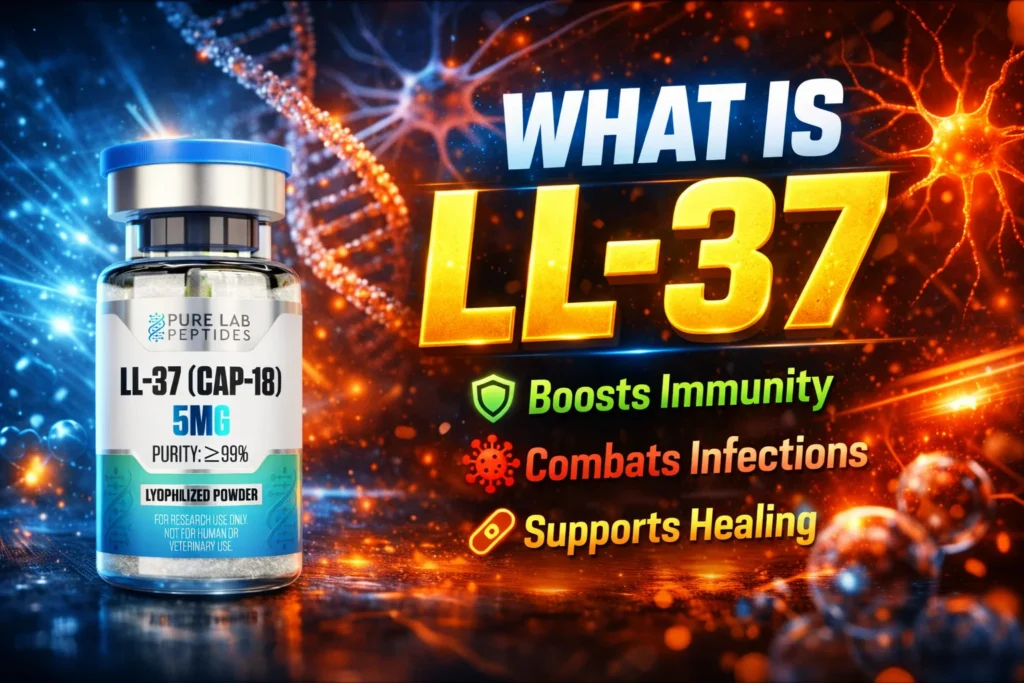
If you’ve heard people talk about “LL-37 peptide therapy” and you’re wondering what it actually is, you’re not alone. LL‑37 (also written “LL37”) is a natural human antimicrobial peptide connected to innate immunity, inflammation signaling, and wound repair. This guide breaks down what LL‑37 is, how it works, what the research really supports, and the key safety and quality considerations.
Fast Answer / Executive Summary
LL‑37 is the active 37‑amino‑acid “cathelicidin” peptide made by the human body that helps defend against microbes and also shapes inflammation and tissue repair. It works mainly by binding to negatively charged microbial surfaces (disrupting membranes, neutralizing endotoxin like LPS) and by signaling through immune pathways that affect chemotaxis and wound healing. Human clinical evidence exists mostly for topical wound applications, not systemic self‑use. [1]
Core Concepts & Key Entities
What LL-37 is in plain English
LL‑37 is a host defense peptide (also called an antimicrobial peptide) that your body produces as part of innate immunity. In humans, the relevant gene is CAMP, which encodes a precursor protein that is later processed into the active antimicrobial fragment (LL‑37). [2]
A helpful mental model: LL‑37 is not “an antibiotic” in the classic drug sense; it’s a built‑in immune tool that can both attack microbes and “steer” immune responses. That dual role is why it’s studied in infections and inflammatory/autoimmune conditions. [3]
What does “LL-37” stand for?
LL‑37 is a 37‑amino‑acid peptide named for its N‑terminal leucine‑leucine (“LL”) motif and its length (“37”). [4]
Where LL-37 comes from in the body
Humans produce LL‑37 as part of the CAMP/hCAP18 system, and expression is notable in immune cells and barrier tissues. Key points the literature repeats:
- The precursor (often called hCAP18) is associated with immune cell granules (classically neutrophils), and LL‑37 can also be produced in various epithelial contexts. [5]
- The gene summary for CAMP (RefSeq) describes broad antimicrobial roles plus functions in chemotaxis and inflammatory regulation. [6]
- Reviews emphasize LL‑37 as the sole human cathelicidin, with broad expression across cell types in immune and epithelial systems. [7]
How LL-37 is activated and processed
LL‑37 is produced from a larger precursor through proteolysis. Two commonly cited processing concepts are:
- Proteinase 3 can cleave the precursor to generate LL‑37 in immune contexts. [8]
- In skin biology, additional serine proteases (including kallikrein-family enzymes) are discussed in processing and generating different fragments with different activities. [9]
Practical takeaway: “LL‑37” in papers may refer to the canonical 37‑mer, but biology also contains LL‑37‑derived fragments that can behave differently. [10]
Key structural features that explain why LL-37 works
LL‑37’s structure explains why it binds microbes and influences membranes:
- It is cationic (positively charged) and amphipathic (has both hydrophobic and hydrophilic sides), which favors interaction with negatively charged microbial surfaces. [11]
- It is commonly described as adopting an α‑helical structure under physiological or membrane‑like conditions. [12]
- A frequently cited physicochemical detail is a net charge around +6 at neutral pH, consistent with cationic host defense peptide behavior. [8]
What LL-37 does, mechanistically
LL‑37 is best understood as having two main “lanes” of activity.
Direct antimicrobial and anti-endotoxin actions
LL‑37 can directly damage microbes by membrane interaction. Reviews describe membrane disruption/pore formation as a major theme of activity for cathelicidins like LL‑37. [13]
LL‑37 is also discussed as an LPS (endotoxin) binder/neutralizer, which can reduce downstream inflammatory signaling triggered by endotoxin recognition pathways. [14]
Immune signaling and immunomodulation
LL‑37 doesn’t just “kill bugs.” It also affects immune behavior:
- It is described as participating in chemotaxis and immune mediator effects. [15]
- FPRL1/FPR2 (formyl peptide receptor–like 1, often modernly discussed as the FPR2 family) is repeatedly described as involved in LL‑37‑related chemotactic and angiogenic signaling in experimental systems. [16]
- Multiple reviews emphasize that LL‑37 can push immune responses in either pro‑ or anti‑inflammatory directions depending on dose, context, and tissue, which is part of why it appears in both infection and autoimmune discussions. [17]
LL-37, biofilms, and why the peptide world talks about it
Biofilms (structured microbial communities) are harder to eradicate than free‑floating bacteria, and LL‑37 is frequently studied here.
A wound-focused review summarizes that LL‑37 has antimicrobial and anti‑biofilm activity against multiple Gram‑positive and Gram‑negative pathogens and argues that the combination of anti‑biofilm and wound‑healing effects is why LL‑37 is explored as a topical candidate. [18]
A second review frames LL‑37 as promising but highlights limitations (like resistance mechanisms and translation challenges), which is important context for anyone reading enthusiastic claims online. [19]
The strongest human evidence: topical wound healing trials
For people searching “What is LL‑37?” the next question is usually: “Is there real human evidence?”
There is human clinical research, but it is most established in topical wound contexts rather than generalized “systemic immune boosting.”
- A randomized, placebo‑controlled clinical trial in hard‑to‑heal venous leg ulcers (34 participants) reported that two lower topical concentrations improved healing measures and were well tolerated, while a higher concentration did not outperform placebo. The abstract also states no safety concerns regarding local or systemic adverse events in that trial. [20]
- A later phase IIb randomized placebo‑controlled trial (148 participants) found no significant improvement in healing in the full population, but reported post hoc improvements in a subgroup with larger ulcers, and stated the study drug was well tolerated and safe in both dose strengths. [21]
- A randomized double‑blind controlled trial of an LL‑37 cream in diabetic foot ulcers with mild infection reported improvements in granulation index/healing measures, with mixed findings on inflammatory markers and aerobic bacterial colonization, and listed a trial registration number. [22]
Key takeaway: The best human data for LL‑37 is localized/topical wound research, and even there the results are mixed across studies and subgroups. [23]
The “context dependence” insight most pages miss
Here’s the information-gain framework that clears up a lot of confusion:
LL‑37 behaves less like a single-purpose “drug” and more like a “context amplifier.” In other words, the same peptide can help (by reducing microbial burden and assisting repair) or harm (by fueling inflammatory loops) depending on what it binds to and which receptors get engaged.
Three real examples from the literature:
- Binding endotoxin (LPS) can dampen endotoxin-triggered inflammatory signaling pathways. [24]
- Binding self-DNA or self-RNA can convert normally “ignored” nucleic acids into triggers for toll‑like receptors and type I interferon signaling—mechanisms implicated in psoriasis and broader autoimmune discussions. [25]
- Dose and tissue matter: reviews describe cytotoxicity or cell-death effects at higher concentrations in some cell types and protective effects in others, reinforcing that LL‑37 is not “one-directional.” [26]
If you keep that lens—what is LL‑37 binding, where is it acting, and at what concentration?—you’ll interpret papers and marketing claims far more accurately. [17]
Regulatory and safety reality check
LL‑37 is widely discussed online, but regulatory status matters:
- A dedicated review on LL‑37 as an antimicrobial/anti‑biofilm agent notes that LL‑37 and derivatives have not achieved regulatory approval as a therapeutic agent (as of the review’s publication). [27]
- S. Food and Drug Administration[28] has publicly listed “Cathelicidin LL‑37” among certain bulk drug substances in 503A Category 2 (a category associated with “significant safety risks” concerns in compounding review context). The entry specifically flags concerns such as immunogenicity risk, peptide-related impurities/API characterization complexity, limited safety information, and also references nonclinical findings suggesting detrimental effects on male reproduction and potential protumorigenic effects in some tissues. [29]
Bottom line: LL‑37 is not a casual “supplement peptide.” It’s an immune-active molecule with meaningful scientific interest and meaningful safety questions. [30]
Step‑by‑Step / How‑To
Step One: Clarify what you mean by “LL-37”
LL‑37 is the active 37‑mer cathelicidin fragment; “LL37” is just a different spelling, and biology also contains LL‑37‑derived fragments. [31]
Step Two: Match the claim to the correct evidence type
If the claim is “LL‑37 improves chronic wound healing,” look for topical human trials; if the claim is “LL‑37 boosts immunity systemically,” you’re often looking at mechanistic or preclinical evidence, not broad clinical proof. [32]
Step Three: Separate antimicrobial action from immune signaling
LL‑37 can disrupt microbial membranes and neutralize endotoxin, but it also signals through immune pathways that can raise or lower inflammation depending on context. [33]
Step Four: Screen for “inflammation amplifier” scenarios
LL‑37 can bind self‑DNA/self‑RNA and activate toll‑like receptor pathways in dendritic cells and neutrophils—mechanisms central to psoriasis research and relevant to autoimmunity discussions. [25]
Step Five: Use a quality-first checklist before you trust any product layer
Quality concerns with peptides include impurities, characterization, and immunogenicity risk—issues explicitly highlighted for LL‑37 in the compounding safety-risk context. [29]
Step Six: Keep the “topical evidence bias” in mind
When you see compelling outcomes, notice the route—LL‑37’s best human evidence base is currently topical wound research, with mixed replication across trials and subgroups. [23]
Comparison / Alternatives
When someone is researching LL‑37, they are often really asking: “What’s the best ‘anti-infection + healing’ approach—and is LL‑37 unique?”
A useful comparison is LL‑37 (a human host defense peptide) vs. other antimicrobial strategies, including synthetic antimicrobial peptides like omiganan and standard topical antiseptics/antimicrobials.
LL‑37 vs omiganan vs standard topical antimicrobials
| Feature | LL‑37 (human cathelicidin) | Omiganan (synthetic AMP) | Standard topical antiseptics/antimicrobials |
| What it is | Endogenous human host defense peptide fragment | Synthetic cationic peptide analog (indolicidin‑related) | Small-molecule antiseptics/antibiotics (varies) |
| Main “draw” | Dual role: antimicrobial + immune/wound signaling | Broad topical antimicrobial spectrum in development | Established protocols, wide clinical familiarity |
| Mechanism headline | Membrane interaction; endotoxin binding; immune pathway effects | Rapidly bactericidal/fungicidal in topical contexts | Diverse; often direct microbe kill/inhibition |
| Strongest human‑relevant lane | Topical wound healing trials (mixed results) | Studied as topical gel for preventing catheter-site infections | Standard of care in many wound/skin protocols |
| Notable limitation | Context‑dependent signaling; safety unknowns for systemic use; not approved | Still investigational for many uses; outcomes indication-specific | Resistance (for antibiotics), irritation/toxicity (for antiseptics) |
| Why it matters for peptide readers | “Immune-active,” not just antimicrobial | “Antimicrobial-first” peptide development pathway | Often first-line before experimental peptides |
Key takeaway: LL‑37 stands out because it’s not only antimicrobial—it also participates in chemotaxis, inflammatory regulation, and angiogenesis/wound repair pathways, which can be beneficial or problematic depending on the scenario. [35]
Practical alternatives people should consider first
If your goal is “better wound outcomes,” the evidence base tends to favor evidence-driven wound care fundamentals (debridement decisions, offloading, compression in VLUs, infection control, and appropriately selected topical agents) before experimental peptides. The LL‑37 wound trials still sit inside that broader standard-of-care context, not outside it. [36]
Templates / Checklist / Example
Use this checklist as a copy‑ready filter for deciding whether LL‑37 information you’re reading is actionable, overhyped, or missing safety context.
LL‑37 research literacy checklist
- Define whether “LL‑37” refers to the canonical 37‑mer or an LL‑37 fragment/analog. [37]
- Locate the evidence tier (human RCT, small trial, animal model, in vitro). [38]
- Confirm the route of use in the evidence (topical vs systemic). [39]
- Check for context risks (autoimmune signaling via self‑DNA/RNA complexes). [40]
- Separate antimicrobial claims from immune‑modulation claims. [41]
- Look for mixed or null results in later trials, not only early positives. [42]
- Account for peptide limitations like resistance adaptation and degradation issues discussed in reviews. [43]
- Verify whether the peptide is regulated/approved for the intended use (most LL‑37 use is investigational). [44]
- Treat compounding and injection discussions as higher risk due to immunogenicity/impurity concerns highlighted by regulators. [29]
- Prefer products with transparent batch documentation and clear “research use only” positioning if you are in a legitimate research context. [45]
- Document what outcome you’re tracking (microbial endpoints vs inflammation endpoints vs healing endpoints). [46]
- Consult a qualified clinician for any health decision—LL‑37 content online is often not tailored to your risk profile. [47]
Example: a fast “evidence label” for any LL‑37 claim
When you read an LL‑37 claim, label it in one line:
Claim → Evidence → Route → Risk flags
Example pattern (copy/paste): – “LL‑37 improves venous leg ulcer healing” → Trial evidence exists (mixed) → Topical → Monitor dose/context signals. [48]
– “LL‑37 broadly boosts immunity” → Mechanistic/biomarker discussion → Often non‑clinical or context-specific → Watch for autoimmunity and safety gaps. [49]
FAQs
What is LL-37 used for?
What is LL‑37 used for? LL‑37 is used in scientific research to study antimicrobial defense, immune signaling, biofilm behavior, and wound repair mechanisms. In humans, the best developed clinical lane is topical wound research (venous leg ulcers and diabetic foot ulcers), where findings range from promising early results to mixed outcomes in larger trials. [23]
What is LL-37 in the immune system?
What is LL‑37 in the immune system? LL‑37 is a host defense peptide produced from the CAMP gene system that contributes to innate immune protection and also modulates inflammation. It can interact with microbes directly (membrane effects, endotoxin binding) while also influencing chemotaxis and cytokine-related pathways, which can be protective or pro‑inflammatory depending on context. [50]
Is LL-37 the same as cathelicidin?
Is LL‑37 the same as cathelicidin? LL‑37 is the active antimicrobial peptide fragment most commonly discussed in humans from the cathelicidin system, and humans are often described as having a single cathelicidin (LL‑37). “Cathelicidin” can also refer to the broader precursor/propeptide context and related peptides in other species. [51]
Does LL-37 help with wound healing?
Does LL‑37 help with wound healing? LL‑37 has evidence suggesting it can support wound repair biology (angiogenesis and re‑epithelialization) and has been tested clinically as a topical therapy for chronic wounds. A first-in-man venous leg ulcer trial reported improved healing measures at lower topical concentrations, while a larger phase IIb trial did not show overall benefit but suggested a subgroup signal in larger wounds. [52]
Can LL-37 worsen inflammation or autoimmunity?
Can LL‑37 worsen inflammation or autoimmunity? LL‑37 can participate in inflammatory amplification when it forms complexes with self‑DNA or self‑RNA that activate toll‑like receptor pathways in immune cells. This mechanism is strongly discussed in psoriasis literature and is one reason LL‑37 is treated as context-sensitive—helpful in some settings and risky in others. [25]
Is LL-37 FDA-approved?
Is LL‑37 FDA‑approved? LL‑37 is not generally described as an approved therapeutic agent in the scientific reviews discussing its clinical translation, and regulators have flagged safety-information gaps and risk concerns for compounded LL‑37 in certain contexts. Treat any availability online as “research use” unless a licensed clinician provides an approved, regulated product pathway. [44]
Next Steps
If you remember one thing: LL‑37 is a real human immune peptide with real biology—but it’s not a simple “immune booster,” and the strongest human evidence is still largely topical wound research with mixed results. [53]
For practical, educational context (including the questions beginners most commonly ask about reconstitution math and protocol terminology), the LL‑37 guide on PeptideDosages.com[54] can serve as a starting reference. [55]
If you’re evaluating vendors for legitimate laboratory research, prioritize transparent quality documentation and explicit “research use only” positioning; for example, Pure Lab Peptides[56] states its LL‑37 product information is for research/lab use and not for human or animal consumption, and displays example batch documentation. [45]
[1] [2] [3] [6] [15] [35] [50] CAMP cathelicidin antimicrobial peptide [Homo sapiens (human)] – Gene – NCBI
https://www.ncbi.nlm.nih.gov/gene/820
[4] [7] [31] [51] Antimicrobial Peptides of the Cathelicidin Family: Focus on LL-37 and Its Modifications
https://www.mdpi.com/1422-0067/26/16/8103
[5] Positive correlation between circulating cathelicidin antimicrobial peptide (hCAP18/LL-37) and 25-hydroxyvitamin D levels in healthy adults – PMC
https://pmc.ncbi.nlm.nih.gov/articles/PMC3532295/
[8] [11] [12] [28] [54] The ratio of serum LL-37 levels to blood leucocyte count correlates with COVID-19 severity | Scientific Reports
https://www.nature.com/articles/s41598-022-13260-8
[9] [10] [37] The Human Cathelicidin Antimicrobial Peptide LL-37 and Mimics are Potential Anticancer Drugs – PMC
https://pmc.ncbi.nlm.nih.gov/articles/PMC4485164/
[13] [33] Cathelicidin LL-37: A new important molecule in the pathophysiology of systemic lupus erythematosus – PMC
https://pmc.ncbi.nlm.nih.gov/articles/PMC7388365/
[14] LL-37: Structures, Antimicrobial Activity, and Influence on Amyloid-Related Diseases
https://www.mdpi.com/2218-273X/14/3/320
[16] JCI – An angiogenic role for the human peptide antibiotic LL-37/hCAP-18
https://www.jci.org/content/vol111/page1665
[17] [19] [27] [43] [44] The Potential of Human Peptide LL-37 as an Antimicrobial and Anti-Biofilm Agent – PMC
https://pmc.ncbi.nlm.nih.gov/articles/PMC8227053/
[18] [24] [41] The Human Cathelicidin Antimicrobial Peptide LL-37 as a Potential Treatment for Polymicrobial Infected Wounds – PMC
https://pmc.ncbi.nlm.nih.gov/articles/PMC3699762/
[20] [23] [32] [34] [38] [39] [48] [52] [53] [56] Treatment with LL-37 is safe and effective in enhancing healing of hard-to-heal venous leg ulcers: a randomized, placebo-controlled clinical trial – PubMed
https://pubmed.ncbi.nlm.nih.gov/25041740/
[21] Evaluation of LL-37 in healing of hard-to-heal venous leg ulcers: A multicentric prospective randomized placebo-controlled clinical trial – PubMed
https://pubmed.ncbi.nlm.nih.gov/34687253/
[22] [46] Efficacy of LL-37 cream in enhancing healing of diabetic foot ulcer: a randomized double-blind controlled trial – PMC
https://pmc.ncbi.nlm.nih.gov/articles/PMC10514151/
[25] [40] Self-RNA–antimicrobial peptide complexes activate human dendritic cells through TLR7 and TLR8 – PMC
https://pmc.ncbi.nlm.nih.gov/articles/PMC2737167/
[26] [49] Little peptide, big effects: the role of LL-37 in inflammation and autoimmune disease – PMC
https://pmc.ncbi.nlm.nih.gov/articles/PMC3836506/
[29] [30] [47] Certain Bulk Drug Substances for Use in Compounding that May Present Significant Safety Risks | FDA
[36] [42] Evaluation of LL‐37 in healing of hard‐to‐heal venous leg ulcers: A multicentric prospective randomized placebo‐controlled clinical trial – PMC
https://pmc.ncbi.nlm.nih.gov/articles/PMC9298190/
[45] Buy LL-37 Online | Broad-Spectrum Antimicrobial Research Peptide
https://purelabpeptides.com/buy-peptides/buy-ll-37-5mg/
[55] LL-37 Dosage Protocol | PeptideDosages.com
https://peptidedosages.com/single-peptide-dosages/ll-37-5-mg-vial-dosage-protocol/