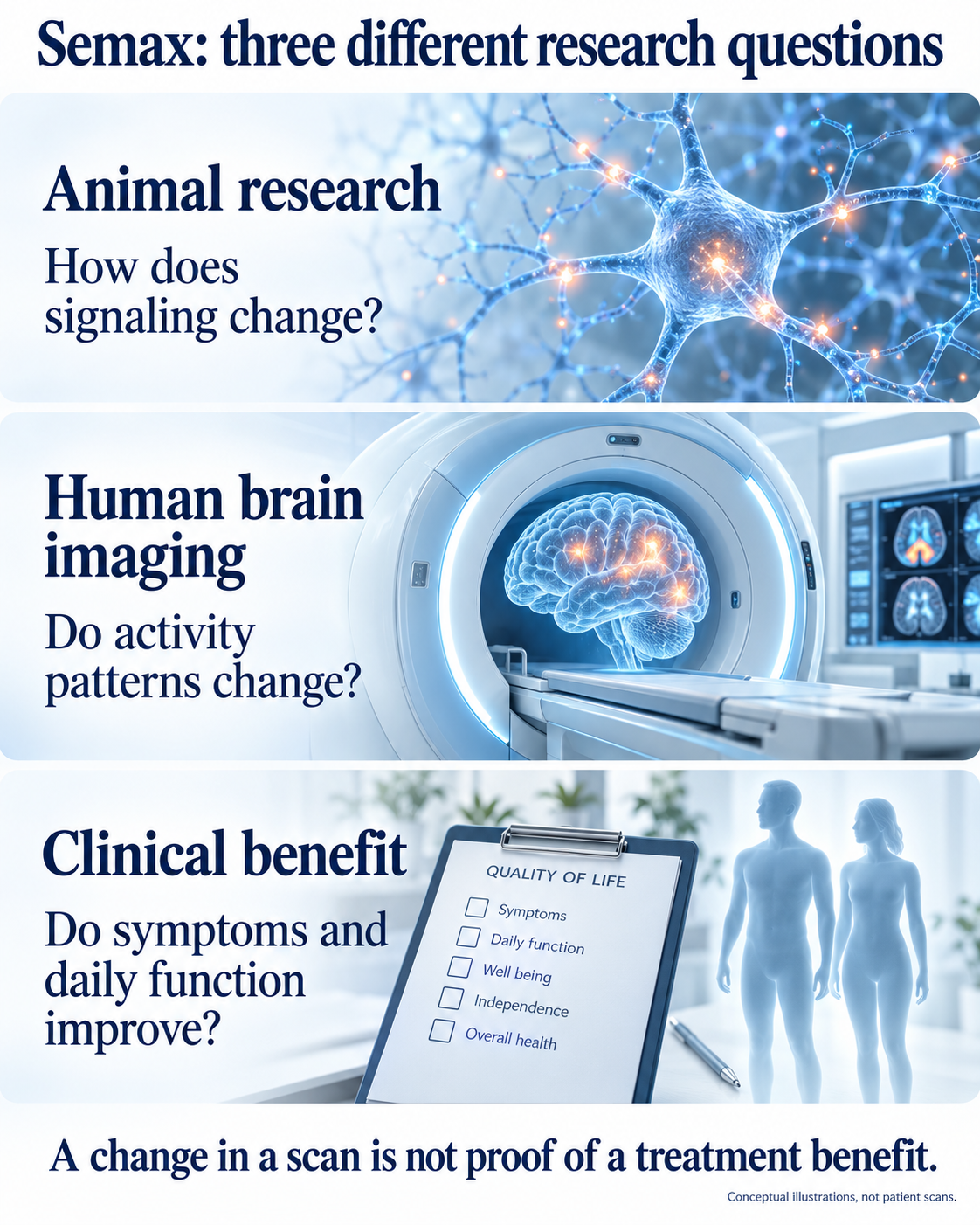

If you searched “What is Semax,” you’re probably trying to do one of three things: understand what it is, understand what it actually does (vs. internet hype), and figure out whether it’s worth considering in a responsible, evidence-based way.

This guide is written for peptide beginners and experienced enthusiasts alike. It focuses on the real research: what Semax is, how it may work, where the evidence is strongest (and weakest), what safety and legality signals matter most, and how to evaluate it without guesswork.

Fast Answer / Executive Summary

Semax is a synthetic, ACTH-derived heptapeptide (7 amino acids) researched for neuroprotective and nootropic effects, most notably in Russian clinical practice and preclinical brain-injury models. It’s commonly studied via intranasal delivery, with proposed mechanisms involving neurotrophins like BDNF/TrkB, gene-expression changes after stress or ischemia, and neurotransmitter modulation. Human evidence exists but is limited, and U.S. regulators have flagged compounding-related safety concerns.

Core Concepts & Key Entities

What Semax is in plain English

Semax is a short synthetic peptide made of seven amino acids (a “heptapeptide”). Its sequence is commonly listed as Met–Glu–His–Phe–Pro–Gly–Pro, and it’s also identified as ACTH(4–7)-PGP. [1]

Semax was designed from a fragment of adrenocorticotropic hormone (ACTH), but with changes intended to preserve neuroactive effects while avoiding the classical hormonal effects of full-length ACTH. [2]

A key practical takeaway: Semax is usually discussed in “brain and nervous system” contexts, not in metabolic hormone contexts (like GLP‑1). In other words, it’s a peptide people pursue for cognition, recovery, and resilience—not for weight loss.

Where Semax fits among peptides

Semax isn’t an “everything peptide.” It sits in a specific niche: melanocortin-derived regulatory peptides and (by design) “glyproline” hybrids that use a stabilizing Pro–Gly–Pro tail. [3]

That niche matters because it frames two realities simultaneously:

Semax has serious mechanistic research (gene expression, neurotrophins, monoamines, ischemia models). [4]
Semax also has serious translation limitations (most work outside Western clinical pathways, variable products online, and U.S. regulatory caution for compounded versions). [5]

The sequence isn’t trivia: the “MEHF + PGP” design

Semax is often described as a “hybrid” molecule: a fragment corresponding to ACTH(4–7) (Met–Glu–His–Phe) fused to a Pro–Gly–Pro tail. This design is repeatedly discussed as a strategy to improve resistance to peptidase degradation (metabolic stability). [6]

This helps explain why Semax is frequently framed as “short-lived molecule, longer-lived effect.” In melanocortin-derivative research, Semax is described as having a short half-life in the body but effects that may persist longer (at least in animal behavioral paradigms). [7]

How Semax is typically delivered and why

Semax is most commonly studied as an intranasal peptide (drops or spray), and this choice isn’t arbitrary: intranasal administration is widely researched as a way to deliver peptides toward the central nervous system while reducing barriers like the blood–brain barrier (BBB). [8]

Intranasal “nose-to-brain” delivery is associated with transport pathways involving the olfactory and trigeminal systems, but the field still considers mechanisms complex and not fully settled. [9]

Just as important: oral peptides are generally hard to deliver effectively because oral delivery is hindered by enzymatic degradation and poor permeability in the GI tract. That’s a general peptide-drug constraint that helps explain why Semax is not commonly presented as an oral peptide in serious research discussions. [10]

How Semax may work

Semax research clusters into three “mechanism layers.” This is a useful way to separate what’s well-described in lab work from what’s still speculative in humans.

Mechanism layer one: neurotransmitters and “signal tuning”

Semax has been studied for interactions with monoaminergic systems—especially serotonergic and dopaminergic signaling—in rodent models. For example, one study reports changes consistent with a modulatory effect on serotonergic turnover (e.g., 5‑HIAA changes) and enhancement of amphetamine-evoked dopamine release and locomotor activity. [11]

This dovetails with the broader hypothesis that melanocortin-related peptides can interact with monoaminergic networks. [12]

What this does not prove: that Semax is a “stimulant.” It suggests neuromodulation, not guaranteed stimulant-style effects in every context.

Mechanism layer two: neurotrophins and neuroplasticity signals

A major recurring theme is Semax and neurotrophins—especially BDNF (brain-derived neurotrophic factor) and TrkB (tropomyosin receptor kinase B).

In rodent hippocampus research, a single intranasal Semax administration has been reported to increase BDNF-related signals (including BDNF protein and TrkB phosphorylation and mRNA changes), alongside behavioral learning measures in that paradigm. [13]

Other work has explored Semax effects on BDNF levels after intranasal application, including in basal forebrain contexts. [14]

A practical way to read this: Semax is often framed less like “blocking a receptor” (coffee) and more like nudging plasticity programs (BDNF/TrkB signaling) in certain models. That’s why it’s so often marketed as “neurotrophic”—even though marketing language frequently outruns the evidence.

Mechanism layer three: gene expression shifts after ischemia or stress

Semax has unusually extensive research examining transcriptomic (gene expression) changes in ischemia models.

One genome-wide transcriptional analysis in rat focal ischemia reports that Semax altered expression of numerous genes, with especially notable clusters related to immune response and vascular system processes (with different timing profiles after ischemia). [15]

Other RNA‑seq work in a transient ischemia–reperfusion model identified hundreds of differentially expressed genes after Semax treatment versus saline. [16]

This is an important “information gain” point many competing pages miss: Semax may be “context-sensitive.” In at least one stress-model transcriptome study, Semax showed minimal differential gene expression at a later timepoint in non-stressed conditions, even while other findings highlight rapid-onset behavioral effects when timing is different. [7]

A clean way to interpret that (without overclaiming): Semax may have its most detectable “signature” when the brain is under a perturbation (stress/ischemia models), rather than acting as a constant, baseline amplifier in all conditions.

What Semax is used for in research and clinical contexts

Semax is used in Russian clinical practice and researched primarily for neurological pathologies and stress-related conditions, with notable emphasis on cerebrovascular injury contexts (e.g., stroke) and neuroprotection. [17]

A PubMed-indexed review describing Semax’s research and clinical experience states it is used in treatment of CNS diseases and describes positive effects reported in those use contexts. [18]

Semax is also discussed in hypothesis-oriented literature as a potential agent for ADHD or Rett syndrome based on mechanistic rationale and preclinical observations, though that is not the same thing as established, guideline-supported therapy. [19]

What benefits people talk about—and what the evidence supports

To match real search intent, here’s the truth-table most readers need: “What’s plausible, what’s supported, what’s hype?”

Most supported (relative strength): neuroprotection contexts and brain-injury models. Semax is repeatedly discussed in stroke/ischemia contexts and shows robust mechanistic exploration in ischemia models (including transcriptomics). [20]

Some support: attention and memory outcomes in humans under specific conditions. Human-oriented summaries describe improvements in attention/memory in healthy men under “extreme conditions of activities,” and broader summaries note memory/attention stimulation after intranasal use in rodents and humans. [21]

Mechanistic support with limited direct translation: cholinergic neuron survival markers. In vitro work reports increased survival of basal forebrain cholinergic neurons and stimulation of choline acetyltransferase activity at a tested concentration. [22]

Interesting but early-stage: amyloid/copper aggregation models. A mechanistic study tested Semax in amyloid-β aggregation systems and reported concentration-dependent inhibition of fiber formation and reduced membrane disruption in model systems—promising as a research direction, not a clinical claim. [23]

Bottom line: Semax is “research-rich,” but not “clinically settled” in the way FDA-approved, guideline-driven therapies are.

Safety and legality: the part most pages understate

Semax safety is not one simple question. It’s three questions:

Molecule safety: what the peptide itself appears to do in studies. [24]
Route safety: intranasal vs other routes carry different practical risks (e.g., local irritation, variability in dosing delivery). [25]
Product safety: purity, aggregates, endotoxin, and batch consistency—especially outside formal pharmaceutical channels. [5]

In the United States, the U.S. Food and Drug Administration[26] has publicly listed Semax (heptapeptide) in its discussion of bulk drug substances that may present significant safety risks when used in compounding, specifically noting potential immunogenicity risks tied to aggregation and peptide-related impurities, and limited safety-related information for proposed routes. [5]

That statement doesn’t mean “Semax is dangerous in all forms.” It means: if Semax is being produced/handled outside standardized pharmaceutical manufacturing, the risk profile can shift materially.

Step-by-Step / How-To

Step One: Define the outcome you want

The fastest way to waste money is to chase “Semax” as a general brain upgrade. Decide what you want: focus, mental stamina, recovery support, stress resilience, or research interest in neurotrophins. Different goals point to different tools—and sometimes away from Semax entirely. [27]

Step Two: Match the goal to the evidence tier

Semax has its strongest mechanistic depth in ischemia/stress biology and neurotrophin signaling. If your goal is “I want a reliable, predictable cognitive boost for normal weekdays,” you’re asking Semax to be something it isn’t well-proven to be. [28]

A clean mental model:

  • Brain injury / ischemia models: strongest mechanistic evidence. [29]
  • Healthy human cognitive performance: some signals, limited breadth. [21]
  • Online “biohacker claims”: high variance; treat as hypotheses until proven.

Step Three: Understand why delivery method changes the entire experience

Semax is commonly discussed as intranasal because intranasal delivery is widely researched for peptide delivery toward the brain, but it’s also variable and not “plug-and-play.” [25]

If you’re comparing common routes mentioned online, remember:

  • Intranasal delivery may leverage olfactory/trigeminal pathways, but delivery is influenced by nasal anatomy, technique, and formulation. [9]
  • Systemic routes can change pharmacokinetics and may not mirror the literature you’re reading (which is often intranasal focused). [30]

If you want a protocol-style walk-through (reconstitution math, measuring guidance, and practical cautions), these internal references are designed for that use case:

These are educational resources, not medical prescriptions.

Step Four: Vet sourcing like a scientist, not a shopper

This is the uncomfortable truth: for peptides, product risk can exceed molecule risk.

The FDA’s compounding risk language focuses on issues like aggregation, peptide-related impurities, and insufficient safety info—exactly the category of problems that sourcing and handling can amplify. [5]

A practical quality bar to insist on (even for “research use”):

  • Identity confirmation (e.g., mass spec/sequence confirmation)
  • Purity testing (e.g., HPLC)
  • Endotoxin controls where applicable
  • Transparent batch documentation and COA availability

Semax’s known identifiers (molecular formula/weight and names) also make it easier to sanity-check documentation. [31]

Step Five: Track effects with a short, pre-defined rubric

If you don’t track, you can’t tell placebo from signal—especially for peptides marketed as “subtle but powerful.”

A simple rubric aligns with Semax’s hypothesized domains:

  • Cognition: attention, learning, memory consolidation signals (subjective + objective tasks). [27]
  • Mood/stress: calm vs agitation, stress resilience markers. [7]
  • Tolerability: sleep disruption, headaches, nasal irritation, or “wired” feeling (if intranasal). [32]

Key takeaway: Define what “success” means before you start. That’s how you avoid chasing stories.

Comparison / Alternatives

Semax gets lumped into “nootropics,” but it behaves very differently from many mainstream nootropics. The cleanest comparison is not just “Semax vs X,” but “peptide neuromodulation vs classic pharmacology.”

Here’s a practical, SERP-friendly comparison:

Option Primary research focus Typical delivery discussed Evidence base (high level) Common “fit” Main cautions
Semax Neuroprotection, neurotrophins, ischemia/stress biology Mostly intranasal in literature Strong preclinical depth; limited Western clinical footprint Researchers + peptide enthusiasts with specific goals Product quality variance; FDA compounding safety concerns noted
Selank Anxiolytic/stress modulation; GABAergic gene expression Often intranasal in discussions Preclinical + some clinical discussion; mechanistic gene-expression studies “Calm focus” seekers, anxiety-leaning profiles Same sourcing/quality issues as peptides
Modafinil Wakefulness promotion Oral prescription drug Broad clinical use for specific indications Sleepiness-related performance issues Prescription-only; side effects and interactions matter
Caffeine + L-theanine Alertness + smoother stimulation Oral Large body of human use data Everyday focus/energy support Tolerance, sleep disruption, anxiety
Behavioral stack (sleep, exercise, light, timing) Cognitive performance foundation Lifestyle Strong evidence across domains Everyone Requires consistency, not novelty

Selank’s mechanistic research includes effects on expression of genes involved in GABAergic neurotransmission and proposed allosteric modulation in that pathway. [33]
Semax and Selank are also discussed together as products of the same design strategy: stabilizing glyproline hybrids based on different parent fragments. [34]

Decisive comparison point: If you want “more drive and cognitive push,” Semax is the more common direction; if you want “less anxiety and smoother calm,” Selank is the more common direction. The evidence for either is not equally mature in Western regulatory terms, so the decision should emphasize risk tolerance and sourcing discipline. [35]

Templates / Checklist / Example

Semax “reality check” checklist

Use this copy-ready checklist before you commit time or money:

  • Define the outcome you want in one sentence.
  • Separate “clinical use in Russia” from “online research product” in your risk thinking. [36]
  • Confirm the molecule identity (name, CAS/UNII references, sequence). [31]
  • Request a recent COA and verify it matches the batch you receive.
  • Inspect storage/shipping conditions to reduce degradation/aggregation risk. [5]
  • Choose a route aligned with the literature you’re reading (often intranasal). [37]
  • Start tracking baseline cognition, mood, and sleep for at least one week first.
  • Measure outcomes using the same simple tests each time (reaction time, working memory tasks, journaling).
  • Stop if adverse effects appear or if sleep worsens consistently.
  • Consult a qualified clinician if you have neurologic conditions, psychiatric history, or take psychoactive medications.

A simple tracking template

Copy/paste this into your notes app:

  • Goal: (e.g., “reduce cognitive fatigue during long work blocks”)
  • Baseline week score: focus / mood / sleep (1–10)
  • Daily check:
  • Focus (1–10)
  • Stress (1–10)
  • Sleep quality (1–10)
  • Side effects (yes/no + notes)
  • Weekly review: Did anything improve without harming sleep?

This keeps you honest—especially with peptides where perceived effects can be subtle and expectation-driven.

FAQs

What is Semax used for?

What is Semax used for? Semax is used in Russian clinical practice and research contexts for neurological pathologies and stress-related conditions, with major emphasis on neuroprotection and cerebrovascular injury (like stroke) in the literature. Outside that context, it’s commonly discussed as a nootropic peptide, but human evidence for broad “everyday cognition” use is limited. [38]

How does Semax work?

How does Semax work? Semax appears to act through multiple overlapping mechanisms, including neurotrophin signaling (BDNF/TrkB), gene-expression changes after ischemia or stress, and neuromodulatory effects on monoaminergic systems in animal models. These findings are strongest in preclinical research, so they are best treated as mechanistic hypotheses rather than guaranteed outcomes in healthy humans. [39]

Does Semax increase BDNF?

Does Semax increase BDNF? Semax has been reported to increase BDNF-related signals in rodent brain studies, including measured changes in BDNF protein and TrkB signaling and mRNA in the hippocampus after intranasal dosing. This supports the “neurotrophic” narrative mechanistically, but it does not automatically mean Semax reliably increases BDNF in healthy humans in real-world use. [30]

Is Semax FDA-approved?

Is Semax FDA-approved? Semax is not an FDA-approved drug for medical use in the United States, and the FDA has publicly flagged compounded Semax (heptapeptide) as a substance that may present significant safety risks, citing potential immunogenicity issues tied to aggregation and peptide-related impurities and limited safety information. That’s why legality and quality are frequent concerns in U.S. sourcing discussions. [5]

What are the side effects of Semax?

What are the side effects of Semax? Semax side-effect reporting in accessible human literature is limited, and safety conclusions depend heavily on formulation and sourcing. Some clinical summaries describe positive effects without reported complications in their described use contexts, while U.S. regulatory language highlights potential immunogenicity and impurity risks for compounded products. The most practical approach is conservative tracking and clinician input for higher-risk individuals. [40]

Semax vs Selank: what’s the difference?

Semax vs Selank: what’s the difference? Semax is an ACTH-fragment-derived peptide often discussed for memory, attention, and neuroprotection, while Selank is a tuftsin-analog peptide discussed more for anxiolytic and stress-modulating effects with GABAergic involvement. Both are short stabilized peptides with overlapping “nootropic” positioning, but their mechanistic emphases differ. [41]

Next Steps

Semax is best understood as a neuroactive research peptide with strong preclinical depth and limited, context-specific human evidence—not as a universal cognitive shortcut. [42]

If you want to go deeper with protocol-style education (measurement math, handling notes, and practical considerations), start with PeptideDosages.com[43]:

If you’re comparing suppliers, prioritize documentation quality and transparency. For readers specifically looking for a purchase link example, PureLabPeptides.com[44] lists Semax here:

Educational content only—this is not medical advice or a prescription, and you should involve a qualified clinician for any health decisions.


[1] [31] SEMAX

https://drugs.ncats.io/substance/I5FAL2585H

[2] [6] [17] [20] [36] [38]  The Potential of the Peptide Drug Semax and Its Derivative for Correcting Pathological Impairments in the Animal Model of Alzheimer’s Disease – PMC

https://pmc.ncbi.nlm.nih.gov/articles/PMC12755871/

[3] [34] [41] Natural and hybrid (“chimeric”) stable regulatory glyproline peptides – ScienceDirect

https://www.sciencedirect.com/science/article/abs/pii/S0928468004001051

[4] [15] [28] [42]  The peptide semax affects the expression of genes related to the immune and vascular systems in rat brain focal ischemia: genome-wide transcriptional analysis – PMC

https://pmc.ncbi.nlm.nih.gov/articles/PMC3987924/

[5] [43] Certain Bulk Drug Substances for Use in Compounding that May Present Significant Safety Risks | FDA

https://www.fda.gov/drugs/human-drug-compounding/certain-bulk-drug-substances-use-compounding-may-present-significant-safety-risks

[7] Antistress Action of Melanocortin Derivatives Associated with Correction of Gene Expression Patterns in the Hippocampus of Male Rats Following Acute Stress | MDPI

https://www.mdpi.com/1422-0067/22/18/10054

[8] [9] [25]  Nose-to-brain drug delivery: from bench to bedside – PMC

https://pmc.ncbi.nlm.nih.gov/articles/PMC12090632/

[10]  Barriers and Strategies for Oral Peptide and Protein Therapeutics Delivery: Update on Clinical Advances – PMC

https://pmc.ncbi.nlm.nih.gov/articles/PMC12030352/

[11] [12] Semax, an ACTH(4-10) analogue with nootropic properties, activates dopaminergic and serotoninergic brain systems in rodents – PubMed

https://pubmed.ncbi.nlm.nih.gov/16362768/

[13] [30] [39] Semax, an analog of ACTH(4-10) with cognitive effects, regulates BDNF and trkB expression in the rat hippocampus – PubMed

https://pubmed.ncbi.nlm.nih.gov/16996037/

[14] Semax, an analogue of adrenocorticotropin (4-10), binds specifically and increases levels of brain-derived neurotrophic factor protein in rat basal forebrain – PubMed

https://pubmed.ncbi.nlm.nih.gov/16635254/

[16] [26] [29]  Novel Insights into the Protective Properties of ACTH(4-7)PGP (Semax) Peptide at the Transcriptome Level Following Cerebral Ischaemia–Reperfusion in Rats – PMC

https://pmc.ncbi.nlm.nih.gov/articles/PMC7350263/

[18] [21] [24] [40] [44] [A nootropic adrenocorticotropin analog 4-10-semax (l5 years experience in its design and study)] – PubMed

https://pubmed.ncbi.nlm.nih.gov/9173745/

[19] [27] Semax, an analogue of adrenocorticotropin (4-10), is a potential agent for the treatment of attention-deficit hyperactivity disorder and Rett syndrome – PubMed

https://pubmed.ncbi.nlm.nih.gov/16996699/

[22] Effects of behaviorally active ACTH (4-10) analogue – Semax on rat basal forebrain cholinergic neurons – PubMed

https://pubmed.ncbi.nlm.nih.gov/18431004/

[23]  Semax, a Synthetic Regulatory Peptide, Affects Copper-Induced Abeta Aggregation and Amyloid Formation in Artificial Membrane Models – PMC

https://pmc.ncbi.nlm.nih.gov/articles/PMC8855339/

[32] [37]  Intranasal Delivery of Proteins and Peptides in the Treatment of Neurodegenerative Diseases – PMC

https://pmc.ncbi.nlm.nih.gov/articles/PMC4476983/

[33] [35] Selank Administration Affects the Expression of Some Genes …

https://pmc.ncbi.nlm.nih.gov/articles/PMC4757669/?utm_source=chatgpt.com