If you searched “What is PNC-27”, you’re probably seeing big claims—and not much clarity. PNC-27 (sometimes written PNC27) is talked about as a “targeted anti-cancer peptide,” but the real story lives in the preclinical literature, not in established human treatment guidelines. This guide explains what PNC-27 is, how it’s thought to work, what studies actually show, and the safety/regulatory reality—so you don’t have to keep Googling.
Fast Answer / Executive Summary
PNC-27 is a synthetic 32–amino-acid, p53-derived research peptide designed to bind membrane-associated HDM2 (MDM2) on certain cancer cells and trigger pore formation that can lyse cells in preclinical models. It is not FDA-approved, has no established human safety or efficacy, and should be treated as a laboratory research tool, not a medical therapy. [1]
Core Concepts & Key Entities
What is PNC-27?
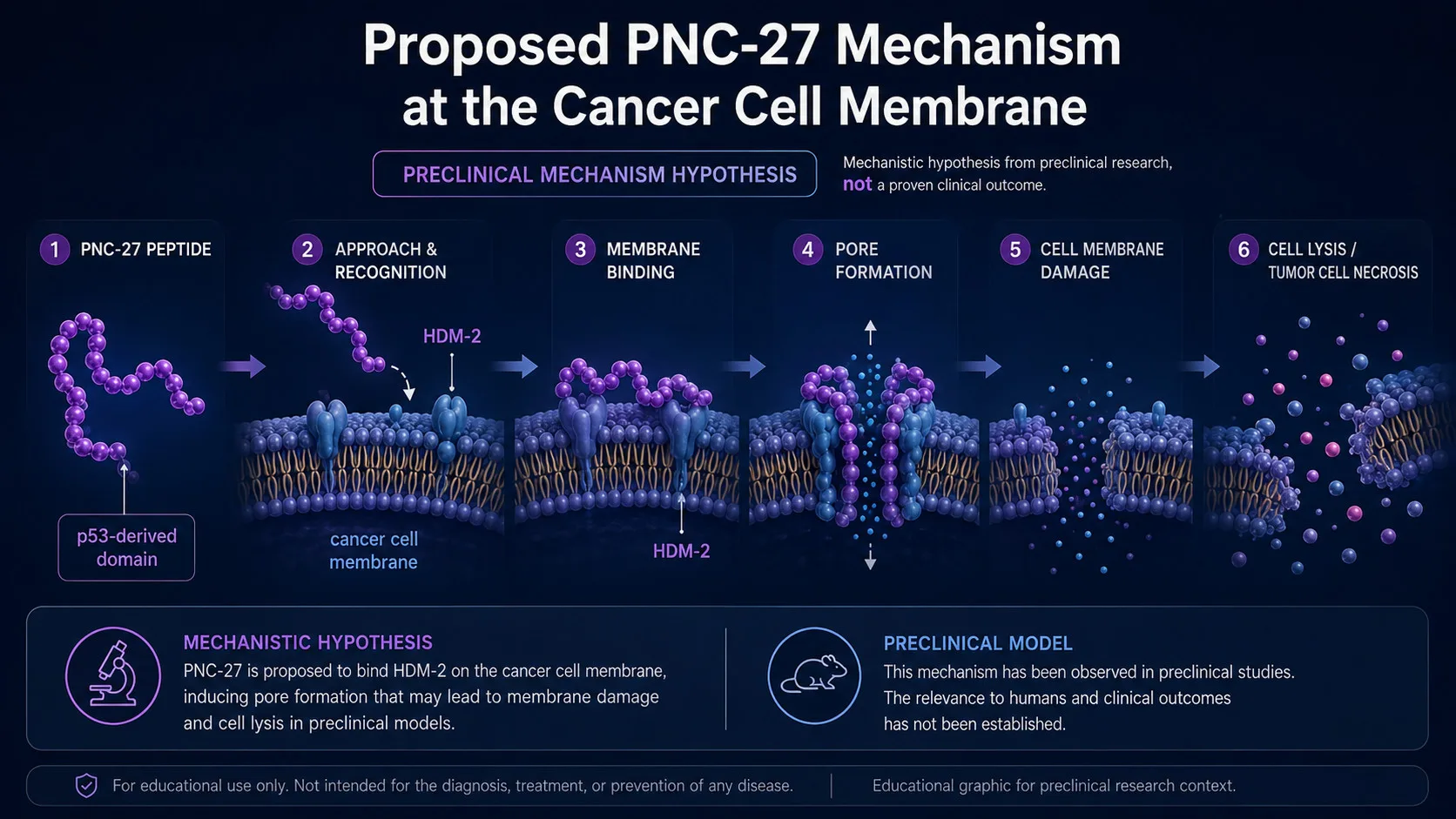
PNC-27 is a chimeric (two-part) peptide built from: (1) a p53 segment that binds HDM2 and (2) a membrane-penetrating “leader” sequence intended to enable membrane interaction and pore formation. In the core preclinical hypothesis, PNC-27 binds HDM2 (human double minute 2) located on the surface membrane of certain tumor cells and contributes to transmembrane pore formation leading to cell lysis/necrosis rather than classical apoptosis. [2]
A practical way to think about PNC-27 is: it’s trying to turn a cancer-associated surface protein (membrane HDM2) into an “anchor point,” then leverage peptide clustering to damage the membrane. That is fundamentally different from many “p53/MDM2” strategies that aim to reactivate p53-driven apoptosis inside the cell. [3]
What does “p53-derived” mean, and why p53 matters
p53 (TP53) is a tumor suppressor pathway cornerstone that helps regulate cell division and cell death in response to stress and DNA damage. When p53 is mutated or its pathway is disrupted, cells can grow unchecked—one reason TP53 alterations are common in cancer biology. [4]
PNC-27 uses a small segment of p53—specifically a region that participates in binding to MDM2/HDM2. Structural work on the p53–MDM2 interaction shows that short p53 peptides in this region can adopt an α-helix and bind a hydrophobic pocket on MDM2, with key residues (often described as a Phe–Trp–Leu “triad”) contributing strongly to binding. [5]
HDM2 vs MDM2: the same target, different naming
MDM2 is the commonly used name for the protein; “HDM2” is often used to emphasize the human form (“human double minute 2”). Functionally in cancer biology, MDM2 is best known as a key negative regulator of p53, acting as an E3 ubiquitin ligase that promotes p53 ubiquitination and degradation in many contexts. [6]
That classic “MDM2 keeps p53 low” story is intracellular. PNC-27’s distinctive claim is that HDM2 is also present on the cell membrane of some malignant cells and that this membrane-associated form (often written mHDM2) can be targeted. [7]
The leader sequence: why “cell-penetrating” peptides show up in the design
Cell-penetrating peptides (CPPs) are short amino-acid sequences used in research to enhance cellular uptake or membrane interactions. A well-known CPP is penetratin, a 16-residue peptide derived from the Antennapedia homeodomain, frequently used as a delivery vector in experimental biology. [8]
In the PNC-27 family of peptides (PNC-27, PNC-28), the leader sequence is not just a delivery “handle.” Published work argues it materially shifts the outcome toward rapid necrotic killing/pore formation rather than the slower, signaling-driven apoptosis patterns expected from traditional “restore p53” approaches. [9]
Sequence and size: what “PNC-27” actually is at the amino-acid level
PNC-27 is described in peer-reviewed work as a 32–amino-acid peptide with an N-terminal p53 (residues 12–26) segment linked to a membrane-penetrating “MRP” (membrane residency peptide) sequence. [10]
A commonly published sequence representation is:
Pro-Pro-Leu-Ser-Gln-Glu-Thr-Phe-Ser-Asp-Leu-Trp-Lys-Leu-Leu-Lys-Lys-Trp-Lys-Met-Arg-Arg-Asn-Gln-Phe-Trp-Val-Lys-Val-Gln-Arg-Gly
How PNC-27 is proposed to kill cells: pore formation and “poptosis”
PNC-27 is proposed to bind HDM2 associated with tumor cell membranes and contribute to pore formation that results in rapid leakage/lysis (a necrotic pattern), a process some authors call “poptosis.” [12]
This matters because necrosis and apoptosis are not the same biological event. Necrosis is commonly described as cell injury with membrane rupture and spillage of cellular contents, while apoptosis is a regulated dismantling pathway with different biochemical signatures. [13]
In several experimental setups, LDH (lactate dehydrogenase) release is used as a proxy for cell membrane damage because LDH is released when membranes are compromised. LDH-based cytotoxicity is not specific to one death pathway, but it is a practical indicator of membrane integrity loss. [14]
What the strongest preclinical evidence actually says (and what it doesn’t)
The strongest accessible evidence base for PNC-27 is preclinical (cell culture + animal models). Key themes repeat across papers:
- Selectivity claim: membrane HDM2 appears higher in several cancer cell membranes than in tested normal/untransformed lines, and engineered membrane localization of HDM2 can make previously resistant normal cells more susceptible in vitro. [15]
- Mechanistic claim: PNC-27 colocalizes with membrane HDM2 and is associated with pore formation/lysis patterns in cancer cells. [12]
- Hematologic angle (AML): a major AML-focused paper reports membrane HDM2 on AML blasts (including stem-cell–enriched populations) and shows PNC-27 binding, membrane damage, and in vivo activity in AML models with attention to sparing normal hematopoietic stem cell activity in those experiments. [16]
What the evidence does not provide:
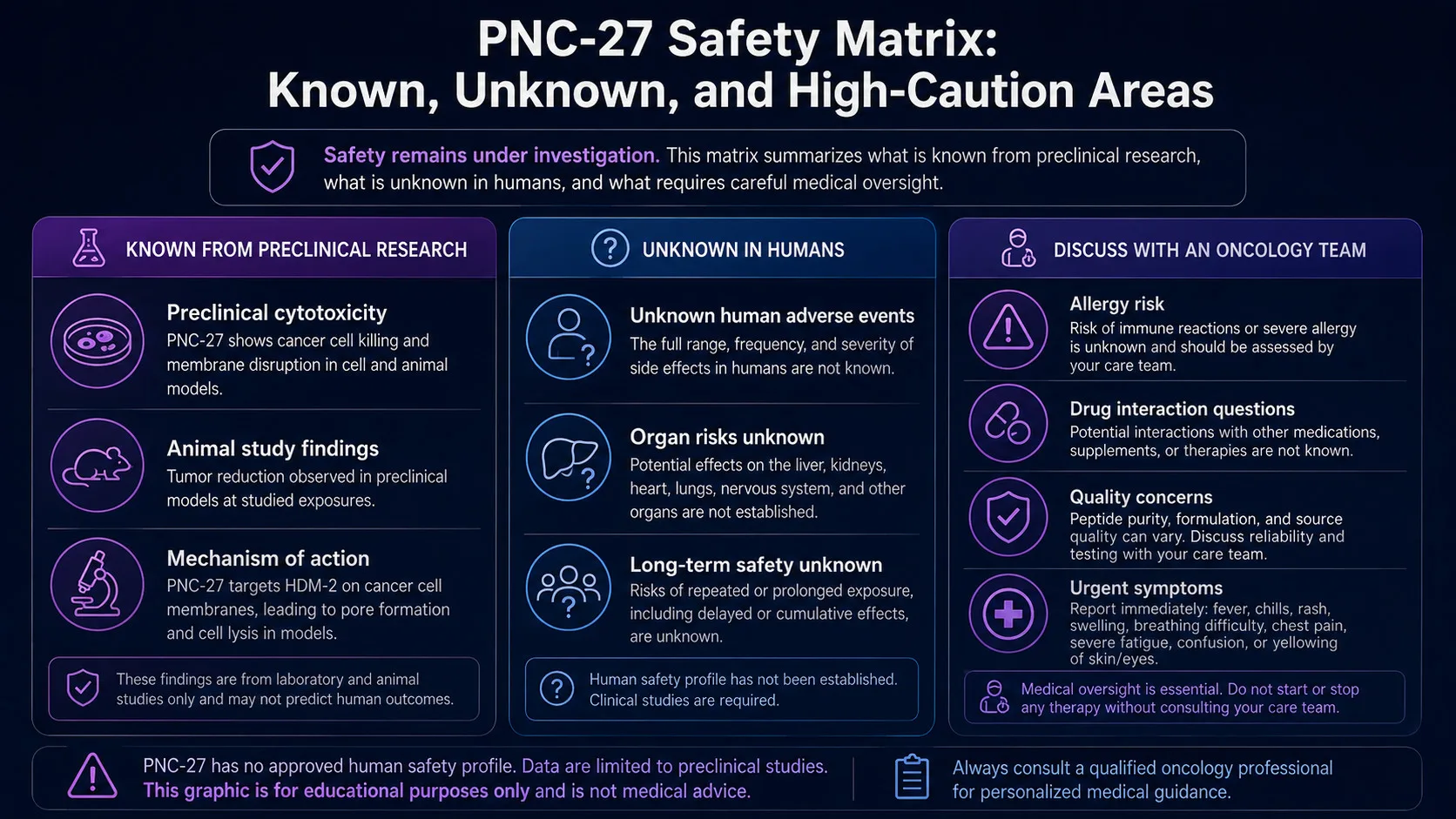
- No established clinical dosing, safety, or efficacy for humans supported by robust, regulated trials. [17]
- No basis for broad consumer claims like “cures cancer” or “non-toxic”—those are marketing statements, not established clinical facts. [18]
The most important safety/regulatory context (do not skip)
PNC-27 is not an FDA-approved drug, and the FDA has explicitly warned the public not to purchase or use PNC-27 products marketed as cancer treatments. [18]
In that warning, the Food and Drug Administration[19] reported laboratory detection of bacterial contamination (including Variovorax paradoxus and later Ralstonia insidiosa) in products promoted as PNC-27 for inhalation—highlighting real-world risks when unapproved products are sold into vulnerable populations. [18]
Key takeaway: Even if a molecule looks interesting in preclinical research, the real-world danger often comes from unregulated manufacturing, contamination, and unproven therapeutic use. [18]
Step-by-Step / How-To
Step 1: Define your intent before you evaluate the peptide
Your first step is deciding whether you’re doing “mechanism learning” or looking for a “therapy,” because PNC-27 only meaningfully fits the first category today. The accessible literature supports PNC-27 as a preclinical research concept; it does not establish it as a validated human treatment option. [20]
If you are a patient or caregiver searching for treatment options, treat PNC-27 claims online as high-risk and discuss evidence-based options with a licensed oncology team—exactly what the FDA advises. [18]
Step 2: Anchor the mechanism in plain English (what needs to be true for PNC-27 to work)
For PNC-27 to work as described, at least three mechanistic conditions must hold: membrane HDM2 must be meaningfully present, PNC-27 must bind it, and complexes must form pores that compromise membranes. The core PNC-27 papers and reviews consistently argue along these lines, including colocalization and pore-formation observations. [12]
This is why you’ll often see the term mHDM2 (membrane HDM2): the entire selectivity story depends on whether malignant cells display enough of the target on the surface compared with normal cells. [21]
Step 3: Place PNC-27 on an evidence ladder (information gain framework)
A fast way to “de-hype” any peptide claim is to grade it on a 3-rung evidence ladder: in vitro → animal → human. PNC-27 has meaningful discussion in the first two rungs, but does not have mature, practice-changing evidence in the third. [22]
Here’s the quick read:
- In vitro: multiple reports describe tumor cell killing with membrane pore formation signatures and limited effects in certain untransformed controls. [23]
- Animal models: at least one major AML-focused paper reports in vivo activity in AML models and attention to hematopoietic sparing within that experimental context. [16]
- Humans: the FDA states PNC-27 has not been evaluated/approved for disease treatment, and contamination was found in marketed products—meaning “real-world” signals are currently about risk, not validated benefit. [18]
Step 4: Use the “two-risk” screen—biology risk and product risk
PNC-27 has two separate risk buckets: (1) biological uncertainty and (2) product quality/contamination risk. Biological uncertainty exists because translating membrane-active cytotoxicity from preclinical models into safe human therapeutics is complex and often fails. [24]
Product risk is concrete: the FDA warning shows that when PNC-27 is sold as a “cancer cure,” contamination can occur and can be dangerous—especially for immunocompromised people. [18]
Step 5: If you’re evaluating research-grade material, verify identity and documentation (without assuming “GMP = drug”)
If you’re sourcing PNC-27 for laboratory work, prioritize identity and documentation over marketing language. A vendor may list sequence, molecular weight, purity claims, and storage statements, but those are not substitutes for regulated clinical-grade manufacturing or independent verification. [25]
For example, Pure Lab Peptides[26] publishes a product listing that includes a peptide sequence, CAS number, purity claim, and “research use only / not for human or animal consumption” language—appropriate framing for lab supply, not medical use. [27]
Comparison / Alternatives
Is PNC-27 the same as “MDM2 inhibitors” like Nutlin or idasanutlin?
No—PNC-27 is not the same category as classic MDM2 inhibitors, because it’s designed around membrane-associated HDM2 and pore-forming cytotoxicity rather than simply reactivating p53 transcription inside the cell. [28]
Small-molecule MDM2 antagonists (like Nutlin-3) are typically framed as compounds that block the p53–MDM2 interaction to stabilize/activate p53 signaling, often leading to growth arrest or apoptosis in TP53-wild-type settings. [29]
Some p53-targeting strategies have advanced far enough to generate human safety signals (and side effects) in trials—something PNC-27 does not currently have in a comparable evidence base. [30]
PNC-27 vs other p53/MDM2-pathway approaches (table)
If your goal is “clinically grounded p53/MDM2 modulation,” look first at modalities with human trial data; if your goal is “membrane HDM2 pore biology,” PNC-27 is the relevant research concept. [31]
| Approach | Example | Primary mechanism goal | Evidence maturity | What it’s best for | Biggest limitation |
| PNC-27 (research peptide) | PNC-27 | Bind membrane HDM2 and contribute to pore formation/lysis | Preclinical (cells/animals) | Studying mHDM2 targeting, pore formation hypotheses | No established human safety/efficacy; not FDA-approved [22] |
| Small-molecule MDM2 antagonists | Nutlin-3 (research benchmark) | Block p53–MDM2 binding to stabilize/activate p53 | Strong preclinical; clinical class exists | Mapping p53 reactivation biology in TP53-WT contexts | Activity/toxicity tradeoffs; resistance mechanisms exist [32] |
| Dual MDM2/MDMX peptide inhibitor (stapled peptide) | ALRN-6924 | Disrupt p53 inhibition by MDM2 + MDMX | Human phase 1 data available | Understanding p53 reactivation with clinical tolerability signals | Still investigational; IV dosing and AEs reported [33] |
| MDM2 degraders (targeted protein degradation) | KT-253 | Degrade MDM2 to stabilize p53; address feedback loop | Preclinical + advancing development | Studying degrader pharmacology vs inhibitors | Still investigational; not established standard care [34] |
Templates / Checklist / Example
The PNC-27 “Reality Check” checklist (copy-ready)
Use this checklist to keep PNC-27 evaluation evidence-based and avoid the most common online traps. [35]
- Clarify your intent (mechanism research vs therapy search); PNC-27 currently fits only the research category. [36]
- Confirm the definition: PNC-27 is a p53-derived, membrane-active research peptide targeting membrane-associated HDM2 in preclinical models. [15]
- Verify the evidence rung: in vitro and animal data exist; human clinical validation is not established. [37]
- Reject “cures cancer” or “non-toxic” marketing claims as non-clinical statements. [18]
- Screen for contamination risk and sourcing risk; unapproved products have been found contaminated in the past. [18]
- Check vendor documentation (sequence, CAS, stated purity, COA availability) while remembering that documentation ≠ clinical-grade evidence. [38]
- Avoid self-experimentation; PNC-27 is not an approved medicine and lacks established human safety. [18]
- Use controlled comparisons in research (e.g., negative control peptides used in the literature are commonly discussed as part of experimental design). [39]
Example: a safe way to “answer the query behind the query”
If the real question is “Could PNC-27 treat cancer?”, the evidence-based answer is: not as an established clinical therapy today. The clinically responsible next step is to focus on validated treatments and trials rather than unapproved products, exactly as regulators advise. [18]
If the real question is “What does PNC-27 target and how does it work in studies?”, the answer is: membrane HDM2 targeting with pore formation and necrotic cell death signatures in preclinical models. [40]
FAQs
Is PNC-27 approved by the FDA?
PNC-27 is not approved by the Food and Drug Administration[19] for treating any disease, including cancer. The FDA has stated it has not evaluated or approved PNC-27 as safe and effective and has warned the public not to purchase or use PNC-27 products marketed as cancer treatments. [18]
What is PNC-27 used for?
PNC-27 is used primarily as a research peptide to study tumor-cell membrane targeting (via membrane-associated HDM2) and pore formation/lysis mechanisms in preclinical models. Published work discusses cancer cell killing in vitro and activity in animal models, but this does not translate into an established clinical indication for people. [41]
How does PNC-27 work?
PNC-27 works (as proposed in the literature) by binding HDM2 associated with cancer cell membranes and contributing to transmembrane pore formation that compromises membrane integrity and leads to necrotic cell death. This model is supported by colocalization experiments and pore-formation imaging discussions in preclinical publications. [40]
Is PNC-27 “p53-dependent”?
PNC-27 is described in multiple sources as producing tumor cell killing that can be independent of functional p53 signaling. This is one reason it attracts attention in cancer biology discussions: some studied systems include p53-null or p53-defective contexts while still reporting membrane-associated effects tied to HDM2 targeting. [42]
Is PNC-27 safe for humans?
PNC-27 safety for humans is not established, and the FDA has specifically cautioned against using PNC-27 products marketed as cancer treatments. In addition to the lack of approval and established clinical evidence, the FDA reported bacterial contamination in certain marketed PNC-27 inhalation solutions—an example of real-world risk. [18]
Where can I buy PNC-27?
PNC-27 is commonly sold online as a “research use only” peptide, not as a medicine, and you should avoid any source marketing it as a cancer cure. For a purchase link explicitly framed for laboratory use, see the vendor page at PureLabPeptides.com, which includes “research only” disclaimers and product identifiers like sequence and CAS number. [43]
Next Steps
PNC-27 is best understood as a preclinical, mechanism-driven research peptide—not a validated therapy—and that distinction is the single most important takeaway. [44]
If you want the most practical on-site companion resource, use the internal guide on PeptideDosages.com[45] for educational context and sourcing references: PNC-27 (30 mg Vial) Dosage Protocol. Keep your use case aligned with research and education, and avoid translating unapproved protocols into self-experimentation. [46]
[1] [2] [3] [7] [12] [15] [19] [22] [23] [28] [39] [40] [41] Anticancer peptide PNC-27 adopts an HDM-2-binding conformation and kills cancer cells by binding to HDM-2 in their membranes – PMC
https://pmc.ncbi.nlm.nih.gov/articles/PMC2836618/
[4] Definition of p53 gene – NCI Dictionary of Cancer Terms
https://www.cancer.gov/publications/dictionaries/cancer-terms/def/p53-gene?utm_source=chatgpt.com
[5] Structural Basis for Inhibition of the MDM2:p53 Interaction by …
https://pmc.ncbi.nlm.nih.gov/articles/PMC4183577/?utm_source=chatgpt.com
[6] Dual Roles of MDM2 in the Regulation of p53 – PMC – NIH
https://pmc.ncbi.nlm.nih.gov/articles/PMC3494363/?utm_source=chatgpt.com
[8] [26] Membrane interaction and cellular internalization of …
https://pubmed.ncbi.nlm.nih.gov/15009197/?utm_source=chatgpt.com
[9] Poptosis or Peptide-Induced Transmembrane Pore Formation: A Novel Way to Kill Cancer Cells without Affecting Normal Cells – PMC
https://pmc.ncbi.nlm.nih.gov/articles/PMC11201261/
[10] [11] PNC-27, a Chimeric p53-Penetratin Peptide Binds to HDM-2 in a p53 Peptide-like Structure, Induces Selective Membrane-Pore Formation and Leads to Cancer Cell Lysis – PMC
https://pmc.ncbi.nlm.nih.gov/articles/PMC9138867/
[13] Necrosis Pathology – StatPearls – NCBI Bookshelf – NIH
https://www.ncbi.nlm.nih.gov/books/NBK557627/?utm_source=chatgpt.com
[14] Analysis of Cell Viability by the Lactate Dehydrogenase …
https://pubmed.ncbi.nlm.nih.gov/29858337/?utm_source=chatgpt.com
[16] [21] [37] Targeting Cell Membrane HDM2: A Novel Therapeutic Approach for Acute Myeloid Leukemia – PMC
https://pmc.ncbi.nlm.nih.gov/articles/PMC7951797/
[17] [18] [20] [35] [36] [44] [45] FDA warns cancer patients not to use PNC-27 products for treatment | FDA
[24] Recent advances and applications of peptide–agent conjugates for targeting tumor cells – PMC
https://pmc.ncbi.nlm.nih.gov/articles/PMC11797435/
[25] [27] [38] [43] Buy PNC-27 Peptide | Targeted Anti-Cancer Research
https://purelabpeptides.com/buy-peptides/buy-pnc-27-30mg/
[29] [32] Pharmacologic activation of p53 by small-molecule MDM2 antagonists – PMC
https://pmc.ncbi.nlm.nih.gov/articles/PMC3613239/
[30] [31] [33] Phase 1 Trial of ALRN-6924, a Dual Inhibitor of MDMX and MDM2, in Patients with Solid Tumors and Lymphomas Bearing Wild-type TP53 – PMC
https://pmc.ncbi.nlm.nih.gov/articles/PMC9401461/
[34] KT-253, a Novel MDM2 Degrader and p53 Stabilizer, Has Superior Potency and Efficacy than MDM2 Small-Molecule Inhibitors – PMC
https://pmc.ncbi.nlm.nih.gov/articles/PMC11962396/
[42] The anti-cancer peptide, PNC-27, induces tumor cell …
https://pubmed.ncbi.nlm.nih.gov/25117093/?utm_source=chatgpt.com
[46] PNC-27 Dosage Protocol | PeptideDosages.com
https://peptidedosages.com/single-peptide-dosages/pnc-27-30-mg-vial-dosage-protocol/