
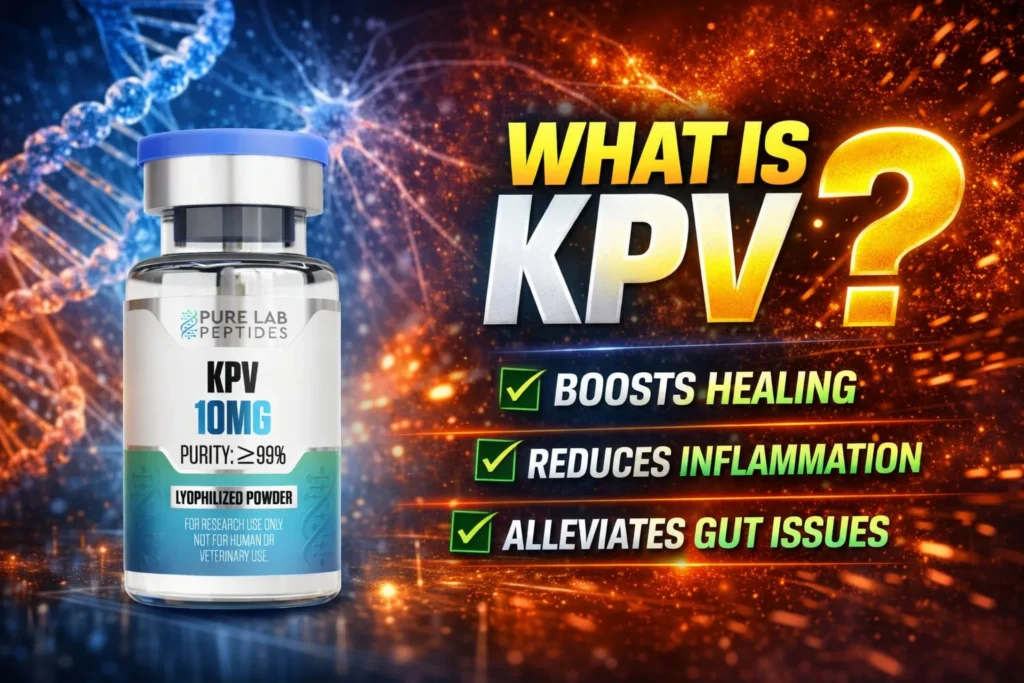
If you’ve been searching “What is KPV”, you’re not alone. KPV is one of the most talked‑about “anti‑inflammatory peptides,” but most pages either oversell it or reduce it to a one‑line definition. The reality sits in the middle: KPV is a real, biologically derived tripeptide with strong preclinical signals—yet limited human clinical proof. This guide explains what KPV is, how it may work, what the research actually shows, and how to evaluate quality and claims responsibly.
Fast Answer / Executive Summary
KPV is a three–amino acid peptide (Lys–Pro–Val) derived from alpha‑melanocyte‑stimulating hormone (α‑MSH) and studied for anti‑inflammatory activity. In lab and animal models, it can reduce NF‑κB/MAPK‑driven cytokine activity and intestinal inflammation, partly via the PepT1 peptide transporter. Human clinical evidence is still limited. [1]
Core Concepts & Key Entities
KPV is easiest to understand when you connect four recurring “entities” in the science: α‑MSH → melanocortin biology → inflammatory signaling (NF‑κB/MAPK) → PepT1 transport. Those links explain why a tiny tripeptide attracts outsized attention—and also why you should be skeptical of anyone treating it like a proven medicine. [2]
KPV, decoded: what the letters mean
KPV is shorthand for the amino‑acid sequence Lysine–Proline–Valine (Lys–Pro–Val)—a tripeptide with only three residues. In the research literature, you’ll also see it written as α‑MSH(11–13) (or “MSH 11–13”), meaning it corresponds to the 11th–13th amino acids on the C‑terminal end of α‑MSH. [3]
A useful beginner translation is: KPV is a “minimal fragment” that still carries an anti‑inflammatory message. That framing is why KPV is discussed alongside much larger peptides, even though it’s dramatically shorter. [4]
Where KPV comes from: α‑MSH and POMC
KPV comes from α‑melanocyte‑stimulating hormone (α‑MSH), a 13‑amino‑acid peptide derived from the precursor protein proopiomelanocortin (POMC). α‑MSH is part of the melanocortin system and has been researched for protective and anti‑inflammatory effects across multiple animal inflammation models. [5]
One obstacle to using full‑length α‑MSH is that it can have visible melanotropic (pigmentation‑related) effects. Reviews repeatedly highlight KPV as an attractive alternative because it preserves anti‑inflammatory effects while lacking pigmentary action in the same way. [6]
The “minimal sequence” idea: why three amino acids can matter
KPV is often described as the minimum sequence required for α‑MSH’s anti‑inflammatory activity. An open‑access review notes that the C‑terminal tripeptide Lys‑Pro‑Val retains anti‑inflammatory activity and that modified formats (such as dimers like (CKPV)₂) have been investigated for potentially stronger anti‑inflammatory effects in experimental models. [7]
This is one of the most important context points for peptide beginners: KPV is not “random peptide hype.” It’s a deliberately studied fragment from an endogenous signaling peptide with a long research history. [4]
KPV at a glance: identity and basic specs
If you want to evaluate KPV claims, you need to know the basics well enough to sanity‑check labels and COAs:
- Sequence: Lys‑Pro‑Val [8]
- CAS number: 88193‑00‑2 [9]
- Molecular weight: ~384.48 g/mol (one common vendor spec; exact values can vary by salt/counter‑ion form) [9]
- Molecular formula: C17H32N6O4 [9]
- Purity claims in commerce: often listed as ≥99% on vendor pages (verify with a batch‑specific CoA) [9]
KPV is commonly sold as a lyophilized (freeze‑dried) white powder intended for laboratory research. Many product pages also include explicit “research use only” language and “not evaluated/approved” disclaimers. [9]
What “anti‑inflammatory” means here: NF‑κB, MAPK, and cytokines
In KPV discussions, “anti‑inflammatory” usually means reduced inflammatory signaling and reduced pro‑inflammatory outputs—not guaranteed symptom improvement. In one of the most cited KPV gut‑inflammation papers, researchers report that nanomolar concentrations of KPV inhibited NF‑κB and MAP kinase (MAPK) inflammatory signaling pathways and reduced pro‑inflammatory cytokine secretion in cell models. [10]
NF‑κB matters because it helps regulate transcription of many inflammatory genes. When upstream NF‑κB signaling is lowered, downstream inflammatory mediators (including certain cytokines and chemokines) can decrease. That’s why KPV is often framed as acting “upstream,” at the level of pathway control rather than as a single‑target symptomatic agent. [11]
In the same research program, oral KPV reduced severity of experimental colitis and inflammatory readouts in mice. For example, in a DSS colitis model, KPV reduced myeloperoxidase (MPO) activity—used as an indicator of neutrophil infiltration—by roughly 50%, and histology showed reduced intestinal inflammation compared with DSS alone. [12]
Just as important: in that DSS dataset, KPV reduced expression of multiple pro‑inflammatory cytokine mRNAs (including IL‑6 and IL‑12) but did not increase IL‑10 mRNA expression in colon tissue. That suggests KPV’s anti‑inflammatory effect there was driven mainly by reducing pro‑inflammatory signaling rather than increasing IL‑10 locally. [13]
The PepT1 angle: why KPV is unusual among peptides
Most peptides share a brutal limitation: enzymatic breakdown and poor cellular uptake. KPV is unusual because a core mechanistic paper links its activity to a named “delivery gate” into cells: the intestinal di/tripeptide transporter PepT1 (peptide transporter 1). [10]
In that study, PepT1 is described as normally expressed in the small intestine and induced in the colon during inflammatory bowel disease (IBD). The authors report that KPV’s anti‑inflammatory effect is mediated via PepT1 expressed in immune and intestinal epithelial cells, and uptake experiments show KPV is transported by PepT1 with a reported Km of ~160 μM. [14]
In vivo, oral KPV reduced severity of DSS‑ and TNBS‑induced colitis in mice, consistent with the idea that PepT1‑mediated uptake can matter in inflamed gut tissue. [15]
Information gain (a useful mental model): “disease‑state bioavailability.” In this gut‑inflammation research line, PepT1 expression is low in healthy colon but induced in inflamed colon, and KPV’s uptake/impact is tied to PepT1. A practical interpretation is: KPV may be more “deliverable” to inflamed colonic tissue than you’d expect for a peptide in general—at least in certain colitis models. That can help explain why oral KPV shows signal in DSS/TNBS models, and why those results may not generalize to unrelated contexts where PepT1 isn’t induced or where other barriers dominate. [16]
Delivery and formulation research: why KPV is often “packaged” in studies
Even if a peptide has a promising mechanism, delivery can be the limiting factor. That’s why some KPV research focuses on drug delivery systems—ways to deliver KPV to the right tissue at the right concentration.
One example is oral colonic targeting. In a study developing hyaluronic‑acid‑functionalized KPV nanoparticles delivered within a hydrogel, the authors report that this strategy enabled targeted delivery to colitis‑related cell types and showed combined effects against ulcerative colitis (UC) in vitro and in a mouse model, including reduced mucosal damage and downregulation of inflammatory markers like TNF‑α. [17]
Another delivery example is transdermal research. A study on transdermal delivery explored whether iontophoresis and microneedles could enhance KPV delivery across human skin, noting basic properties like KPV’s molecular weight and reported isoelectric point (pI). The key point is not “everyone should do this,” but that delivery constraints are real enough that researchers invest in delivery technology rather than assuming KPV naturally reaches every tissue well. [18]
Beyond the gut: brain injury and other preclinical contexts
KPV is also discussed in other animal inflammation settings, including neuroinflammation. In a mouse traumatic brain injury study, the authors describe α‑MSH(11–13) (KPV) as an anti‑inflammatory tripeptide and discuss proposed mechanisms observed in specific experimental systems, including inhibition of TNF‑α, IL‑6, nitric oxide production, and NF‑κB activity/translocation. [19]
This doesn’t mean KPV is “a brain peptide” or that it treats neurologic disease. It means KPV is researched as a pathway‑level inflammation modulator, and that framing shows up in more than one organ system in preclinical literature. [20]
KPV and receptor questions: MC1R vs IL‑1 signaling vs “something else”
A common beginner question is: “If KPV comes from α‑MSH, does it activate melanocortin receptors like MC1R?” The sober answer is: the literature is mixed, and multiple mechanisms have been proposed. For example, one discussion of α‑MSH(11–13) notes that some studies failed to show interaction with MC1R and instead suggested IL‑1 receptor‑related explanations, while other work reported MC1R‑dependent calcium signaling in engineered cell models and impacts on NF‑κB. [19]
For non‑specialists, the best takeaway is: KPV appears to converge on inflammatory pathway control (NF‑κB and related signaling), but it should not be treated as a single‑receptor “lock‑and‑key” drug with a universally agreed pathway map. [11]
Skin and immune tolerance: what α‑MSH‑related peptides suggest
KPV is discussed beyond the gut. In a review on α‑MSH‑related peptides, KPV (and related tripeptides) are described as suppressing contact dermatitis reactions in mice and contributing to tolerance induction in those experimental models. The same review highlights IL‑10 as an important mediator in α‑MSH‑linked tolerance mechanisms in that particular context. [21]
This matters because it suggests melanocortin‑related peptides can influence immune cell behavior, inflammatory cell migration, and cytokine balance across tissues. But these are still mainly animal and mechanistic findings. [22]
Antimicrobial signals: why KPV shows up in “gut microbiome” conversations
KPV appears in antimicrobial peptide discussions because α‑MSH and its C‑terminal fragments have been reported to show antimicrobial activity in experimental settings. An open‑access review notes that α‑MSH’s C‑terminal tripeptide (KPV) and related fragments have been reported to have antimicrobial potential in addition to anti‑inflammatory activity. [7]
Practically, this does not mean KPV is an antibiotic or a proven “microbiome fix.” It means that researchers have observed some antimicrobial‑like effects in model systems and that KPV sits at an intersection of host defense and inflammatory control in melanocortin research. [4]
What KPV is not: avoid the most common category errors
KPV is not a “GLP‑1‑like” weight‑loss peptide, and it is not a tanning peptide like melanotan. In the scientific KPV context, it is primarily an α‑MSH fragment discussed for anti‑inflammatory and immunomodulatory research effects. [23]
KPV is also not a guarantee of symptom change. Claims that jump straight from “mouse colitis readouts improved” to “this will treat human IBD” are a classic translation error. [24]
What the research still doesn’t answer: the “known unknowns”
KPV is supported by substantial mechanistic and animal-model evidence, but it is not yet supported by the kind of large, definitive human clinical evidence that would settle questions of real-world efficacy, dosing, and long‑term safety. That gap is exactly why credible sources keep framing KPV as a research peptide rather than a standard therapy. [25]
Here are the most important “known unknowns” to keep in mind:
First, translation is uncertain. DSS/TNBS colitis models and skin inflammation models are useful for studying pathways like NF‑κB and cytokine expression, but they are not the same thing as treating human inflammatory disease. Improvements in mouse body‑weight loss, MPO activity, or colon histology are meaningful signals, yet they are still preclinical. [26]
Second, delivery is context-dependent. KPV looks unusually “deliverable” in some gut models because PepT1 can transport it and PepT1 expression can be induced during intestinal inflammation. That does not guarantee the same uptake, tissue levels, or effects in other conditions—or even in non-inflamed gut tissue. [16]
Third, product quality factors become part of the outcome. Outside regulated drug channels, the risk isn’t only “does KPV work,” but also “is this vial what I think it is, and is it stable/pure.” Vendor pages often emphasize “research use only” and list basic specs (purity, sequence, storage). Regulators have also warned that drugs sold online outside safeguards may be contaminated or contain variable active ingredient amounts. [27]
Step-by-Step / How-To
To use KPV information responsibly—whether you’re a peptide beginner or a long‑time enthusiast—follow a process that separates curiosity from credibility and keeps you grounded in evidence.
Define the question you want KPV to answer
Step 1: Define the question you want KPV to answer by naming the target context (gut inflammation, skin irritation, immune signaling assays), because KPV’s strongest evidence clusters around inflammatory signaling and specific preclinical disease models. [28]
A useful one‑liner template is: “I’m looking at KPV to understand [pathway or tissue] because the research suggests [mechanism] in [model].” [29]
Match the claim to the evidence level
Step 2: Match the claim to the evidence level—cell study, animal model, or human clinical data—because most widely cited KPV findings come from in vitro work and animal models (including DSS/TNBS colitis, skin inflammation, and other experimental inflammation setups). [30]
If you see a claim that doesn’t name the model, treat it as marketing until proven otherwise. [31]
Map the mechanism in one sentence
Step 3: Map the mechanism in one sentence, because “KPV reduces inflammation” becomes meaningful only when you connect it to pathways like NF‑κB/MAPK inhibition, cytokine output, and—in the gut—PepT1‑mediated uptake. [32]
A clean mechanism sentence supported by major KPV papers looks like: “KPV can reduce inflammatory signaling (NF‑κB/MAPK) and thereby reduce pro‑inflammatory cytokine expression, with PepT1 transport helping cellular uptake in gut contexts.” [16]
Decide whether the PepT1 “gate” matters to your context
Step 4: Decide whether PepT1 is relevant, because KPV’s best‑documented uptake mechanism is PepT1‑mediated transport in intestinal epithelial and immune cells, and PepT1 expression changes with tissue and inflammatory state. [16]
This is the “don’t copy/paste conclusions” step: a gut paper about PepT1‑mediated uptake does not automatically imply identical behavior in skin, brain, or systemic circulation. [33]
Treat peptide quality like part of the experiment
Step 5: Treat peptide quality like part of the experiment, because peptide content and stability can vary with counter‑ions, residual moisture, oxidation, and handling.
A manufacturer note from Bachem[34] highlights a nuance many buyers miss: even when a peptide is “>95% pure by HPLC,” the net peptide content of the solid can be lower (for example, 70–90%) due to counter ions and residual moisture, and that batch‑specific content should be considered when preparing solutions of a defined concentration. [35]
This matters for KPV because people often treat “purity %” and “actual mass of peptide per vial” as the same thing. They are not. [36]
Learn to read a COA like a researcher, not a shopper
Step 6: Read a certificate of analysis (CoA) like a researcher. A CoA helps you answer one question: “Is this vial plausibly what it claims to be?”
A CoA is most useful when it includes: – a batch/lot number you can match to your vial, – peptide sequence confirmation and a molecular weight that matches the label, – HPLC purity with a method description, – and labeling that clearly states the peptide form (free base vs acetate vs other). [37]
If a vendor lists technical specs (sequence, MW, CAS) but does not provide batch‑specific documentation, treat it as “unknown quality” until you see the paperwork. [9]
Handle and store peptides to preserve integrity
Step 7: Handle and store peptides to preserve integrity because moisture exposure, oxidation, and temperature cycling can degrade peptides.
Bachem recommends storing lyophilized peptides below −15 °C for maximum stability, warming hygroscopic peptides in a desiccator before opening to limit moisture uptake, and aliquoting solutions and freezing them to prevent repeated freeze–thaw cycles. [35]
Vendor storage guidance for KPV also commonly emphasizes freezing lyophilized vials and using a limited refrigerated window after reconstitution. For example, one KPV product page states stability up to 24 months at −20 °C for the lyophilized product and a limited period at 4 °C after reconstitution. [38]
Know your regulatory reality and set a stop rule
Step 8: Know your regulatory reality and set your stop rule before you start. Many KPV products marketed online are explicitly labeled for research use and include statements that they are not approved as medicines. [9]
Separately, the U.S. Food and Drug Administration[39] has issued warning letters to peptide sellers when “research use only” products are marketed with drug‑like claims. The FDA warns that unapproved/misbranded drugs sold outside regulatory safeguards may be contaminated, counterfeit, or contain varying amounts of active ingredients. [31]
A practical stop rule is therefore: if sourcing, documentation, or claims feel “too confident for the evidence,” pause and reassess. [31]
Comparison / Alternatives
KPV is best compared on mechanism and evidence level, not hype—because many “anti‑inflammatory peptides” are discussed together despite working very differently.
KPV vs other options people consider for inflammation research
KPV differs from many alternatives because it is an α‑MSH fragment linked in the literature to NF‑κB/MAPK pathway modulation and PepT1‑mediated uptake in gut models, while many other popular peptides are discussed mainly in repair/“recovery” contexts with different proposed pathways. [40]
| Option | What it is | Core “why it’s used” in research | Main proposed mechanism (simplified) | Human clinical footing | Biggest caveat |
| KPV (Lys–Pro–Val) | α‑MSH C‑terminal tripeptide | Inflammation signaling; gut‑inflammation models | PepT1 uptake + NF‑κB/MAPK dampening → lower cytokines | Limited/unclear | Most data are preclinical; mechanism not fully settled |
| Full α‑MSH | 13‑aa melanocortin peptide from POMC | Broad anti‑inflammatory & protective effects | Melanocortin receptor signaling + downstream pathway modulation (incl. NF‑κB, cytokines, adhesion molecules, IL‑10) | Limited | Pigmentary/melanotropic effects complicate use |
| KdPT and related tripeptides | α‑MSH‑related / IL‑1β‑related tripeptides discussed in the melanocortin field | Anti‑inflammatory immunomodulation | Proposed IL‑1 / immune signaling modulation (varies by peptide) | Limited | Easy to confuse with KPV; less standardized discussion |
| Oral‑targeted delivery systems (KPV + carrier) | KPV formulated for colonic targeting | Improve delivery to inflamed colon | Nanoparticle/hydrogel targeting + local release of KPV | Preclinical | Delivery approach adds complexity but can improve targeting signals |
| Evidence‑based anti‑inflammatory basics | Diet, sleep, stress management, clinician‑guided therapy | Lower inflammatory burden/triggers | Multiple validated pathways | Stronger | Not a “quick fix,” but highest‑confidence foundation |
Decisive takeaway: If your main interest is “KPV specifically,” the strongest rationale is its role as an α‑MSH fragment that can enter cells (notably via PepT1 in gut models) and suppress pro‑inflammatory signaling. If your interest is simply “less inflammation,” the most reliable foundation is still evidence‑based fundamentals plus clinician guidance—not stacking research peptides and hoping for the best. [42]
Templates / Checklist / Example
If you want something you can actually use (and copy into your notes), start with this checklist. It’s designed to keep KPV discussions grounded in identity, evidence, and quality—the three places misinformation tends to creep in.
KPV “reality check” checklist
- Define your goal in one sentence (e.g., “I’m learning about KPV for gut‑inflammation research contexts”). [12]
- Verify identity (sequence, MW, CAS match KPV labeling). [8]
- Locate the model (cell, mouse DSS/TNBS colitis, contact dermatitis model, etc.). [43]
- Translate the mechanism into plain language (NF‑κB/MAPK down → cytokines down; PepT1 transport can matter in gut). [14]
- Request a batch‑specific CoA (not just “≥99% purity” marketing). [37]
- Separate “HPLC purity” from “net peptide content” when doing concentration math. [35]
- Plan storage before delivery (cold storage; protect from moisture/light; avoid freeze–thaw). [36]
- Document what you read and why you believe it (so hype doesn’t overwrite evidence).
- Consult a qualified clinician for any personal health decisions; this content is educational, not medical advice. [31]
Example: how to read a “10 mg vial protocol” page without getting lost
A lot of KPV confusion comes from mixing up three separate topics: what KPV is, how KPV is handled as a lab reagent, and how some websites describe “protocols.” [44]
On PeptideDosages.com[45], the educational KPV (10 mg vial) page lays out dilution math (for example, 10 mg reconstituted into 3 mL to yield ~3.33 mg/mL) and includes storage guidance for lyophilized vs reconstituted material (freeze the powder; refrigerate the solution for a limited time window). [46]
Here’s the beginner payoff: a protocol page can be useful for concentration calculations and handling reminders even if you ignore every “dosage” claim on the page until you understand the evidence. Use it as a calculator and a checklist—not as a substitute for clinical research. [47]
If you’re trying to understand the science behind KPV, keep coming back to the same anchor chain: α‑MSH fragment → inflammatory signaling control (NF‑κB/MAPK) → PepT1 transport in gut contexts. [48]
FAQs
What is KPV used for?
What is KPV used for? KPV is used mainly as a research peptide to study anti‑inflammatory and immunomodulatory signaling, especially pathways like NF‑κB/MAPK and cytokine output. The most cited in vivo research involves intestinal inflammation models where oral KPV reduced colitis severity in mice and its uptake was linked to PepT1 transport. [16]
How does the KPV peptide work?
How does the KPV peptide work? KPV peptide work is most often described as dampening pro‑inflammatory signaling, including inhibited NF‑κB and MAPK pathway activation and lower pro‑inflammatory cytokine expression. In gut‑inflammation research, KPV can be transported into cells via the PepT1 di/tripeptide transporter, helping explain how it shows activity after oral administration in mice. [49]
Does KPV affect pigmentation like α‑MSH or melanotan?
Does KPV affect pigmentation like α‑MSH or melanotan? KPV is generally discussed as lacking the melanotropic (pigmentation‑related) effects that complicate full‑length α‑MSH, while still retaining anti‑inflammatory activity in multiple preclinical models. This is a core reason KPV and related tripeptides are repeatedly highlighted in melanocortin reviews as alternatives for anti‑inflammatory research. [6]
Can KPV be taken orally?
Can KPV be taken orally? KPV can be administered orally in some animal studies, and oral KPV reduced DSS‑ and TNBS‑induced colitis severity in mice, with evidence that KPV is transported into cells by PepT1. However, oral peptide delivery is generally challenging, and some studies explore delivery systems (for example, targeted nanoparticles/hydrogels) to improve colonic targeting. Human conclusions cannot be assumed from these models. [50]
Is KPV FDA-approved or clinically proven?
Is KPV FDA-approved or clinically proven? KPV is commonly sold online as a “research use only” peptide rather than as an approved medicine, and much of the published KPV evidence base is preclinical rather than large, definitive human clinical trials. The U.S. FDA has also warned that unapproved/misbranded drug products sold online can pose risks, including contamination and variable active ingredient amounts. [51]
What are the main safety and quality risks with KPV products?
What are the main safety and quality risks with KPV products? The biggest risks are uncertainty in purity, identity, sterility, and stability—especially when products are sourced online outside standardized drug‑approval pathways. FDA warning letters note that drugs sold outside regulatory safeguards may be contaminated or contain varying amounts of active ingredients. Separately, peptide manufacturers emphasize that moisture exposure and freeze–thaw cycles can degrade peptide integrity. [52]
Next Steps
KPV is a small α‑MSH fragment (Lys–Pro–Val) with credible preclinical anti‑inflammatory signaling data—especially in gut inflammation models tied to PepT1 transport—but it is not a clinically “settled” therapy. [40]
If you want the most practical next step as a reader, choose the path that matches your intent:
- If you came for definitions, mechanism, and evidence, revisit the “Core Concepts” section and note the three anchors (α‑MSH fragment, NF‑κB/MAPK signaling, PepT1 transport). [48]
- If you came for vial handling and dilution math, use the dedicated internal guide: KPV (10 mg vial) dosage protocol. [46]
- If you are sourcing KPV strictly for research and laboratory use, the product page for Pure Lab Peptides[53] lists sequence, purity, molecular weight, CAS number, storage statements, and a “research use only” disclaimer: Buy KPV 10mg. [9]
Educational note: This article is for information only and does not provide medical advice, diagnosis, or treatment. Always involve a licensed professional for personal health decisions.
[1] [4] [7] Alpha-Melanocyte Stimulating Hormone: An Emerging Anti-Inflammatory Antimicrobial Peptide – PMC
https://pmc.ncbi.nlm.nih.gov/articles/PMC4130143/
[2] [5] [6] [11] [20] [22] [23] academic.oup.com
https://academic.oup.com/edrv/article/29/5/581/2355047
[3] [19] [33] [34] Single Administration of Tripeptide α-MSH(11–13) Attenuates Brain Damage by Reduced Inflammation and Apoptosis after Experimental Traumatic Brain Injury in Mice – PMC
https://pmc.ncbi.nlm.nih.gov/articles/PMC3733710/
[8] [9] [27] [37] [38] [45] [51] Buy KPV Peptide | Anti-Inflammatory Research Peptide 10mg
https://purelabpeptides.com/buy-peptides/buy-kpv-10mg/
[10] [12] [13] [14] [15] [16] [24] [25] [26] [28] [29] [30] [32] [39] [40] [41] [42] [43] [48] [49] [50] [53] PepT1-Mediated Tripeptide KPV Uptake Reduces Intestinal Inflammation – PMC
https://pmc.ncbi.nlm.nih.gov/articles/PMC2431115/
[17] https://pmc.ncbi.nlm.nih.gov/articles/PMC5498804/
https://pmc.ncbi.nlm.nih.gov/articles/PMC5498804/
[18] https://www.sciencedirect.com/science/article/abs/pii/S0022354917301740
https://www.sciencedirect.com/science/article/abs/pii/S0022354917301740
[21] α‐MSH related peptides: a new class of anti‐inflammatory and immunomodulating drugs – PMC
https://pmc.ncbi.nlm.nih.gov/articles/PMC2095288/
[31] [52] https://www.fda.gov/inspections-compliance-enforcement-and-criminal-investigations/warning-letters/usapeptidecom-696885-02262025
[35] [36] https://www.bachem.com/knowledge-center/technical-notes/care-and-handling-of-peptides/
https://www.bachem.com/knowledge-center/technical-notes/care-and-handling-of-peptides/
[44] [46] [47] KPV Dosage Protocol | PeptideDosages.com
https://peptidedosages.com/single-peptide-dosages/kpv-10-mg-vial-dosage-protocol/