
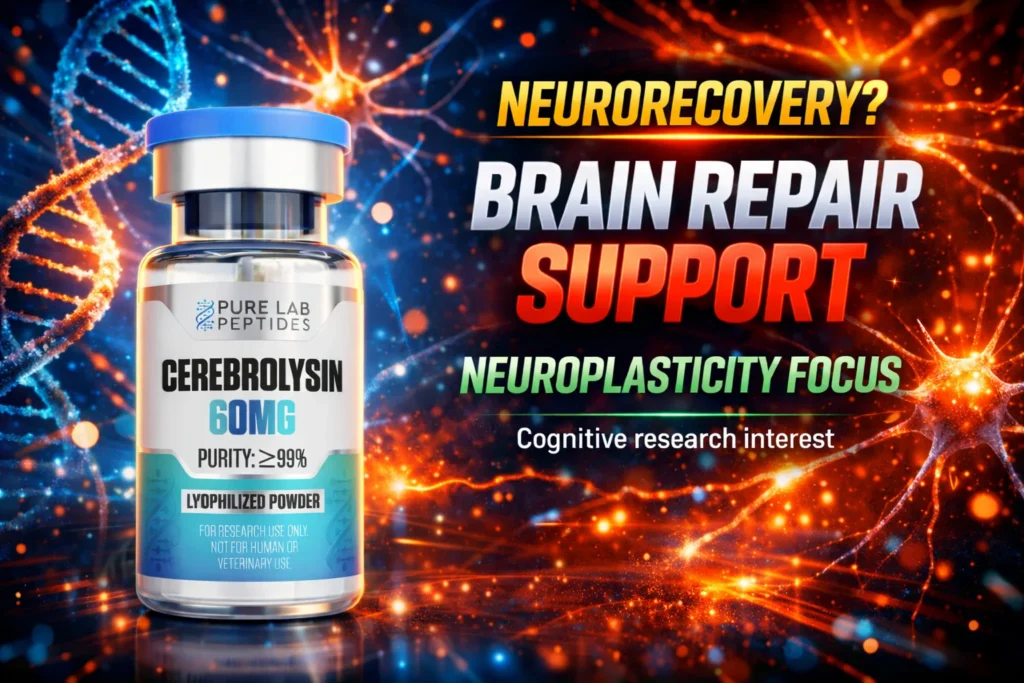
If you’re wondering “What is Cerebrolysin”, you’re not alone—search results mix prescription‑drug details, biohacker lore, and “research peptide” listings. This guide clarifies what Cerebrolysin actually is, where the evidence is strongest (and weakest), and how to evaluate safety and sourcing. If you know GLP‑1 (glucagon‑like peptide‑1) weight‑loss/diabetes drugs, you’ll also see why Cerebrolysin is a completely different category. [1]
Educational content only. This article does not provide medical advice, diagnosis, or treatment recommendations.
Fast Answer / Executive Summary
Cerebrolysin is an injectable mixture of low‑molecular‑weight peptides and amino acids derived from porcine (pig) brain proteins, developed for neurorecovery research and clinical use in conditions like stroke, traumatic brain injury, and some dementias. It is not FDA‑approved in the United States, and evidence is mixed—some meta‑analyses show early neurological improvement, while high‑rigor reviews report uncertain clinical benefit and potential safety signals. [2]
Core Concepts & Key Entities
What Cerebrolysin is in plain English
Cerebrolysin is best understood as a biological “peptide soup” delivered by injection, not a single clean molecule like many modern drugs. Major reviews describe it as a mixture of peptides and amino acids derived from pig brain, intended to support neuroprotective and neurotrophic (repair‑supporting) activity after injury or in neurodegeneration. [3]
That “mixture” point matters: when you read claims like “it contains BDNF” (brain‑derived neurotrophic factor) or “it’s basically NGF” (nerve growth factor), treat them as simplified explanations, not a guaranteed ingredient list. Even analytical work referenced in a major Cochrane update notes that hundreds of distinct peptides have been identified, and they did not map cleanly to known trophic factors—suggesting the effect (if any) comes from embedded functional peptide sequences, not direct delivery of intact growth factors. [4]
What Cerebrolysin is made of
Cerebrolysin is described across sources as a mixture of low‑molecular‑weight peptides + free amino acids, derived from porcine brain proteins. [5]
You’ll see different “percentage splits” (which is common for complex biologic mixtures, depending on the measurement method and reference):
- One clinical review describes Cerebrolysin as low‑molecular‑weight peptides and amino acids and notes broad use in multiple countries. [6]
- A professional monograph from International Peptide Society[7] describes a “molecular composition” framing as 25% low molecular weight peptides and 75% free amino acids (and lists several neuropeptide/growth‑factor names as included). [8]
- A later Cochrane update describes Cerebrolysin as a mixture of low‑molecular‑weight peptides and amino acids derived from porcine brain and cites peptide‑profiling work identifying 638 unique peptides. [4]
Key takeaway: Cerebrolysin is not “one peptide.” It’s a complex preparation where “what’s in it” is better described as a peptide profile than a single sequence. [4]
How Cerebrolysin is administered and labeled
Cerebrolysin is a solution for injection in its pharmaceutical form, commonly administered intravenously (IV) as an infusion in clinical trials, and also used via IV/IM administration in product guidance. [9]
Manufacturer prescribing info and product materials repeatedly list a strength of 215.2 mg/mL (concentrate in aqueous solution). [10]
This creates a common confusion in peptide communities:
- Pharmaceutical Cerebrolysin is usually discussed in mL dosing (e.g., 10–30 mL/day or 20–50 mL/day depending on indication and local guidance). [11]
- Some online listings present “Cerebrolysin 60 mg” as a research product with different labeling claims (including “proprietary mixture” and even “solid‑phase synthesis”). [12]
Information gain you can use immediately: if you see mg‑only labeling, it may not map cleanly to the mainstream clinical literature that reports dosing in mL of injectable solution. This isn’t nitpicking—unit mismatch is one of the easiest ways people misunderstand “how much” is being discussed. [13]
What Cerebrolysin aims to do biologically
Cerebrolysin is positioned as a multimodal neurorecovery agent—meaning it’s intended to support repair processes rather than target a single receptor. Manufacturer material emphasizes neurotrophic signaling and notes pathways such as neurotrophic factor signaling and sonic hedgehog signaling. [14]
Independent preclinical work supports at least one plausible mechanistic route: a stroke model found that inhibiting the sonic hedgehog (Shh) pathway reversed Cerebrolysin‑associated increases in neurogenesis/white‑matter remodeling and functional recovery in rats—suggesting Shh activity is involved in the observed effects in that model. [15]
A practical way to summarize mechanism claims (without overpromising):
- Neurotrophic‑like signaling: supports growth and survival signaling relevant to neurons. [16]
- Neuroplasticity + repair: aims to help the brain “re‑wire” after injury, especially when combined with structured rehabilitation. [17]
- Not a direct growth‑factor injection: peptide profiling referenced in a Cochrane update suggests the active components may be “hidden functional sequences,” not intact canonical trophic factors. [4]
Key takeaway: Think “repair‑supporting mixture,” not “BDNF in a vial.” [4]
Where Cerebrolysin is used and its regulatory reality
Cerebrolysin is described as widely used in parts of Europe and Asia, and one recent real‑world stroke registry paper cites approval status in about 60 countries. [18]
In the United States[19], the key point is simpler: it is not registered with the U.S. Food and Drug Administration[20] and is not approved for sale or distribution there, per the manufacturer’s U.S. visitor notice. [21]
The Alzheimer’s Drug Discovery Foundation[22] also states it is not approved for use in the United States, while noting approval in many European/Asian countries and emphasizing that evidence in healthy adults is limited. [23]
Benefits people expect vs what the evidence actually supports
Dominant search intent for “What is Cerebrolysin” usually includes: “What does it do?”, “Is it legit?”, “Is it safe?”, and “Does it work for cognition?”
Here’s the evidence‑aligned answer:
- Stroke recovery / neurorehabilitation: Some trials and meta‑analyses report improvements in neurological deficit or motor outcomes, especially when paired with early rehab (e.g., CARS‑series analyses). [17]
But a 2023 Cochrane update found no clear benefit on death, no beneficial effect on serious adverse events overall, and flagged a potential increase in non‑fatal serious adverse events, with substantial risk‑of‑bias and industry support in parts of the evidence base. [24] - Dementia (Alzheimer’s / vascular): Meta‑analyses in Alzheimer’s disease have reported improvements in cognition and global clinical change vs placebo (often involving 30 mL/day regimens in the trials included). [25]
The ADDF summarizes that benefits appear small/modest, and it remains unknown whether Cerebrolysin prevents dementia or slows decline; evidence in healthy adults is limited. [26] - Traumatic brain injury (TBI): A randomized trial report in moderate‑severe TBI concluded beneficial effects on multidimensional outcomes, and a subsequent meta‑analysis of the CAPTAIN series concluded safety and efficacy (language typical of authors’ interpretation, not a guarantee). [27]
- Cognitive enhancement in healthy users: There’s no strong clinical base for “stacking Cerebrolysin to become smarter.” The ADDF explicitly notes limited evidence for healthy adults and no prevention studies for dementia; it also flags that peptides taken orally are typically broken down in the gut. [28]
Safety, side effects, and who should avoid it
Cerebrolysin’s safety profile is often described as generally favorable in trials, but “well tolerated” does not mean “risk free,” especially with injection‑based administration.
Commonly cited side effects across clinical literature and summaries include headache, dizziness, anxiety/agitation, weight loss, and “feeling hot”, and adverse event rates are often reported as similar to placebo in some dementia trials. [29]
Contraindications listed in prescribing information include hypersensitivity to components, epilepsy, and severe renal impairment. [30]
Also, because Cerebrolysin is derived from animal tissue and delivered intravenously in clinical settings, the ADDF notes injection‑process risks and highlights the theoretical risk of contamination if manufacturing controls are inadequate. [31]
Key takeaway: The biggest real‑world risk is usually not “the peptide effect”—it’s the combination of uncertain product provenance + injection‑route risk. [32]
Step‑by‑Step / How‑To
Step one: Define your goal before you touch the evidence
Your outcome goal determines what counts as “good evidence.” Stroke neurorehab, dementia symptoms, and “biohacker cognitive enhancement” are not equivalent use cases, and most published work is in clinical populations rather than healthy users. [33]
Step two: Match the evidence to your goal, using an “evidence ladder”
Look for the highest‑signal sources first: Cochrane reviews and well‑done meta‑analyses, then large RCTs, then smaller RCTs, and only then mechanistic or anecdotal reports. For acute ischemic stroke, an updated Cochrane review (2023) is a high‑signal reference and reaches cautious conclusions about benefits and harms. [24]
Step three: Understand why Cerebrolysin studies can look contradictory
Conflicting results are often explained by baseline severity and “ceiling effects.” In the pooled CARS meta‑analysis, the authors discuss how a milder baseline in one placebo group likely produced far better placebo outcomes, compressing apparent differences at day 90. This matters because it’s a clean example of why “my friend felt nothing” and “someone else improved” can both happen without implying fraud or miracles. [34]
Step four: Screen for contraindications and “don’t‑experiment” lines
If you have a history of epilepsy, severe kidney impairment, or prior hypersensitivity reactions to injectable biologics, those are red flags reflected in prescribing information. [30]
Even without those conditions, remember: injection administration introduces risks that do not exist for most supplements. [31]
Step five: Verify product form and supply‑chain reality
This is the step most beginners skip—and it’s where the biggest “information gain” lives.
Cerebrolysin is not automatically interchangeable across look‑alike products. A 2024 comparative analysis found that several peptide preparations marketed as similar lacked neurotrophic activity in their assays and had significantly different peptide composition compared with Cerebrolysin—leading the authors to warn against treating these products as interchangeable. [35]
Also, the Cochrane update notes that peptide profiling work has identified hundreds of unique peptides and suggests active sequences may be “hidden,” reinforcing that composition is complex and not easily inferred from marketing claims. [4]
Step six: Treat “research‑only” labeling as a safety signal, not reassurance
Many peptide vendors label products “for research only.” That language does not guarantee pharmaceutical‑grade manufacturing. A “research only” product page for Cerebrolysin explicitly states it is not intended for human or animal consumption and says any bodily introduction is prohibited by law. [36]
Separately, the U.S. Food and Drug Administration[20] has warned consumers about unapproved drugs sold under “research purposes” labeling in other contexts (e.g., GLP‑1 drug counterfeits), emphasizing unknown quality and potential harm—an important general lesson for the peptide ecosystem. [37]
Comparison / Alternatives (“X vs Y”)
Below is a practical comparison of three things that get discussed in the same “peptide / nootropic” circles but are not interchangeable.
| Feature | Cerebrolysin | GLP‑1 receptor agonists | Citicoline (CDP‑choline) |
| What it is | Injectable mixture of peptides + amino acids from porcine brain proteins | Drugs that activate the GLP‑1 receptor (based on an incretin hormone) | Choline/cytidine donor compound used as drug or supplement depending on country |
| Main “system” | CNS neurorecovery / neurotrophic‑like activity | Metabolic regulation (glucose, appetite, weight) | Membrane phospholipid metabolism + neurorepair hypotheses |
| Typical studied use | Stroke rehab, dementia, TBI | Type 2 diabetes, obesity | Acute ischemic stroke; cognitive impairment studies |
| U.S. status | Not registered/approved by FDA (per manufacturer notice) | Several are FDA‑approved meds for diabetes/obesity | Sold as supplement in some markets; evidence mixed for stroke outcomes |
| Evidence vibe | Mixed: some positive trials/meta‑analyses, but high‑rigor reviews cautious | Strong for metabolic outcomes in approved indications | Stroke: high‑rigor reviews show limited/uncertain benefit; cognition studies vary |
Decisive comparison point: Cerebrolysin is not a GLP‑1 drug and won’t behave like one. GLP‑1 is an intestinal incretin hormone and GLP‑1 receptor agonists are metabolic medications, while Cerebrolysin is designed around neurological injury/recovery contexts. [38]
For citicoline specifically, a Cochrane review on acute ischemic stroke concludes that citicoline may not improve disability/dependence outcomes compared with placebo in key analyses, illustrating why “popular nootropics” often have weaker‑than‑expected clinical signal in stroke. [39]
If you want a “Cerebrolysin‑adjacent” comparator inside the stroke literature, the 2023 Cochrane update on Cerebrolysin also included a Cerebrolysin‑like agent (Cortexin) and still reached cautious conclusions about death and serious adverse events. [24]
Templates / Checklist / Example
Use this checklist to evaluate Cerebrolysin claims (and to avoid the most common beginner mistakes).
- Define the goal (stroke rehab, dementia symptoms, TBI recovery, or general “nootropic” use). [33]
- Prioritize high‑signal summaries (Cochrane reviews, high‑quality meta‑analyses) before anecdotes. [40]
- Confirm regulatory status in your location; do not assume availability equals approval. [41]
- Check contraindications (hypersensitivity, epilepsy, severe renal impairment). [42]
- Separate “early neurological improvement” from “functional independence” outcomes—these can diverge in stroke data. [43]
- Ask whether the evidence is in humans, and whether the population matches your situation (healthy vs clinical). [33]
- Verify dosage units in the source (mL vs mg) and don’t mix them casually. [13]
- Validate product form (pharmaceutical injection solution vs “research peptide” vial) before comparing protocols. [44]
- Demand credible batch documentation if you are evaluating a supplier; “purity ≥99%” claims are not the same as clinical‑grade traceability for a complex mixture. [45]
- Assume non‑interchangeability across look‑alike peptide mixtures unless proven; composition and activity can differ substantially. [46]
- Respect “research‑only / not for human consumption” language as a hard boundary, not a loophole. [47]
- Document your questions and bring them to a qualified clinician if you’re considering any injectable intervention. [48]
FAQs
What is Cerebrolysin made from?
Cerebrolysin is made from enzymatically processed porcine (pig) brain proteins, resulting in a mixture of low‑molecular‑weight peptides and amino acids intended for injection. The exact peptide profile is complex; a Cochrane update references analytical work identifying hundreds of peptides, and the preparation is better understood as a biological mixture than a single definable peptide. [49]
What is Cerebrolysin used for?
Cerebrolysin is used (in certain countries) and studied for neurological recovery contexts—most commonly acute/subacute stroke rehabilitation, traumatic brain injury recovery, and dementia‑related cognitive impairment. Some clinical trials and meta‑analyses report improvements in neurological scales or cognitive/global outcomes, but high‑rigor reviews emphasize variable study quality and mixed certainty for patient‑important endpoints. [50]
Is Cerebrolysin FDA approved?
Cerebrolysin is not FDA‑approved. The manufacturer states it is not registered with the U.S. Food and Drug Administration[20] and is not approved for sale or distribution in the United States, and the Alzheimer’s Drug Discovery Foundation[22] similarly notes it is not approved for use in the U.S. Regulatory status varies by country, so approval elsewhere does not imply U.S. approval. [51]
Does Cerebrolysin really contain BDNF or NGF?
The answer to “Does Cerebrolysin contain BDNF or NGF?” is not straightforward. Some monographs and summaries describe Cerebrolysin in neurotrophic‑factor terms, but a major Cochrane update references peptide‑profiling work identifying hundreds of peptides and notes that none appeared related to known trophic factors or their precursors—suggesting functional effects (if present) may come from embedded peptide sequences rather than intact growth factors. [52]
What are the common side effects of Cerebrolysin?
Commonly reported side effects in trial summaries and reviews include headache, dizziness, anxiety/agitation, weight loss, and feeling hot, with many reports describing them as transient. Prescribing information also lists contraindications such as hypersensitivity, epilepsy, and severe renal impairment. Importantly, any injectable therapy carries administration‑related risks, and animal‑derived preparations raise additional manufacturing/contamination considerations if the product is not clinically regulated. [53]
What’s the difference between clinical Cerebrolysin and “Cerebrolysin 60 mg” sold online?
The difference is that clinical Cerebrolysin is a prescription injectable solution commonly discussed in mL dosing (and often listed at 215.2 mg/mL concentrate), while some online listings present “Cerebrolysin 60 mg” as a “research” product with different labeling and documentation. One product page explicitly says it is for research use only and prohibits bodily introduction. Because composition can vary and non‑interchangeability is documented for similar peptide preparations, you should not assume equivalence based on name alone. [54]
Next Steps
Cerebrolysin is best understood as an injectable neuropeptide mixture with mixed clinical evidence—not a simple “smart drug peptide.” [55]
If you want to go deeper without guessing, follow this order: (1) read high‑signal reviews (Cochrane + major meta‑analyses), (2) understand the unit conventions (mL vs mg), and (3) evaluate product form and provenance before you compare protocols or anecdotes. [56]
For PeptideDosages.com readers who specifically want the dosing‑math context around 60 mg vials, see the educational protocol here: https://peptidedosages.com/single-peptide-dosages/cerebrolysin-60-mg-vial-dosage-protocol/. [57]
If you’re looking at a purchase listing, remember that at least one vendor’s product page states the item is for research and laboratory use only and not intended for human or animal consumption: https://purelabpeptides.com/buy-peptides/buy-cerebrolysin-60mg/. [58]
[1] [38] https://pmc.ncbi.nlm.nih.gov/articles/PMC4020673/
https://pmc.ncbi.nlm.nih.gov/articles/PMC4020673/
[2] [3] [4] [5] [6] [19] [20] [22] [24] [40] [49] [50] [52] [55] [56] Cerebrolysin for acute ischaemic stroke – PMC
https://pmc.ncbi.nlm.nih.gov/articles/PMC10565895/
[7] [35] [46] Comparing the biological activity and composition of Cerebrolysin with other peptide preparations – PMC
https://pmc.ncbi.nlm.nih.gov/articles/PMC11080511/
[8] https://peptidesociety.org/wp-content/uploads/2018/08/Cerebrolysin-Monograph-Complete-1.pdf
https://peptidesociety.org/wp-content/uploads/2018/08/Cerebrolysin-Monograph-Complete-1.pdf
[9] [30] A comprehensive overview of Cerebrolysin®
https://www.cerebrolysin.com/cerebrolysin/about-cerebrolysin
[10] [21] [41] [48] [51] Cerebrolysin® – EVER Pharma
https://www.everpharma.com/products/cerebrolysin/
[11] [13] https://www.cerebrolysin.com/wp-content/uploads/2022/06/CERE_Dosage-recommendation_CEREINT122018-19.pdf
[12] [36] [44] [45] [47] [58] Buy Cerebrolysin Online | Cognitive Function Research Peptide
https://purelabpeptides.com/buy-peptides/buy-cerebrolysin-60mg/
[14] [16] [42] [54] https://cerebrolysin.com/wp-content/uploads/2022/06/CEREBROLYSIN_ProductMonograph_2021_SCREEN.pdf
https://cerebrolysin.com/wp-content/uploads/2022/06/CEREBROLYSIN_ProductMonograph_2021_SCREEN.pdf
[15] https://pubmed.ncbi.nlm.nih.gov/23696546/
https://pubmed.ncbi.nlm.nih.gov/23696546/
[17] [34] Safety and efficacy of Cerebrolysin in motor function recovery after stroke: a meta-analysis of the CARS trials – PMC
https://pmc.ncbi.nlm.nih.gov/articles/PMC5605586/
[18] https://pmc.ncbi.nlm.nih.gov/articles/PMC12589672/
https://pmc.ncbi.nlm.nih.gov/articles/PMC12589672/
[23] [26] [28] [31] [32] [33] [53] https://www.alzdiscovery.org/uploads/cognitive_vitality_media/addf-cerebrolysin-full-report.pdf
https://www.alzdiscovery.org/uploads/cognitive_vitality_media/addf-cerebrolysin-full-report.pdf
[25] Cerebrolysin in mild-to-moderate Alzheimer’s disease: a meta-analysis of randomized controlled clinical trials – PubMed
https://pubmed.ncbi.nlm.nih.gov/25832905/
[27] https://pubmed.ncbi.nlm.nih.gov/31897941/
https://pubmed.ncbi.nlm.nih.gov/31897941/
[29] https://pubmed.ncbi.nlm.nih.gov/12111446/
https://pubmed.ncbi.nlm.nih.gov/12111446/
[37] https://www.fda.gov/drugs/postmarket-drug-safety-information-patients-and-providers/fdas-concerns-unapproved-glp-1-drugs-used-weight-loss
[39] Citicoline for treating people with acute ischemic stroke – PMC
https://pmc.ncbi.nlm.nih.gov/articles/PMC8406786/?utm_source=chatgpt.com
[43] Safety and Efficacy of Cerebrolysin for Neurorecovery After Acute Ischemic Stroke: A Systematic Review and Meta-Analysis of 14 Randomized Controlled Trials – PubMed
https://pubmed.ncbi.nlm.nih.gov/41018475/
[57] Cerebrolysin Dosage Protocol | PeptideDosages.com
https://peptidedosages.com/single-peptide-dosages/cerebrolysin-60-mg-vial-dosage-protocol/