If you searched “What is CJC-1295 DAC” (sometimes written “CJC 1295 DAC” or “DAC‑GRF”), you’re looking for a clear definition, what it does in the body, and what the research actually shows. This guide explains CJC-1295 DAC in plain English, separates real clinical data from hype, and compares it to common alternatives—so you can make informed, safety-first decisions. (Educational only; not medical advice.) [1]
Fast Answer / Executive Summary
CJC-1295 DAC is a long‑acting, synthetic growth hormone–releasing hormone (GHRH) analog designed to increase your body’s own growth hormone (GH) and insulin‑like growth factor‑1 (IGF‑1) levels for days after a dose. “DAC” (Drug Affinity Complex) helps the peptide bind to serum albumin, which greatly extends its half‑life compared with short‑acting GHRH fragments. [2]
Core Concepts & Key Entities
CJC-1295 DAC is best understood as a “signal extender” for the GH axis: it does not supply GH directly, but it pushes the pituitary to secrete more GH over a longer window than natural GHRH typically can. [3]
What CJC-1295 DAC is, in one sentence
CJC-1295 DAC is a modified GHRH(1‑29) peptide that’s chemically engineered to stay in circulation for days by binding to albumin, creating sustained GH and IGF‑1 increases in human studies. [2]
What “DAC” actually means
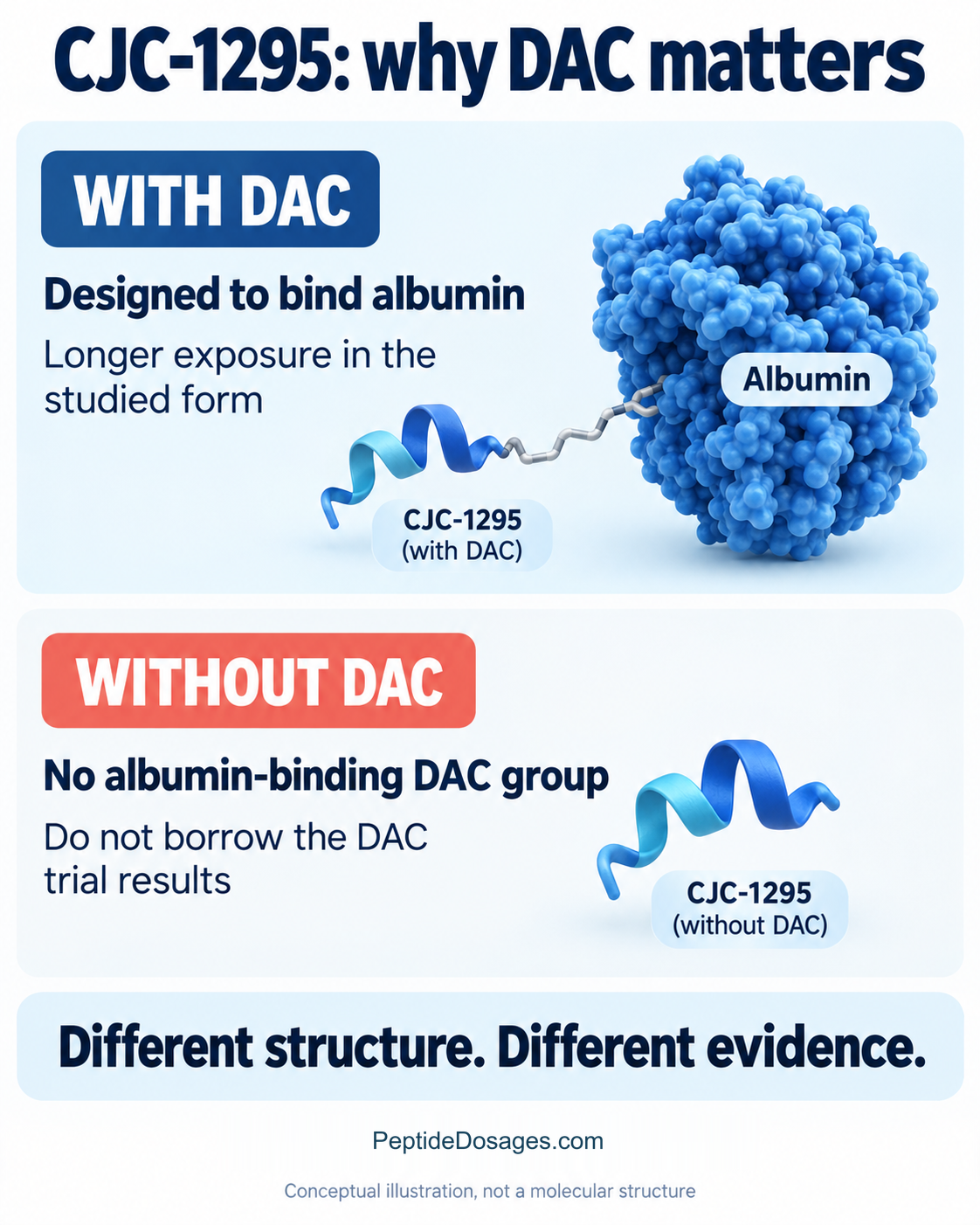
“DAC” stands for Drug Affinity Complex—a design approach where a reactive group (commonly described in the clinical literature as a maleimide‑type chemistry) allows the peptide to bind to serum albumin. Albumin is abundant in blood and acts like a carrier protein; binding to it can dramatically extend how long a peptide stays in the body. [4]
In the pivotal human trial write‑up, CJC‑1295 is described as permanently and covalently binding to serum albumin after administration, and the paper’s chemical figure explains the binding is directed at albumin’s cysteine 34.
Where it fits in the GH “control system”
Your GH output is tightly regulated and pulsatile (released in bursts). The hypothalamus drives GH release using: – GHRH (positive signal), and
– Somatostatin (negative signal, a “brake”). [5]
A key reason people are interested in GHRH analogs is that stimulating the pituitary via GHRH can preserve a more episodic GH pattern than giving recombinant GH directly (which is typically a once‑daily injection, not naturally pulsatile). [6]
GH vs IGF‑1: what changes, and why you should care
GH is released from the pituitary and exerts effects directly—and also indirectly by increasing IGF‑1 production (largely from the liver). IGF‑1 is commonly used as a more stable marker of GH activity because GH itself fluctuates rapidly. [7]
A practical takeaway: If someone claims “more GH,” what they often mean is “higher average IGF‑1 over time,” because IGF‑1 integrates GH signaling. [8]
What the strongest human data actually shows
In randomized, placebo‑controlled dose‑escalation studies in healthy adults, a single injection of CJC‑1295 produced: – Mean GH increases ~2–10× for 6+ days, and
– Mean IGF‑1 increases ~1.5–3× for ~9–11 days, with an estimated half‑life ~5.8–8.1 days. [9]
In the same report, after multiple doses, IGF‑1 remained above baseline for up to 28 days. [9]
This is why CJC‑1295 DAC is categorized as “long‑acting” in the peptide community: the clinical data supports a multi‑day pharmacologic footprint. [10]
The “PULSE vs PLATEAU” insight most pages miss
Many competitor pages oversimplify this as “weekly dosing = better.” The real nuance is pattern.
Here’s the framework:
- Pulse (physiology): GH is normally released in bursts, coordinated by GHRH and somatostatin. [11]
- Plateau (risk signal): Long‑acting stimulation can raise trough GH (the “baseline” between peaks), which may change downstream effects even if pulses still occur. [12]
In other words, the question isn’t only “Does it increase GH?” It’s “Does it keep GH signaling closer to a normal rhythm—or does it flatten the system into higher baseline stimulation?” The clinical literature reports preserved pulsatility with CJC‑1295 while also noting increased trough/mean secretion, which is an important distinction for informed risk‑benefit thinking. [13]
Step‑by‑Step / How‑To
You can evaluate CJC‑1295 DAC quickly (and safely) by using this evidence‑first workflow. This is not a dosing guide. It’s a decision framework to reduce misinformation and risk.
- Define the exact compound.
“CJC‑1295” is often used loosely online. Confirm you mean CJC‑1295 with DAC (DAC‑GRF), not CJC‑1295 without DAC (often referred to as modified GRF(1‑29)). [14] - Anchor to human clinical endpoints first.
The best‑cited human study endpoints are GH/IGF‑1 changes and half‑life—not fat loss, “anti‑aging,” or bodybuilding outcomes in healthy people. [15] - Check the time‑course claims.
If a page says “works for weeks,” verify whether it’s referencing IGF‑1 persistence versus the estimated half‑life. Those are related but not identical. [16] - Read safety data like a clinician would.
Favor sources that report: adverse events, labs, and whether antibody formation was detected—not just “side effects are mild.” [17] - Separate GH‑axis effects from real‑world outcomes.
Even when GH/IGF‑1 rise, that does not automatically translate into better strength, performance, or “reversal of aging.” This is a recurring finding in GH research in healthy populations. [18] - Verify legality and compliance for your context.
If you compete in tested sport, growth hormone releasing factors (including CJC‑1295) are listed on the prohibited list. Treat that as a hard stop. [19] - Use a quality‑control checklist before you trust any vial.
The safety risk profile changes drastically when products are mis‑manufactured, contaminated, or incorrectly characterized—especially for peptides, where impurities and aggregation can matter. [20]
Comparison / Alternatives
CJC‑1295 DAC is only one way to influence the GH/IGF‑1 axis. The right comparison depends on what you mean by “alternative”: shorter‑acting GHRH fragments, clinically approved GHRF analogs, ghrelin‑pathway secretagogues, or recombinant GH.
CJC‑1295 DAC vs common alternatives at a glance
| Option | Primary pathway | Duration signal | Evidence strength in humans | Regulatory reality (US) | Best‑fit use case (high-level) |
| CJC‑1295 with DAC | GHRH analog → pituitary GH → ↑ IGF‑1 | Multi‑day | RCTs show multi‑day GH/IGF‑1 increases | Not FDA‑approved; FDA flags compounding safety concerns | Research discussion; caution-first evaluation |
| CJC‑1295 without DAC (often “mod GRF(1‑29)”) | GHRH fragment analog | Short‑acting | Less robust public human PK/PD compared with DAC form | Not FDA‑approved | Shorter pulse‑style protocols (often discussed), but evidence varies |
| Tesamorelin | GHRF analog (GHRH-class) | Daily use in labeling | Strong clinical program for its indication | FDA‑approved for HIV‑associated lipodystrophy (VAT reduction) | A medically supervised, on‑label option for a specific population |
| MK‑677 (ibutamoren) | Ghrelin receptor (GHSR) agonism → ↑ GH/IGF‑1 | Oral, longer acting than peptides | Multi‑month studies exist (e.g., older adults) | Not approved for human use; not legal as a supplement ingredient | Research contexts; higher appetite/metabolic considerations |
| Recombinant human GH | GH replacement | Daily injections typical | Strong evidence in true GH deficiency | FDA‑approved for specific indications | Medical diagnosis + monitoring only |
Where the table comes from: The CJC‑1295 DAC half‑life and magnitude/duration of GH/IGF‑1 changes come from randomized controlled trials in healthy adults. [21]
Why tesamorelin is different: Tesamorelin (Egrifta) is a GHRF analog with an FDA‑approved indication for reducing excess abdominal fat in HIV‑associated lipodystrophy (and is not indicated for general weight loss). [22]
Why MK‑677 is different: MK‑677 is a ghrelin mimetic; studies in older adults show increased pulsatile GH secretion and increased fat‑free mass, but it remains unapproved for human use and carries compliance/legal constraints depending on context. [23]
The most important comparison point
The decisive difference is not “which increases GH,” but how GH is increased (GHRH‑pathway vs ghrelin receptor vs direct GH) and whether the pattern resembles normal physiology. [24]
“Benefits” claims: what’s plausible vs what’s proven
A lot of online content implies: “Higher GH/IGF‑1 = more muscle, less fat, better performance.” That is not a safe assumption.
- In healthy older adults, randomized trials of GH therapy show small changes in body composition and higher rates of adverse events, and major reviews conclude GH cannot be recommended as an anti‑aging therapy. [25]
- Reviews of GH and athletic performance report increased lean body mass but no consistent improvement in strength or aerobic capacity in healthy people, while adverse events may increase. [26]
Since CJC‑1295 DAC’s core demonstrated effect is raising GH/IGF‑1, it’s appropriate to apply the same skepticism to broad “performance” promises—unless you see controlled outcome data specific to CJC‑1295 in the population and endpoint being claimed. [27]
Templates / Checklist / Example
Use this section as a copy‑ready template for safer, clearer decision‑making.
Quality & sourcing checklist for peptide products
- Confirm the label matches the compound: “CJC‑1295 DAC / DAC‑GRF,” not “CJC‑1295” ambiguously. [14]
- Request a recent Certificate of Analysis (COA) that includes identity + purity method (not just “99%”).
- Verify lot consistency and third‑party testing when possible; peptides can have characterization/impurity complexity. [28]
- Avoid products marketed as “dietary supplements” if the compound is not legally allowed as a supplement ingredient. (This is a known issue for GH‑axis agents like MK‑677, and the same caution mindset applies.) [29]
- Document storage conditions and handling; peptides can degrade, and degraded product increases uncertainty and risk. [28]
Safety‑first questions to ask before you “believe” a protocol
- What endpoint is being measured? GH pulses, IGF‑1 averages, body composition, strength, lipids, glucose tolerance? [30]
- Is the data from humans or animals? Human PK/PD ≠ outcome proof in healthy users. [27]
- What does the adverse event section say? Look for injection‑site reactions, flushing/vasodilation, blood pressure changes, headaches, and whether antibody formation was detected.
- Does the source mention regulatory concerns? FDA has specifically flagged risks and limited data around compounded CJC‑1295. [28]
- Are you in a tested sport or military context? GH releasing factors (including CJC‑1295) are listed as prohibited. [19]
Mini example: an evidence‑tier filter (information gain)
Most CJC‑1295 content online fails because it treats all “evidence” as equal. Use this quick filter:
Tier A: Human randomized trials (best starting point)
If the claim is about duration, half‑life, GH/IGF‑1 change magnitude—use Tier A first. [10]
Tier B: Human observational or mechanistic studies (useful, but narrower)
Good for understanding pattern (pulsatility), biomarkers, and mechanistic plausibility. [31]
Tier C: Animal/in vitro + anecdotes (hypothesis only)
Useful for questions, not conclusions—especially for “anti‑aging,” “muscle gain,” or “fat loss” claims in healthy people. [32]
Key takeaway: If a page leads with Tier C promises and barely cites Tier A/B data, it’s optimized for clicks—not accuracy. [33]
FAQs
What is CJC-1295 DAC?
CJC-1295 DAC is a long‑acting synthetic GHRH analog designed to raise your body’s GH and IGF‑1 levels for days after administration. “DAC” refers to Drug Affinity Complex technology that enables binding to serum albumin, extending the peptide’s half‑life and duration of effect compared with short‑acting GHRH fragments. [2]
What’s the difference between CJC‑1295 DAC and CJC‑1295 no DAC?
CJC‑1295 DAC includes an albumin‑binding strategy (DAC), which is why human studies report multi‑day effects and a multi‑day half‑life. “CJC‑1295 no DAC” is often described online as modified GRF(1‑29), a shorter‑acting GHRH‑fragment analog; it’s commonly discussed as requiring more frequent administration due to faster clearance, but the strongest widely cited human half‑life data is for the DAC form. [34]
Does CJC‑1295 DAC increase IGF‑1?
Yes—CJC‑1295 DAC increases IGF‑1 in human trials, with mean IGF‑1 rising roughly 1.5–3× and remaining elevated for around 9–11 days after a single dose in the pivotal placebo‑controlled study. Because IGF‑1 is a primary downstream mediator of GH activity and is more stable than pulsatile GH, it’s often used as a key measurable marker of effect. [35]
Is CJC‑1295 DAC safe?
Safety is not “settled.” In controlled studies in healthy adults, no serious adverse reactions were reported, but common adverse events included injection‑site reactions and systemic symptoms like headache, flushing/vasodilation, and diarrhea—often more frequent at higher doses; antibody formation was not detected in that report. Separately, FDA has warned that compounded CJC‑1295 may present immunogenicity risks and noted serious adverse events associated with CJC‑1295 in its review context, emphasizing limited clinical data. [36]
Is CJC‑1295 DAC legal for athletes?
No for tested sport: CJC‑1295 is listed under growth hormone releasing factors on the World Anti-Doping Agency[37] prohibited list, meaning it is banned in sport contexts governed by that code. If you compete in tested athletics, treat CJC‑1295 DAC as prohibited unless you have an approved therapeutic use exemption for a permitted therapy (and this peptide is not typically positioned that way). [19]
Why do people compare CJC‑1295 DAC to MK‑677 or ipamorelin?
People compare them because all can increase GH signaling, but they do it through different receptors. CJC‑1295 DAC is a GHRH‑pathway stimulator, while MK‑677 and ipamorelin act through the ghrelin/growth hormone secretagogue receptor (GHSR). Those pathway differences can change duration, side‑effect profile, appetite/metabolic effects, and legality/approval status—so “they all boost GH” is an oversimplification. [38]
Next Steps
If you remember only one thing: CJC‑1295 DAC is best supported as a long‑acting GHRH analog that measurably raises GH/IGF‑1 for days—but “real‑world benefits” beyond that are often overstated online and should be treated as unproven until controlled outcome data exists. [39]
If you want practical, beginner‑friendly resources from PeptideDosages.com[40], start here (internal references): – CJC‑1295 DAC 2 mg vial dosage protocol
– CJC‑1295 DAC 5 mg vial dosage protocol
If you are looking at purchase pages, treat them as vendor information, not medical guidance, and apply the quality checklist above: – Buy CJC‑1295 DAC 2mg
– Buy CJC‑1295 DAC 5mg
Finally, if your interest is body composition or visceral fat reduction and you want something with an FDA‑approved indication (for a specific population), consider learning about tesamorelin’s labeled use and limitations as a point of contrast. [41]
[1] [2] [9] [10] [15] [16] [21] [27] [33] [34] [35] [37] [39] [40] https://academic.oup.com/jcem/article-pdf/91/3/799/10779632/jcem0799.pdf
https://academic.oup.com/jcem/article-pdf/91/3/799/10779632/jcem0799.pdf?utm_source=chatgpt.com
[3] [5] [11] [24] Targeting growth hormone function: strategies and …
https://www.nature.com/articles/s41392-019-0036-y?utm_source=chatgpt.com
[4] [6] [31] Activation of the GH/IGF-1 axis by CJC-1295, a long acting GHRH analog, results in serum protein profile changes in normal adult subjects – PMC
https://pmc.ncbi.nlm.nih.gov/articles/PMC2787983/?utm_source=chatgpt.com
[7] Insulin-like growth factor 1 (IGF-1): a growth hormone – PMC
https://pmc.ncbi.nlm.nih.gov/articles/PMC1187088/?utm_source=chatgpt.com
[8] [30] IGF-1 (Insulin-like Growth Factor 1) Test
https://medlineplus.gov/lab-tests/igf-1-insulin-like-growth-factor-1-test/?utm_source=chatgpt.com
[12] [13] Pulsatile secretion of growth hormone (GH) persists … – PubMed
https://pubmed.ncbi.nlm.nih.gov/17018654/?utm_source=chatgpt.com
[14] Modified GRF (1-29)
https://en.wikipedia.org/wiki/Modified_GRF_%281-29%29?utm_source=chatgpt.com
[17] [20] [28] [36] Certain Bulk Drug Substances for Use in Compounding …
[18] [25] the safety and efficacy of growth hormone in the healthy elderly
https://pubmed.ncbi.nlm.nih.gov/17227934/?utm_source=chatgpt.com
[19] The Prohibited List | World Anti Doping …
https://www.wada-ama.org/en/prohibited-list?utm_source=chatgpt.com
[22] EGRIFTA® (tesamorelin for injection), for subcutaneous use
[23] Effects of an Oral Ghrelin Mimetic on Body Composition and …
https://pmc.ncbi.nlm.nih.gov/articles/PMC2757071/?utm_source=chatgpt.com
[26] [32] the effects of growth hormone on athletic performance
https://pubmed.ncbi.nlm.nih.gov/18347346/?utm_source=chatgpt.com
[29] Performance Enhancing Substance: MK-677 (Ibutamoren)
[38] The Growth Hormone Secretagogue Receptor: Its Intracellular …
https://pmc.ncbi.nlm.nih.gov/articles/PMC3975427/?utm_source=chatgpt.com
[41] FULL PRESCRIBING INFORMATION – accessdata.fda.gov
https://www.accessdata.fda.gov/drugsatfda_docs/label/2025/022505s020lbl.pdf?utm_source=chatgpt.com