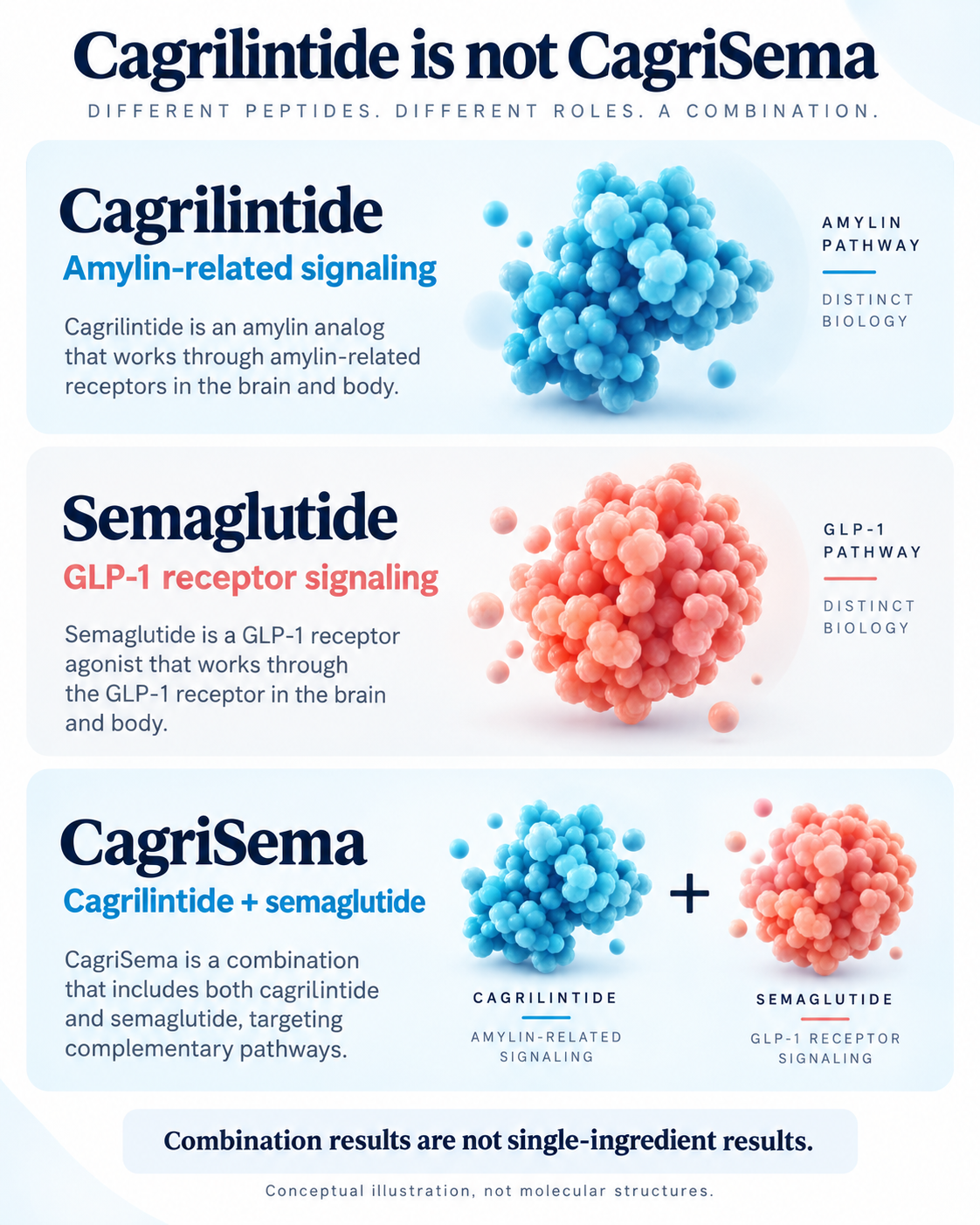

Cagrilintide is showing up in more peptide conversations because it targets appetite regulation through a different pathway than typical GLP‑1 drugs. If you’re searching “What is Cagrilintide”, you probably want a clear definition, what studies show, how it works, and how it compares to options like semaglutide and tirzepatide—without the hype.
This guide breaks down the core biology (amylin vs GLP‑1), the best human evidence so far, realistic safety considerations, and how to evaluate claims you’ll see online—especially if you’re new to peptides.
Fast Answer / Executive Summary
Fast Answer: Cagrilintide is a long‑acting amylin analogue (a dual amylin and calcitonin receptor agonist) being studied for obesity and metabolic disease, often combined with the GLP‑1 receptor agonist semaglutide. In phase 2–3 trials, cagrilintide-based regimens reduced body weight, with gastrointestinal side effects being the most common. [1]
Core Concepts & Key Entities
Cagrilintide in one sentence
Cagrilintide is an investigational, long‑acting “amylin‑pathway” peptide designed for once‑weekly dosing that helps reduce food intake by strengthening satiety signals in the brain. [2]
Cagrilintide is most widely discussed today because it is part of an investigational combination with semaglutide (often referred to as “CagriSema”) that has been studied in large phase 3 trials. [3]
Where cagrilintide fits in the “appetite hormone” map
Appetite and energy intake are regulated by overlapping signals from the gut, pancreas, adipose tissue, and brain. Two of the most relevant signals here are:
- Amylin: a pancreatic hormone released with insulin after meals that supports satiety and post‑meal glucose control. [4]
- GLP‑1 (glucagon‑like peptide‑1): an incretin hormone released after eating that increases glucose‑dependent insulin secretion, suppresses glucagon when glucose is high, slows gastric emptying, and reduces appetite. [5]
These pathways overlap (both can reduce appetite and slow gastric emptying), but they are not the same—which is one reason combination strategies are being tested. [6]
Amylin basics (because cagrilintide is an amylin analogue)
Amylin is a 37‑amino‑acid peptide co‑secreted with insulin from pancreatic beta cells in response to meals. [7]
Amylin’s best‑established actions include delaying gastric emptying, suppressing post‑meal glucagon, and reducing food intake via centrally mediated satiety. [8]
A key clinical reference point is pramlintide (Symlin), an earlier amylin analogue approved for use with mealtime insulin in diabetes, which acts through these same core mechanisms (satiety, glucagon suppression, gastric emptying). [9]
What does “DACRA” mean, and why does it show up with cagrilintide?
You’ll often see cagrilintide described as a DACRA, short for dual amylin and calcitonin receptor agonist. This label matters because “amylin receptors” are built from the calcitonin receptor plus an accessory protein (RAMP), and some drugs engage both calcitonin-family receptor signaling routes. [10]
Amylin receptor subtypes (AMY1R, AMY2R, AMY3R) are heterodimers of the calcitonin receptor paired with RAMP1, RAMP2, or RAMP3. [11]
Cagrilintide has been characterized as engaging amylin receptor subtypes and the calcitonin receptor, which is part of why it’s considered DACRA‑like in the literature. [12]
GLP‑1, incretins, and why people compare cagrilintide to “GLP‑1 drugs”
GLP‑1 is an incretin hormone—a gut-derived signal that boosts insulin secretion in a glucose‑dependent way and supports appetite reduction. [13]
If you’ve ever seen it typed as “GLP1,” it’s the same thing—the standard scientific form is GLP‑1, and that’s the version used in most medical literature. [14]
People compare cagrilintide to GLP‑1 receptor agonists because both can reduce appetite and body weight, and because the most advanced development program pairs cagrilintide with semaglutide (a GLP‑1 receptor agonist). [15]
How cagrilintide was engineered to be long‑acting
Cagrilintide was developed as a stable, lipidated long‑acting amylin analogue—one goal being less frequent dosing than older amylin analogues like pramlintide (which requires multiple daily injections). [16]
In an early phase 1b study evaluating cagrilintide with semaglutide, cagrilintide’s half‑life was reported in the ~159–195 hour range, consistent with once‑weekly dosing strategies. [17]
What the best human evidence says so far
Cagrilintide alone (phase 2 dose‑finding in obesity)
Cagrilintide monotherapy produced dose‑dependent weight loss in a 26‑week phase 2 trial in adults with overweight/obesity. [18]
In that trial, mean weight reductions (trial product estimand) ranged from roughly ~6% to ~10.8% across once‑weekly cagrilintide doses (0.3–4.5 mg) compared with about ~3% with placebo, and the highest dose outperformed liraglutide 3.0 mg in that study. [19]
The most common adverse events were mainly gastrointestinal (e.g., nausea, constipation, diarrhea) and injection‑site reactions, with higher GI event rates in cagrilintide groups than placebo. [20]
Cagrilintide plus semaglutide (phase 3 REDEFINE trials)
The most widely cited “headline numbers” come from phase 3 trials of once‑weekly cagrilintide–semaglutide.
In REDEFINE 1 (adults with overweight/obesity without diabetes), estimated mean weight change at 68 weeks was −20.4% with cagrilintide–semaglutide vs −3.0% with placebo (treatment‑policy estimand). [21]
The same REDEFINE 1 report shows the monotherapy reference arms at 68 weeks around −14.9% (semaglutide) and −11.5% (cagrilintide) versus placebo under the same estimand. [22]
In REDEFINE 2 (adults with type 2 diabetes and overweight/obesity), estimated mean weight change at 68 weeks was −13.7% with cagrilintide–semaglutide vs −3.4% with placebo (treatment‑policy estimand). [23]
REDEFINE 2 also reported glycemic improvements: the mean HbA1c change at 68 weeks was larger in the cagrilintide–semaglutide group than placebo, and 73.5% reached HbA1c ≤6.5% compared with 15.9% on placebo (treatment‑policy estimand reporting). [24]
A key nuance competitors often omit: “estimands” change the story
Many modern obesity trials report more than one “estimand,” meaning more than one way of defining and analyzing outcomes depending on adherence/discontinuation assumptions. [25]
In REDEFINE 1 and REDEFINE 2, you’ll see terms like:
- Treatment‑policy estimand: closer to an intention‑to‑treat view during the in‑trial period, regardless of discontinuation or rescue interventions. [25]
- Trial‑product estimand: closer to “as‑treated/as‑intended,” based on the on‑treatment period (i.e., what happens if people stay on therapy as intended). [25]
This matters because headline weight loss can look higher under “as‑intended” assumptions, and real‑world persistence can shift what people actually experience. [26]
Common side effects and safety signals seen in trials
Gastrointestinal adverse events are the most common tolerability issue across cagrilintide-based regimens, especially nausea, vomiting, diarrhea, constipation, and abdominal pain. [27]
In REDEFINE 1, GI adverse events were reported in 79.6% of participants on cagrilintide–semaglutide and 39.9% on placebo, and were described as mainly transient and mild‑to‑moderate in severity. [28]
In REDEFINE 2, GI disorders occurred in 72.5% on cagrilintide–semaglutide vs 34.4% on placebo, with nausea/vomiting/diarrhea peaking during dose escalation while constipation remained more stable across the trial period. [29]
Serious adverse events occurred in both active and placebo groups in these trials; REDEFINE 2 provides detailed comparative adverse event reporting (including discontinuations and selected safety endpoints). [30]
Regulatory status and why it matters for “peptide” buyers
Cagrilintide is investigational and is not something clinicians can broadly prescribe as a standalone approved obesity drug today. [31]
A fixed‑dose combination of cagrilintide + semaglutide has been under regulatory review processes: Novo Nordisk[32] announced an FDA application submission in late 2025 and noted the product was not approved in the U.S. or EU at that time. [33]
This is also why online “research peptide” markets are noisy: the scientific development is real, but product quality, labeling, and legality can vary dramatically outside regulated pharmaceutical channels. [34]
Step‑by‑Step / How‑To
Step One: Define what you’re actually looking at
Cagrilintide is an investigational amylin analogue, not an FDA‑approved consumer weight‑loss medication you can treat like a supplement. [35]
If you see it marketed as a casual “fat-loss peptide,” that framing is missing the key point: most evidence comes from controlled clinical trials with defined eligibility criteria, monitoring, and escalation rules. [36]
Step Two: Anchor your expectations to human trial endpoints
The most reliable “what it does” claims are percent body‑weight change over time and the proportion reaching clinically meaningful thresholds (≥5%, ≥10%, ≥15%, etc.). [37]
For example, REDEFINE 1 reports multiple thresholds and shows that higher thresholds are achieved more often with the combination than placebo (and more often than monotherapies). [38]
Step Three: Understand the mechanism in plain English
Amylin‑pathway drugs primarily strengthen “meal‑stop” signaling (satiety), while GLP‑1 receptor agonists combine satiety with strong metabolic (glucose) effects and appetite reduction. [39]
This is one scientifically grounded reason combination therapy is plausible: complementary signals can reduce energy intake more than either pathway alone. [6]
Step Four: Read side effects the way clinicians do—by pattern, not just presence
With cagrilintide-based regimens, the “pattern” that appears repeatedly is GI symptoms that peak during escalation and often ease later. [40]
That’s different from implying “no side effects,” and it’s also different from assuming any nausea means “it’s unsafe.” Trials report both frequency and severity and document discontinuations. [41]
Step Five: If you’re evaluating a “research peptide” listing, verify quality as if you were auditing a lab input
Online peptide sourcing should be approached like supply chain QA: identity, purity, contamination risk, and documentation—before price. [34]
In early 2026, U.S. Food and Drug Administration[42] publicly highlighted actions aimed at restricting non‑approved GLP‑1 active ingredients in mass‑marketed compounded drugs, emphasizing quality and safety verification challenges outside approved channels. [43]
Step Six: Track the “status story,” because it changes what is known
Cagrilintide’s evidence base is growing, and new data can materially change comparisons. [44]
For example, later-stage communications and press coverage have discussed head‑to‑head outcomes versus tirzepatide and how those results affect expectations—even when both drugs show large average weight reductions. [45]
Comparison / Alternatives (“X vs Y”)
The short comparison that matters most
Cagrilintide targets the amylin/calcitonin receptor family, while GLP‑1 receptor agonists target the GLP‑1 receptor—and “cagrilintide + GLP‑1” combinations are being tested because they can outperform either pathway alone in trials. [46]
Comparison table: amylin pathway vs GLP‑1 vs dual incretin
| Option | Primary target(s) | What it tends to do best | Evidence strength in obesity | Approval status (US) | Most common tradeoffs |
| Cagrilintide (monotherapy) | Amylin receptor family / DACRA‑like signaling [47] | Satiety (“meal‑stop” signaling), reduced food intake [48] | Phase 2 dose‑finding shows dose‑dependent weight loss [49] | Investigational [50] | GI effects (nausea/constipation/diarrhea), injection-site reactions [49] |
| Semaglutide (GLP‑1 RA) | GLP‑1 receptor [51] | Glucose control + appetite reduction; slows gastric emptying [14] | Strong phase 3 obesity outcomes (reference comparator in REDEFINE 1) [52] | FDA‑approved for chronic weight management (Wegovy) [53] | GI effects; tolerability can affect persistence [54] |
| Cagrilintide + semaglutide | Amylin pathway + GLP‑1 receptor [55] | Greater average weight loss than either alone (in trials) [56] | Two large phase 3 trials (REDEFINE 1 & 2) [57] | Under regulatory review / not approved at time of filing announcements [33] | High GI event frequency; escalation-phase symptoms common [58] |
| Tirzepatide (dual GIP/GLP‑1) | GIP + GLP‑1 receptors [59] | Very strong average weight loss + glycemic benefits [60] | Multiple large trials; often top-of-class for weight loss [61] | FDA‑approved for chronic weight management (Zepbound) [62] | GI effects; compounded-product quality issues reported in news context [63] |
Cagrilintide vs semaglutide: the practical difference
Cagrilintide is best thought of as “amylin‑pathway satiety,” while semaglutide is “GLP‑1 incretin‑plus satiety,” and the combination’s performance suggests additive effects. [64]
In REDEFINE 1, the combination’s mean weight reduction (treatment‑policy estimand) exceeded both monotherapies at week 68, and it also improved multiple secondary outcomes (e.g., cardiometabolic measures) compared with placebo. [65]
Cagrilintide vs tirzepatide: why “best” depends on the question
Tirzepatide has strong evidence and FDA approval for chronic weight management, while cagrilintide is investigational and is most competitive in combination strategies rather than as a standalone approved option today. [66]
A large open‑label head‑to‑head study discussed in 2026 reporting suggested higher average weight loss for tirzepatide than the cagrilintide–semaglutide combination at 84 weeks, and the sponsor communications note the study’s non‑inferiority target was not achieved. [45]
Cagrilintide vs pramlintide: “new generation” vs “first generation”
Pramlintide is an FDA‑approved amylin analogue used with mealtime insulin, while cagrilintide is a long‑acting investigational analogue designed for far less frequent dosing. [67]
This difference is largely pharmacokinetic: pramlintide’s labeling describes its amylin‑analog effects, and cagrilintide’s development papers emphasize long‑acting design features aimed at weekly administration. [68]
Alternatives beyond peptides: the “non‑peptide” reality check
Medication isn’t the only lever that reliably changes long‑term weight outcomes, and the best choice depends on medical context, risk, and sustainability. [69]
For many people, the practical alternatives include structured nutrition + resistance training, sleep and stress interventions, evidence-based obesity pharmacotherapy (where appropriate), and bariatric procedures for qualifying patients—each with different benefit/risk profiles. [69]
Templates / Checklist / Example
A unique framework for “information gain”: The Satiety Signal Stack
Most people talk about weight loss peptides as if they reduce one thing (“hunger”), but appetite is a stack of signals that turn on at different times. [39]
Here’s a practical way to map claims you see online:
- Meal‑stop signals (satiation): What makes you naturally stop eating during a meal. Amylin is strongly tied to this layer. [70]
- Between‑meal hunger signals: What drives hunger return between meals, often linked to gut–brain signaling and metabolic context. GLP‑1 contributes here. [13]
- Food reward / hedonic pull: Why cravings can persist even when you “should be full.” Central appetite circuitry is involved, and trials discuss complementary central actions when combining mechanisms. [71]
The “stack” insight: cagrilintide (amylin pathway) is most plausibly strongest at Layer 1, while GLP‑1 receptor agonists influence Layers 1–2 and metabolic control; combining them can widen coverage across the stack. [64]
Copy‑ready checklist: evaluating cagrilintide claims safely
- Confirm the status: investigational peptide, not a broadly prescribed approved obesity drug. [50]
- Define your goal in measurable terms (e.g., % weight loss over time, appetite control, glycemic markers). [72]
- Anchor expectations to phase 2–3 endpoints (week 26, week 68 outcomes). [73]
- Compare like-for-like: treatment‑policy vs trial‑product estimands before repeating “headline” numbers. [74]
- Scan side effects by phase: escalation vs maintenance tolerability patterns. [40]
- Verify supply documentation if sourcing for research (COA, third‑party purity, contamination controls). [34]
- Avoid equating “research peptide” listings with regulated pharmaceutical manufacturing standards. [43]
- Document inputs and outcomes if you’re tracking publicly reported research: dose definitions, duration, and endpoints reported. [75]
- Update your view when new trial readouts change comparisons (especially head‑to‑head outcomes). [76]
- Consult a qualified clinician for personal medical decisions; this is educational content, not medical advice. [77]
FAQs
Is cagrilintide a GLP‑1?
Is cagrilintide a GLP‑1? Cagrilintide is not a GLP‑1; cagrilintide is an amylin analogue that targets the amylin/calcitonin receptor family, while GLP‑1 drugs activate the GLP‑1 receptor. Cagrilintide is often discussed alongside GLP‑1 therapies because clinical development has emphasized combination treatment with semaglutide. [78]
What is cagrilintide used for?
What is cagrilintide used for? Cagrilintide is being investigated for weight management and metabolic disease, including obesity, and has been studied alone and in combination with semaglutide. Phase 2 and phase 3 trials report meaningful weight reductions, but cagrilintide remains investigational rather than an established approved obesity medicine. [79]
Is cagrilintide FDA approved?
Is cagrilintide FDA approved? Cagrilintide is not FDA approved as a standalone therapy for obesity. Development has focused heavily on a fixed‑dose combination with semaglutide, and sponsor announcements have described regulatory submissions and noted the product was not approved in the U.S. or EU at the time of those filings. [50]
What are the most common side effects of cagrilintide-based regimens?
What are the most common side effects of cagrilintide-based regimens? The most common side effects reported in trials are gastrointestinal, including nausea, vomiting, diarrhea, constipation, and abdominal pain. In phase 3 trial reporting, GI symptoms commonly peaked during dose escalation and were often described as mild‑to‑moderate and transient, though discontinuations due to adverse events did occur. [80]
Why do researchers combine cagrilintide with semaglutide?
Why do researchers combine cagrilintide with semaglutide? Researchers combine cagrilintide with semaglutide to target complementary appetite and metabolic pathways, aiming for greater weight loss than either drug alone. In REDEFINE 1, the combination achieved larger average weight reduction than semaglutide or cagrilintide alone, supporting the “complementary mechanisms” hypothesis in humans. [81]
Next Steps
The main takeaway: cagrilintide is a long‑acting amylin analogue (DACRA‑like) with real human clinical evidence, but it remains investigational—so the smartest approach is evidence‑anchored, status‑aware, and safety‑first. [82]
If you want a deeper, dosing‑protocol–specific resource for educational research context, see the internal guides on PeptideDosages.com[83]: – Cagrilintide protocol (5 mg vial): https://peptidedosages.com/single-peptide-dosages/cagrilintide-5-mg-vial-dosage-protocol/ [84]
– Cagrilintide protocol (10 mg vial): https://peptidedosages.com/single-peptide-dosages/cagrilintide-10-mg-vial-dosage-protocol/ [85]
If you are sourcing for laboratory research (not for human use), the external purchase listings provided are: – https://purelabpeptides.com/buy-peptides/buy-cagrilintide-5mg/ [86]
– https://purelabpeptides.com/buy-peptides/buy-cagrilintide-10mg/ [87]
A final safety note: the broader “peptide/compounded weight‑loss drug” ecosystem has active quality and regulatory scrutiny, so treat sourcing claims skeptically and prioritize documentation and verified testing. [34]
[1] [2] [16] [35] [82] Development of Cagrilintide, a Long-Acting Amylin Analogue
https://pubmed.ncbi.nlm.nih.gov/34288673/?utm_source=chatgpt.com
[3] [15] [21] [22] [25] [26] [27] [28] [32] [36] [37] [38] [41] [52] [55] [56] [57] [58] [65] [69] [71] [72] [74] [80] [81] mediacenteratypon.nejmgroup-production.org
https://mediacenteratypon.nejmgroup-production.org/NEJMoa2502081.pdf
[4] [7] [8] [39] [48] [64] [70] Review of pramlintide as adjunctive therapy in treatment …
https://pubmed.ncbi.nlm.nih.gov/19920907/?utm_source=chatgpt.com
[5] [13] [14] [78] Glucagon-like peptide 1 (GLP-1)
https://pmc.ncbi.nlm.nih.gov/articles/PMC6812410/?utm_source=chatgpt.com
[6] A Long-Acting Amylin Analog for the Treatment of Obesity
https://pubmed.ncbi.nlm.nih.gov/36883831/?utm_source=chatgpt.com
[9] [67] [68] SYMLIN (pramlintide acetate) injection – accessdata.fda.gov
https://www.accessdata.fda.gov/drugsatfda_docs/label/2014/021332s007_S016.pdf?utm_source=chatgpt.com
[10] [11] [46] Calcitonin and Amylin Receptor Peptide Interaction Mechanisms
https://pmc.ncbi.nlm.nih.gov/articles/PMC4861438/?utm_source=chatgpt.com
[12] Coadministered Cagrilintide and Semaglutide in Adults with …
https://mediacenteratypon.nejmgroup-production.org/NEJMoa2502081.pdf?utm_source=chatgpt.com
[17] a randomised, controlled, phase 1b trial
https://pubmed.ncbi.nlm.nih.gov/33894838/?utm_source=chatgpt.com
[18] [19] [20] [49] [73] [75] [79] gwern.net
https://gwern.net/doc/longevity/glp/semaglutide/2021-lau.pdf
[23] [24] [29] [30] [40] mediacenteratypon.nejmgroup-production.org
https://mediacenteratypon.nejmgroup-production.org/NEJMoa2502082.pdf
[31] professional.diabetes.org
[33] [44] [50] Novo Nordisk files for FDA approval of CagriSema, the first …
[34] [43] FDA Intends to Take Action Against Non-FDA-Approved …
[42] [51] Glucagon-like peptide-1 receptor: mechanisms and …
https://www.nature.com/articles/s41392-024-01931-z?utm_source=chatgpt.com
[45] [76] Novo Nordisk’s CagriSema trial deals blow in obesity drug battle with Eli Lilly
[47] Amylin receptor subunit interactions are modulated by … – PMC
https://pmc.ncbi.nlm.nih.gov/articles/PMC11482831/?utm_source=chatgpt.com
[53] Office of Clinical Pharmacology Review
https://www.fda.gov/media/185422/download?utm_source=chatgpt.com
[54] Mechanisms of GLP-1 Receptor Agonist-Induced Weight …
https://www.sciencedirect.com/science/article/pii/S0002934325000592?utm_source=chatgpt.com
[59] [60] [83] Tirzepatide, a dual GIP/GLP-1 receptor co-agonist for … – PMC
https://pmc.ncbi.nlm.nih.gov/articles/PMC9438179/?utm_source=chatgpt.com
[61] [62] [66] [77] FDA Approves New Medication for Chronic Weight …
[63] Lilly finds impurity in compounded version of its weight-loss drug, warns of health risks
[84] Cagrilintide 5mg Dosage Protocol | PeptideDosages.com
https://peptidedosages.com/single-peptide-dosages/cagrilintide-5-mg-vial-dosage-protocol/
[85] Cagrilintide 10mg Dosage Protocol | PeptideDosages.com
https://peptidedosages.com/single-peptide-dosages/cagrilintide-10-mg-vial-dosage-protocol/
[86] Buy Cagrilintide Online | Advanced Metabolic Research Peptide
https://purelabpeptides.com/buy-peptides/buy-cagrilintide-5mg/
[87] Buy Cagrilintide Online | Advanced Weight Management
https://purelabpeptides.com/buy-peptides/buy-cagrilintide-10mg/