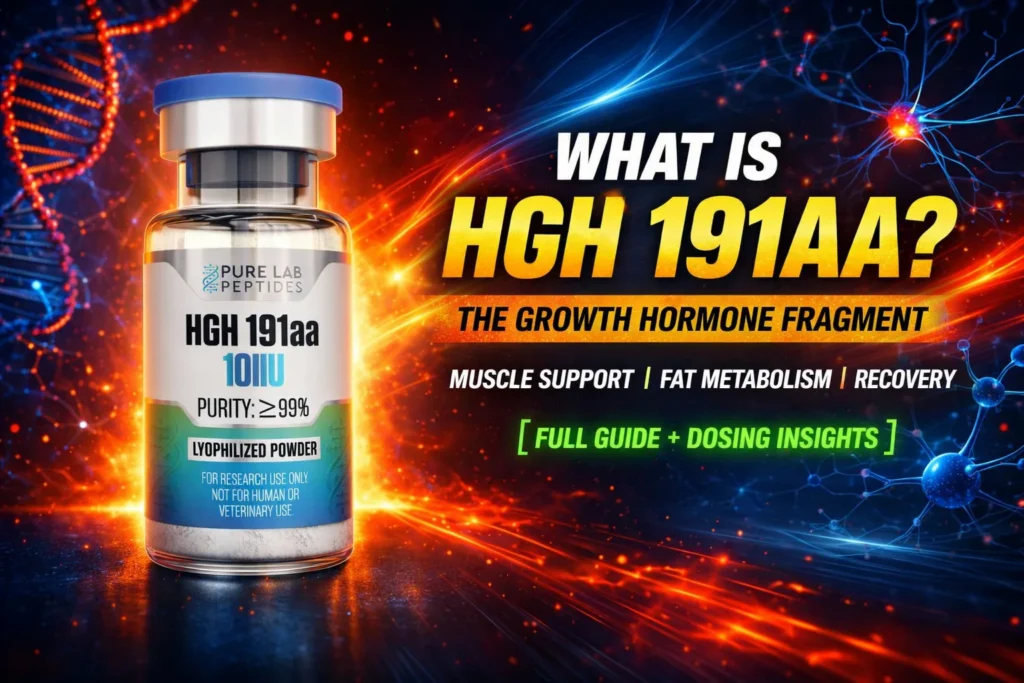
If you’re Googling “What is HGH 191AA”, you’re probably trying to decode a label, understand what “191AA” actually means, and figure out how this compares to other “peptides” in the growth-hormone category. This guide breaks down the definition, how HGH 191AA works in the body, what science supports (and doesn’t), key risks, legality, and the unit math that confuses almost everyone.
Fast Answer / Executive Summary
HGH 191AA is recombinant human growth hormone (somatropin) that contains the same 191‑amino‑acid sequence as the dominant natural human pituitary growth hormone. It works by binding the growth hormone receptor (GHR), activating intracellular signaling (notably JAK2/STAT pathways) and increasing IGF‑1 signaling that influences growth and metabolism. It is a prescription therapy for specific medical conditions, and misuse carries meaningful health and legal risks. [1]
Core Concepts & Key Entities
HGH 191AA in plain English
HGH 191AA is “full‑length” human growth hormone—somatropin—made using recombinant DNA technology. In other words: it’s the lab‑produced version of the hormone your pituitary gland naturally secretes, matching the primary sequence used in modern clinical products. [2]
Human growth hormone (HGH)—also called somatotropin—is a 191‑amino‑acid single‑chain polypeptide made by somatotroph cells in the anterior pituitary. It drives growth in childhood and supports metabolic regulation throughout life. [3]
What “191AA” means and why sellers emphasize it
“191AA” literally means 191 amino acids. Vendors highlight it because older or different recombinant forms of growth hormone existed, and because the peptide community often uses amino‑acid length as shorthand for “which molecule is this really?” [4]
A key practical point: 191AA describes identity—not quality. A vial labeled “HGH 191AA” is claiming it is full‑length somatropin, but that label alone does not guarantee correct content, potency, sterility, or safe handling. This is especially relevant outside regulated pharmacy channels. [5]
HGH 191AA vs 192AA: the most common misconception
If you’ve heard “191AA vs 192AA,” you’re usually hearing about somatropin (191 AA) versus somatrem (192 AA).
- Somatrem (192 AA) was an early recombinant hGH that included an extra methionine at the N‑terminus (often described as “Met‑hGH”), originally needed for some bacterial expression methods.
- Modern clinical rhGH products are designed to match the native 191‑amino‑acid sequence (somatropin). [6]
This matters for search intent because a lot of “HGH 191AA” content online is really trying to communicate: “this is the bioidentical sequence used in current medical somatropin products.” [7]
How HGH 191AA is made in legitimate medicine
In FDA‑approved products, somatropin is produced via recombinant DNA technology. The expression system can differ by product: – Some products are produced using E. coli (a common recombinant system). [8]
– Others have been produced using mammalian cell lines (e.g., certain formulations of Saizen). [9]
The active hormone sequence can still be identical, but manufacturing methods influence formulation details (excipients, stabilizers, device formats) and how quality is controlled. [10]
Mechanism: what HGH 191AA actually “does” biologically
HGH 191AA acts by binding the growth hormone receptor (GHR). That receptor triggers intracellular signaling—classically the JAK2/STAT pathway—and also interfaces with other signaling networks. These signals drive direct metabolic effects and stimulate transcriptional programs that include IGF‑1 regulation. [11]
A practical way to think about it: – GH is the “signal.” – GHR is the “antenna.” – JAK2/STAT is the “wiring.” – IGF‑1 is a major downstream “amplifier” of many growth‑related effects. [12]
From a clinical pharmacology perspective, somatropin’s actions include effects on: – Tissue growth (including skeletal growth in children with open growth plates), – Protein metabolism (nitrogen retention and increased protein synthesis), – Carbohydrate metabolism (higher doses can impair glucose tolerance), – Lipid metabolism (lipid mobilization and reduced fat stores in GHD contexts), – Mineral metabolism (electrolyte and phosphate changes). [13]
What’s medically “proven” vs what’s often marketed
Proven medical use is not the same thing as “popular online use.” In medicine, somatropin is prescribed for defined indications (e.g., certain pediatric growth disorders and adult growth hormone deficiency). [14]
In adults with true growth hormone deficiency (GHD), expert guidelines conclude GH therapy can offer meaningful benefits in body composition and exercise capacity, and can improve quality of life for many patients—while also noting insulin resistance can increase and long‑term outcomes like mortality benefit have not been proven. [15]
By contrast, in healthy older adults, randomized trials summarized in a major meta‑analysis showed small body‑composition changes (fat mass down, lean mass up) but higher rates of adverse events (e.g., edema, joint pain, carpal tunnel syndrome), and the authors concluded GH cannot be recommended as anti‑aging therapy. [16]
Legality and why it matters for “where to buy”
In the U.S., there’s a specific federal provision on growth hormone distribution. 21 U.S.C. § 333(e) makes it a criminal offense to knowingly distribute (or possess with intent to distribute) human growth hormone for human uses other than treatment of disease or another recognized medical condition, authorized by the Secretary under the FDCA and “pursuant to the order of a physician.” [17]
This is why high‑quality educational content needs to say plainly: HGH 191AA (somatropin) is not a casual “wellness peptide.” Legal medical access is prescription‑based, and the legal/quality risks rise sharply outside that pathway. [18]
Sports testing note: HGH and related peptides are prohibited in sport
If you compete in tested sport, the World Anti‑Doping Agency lists growth hormone, its analogues, fragments, and many growth hormone releasing factors/secretagogues as prohibited. That includes GH itself and also common GH‑axis peptides marketed online (e.g., sermorelin, tesamorelin, CJC‑1295, ipamorelin, ibutamoren/MK‑677). [19]
Step‑by‑Step / How‑To
First: Confirm you’re talking about full‑length somatropin
HGH 191AA means full‑length somatropin, not a fragment. If your goal is to understand “the real HGH,” 191AA is the sequence label you’ll see tied to clinical somatropin products. [4]
If your goal is to compare “HGH‑adjacent” options, separate these categories early: – Full hormone: somatropin (HGH 191AA) [13]
– Fragments: e.g., hGH 176–191 / AOD‑9604‑related discussions (also flagged by WADA) [19]
– Secretagogues (stimulators): GHRH analogues and ghrelin/GHS compounds [19]
This one sorting step prevents 80% of beginner confusion.
Next: Convert units without tripping over “units”
The most important conversion: clinical GH potency is commonly referenced as 3 IU per 1 mg. This conversion appears in regulatory/clinical contexts and is echoed in endocrine guideline discussion of biopotency. [20]
So a common shorthand you’ll see on vials: – 10 IU ≈ 3.33 mg (because 10 ÷ 3 = 3.33). [21]
Now the key warning: Insulin‑syringe “units” are volume marks, not International Units of HGH. For U‑100 insulin in the U.S., “100 units = 1 mL” (so 1 “unit” on the syringe corresponds to 0.01 mL). [22]
That’s why protocols often choose a dilution that makes the “math easy,” but the vocabulary stays confusing: – IU (International Unit) = potency (for the hormone). – Syringe unit = a volume tick mark.
If you remember only one sentence: “IU is potency; syringe units are mL.” [23]
Then: Anchor your expectations to actual evidence
In true adult GHD, GH replacement has guideline‑supported benefits, but it still requires titration and monitoring. Expert guidance emphasizes individualized dosing, IGF‑1–guided titration, and ongoing evaluation for adverse effects. [24]
In healthy people, the “results” most often advertised online (fat loss, muscle gain, anti‑aging) do not consistently translate into improved performance or outcomes, and adverse events are more frequent. Meta‑analyses in healthy older adults and healthy young adults show body‑composition shifts can occur, with limited evidence for strength or aerobic performance improvement. [25]
Next: Know the most common side effects people overlook
Fluid retention and nerve compression symptoms are not rare in adults on somatropin. Commonly listed adult adverse reactions across prescribing information include edema, arthralgias/joint pain, paresthesia, and carpal tunnel syndrome, along with glucose‑related effects. [26]
More serious risks and contraindications appear in labeling and include: – Active malignancy (contraindication) [27]
– Acute critical illness (increased mortality seen with pharmacologic dosing in ICU settings; contraindication framing in labeling) [28]
– Intracranial hypertension (usually reversible with discontinuation or dose reduction) [29]
For SERP intent: readers usually want a clean takeaway, so here it is: The “headline risks” beginners should recognize are fluid retention symptoms, glucose intolerance, and the hard‑stop contraindications (active malignancy and acute critical illness). [30]
Finally: Separate “lab research” sourcing from “medical use”
If your intent is legitimate medical therapy, the safe and legal path is clinician diagnosis + prescription + regulated pharmacy dispensing. Somatropin is a prescription drug used for defined indications. [31]
If your intent is laboratory research, vendors may market “research use only” HGH 191AA and include disclaimers that it is not for human consumption. For example, Pure Lab Peptides’ product page states its peptides are intended for research/laboratory use only and “not intended for human or animal consumption,” and it explicitly warns that bodily introduction is prohibited. [32]
The information‑gain point most pages miss: A “COA posted online” is not the same as pharmacy‑grade regulatory oversight, and it does not automatically address sterility, cold‑chain integrity, or chain‑of‑custody expectations used in regulated medicine. FDA‑approved somatropin labeling, by contrast, is governed by rigorous manufacturing and post‑marketing safety frameworks. [10]
Comparison / Alternatives
HGH 191AA is direct hormone replacement; many “alternatives” are either stimulators of your own GH release or non‑drug levers that support the body’s natural GH rhythm. That category difference matters more than marketing claims. [33]
HGH 191AA vs common GH‑axis alternatives
| Option | What it is | Evidence quality (typical use cases) | Regulatory reality (U.S.) | Big practical “gotcha” |
| HGH 191AA (somatropin) | Recombinant human growth hormone, 191 AA | Strongest evidence in diagnosed deficiency states and specific labeled conditions; mixed/limited in healthy “anti-aging” use | Prescription therapy for defined indications; distribution limits apply | Side effects are dose‑related; requires monitoring (IGF‑1, glucose, adverse effects) |
| GH secretagogues (e.g., tesamorelin, sermorelin, CJC‑1295, ipamorelin, MK‑677) | Compounds that stimulate GH release (or mimic signals that do) | Varies widely; tesamorelin has clinical trial evidence for HIV‑associated lipodystrophy; others often lack approval and robust outcomes data | Tesamorelin is FDA‑approved for a specific HIV‑related indication; sermorelin’s FDA product was withdrawn/discontinued; MK‑677 is not FDA‑approved and has regulatory warnings | “More GH” is not automatically “better outcomes,” and safety profiles can be uncertain |
| Lifestyle levers (sleep + training + nutrition) | Behavioral inputs that modulate endogenous GH pulses | Reliable for general health; resistance exercise acutely stimulates GH; sleep is associated with major GH pulse timing | No prescription | Acute GH spikes do not equal long‑term outcomes; consistency matters |
Support for key rows: – Somatropin’s identity and clinical use framework: FDA labeling and endocrine guideline discussion. [34]
– Tesamorelin’s approved use and clinical trial context: EGRIFTA labeling and supporting literature. [35]
– Sermorelin discontinuation/withdrawal context: U.S. Federal Register determination and anti‑doping education. [36]
– MK‑677 status and regulatory concern: OPSS and FDA advisory discussion. [37]
– Sleep + GH pulse timing: classic physiology literature and reviews of GH secretion during sleep. [38]
– Resistance exercise stimulates GH acutely: systematic/review evidence. [39]
Bottom line comparison point: If you need medically indicated GH replacement, HGH 191AA (somatropin) is the direct, regulated pathway—while most “peptide alternatives” are either different mechanisms or different regulatory realities altogether. [40]
Templates / Checklist / Example
The 191AA “Reality Check” framework
Use this quick framework to evaluate anything you read about HGH 191AA:
Identity → Units → Oversight → Outcomes
- Identity: Is the claim actually about somatropin (full 191AA), or about fragments/secretagogues? [41]
- Units: Are they mixing IU, mg, mcg, and syringe units correctly (3 IU/mg; U‑100 is 100 “units” per mL)? [23]
- Oversight: Is the context FDA‑labeled clinical treatment—or “research use only” marketing with disclaimers? [42]
- Outcomes: Are the promised outcomes supported by trials, or is it extrapolation from deficiency treatment to healthy users? [43]
Example: decoding a “10 IU vial” claim without guessing
A common online label is “HGH 191AA 10 IU.” Assuming standard clinical biopotency, 10 IU corresponds to ~3.33 mg of somatropin (because 3 IU ≈ 1 mg). [44]
If someone also says “mix with 1 mL and then 10 syringe units = 1 IU,” they’re describing a convenience dilution where: – U‑100 syringe “units” are 0.01 mL each, so 10 syringe units is 0.10 mL. [22]
– The IU amount depends on concentration, so you can’t accept that shortcut unless you confirm the actual IU per mL. (This is where beginners most often mis-dose or misunderstand protocols.)
Copy‑ready checklist for readers
Use this checklist before acting on any HGH 191AA information online.
- Define HGH 191AA as full‑length somatropin (191 amino acids), not a fragment. [4]
- Verify the unit system: IU ≠ syringe units; U‑100 is 100 units per 1 mL. [23]
- Check legality: U.S. law restricts distribution for non‑recognized human uses outside authorized, physician‑ordered treatment. [17]
- Expect common adult adverse reactions like edema, joint pain, and carpal tunnel symptoms. [45]
- Screen for hard contraindications (e.g., active malignancy; acute critical illness risk context). [46]
- Prioritize medical supervision if used clinically; endocrine guidance emphasizes IGF‑1 and side‑effect monitoring during titration. [15]
- Separate “research use only” vendor claims from pharmacy‑grade oversight, especially when vendor pages forbid human use. [47]
- Confirm sports status: GH and many related peptides/secretagogues are prohibited under WADA. [19]
FAQs
What is HGH 191AA?
HGH 191AA is recombinant human growth hormone (somatropin) with the same 191‑amino‑acid sequence as the dominant natural human growth hormone produced by the pituitary. It binds the growth hormone receptor and drives GH/IGF‑1 axis signaling that influences growth and metabolism. [48]
Is HGH 191AA the same as somatropin?
HGH 191AA is the same molecule as somatropin when the label is accurate. “191AA” describes the amino‑acid length of the somatropin sequence used in modern clinical recombinant GH products. It’s commonly emphasized to distinguish it from older 192‑amino‑acid “somatrem” forms that included an extra methionine. [4]
Is HGH 191AA legal in the United States?
HGH 191AA (somatropin) is legal in the U.S. when used and distributed under the rules for authorized medical treatment. Federal law (21 U.S.C. § 333(e)) restricts distribution for human uses other than treatment of disease or recognized medical conditions authorized under the FDCA and pursuant to a physician’s order. [17]
Does HGH 191AA help with fat loss or “anti‑aging” in healthy people?
HGH 191AA can change body composition in studies, but anti‑aging claims are not supported strongly enough to recommend use in healthy people. A major meta‑analysis in healthy older adults found lean mass increased and fat mass decreased, but adverse events increased, and the authors concluded GH should not be recommended as anti‑aging therapy. [16]
What’s the difference between HGH 191AA and HGH fragment 176–191?
HGH 191AA is the full hormone; HGH fragment 176–191 is a short fragment derived from the full sequence. They are not interchangeable. Full‑length GH acts through the GH receptor with broad endocrine effects, while fragments are discussed as narrower tools and are separately referenced in anti‑doping rules. WADA explicitly lists growth hormone fragments (including hGH 176–191) as prohibited. [49]
How do IU and mg relate for HGH 191AA?
For somatropin, a common clinical reference is 3 IU per 1 mg, meaning 10 IU is about 3.33 mg. This is why many vials and protocols show “10 IU / 3.33 mg.” Separately, “units” on an insulin syringe are volume marks (U‑100 is 100 units per 1 mL) and are not International Units. [50]
Next Steps
The safest next step is to treat HGH 191AA as a regulated hormone, not a casual supplement, and to base any decisions on medical guidance and reputable evidence. [51]
If you want a practical, measurement‑focused reference for vial math and reconstitution-style unit reading, use PeptideDosages.com’s internal guide here: HGH 191AA (10IU Vial) Dosage Protocol. [52]
If you’re browsing external listings for laboratory research, vendors may provide “research use only” HGH 191AA pages (with explicit non‑human‑use disclaimers), such as: Pure Lab Peptides – HGH 191aa 10IU. [32]
Educational note: This article is for education only and is not medical advice, diagnosis, or treatment. Always consult qualified healthcare professionals for medical decisions involving growth hormone therapy. [53]
[1] [2] [4] [8] [13] [34] [41] [48] https://www.accessdata.fda.gov/drugsatfda_docs/label/2006/021426lbl.pdf
https://www.accessdata.fda.gov/drugsatfda_docs/label/2006/021426lbl.pdf
[3] https://www.ncbi.nlm.nih.gov/books/NBK482141/
https://www.ncbi.nlm.nih.gov/books/NBK482141/
[5] [17] [18] [51] https://www.law.cornell.edu/uscode/text/21/333
https://www.law.cornell.edu/uscode/text/21/333
[6] [7] https://pmc.ncbi.nlm.nih.gov/articles/PMC3262362/
https://pmc.ncbi.nlm.nih.gov/articles/PMC3262362/
[9] https://www.accessdata.fda.gov/drugsatfda_docs/label/2007/019764s034lbl.pdf
https://www.accessdata.fda.gov/drugsatfda_docs/label/2007/019764s034lbl.pdf
[10] [14] [27] [30] [31] [42] [46] https://pi.lilly.com/us/humatrope-pi.pdf
https://pi.lilly.com/us/humatrope-pi.pdf
[11] https://pmc.ncbi.nlm.nih.gov/articles/PMC5816795/
https://pmc.ncbi.nlm.nih.gov/articles/PMC5816795/
[12] https://www.frontiersin.org/journals/endocrinology/articles/10.3389/fendo.2018.00035/full
https://www.frontiersin.org/journals/endocrinology/articles/10.3389/fendo.2018.00035/full
[15] [20] [23] [24] [33] [40] [44] [50] [53] https://academic.oup.com/jcem/article/96/6/1587/2833853
https://academic.oup.com/jcem/article/96/6/1587/2833853
[16] [25] [43] https://pubmed.ncbi.nlm.nih.gov/17227934/
https://pubmed.ncbi.nlm.nih.gov/17227934/
[19] [49] https://www.wada-ama.org/en/prohibited-list
https://www.wada-ama.org/en/prohibited-list
[21] [52] https://peptidedosages.com/single-peptide-dosages/hgh-191aa-10-iu-vial-dosage-protocol/
https://peptidedosages.com/single-peptide-dosages/hgh-191aa-10-iu-vial-dosage-protocol/
[22] https://www.ncbi.nlm.nih.gov/books/NBK278938/
https://www.ncbi.nlm.nih.gov/books/NBK278938/
[26] [45] https://www.accessdata.fda.gov/drugsatfda_docs/label/2025/020522s068lbl.pdf
https://www.accessdata.fda.gov/drugsatfda_docs/label/2025/020522s068lbl.pdf
[28] Norditropin (somatropin) injection – accessdata.fda.gov
https://www.accessdata.fda.gov/drugsatfda_docs/label/2017/021148s049lbl.pdf?utm_source=chatgpt.com
[29] https://www.emdserono.com/us-en/pi/serostim-pi.pdf
https://www.emdserono.com/us-en/pi/serostim-pi.pdf
[32] [47] https://purelabpeptides.com/buy-peptides/buy-hgh-191aa-10iu/
https://purelabpeptides.com/buy-peptides/buy-hgh-191aa-10iu/
[35] https://www.accessdata.fda.gov/drugsatfda_docs/label/2019/022505Orig1s010lbl.pdf
https://www.accessdata.fda.gov/drugsatfda_docs/label/2019/022505Orig1s010lbl.pdf
[36] https://www.federalregister.gov/documents/2013/03/04/2013-04827/determination-that-geref-sermorelin-acetate-injection-05-milligrams-basevial-and-10-milligrams?_gl=1%2A1c04zdb%2A_gcl_au%2AMjc4MzM3NzExLjE3MjU1NTc4NjA.%2AFPAU%2AMTQyNjY2NDIyNy4xNzIzMDMzNDUz%2A_ga%2AMjAzNjI0MTcyNi4xNzI1NTU3OTUw%2A_ga_TV0W85C79B%2AMTcyNjYwOTE1NC44LjEuMTcyNjYxMzQzMi4wLjAuMjYwMDQyOTM0%2A_fplc%2AVkQyTjlnaWcyMkZpbExkaG12ZklJcnVkZ3Jwa0UyZjlRMUczV3RMUkRBcEElMkJSRjF3dkRwd1lUaWVTbSUyRkdkbFF1Y2Z0YjB5YXNlUFJhdjJnbWElMkJ0d0pnWUVJeXVEVGY4QUE1OVVsQmVZTyUyRlJzcSUyQk4lMkJKcnBsZVZxMFUwbHdRJTNEJTNE&srsltid=AfmBOopiWj1Sxl8Ot49sRKMijpg656V6wGgjr_4OyZnqRhPkT2DXva_F
[37] https://www.opss.org/article/performance-enhancing-substance-mk-677-ibutamoren
https://www.opss.org/article/performance-enhancing-substance-mk-677-ibutamoren
[38] https://pubmed.ncbi.nlm.nih.gov/8627466/
https://pubmed.ncbi.nlm.nih.gov/8627466/
[39] https://pmc.ncbi.nlm.nih.gov/articles/PMC3915940/