
GHRP-2 (10 mg Vial) Dosage Protocol

Quickstart Highlights
GHRP-2 (pralmorelin) is a synthetic hexapeptide that potently stimulates growth hormone release by activating ghrelin receptors in the pituitary and hypothalamus[1][2]. It has been used in clinical research as a diagnostic GH stimulant and in investigative treatment protocols for growth hormone deficiency[3]. This educational protocol presents a once‑daily subcutaneous approach using a practical dilution for clear insulin‑syringe measurements.
- Reconstitute: Add 3.0 mL bacteriostatic water → ~3.33 mg/mL concentration.
- Typical daily range: 100–300 mcg once daily (gradual titration).
- Easy measuring: At 3.33 mg/mL, 1 unit ≈ 33.3 mcg on a U‑100 insulin syringe.
- Storage: Lyophilized: freeze at −20 °C (−4 °F); after reconstitution, refrigerate at 2–8 °C (35.6–46.4 °F); avoid freeze–thaw cycles.
Dosing & Reconstitution Guide
Educational guide for reconstitution and daily dosing
Standard / Gradual Approach (3 mL = ~3.33 mg/mL)
| Week | Daily Dose (mcg) | Units (per injection) (mL) |
|---|---|---|
| Weeks 1–2 | 100 mcg (0.1 mg) | 3 units (0.03 mL) |
| Weeks 3–4 | 150 mcg (0.15 mg) | 4.5 units (0.045 mL) |
| Weeks 5–8 | 200 mcg (0.2 mg) | 6 units (0.06 mL) |
| Weeks 9–12 (optional) | 250–300 mcg (0.25–0.3 mg) | 7.5–9 units (0.075–0.09 mL) |
Frequency: Inject once daily subcutaneously, typically before sleep to coincide with natural GH pulsatility[4]. For ≤10‑unit (≤0.10 mL) administrations, consider 30‑ or 50‑unit insulin syringes for improved readability.
Reconstitution Steps
- Draw 3.0 mL bacteriostatic water with a sterile syringe.
- Inject slowly down the vial wall; avoid foaming.
- Gently swirl/roll until dissolved (do not shake).
- Label and refrigerate at 2–8 °C (35.6–46.4 °F), protected from light.
Advanced / Aggressive Approach (Multiple Daily Dosing)
Research protocols have explored 2–3 injections per day to amplify cumulative GH exposure[5][6]. This approach is reserved for experienced research settings due to potential for accelerated tachyphylaxis and increased side‑effect risk[4].
| Phase | Per‑Injection Dose (mcg) | Frequency | Units (per injection) (mL) |
|---|---|---|---|
| Phase 1 (Weeks 1–2) | 100 mcg (0.1 mg) | 2× daily | 3 units (0.03 mL) |
| Phase 2 (Weeks 3–4) | 150 mcg (0.15 mg) | 2× daily | 4.5 units (0.045 mL) |
| Phase 3 (Weeks 5–8) | 200 mcg (0.2 mg) | 2–3× daily | 6 units (0.06 mL) |
Note: Total daily doses in the 600–900 mcg range (split across injections) have been studied but may accelerate GH response attenuation[4]. A 5‑days‑on/2‑days‑off cycling pattern may help maintain receptor sensitivity[7].
Supplies Needed
Plan based on an 8–16 week daily protocol with gradual titration (once‑daily schedule).
-
Peptide Vials (GHRP-2, 10 mg each):
- 8 weeks ≈ 1 vial (~9.1 mg used)
- 12 weeks ≈ 2 vials (~15.4 mg used)
- 16 weeks ≈ 3 vials (~22.4 mg used)
-
Insulin Syringes (U‑100, 30‑ or 50‑unit recommended for precision):
- Per week: 7 syringes (1/day)
- 8 weeks: 56 syringes
- 12 weeks: 84 syringes
- 16 weeks: 112 syringes
-
Bacteriostatic Water (10 mL bottles): Use 3.0 mL per vial for reconstitution.
- 8 weeks (1 vial): 3 mL → 1 × 10 mL bottle
- 12 weeks (2 vials): 6 mL → 1 × 10 mL bottle
- 16 weeks (3 vials): 9 mL → 1 × 10 mL bottle
-
Alcohol Swabs: One for the vial stopper + one for the injection site each day.
- Per week: 14 swabs (2/day)
- 8 weeks: 112 swabs → recommend 2 × 100‑count boxes
- 12 weeks: 168 swabs → recommend 2 × 100‑count boxes
- 16 weeks: 224 swabs → recommend 3 × 100‑count boxes
- Sharps Container: 1‑quart container holds ~100 syringes; 2‑quart for 16‑week protocols.


Protocol Overview
Concise summary of the once‑daily regimen.
- Goal: Stimulate pulsatile growth hormone release and elevate IGF‑1 levels over time[5].
- Schedule: Daily subcutaneous injections for 8–12 weeks (extend to 16 weeks if desired).
- Dose Range: 100–300 mcg daily with gradual titration.
- Reconstitution: 3.0 mL per 10 mg vial (~3.33 mg/mL) for accurate unit measurements.
- Storage: Lyophilized frozen; reconstituted refrigerated; use within ~4 weeks after reconstitution[8].
Dosing Protocol
Suggested daily titration approach.
- Start: 100 mcg daily; increase by ~50 mcg every 1–2 weeks as tolerated[3].
- Target: 200 mcg daily by Weeks 5–8; optional increase to 250–300 mcg in Weeks 9–12.
- Frequency: Once per day (subcutaneous); advanced protocols may use 2–3× daily.
- Cycle Length: 8–12 weeks; optional extension to 16 weeks with periodic breaks.
- Timing: Typically before sleep or on empty stomach; rotate injection sites.
Storage Instructions
Proper storage preserves peptide quality[8].
- Lyophilized: Store at −20 °C (−4 °F) in dry, dark conditions; stable for 1+ years frozen.
- Reconstituted: Refrigerate at 2–8 °C (35.6–46.4 °F); use within ~4 weeks; avoid freeze–thaw.
- Allow vials to reach room temperature before opening to reduce condensation uptake.
- Use bacteriostatic water (0.9% benzyl alcohol) for multi‑dose reconstitution[9].
Important Notes
Practical considerations for consistency and safety.
- Use new sterile insulin syringes for each injection; dispose in a sharps container[10].
- Rotate injection sites (abdomen, thighs, upper arms) to reduce local irritation[11].
- Inject slowly; wait a few seconds before withdrawing the needle.
- A 5‑days‑on/2‑days‑off schedule may help maintain GH response sensitivity over long protocols[7].
- Document daily dose and site rotation to maintain consistency.
How This Works
GHRP-2 is a growth hormone‑releasing peptide that acts as a ghrelin receptor agonist (GHS‑R1a)[1]. By binding to receptors in both the pituitary and hypothalamus, it triggers robust, pulsatile GH release that mimics natural secretion patterns[2]. Clinical studies have demonstrated that even a single 100 mcg subcutaneous dose can raise GH levels several‑fold above baseline[4]. When administered consistently, GHRP-2 can elevate IGF‑1 levels over weeks to months[5]. However, the GH response may attenuate with continuous daily use (tachyphylaxis), which is why titration strategies and periodic breaks are often incorporated[4][7].
Potential Benefits & Side Effects
Observations from preclinical and clinical literature.
Potential Benefits
- Potent stimulation of endogenous GH release without suppressing natural production[1].
- Elevation of IGF‑1 levels with sustained administration (~50% increase reported in some studies)[5].
- Used clinically as a diagnostic tool for GH deficiency evaluation[3].
- May support recovery, body composition, and sleep quality (anecdotally reported).
Potential Side Effects
- Increased appetite (ghrelin‑mimetic action) — especially pronounced shortly after injection[1].
- Transient flushing, warmth, or tingling at injection site.
- Possible mild increases in cortisol and prolactin at higher doses[6].
- Water retention or joint stiffness with prolonged high‑dose use.
- Response attenuation (tachyphylaxis) with continuous daily dosing[4].
Lifestyle Factors
Complementary strategies for best outcomes.
- Administer on an empty stomach or before sleep to optimize GH pulse amplitude.
- Pair with a balanced, protein‑forward diet tailored to energy needs and recovery goals.
- Combine resistance training and aerobic activity to support GH/IGF‑1 axis benefits.
- Prioritize 7–9 hours of quality sleep to synergize with natural nocturnal GH secretion.
- Manage stress levels, as elevated cortisol can blunt GH response.
Injection Technique
General subcutaneous guidance from clinical best‑practice resources[10][11].
- Clean the vial stopper and skin with alcohol; allow to dry.
- Pinch a skinfold; insert the needle at 45–90° into subcutaneous tissue[11].
- For very lean individuals, use a 45° angle to avoid intramuscular injection[10].
- Inject slowly and steadily; do not aspirate for subcutaneous injections.
- Rotate sites systematically (abdomen at least 2 inches from navel, thighs, upper arms) to avoid lipohypertrophy[11].
- Dispose of used syringes immediately in a sharps container; never recap needles.
Recommended Source
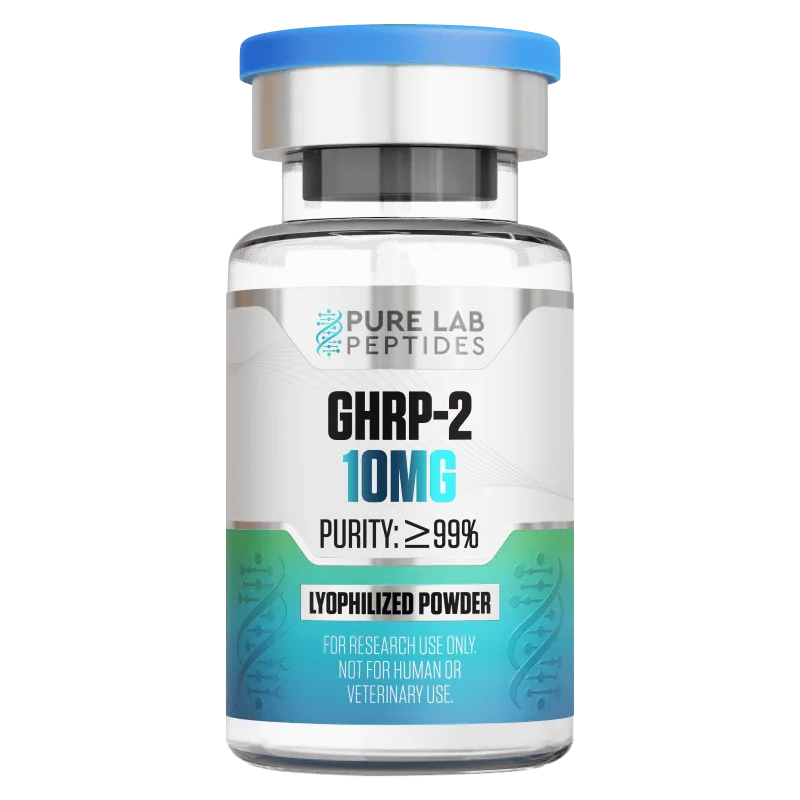
We recommend Pure Lab Peptides for high‑purity GHRP-2 (10 mg).
Why Pure Lab Peptides?
- High‑purity, third‑party‑tested lots with batch COAs.
- Consistent, ISO‑aligned handling and documentation.
- Reliable fulfillment to maintain cold‑chain integrity.
Product ID: 11587
Important Note
This content is intended for therapeutic educational purposes only and does not constitute medical advice, diagnosis, or treatment.
References
-
Pralmorelin (GHRP-2) — Wikipedia
— Overview of GHRP-2 mechanism, ghrelin receptor agonism, and physiological effects -
PubMed — Growth hormone response to GHRP-2 (PMC3297037)
— Pituitary and hypothalamic mechanisms of GH release stimulation -
Pihoker C. et al. (1995) — J Clin Endocrinol Metab
— Diagnostic studies with IV and intranasal GHRP-2 in children of short stature -
Nijland EA. et al. (1998) — Eur J Endocrinol
— Five‑day SC GHRP-2 treatment causes response attenuation in young men -
Sigalos JT. et al. (2017) — Am J Mens Health (PMC5675260)
— GH secretagogue therapy raises IGF-1 levels (~50% increase over 3 months) -
Peptides to Increase Growth Hormone — AgeMed Review
— Overview of GHRP protocols, cortisol/prolactin considerations -
Kim KS et al. (2003) — Asian-Australas J Anim Sci
— Twice‑daily GHRP-2 effects on IGF-1 and tachyphylaxis patterns -
Sigma-Aldrich — Handling and Storage Guidelines for Peptides
— Lyophilized storage at −20 °C; reconstituted use within 4 weeks -
Mountainside Medical — Bacteriostatic Water vs Sterile Water
— Multi‑dose vial guidelines; 28‑day use recommendation -
Usach I. et al. (2019) — Adv Ther (PMC6822791)
— Subcutaneous injection of drugs: factors influencing pain and technique -
MedlinePlus — Subcutaneous (SQ) Injections
— Site selection, angle guidance, and rotation best practices -
OncoLink — How To Give a Subcutaneous Injection
— Step‑by‑step technique, pinch method, and disposal guidance -
NCBI Bookshelf — Best Practices for Injections
— Asepsis, preparation, and administration standards -
GenScript — Peptide Storage and Handling Guidelines
— Long‑term storage recommendations; moisture and temperature control -
Pure Lab Peptides — GHRP-2 (10 mg) Product Page
— Product specifications, quality documentation, and batch COAs