KLOW Dosage Chart
The KLOW peptide blend is dosed at 250 mcg–750 mcg daily via subcutaneous injection in educational protocols. A 80 mg blend reconstituted with bacteriostatic water yields about 26.7 mg/mL. This information is for research and educational use only.
- Reconstitute: Add 3.0 mL bacteriostatic water → ~26.7 mg/mL total concentration.
- Component concentrations: TB-500, BPC-157, KPV each at ~3.33 mg/mL; GHK-Cu at ~16.7 mg/mL.
- Easy measuring: At 26.7 mg/mL total, 1 unit = 0.01 mL ≈ 267 mcg total peptide on a U-100 insulin syringe.
- Storage: Lyophilized: freeze at −20 °C (−4 °F); after reconstitution, refrigerate at 2–8 °C (35.6–46.4 °F); avoid freeze–thaw cycles.
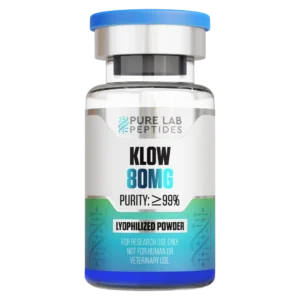
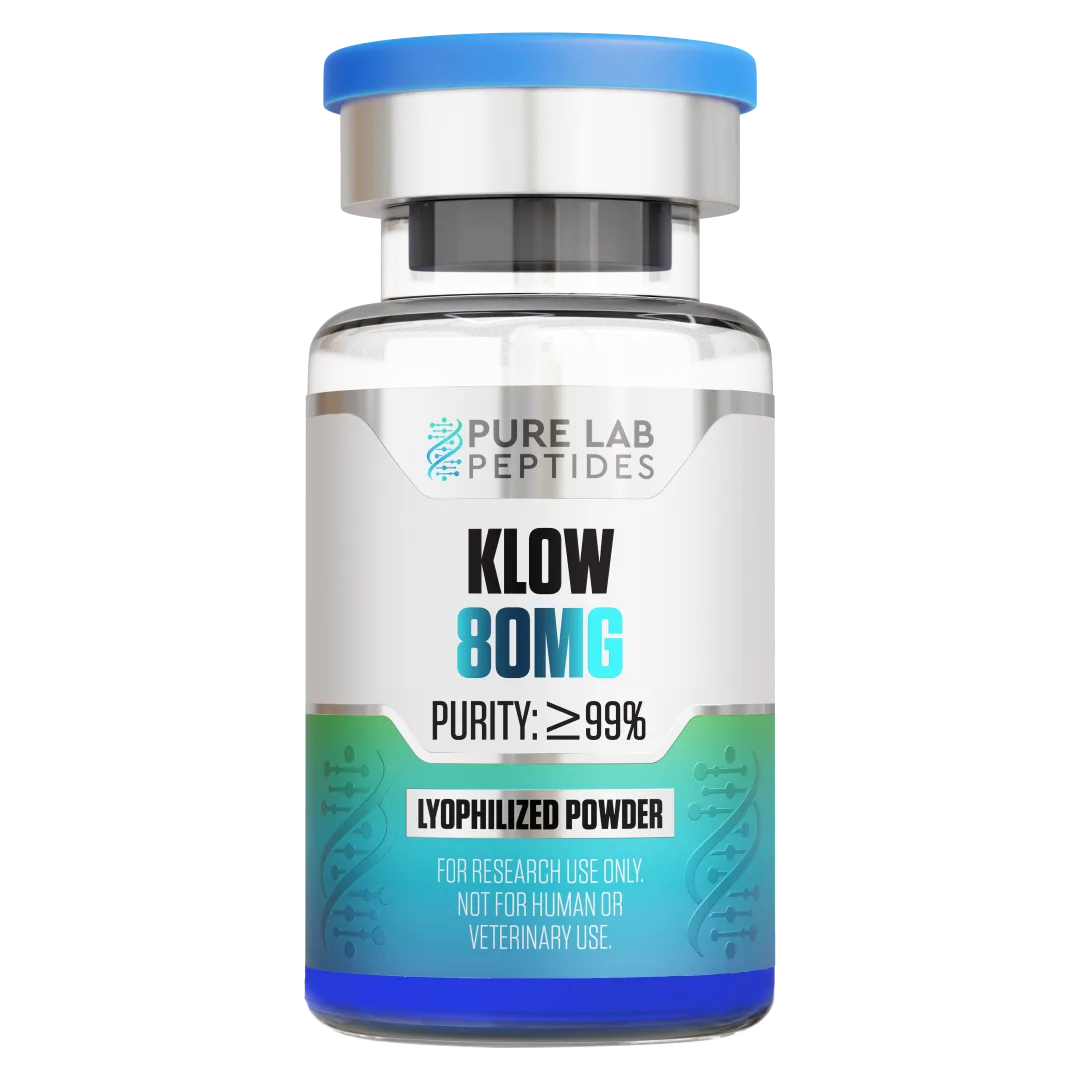
KLOW is a multi-peptide blend combining TB-500 (10 mg), BPC-157 (10 mg), KPV (10 mg), and GHK-Cu (50 mg) for a total of 80 mg per vial. TB-500 (synthetic thymosin beta-4) promotes wound healing, angiogenesis, and tissue repair[1][2]. BPC-157 exhibits regenerative properties with preclinical evidence supporting tendon, ligament, and muscle healing[3][4]. KPV is an anti-inflammatory tripeptide that modulates NF-κB signaling[5][6]. GHK-Cu supports collagen synthesis, wound healing, and tissue regeneration[7][8]. This educational protocol presents a once-daily subcutaneous approach using a practical dilution for clear insulin-syringe measurements.
Research context: For evidence on mechanisms, human and preclinical research, limitations, and safety, read KLOW Peptide: Benefits, Uses, Side Effects, Dosage, and Research.
Dosing & Reconstitution Guide
Educational guide for reconstitution and daily dosing
Standard / Gradual Approach (3 mL = ~26.7 mg/mL Total)
This multi-peptide blend provides synergistic regenerative, anti-inflammatory, and tissue-repair support. The following titration schedule allows gradual introduction of each component.
| Week | Daily Dose (per component) | Units (per injection) (mL) |
|---|---|---|
| Weeks 1–2 | TB-500: 250 mcg | BPC-157: 250 mcg | KPV: 250 mcg | GHK-Cu: 1.25 mg | 7.5 units (0.075 mL) |
| Weeks 3–4 | TB-500: 500 mcg | BPC-157: 500 mcg | KPV: 500 mcg | GHK-Cu: 2.5 mg | 15 units (0.15 mL) |
| Weeks 5–8 | TB-500: 750 mcg | BPC-157: 750 mcg | KPV: 750 mcg | GHK-Cu: 3.75 mg | 22.5 units (0.225 mL) |
| Weeks 9–12 (Maintenance) | TB-500: 500 mcg | BPC-157: 500 mcg | KPV: 500 mcg | GHK-Cu: 2.5 mg | 15 units (0.15 mL) |
Frequency: Inject once daily subcutaneously. This schedule uses a 3.0 mL dilution to maintain measurable volumes. For ≤10-unit (≤0.10 mL) administrations during initial weeks, consider 30- or 50-unit insulin syringes for improved readability.
Reconstitution Steps
- Draw 3.0 mL bacteriostatic water with a sterile syringe.
- Inject slowly down the vial wall; avoid foaming.
- Gently swirl/roll until dissolved (do not shake).
- Label and refrigerate at 2–8 °C (35.6–46.4 °F), protected from light.
Syringe Math Reference
With 3.0 mL reconstitution volume and 80 mg total peptide:
- Total concentration: 26.67 mg/mL (26,667 mcg/mL)
- TB-500: 3.33 mg/mL → 33.3 mcg per unit
- BPC-157: 3.33 mg/mL → 33.3 mcg per unit
- KPV: 3.33 mg/mL → 33.3 mcg per unit
- GHK-Cu: 16.67 mg/mL → 166.7 mcg per unit
- 1 unit (0.01 mL) = 33.3 mcg each of TB-500, BPC-157, KPV + 166.7 mcg GHK-Cu
Supplies Needed
Plan based on an 8–16 week daily protocol with gradual titration.
- Peptide Vials (KLOW, 80 mg each):
- 8 weeks ≈ 3 vials
- 12 weeks ≈ 4 vials
- 16 weeks ≈ 5 vials
- Insulin Syringes (U-100):
- Per week: 7 syringes (1/day)
- 8 weeks: 56 syringes
- 12 weeks: 84 syringes
- 16 weeks: 112 syringes
- Bacteriostatic Water (10 mL bottles): Use ~3.0 mL per vial for reconstitution.
- 8 weeks (3 vials): 9 mL → 1 × 10 mL bottle
- 12 weeks (4 vials): 12 mL → 2 × 10 mL bottles
- 16 weeks (5 vials): 15 mL → 2 × 10 mL bottles
- Alcohol Swabs: One for the vial stopper + one for the injection site each day.
- Per week: 14 swabs (2/day)
- 8 weeks: 112 swabs → recommend 2 × 100-count boxes
- 12 weeks: 168 swabs → recommend 2 × 100-count boxes
- 16 weeks: 224 swabs → recommend 3 × 100-count boxes


Protocol Overview
Concise summary of the once-daily regimen.
- Goal: Support tissue repair, reduce inflammation, and promote regeneration through synergistic peptide action[1][3][5][7].
- Schedule: Daily subcutaneous injections for 8–12 weeks (extend to 16 weeks if desired).
- Dose Range: Gradual titration from low to moderate doses based on individual response.
- Reconstitution: 3.0 mL per 80 mg vial (~26.7 mg/mL total) for accurate unit measurements.
- Storage: Lyophilized frozen; reconstituted refrigerated; avoid repeated freeze–thaw.
Dosing Protocol
Suggested daily titration approach.
- Start: 7.5 units daily (0.075 mL) for initial assessment period.
- Increase: Progress to 15 units by Week 3, then 22.5 units by Week 5 as tolerated.
- Maintenance: 15 units daily for extended protocols.
- Frequency: Once per day (subcutaneous).
- Cycle Length: 8–12 weeks; optional extension to 16 weeks.
- Timing: Any consistent time; rotate injection sites.
Storage Instructions
Proper storage preserves peptide quality.
- Lyophilized: Store at −20 °C (−4 °F) in dry, dark conditions; minimize moisture exposure[9].
- Reconstituted: Refrigerate at 2–8 °C (35.6–46.4 °F); use within 14–28 days and avoid freeze–thaw.
- Allow vials to reach room temperature before opening to reduce condensation uptake.
Important Notes
Practical considerations for consistency and safety.
- Use new sterile insulin syringes for each injection; dispose in a sharps container.
- Rotate injection sites (abdomen, thighs, upper arms) to reduce local irritation[10].
- Inject slowly; wait a few seconds before withdrawing the needle.
- Document daily dose and site rotation to maintain consistency.
- This multi-peptide blend may provide broader regenerative support than single-peptide protocols.
How This Works
KLOW combines four peptides with complementary mechanisms of action:
- TB-500 (Thymosin Beta-4): Promotes angiogenesis, cell migration, and tissue repair by regulating actin, a key protein in cell structure[1]. Preclinical studies demonstrate accelerated wound healing, reduced inflammation, and tissue regeneration[2].
- BPC-157: A gastric pentadecapeptide that supports tendon, ligament, and muscle healing through enhanced angiogenesis and growth factor modulation[3]. Animal studies show favorable tissue repair outcomes[4].
- KPV: A C-terminal tripeptide fragment of α-MSH with potent anti-inflammatory properties. It inhibits NF-κB signaling and reduces pro-inflammatory cytokines without melanotropic effects[5][6].
- GHK-Cu: A naturally occurring copper peptide that stimulates collagen and elastin synthesis, promotes wound healing, and modulates gene expression related to tissue remodeling[7][8].
Potential Benefits & Side Effects
Observations from preclinical and early-stage research.
Potential Benefits
- Accelerated tissue repair and wound healing through multiple complementary pathways[1][3].
- Reduced inflammation via NF-κB inhibition and cytokine modulation[5][7].
- Enhanced collagen synthesis and connective tissue support[8].
- Promotion of angiogenesis and improved blood flow to healing tissues[2].
- Potential support for musculoskeletal recovery and joint health[3].
Possible Side Effects
- Mild injection-site reactions (redness, irritation) may occur with subcutaneous administration.
- Occasional lightheadedness reported with some peptides due to vasodilatory effects.
- Limited human clinical data; most safety observations derive from preclinical studies[4].
Lifestyle Factors
Complementary strategies for best outcomes.
- Pair with a balanced, protein-forward diet tailored to support tissue repair and recovery.
- Combine resistance training and mobility work to reinforce musculoskeletal adaptations.
- Prioritize sleep and stress management to optimize the body’s natural regenerative processes.
- Stay well-hydrated to support peptide absorption and overall metabolic function.
Injection Technique
General subcutaneous guidance from clinical best-practice resources[10][11].
- Clean the vial stopper and skin with alcohol; allow to dry completely.
- Pinch a skinfold; insert the needle at 45–90° into subcutaneous tissue[10].
- Do not aspirate for subcutaneous injections; inject slowly and steadily[11].
- Rotate sites systematically (abdomen, thighs, upper arms) to avoid lipohypertrophy[12].
- Apply gentle pressure after withdrawal; do not massage the injection site.
Important Note
This content is for educational purposes only and is not medical advice.
References
-
PubMed
— Thymosin beta 4 accelerates wound healing (Philp et al., 1999) -
PubMed
— Thymosin β4 promotes dermal healing in preclinical models and clinical trials -
PMC
— Emerging use of BPC-157 in orthopaedic sports medicine: systematic review -
PMC
— Pharmacokinetics, distribution, metabolism, and excretion of BPC-157 in rats and dogs -
PMC
— PepT1-mediated tripeptide KPV uptake reduces intestinal inflammation -
PMC
— Orally targeted delivery of tripeptide KPV via HA-functionalized nanoparticles alleviates ulcerative colitis -
PMC
— Regenerative and protective actions of the GHK-Cu peptide in light of new gene data -
PMC
— GHK peptide as a natural modulator of multiple cellular pathways in skin regeneration -
Sigma-Aldrich
— Handling and storage guidelines for peptides and proteins -
CDC
— Vaccine administration: subcutaneous injection technique guidelines -
CDC
— Vaccine administration best practices (aspiration not recommended for SC injections) -
NCBI Bookshelf
— Chapter 18: Administration of parenteral medications (injection technique)
Additional Research and Background
These sources provide related context and are not presented as support for a specific statement above.
-
PubMed
— Thymosin β4: a multi-functional regenerative peptide (basic properties and clinical applications) -
PMC
— The potential of GHK as an anti-aging peptide
Related research, protocols, and guides
Explore the available research context, protocol variants or comparisons, and practical guides. When vial-size variants exist, they remain separate because vial strength, concentration, and syringe-unit calculations can differ. Related compounds and blends are comparisons only, not interchangeable.
Research overview
- KLOW Peptide: Benefits, Uses, Side Effects, Dosage, and Research
- BPC-157 Peptide: Benefits, Uses, Side Effects, Dosage, and Research
- TB-500 Peptide: Benefits, Uses, Side Effects, Dosage, and Research
- KPV Peptide: Benefits, Uses, Side Effects, Dosage, and Research
- GHK-Cu Peptide: Benefits, Uses, Side Effects, Dosage, and Research
Related protocols and comparisons