
On this page
- Quick reference
- Dosage chart and four steps
- Supplies needed
- Peptide Reconstitution Simulator
- Vial and research context
- Protocol Overview
- Dosing Protocol
- Storage Instructions
- Important Notes
- How This Works
- Potential Benefits & Side Effects
- Lifestyle Factors
- Injection Technique
- Important Note
- References
- Related research, protocols, and guides
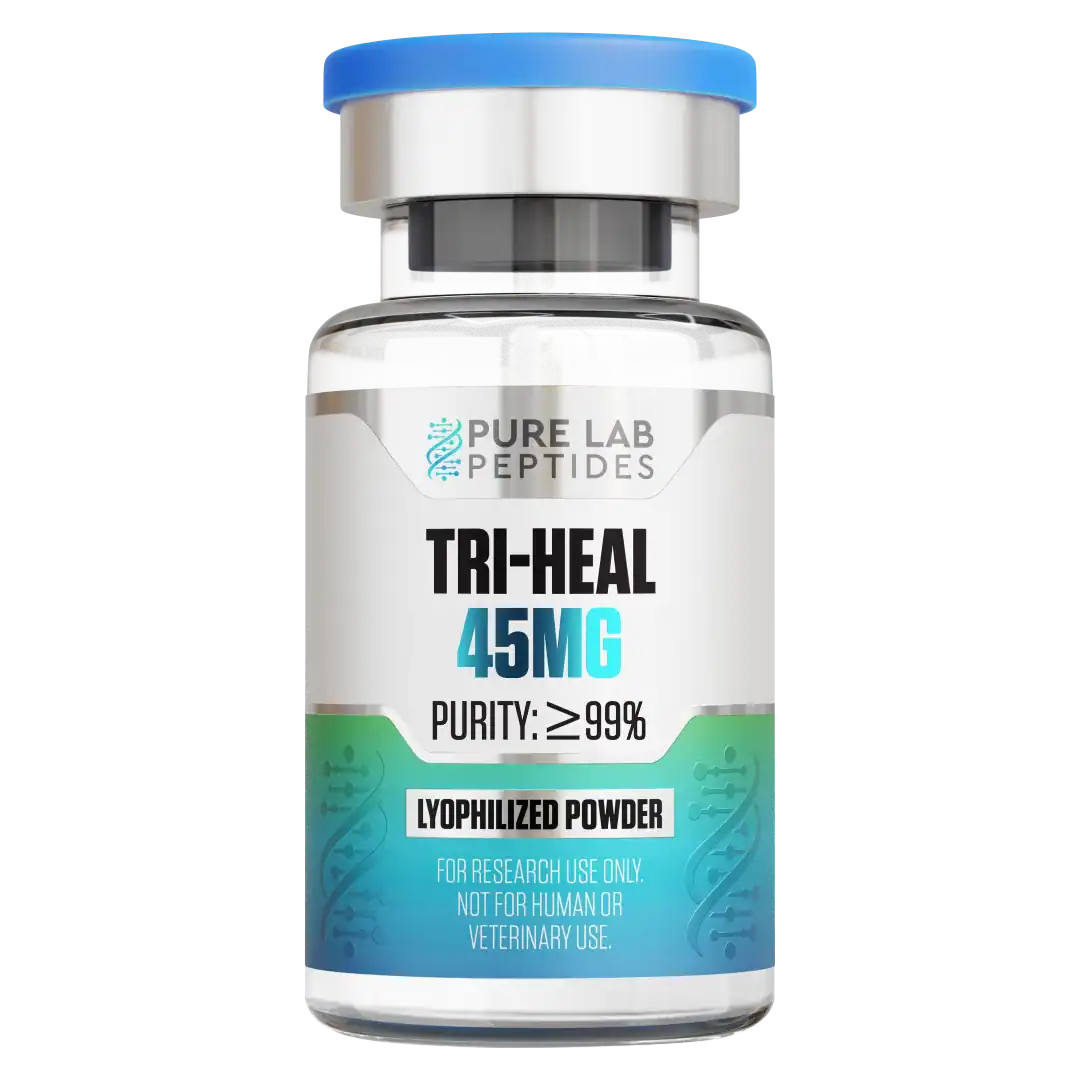
Tri-Heal Quick Reference (45 mg Blend)
- Vial contents
- 45 mg total blend 25 mg TB-500 + 10 mg BPC-157 + 10 mg KPV
- Final volume
- 3 mL
- Total blend concentration
- 15 mg/mL
- One U-100 unit
- 150 mcg total in 0.01 mL
Related research: For distinct compound, component, or formulation evidence and safety context, read BPC-157 Peptide: Benefits, Uses, Side Effects, Dosage, and Research, TB-500 Peptide: Benefits, Uses, Side Effects, Dosage, and Research, and KPV Peptide: Benefits, Uses, Side Effects, Dosage, and Research. These links are comparisons only; the compounds and formulations should not be treated as interchangeable.
Tri-Heal Dosage Chart
Dosing & Reconstitution Guide
Educational guide for reconstitution and daily dosing
Standard 8-Week Protocol (3 mL = 15 mg/mL)
| Week | Daily Dose | U-100 Units (mL) |
|---|---|---|
| Weeks 1–2 | 500 mcg (0.5 mg) | 3.3 units (0.033 mL)* |
| Weeks 3–4 | 1000 mcg (1.0 mg) | 6.7 units (0.067 mL)* |
| Weeks 5–6 | 1500 mcg (1.5 mg) | 10 units (0.10 mL) |
| Weeks 7–8 | 2000 mcg (2.0 mg) | 13.3 units (0.133 mL) |
*Precision Note: For doses ≤10 units (≤0.10 mL), consider using 30-unit or 50-unit insulin syringes for improved readability and accuracy.
Frequency: Inject once daily subcutaneously[6]. This schedule uses the largest practical dilution (3.0 mL) to optimize syringe accuracy across all dose levels.
Extended 12-Week Protocol (3 mL = 15 mg/mL)
| Week | Daily Dose | U-100 Units (mL) |
|---|---|---|
| Weeks 1–2 | 500 mcg (0.5 mg) | 3.3 units (0.033 mL)* |
| Weeks 3–4 | 1000 mcg (1.0 mg) | 6.7 units (0.067 mL)* |
| Weeks 5–6 | 1500 mcg (1.5 mg) | 10 units (0.10 mL) |
| Weeks 7–8 | 2000 mcg (2.0 mg) | 13.3 units (0.133 mL) |
| Weeks 9–10 | 2500 mcg (2.5 mg) | 16.7 units (0.167 mL) |
| Weeks 11–12 | 3000 mcg (3.0 mg) | 20 units (0.20 mL) |
Extended 16-Week Protocol (3 mL = 15 mg/mL)
| Week | Daily Dose | U-100 Units (mL) |
|---|---|---|
| Weeks 1–2 | 500 mcg (0.5 mg) | 3.3 units (0.033 mL)* |
| Weeks 3–4 | 1000 mcg (1.0 mg) | 6.7 units (0.067 mL)* |
| Weeks 5–6 | 1500 mcg (1.5 mg) | 10 units (0.10 mL) |
| Weeks 7–8 | 2000 mcg (2.0 mg) | 13.3 units (0.133 mL) |
| Weeks 9–10 | 2500 mcg (2.5 mg) | 16.7 units (0.167 mL) |
| Weeks 11–12 | 3000 mcg (3.0 mg) | 20 units (0.20 mL) |
| Weeks 13–14 | 3500 mcg (3.5 mg) | 23.3 units (0.233 mL) |
| Weeks 15–16 | 4000 mcg (4.0 mg) | 26.7 units (0.267 mL) |
Reconstitution Steps
- Draw 3.0 mL bacteriostatic water with a sterile syringe.
- Inject slowly down the vial wall; avoid foaming or direct stream onto the lyophilized cake.
- Gently swirl or roll until fully dissolved (do not shake vigorously).
- Label with date and concentration (15 mg/mL); refrigerate at 2–8 °C (35.6–46.4 °F), protected from light.
Supplies Needed
Plan based on an 8–16 week daily protocol with gradual titration.
- Peptide Vials (Tri-Heal, 45 mg each):
- 8 weeks (56 doses, ~70 mg total): 2 vials
- 12 weeks (84 doses, ~147 mg total): 4 vials
- 16 weeks (112 doses, ~252 mg total): 6 vials
- Insulin Syringes (U-100):
- Per week: 7 syringes (1/day)
- 8 weeks: 56 syringes
- 12 weeks: 84 syringes
- 16 weeks: 112 syringes
- Bacteriostatic Water (10 mL bottles): Use 3.0 mL per vial for reconstitution.
- 8 weeks (2 vials): 6 mL → 1 × 10 mL bottle
- 12 weeks (4 vials): 12 mL → 2 × 10 mL bottles
- 16 weeks (6 vials): 18 mL → 2 × 10 mL bottles
- Alcohol Swabs: One for the vial stopper + one for the injection site each day.
- Per week: 14 swabs (2/day)
- 8 weeks: 112 swabs → recommend 2 × 100-count boxes
- 12 weeks: 168 swabs → recommend 2 × 100-count boxes
- 16 weeks: 224 swabs → recommend 3 × 100-count boxes
For the early low-dose phases, a 30-unit or 50-unit syringe can make small-volume markings easier to distinguish.
.webp)


Peptide Reconstitution Simulator
Practice preparing this vial with the verified strength and final volume from this protocol.
Tri-Heal Vial and Research Context
- Reconstitute: Add 3.0 mL bacteriostatic water → 15 mg/mL concentration (15,000 mcg/mL).
- Typical daily range: 500–2000 mcg once daily (gradual titration over 8 weeks).
- Easy measuring: At 15 mg/mL, 1 unit = 0.01 mL = 150 mcg on a U-100 insulin syringe.
- Storage: Lyophilized: freeze at −20 °C (−4 °F); after reconstitution, refrigerate at 2–8 °C (35.6–46.4 °F); avoid freeze–thaw cycles[5].
Tri-Heal is a research peptide blend combining TB-500 (25 mg), BPC-157 (10 mg), and KPV (10 mg) for advanced tissue repair and inflammation modulation[1]. TB-500 is a synthetic fragment of thymosin β4, a 43-amino-acid peptide involved in cell migration, angiogenesis, and wound healing[2]. BPC-157 is a synthetic 15-amino-acid body protection compound with pro-angiogenic and gastroprotective properties[3]. KPV (Lys-Pro-Val) is a tripeptide derived from α-MSH noted for potent anti-inflammatory effects[4]. This educational protocol presents a once-daily subcutaneous approach using a practical dilution for clear insulin-syringe measurements.
Protocol Overview
Concise summary of the once-daily regimen.
- Goal: Support tissue repair, regeneration, and inflammation modulation through synergistic peptide action[2][3][4].
- Schedule: Daily subcutaneous injections for 8–12 weeks (extend to 16 weeks if desired).
- Dose Range: 500–4000 mcg daily with gradual titration.
- Reconstitution: 3.0 mL per 45 mg vial (15 mg/mL) for accurate unit measurements.
- Storage: Lyophilized frozen; reconstituted refrigerated; avoid repeated freeze–thaw[5].
Dosing Protocol
Suggested daily titration approach.
- Start: 500 mcg daily; increase by 500 mcg every 2 weeks as tolerated.
- Target: 1500–2000 mcg daily by Weeks 5–8 (standard); up to 3000–4000 mcg for extended protocols.
- Frequency: Once per day (subcutaneous).
- Cycle Length: 8–12 weeks; optional extension to 16 weeks.
- Timing: Any consistent time; rotate injection sites systematically.
Storage Instructions
Proper storage preserves peptide quality and potency.
- Lyophilized: Follow the exact product’s labeled storage temperature and expiration instructions; keep the vial dry and protected from light.
- Reconstituted: Refrigerate at 2–8 °C (35.6–46.4 °F); follow formulation-specific use-by and sterile-handling instructions. Do not assume aliquoting extends stability or sterility; avoid freeze–thaw cycles.
- Allow vials to reach room temperature before opening to reduce condensation uptake.
Important Notes
Practical considerations for consistency and safety.
- Use new sterile insulin syringes for each injection; dispose in a sharps container.
- Rotate injection sites (abdomen, thighs, upper arms) to reduce local irritation and prevent lipohypertrophy[6].
- Inject slowly; wait a few seconds before withdrawing the needle.
- Document daily dose, site rotation, and any observations to maintain consistency.
- For doses under 10 units, use 30-unit or 50-unit insulin syringes for improved accuracy.
How This Works
Tri-Heal combines three peptides with complementary mechanisms targeting multiple aspects of tissue injury repair:
TB-500 (Thymosin β4): Acts as a natural repair factor, inhibiting inflammation and apoptosis while promoting angiogenesis, cell migration, and matrix remodeling[2][7]. This 43-amino-acid peptide has been shown to accelerate dermal healing in both preclinical models and clinical applications[2].
BPC-157 (Body Protection Compound): Enhances healing via VEGFR2/Akt-eNOS activation, increasing nitric oxide production and angiogenesis while stimulating fibroblast activity[8]. This 15-amino-acid gastric peptide accelerates tendon, muscle, and gut repair[3][9].
KPV (Lys-Pro-Val): Provides anti-inflammatory effects by reducing NF-κB activation and attenuating pro-inflammatory cytokine signaling in epithelial and immune cells[4]. This α-MSH-derived tripeptide complements the regenerative actions of TB-500 and BPC-157.
The combination thus addresses wound repair, angiogenesis, and inflammation simultaneously through distinct but synergistic pathways.
Potential Benefits & Side Effects
Observations from preclinical and clinical literature on the individual components.
- TB-500: Promotes cell proliferation, angiogenesis, and accelerated tissue repair; inhibits apoptosis and inflammation in healing tissues[2][7].
- BPC-157: Accelerates musculoskeletal healing including tendon and muscle repair; stimulates endothelial regeneration and fibroblast activity[3][9].
- KPV: Reduces inflammatory cytokine release; demonstrates efficacy in models of epithelial inflammation[4].
- General tolerability: Individual peptides are generally well tolerated in preclinical studies; occasional mild injection-site reactions (redness, transient discomfort) may occur with subcutaneous administration.
Note: Human clinical data on this specific combination is limited; observations are extrapolated from studies of individual components.
Lifestyle Factors
Complementary strategies for optimal recovery outcomes.
- Pair with adequate protein intake (1.6–2.2 g/kg body weight) to support tissue regeneration.
- Maintain appropriate activity levels; avoid overloading healing tissues while promoting controlled movement.
- Prioritize sleep (7–9 hours) to maximize endogenous repair processes.
- Manage stress through appropriate techniques, as chronic stress impairs healing.
- Stay well-hydrated and maintain balanced micronutrient intake (vitamin C, zinc, collagen precursors).
Injection Technique
General subcutaneous guidance from clinical best-practice resources[6].
- Clean the vial stopper and skin with alcohol; allow to dry completely before proceeding.
- Pinch a skinfold; insert the needle at 45–90° into subcutaneous tissue[6][10].
- Do not aspirate for subcutaneous injections; inject slowly and steadily[6].
- Rotate sites systematically (abdomen, thighs, upper arms) to avoid lipohypertrophy and local irritation[11].
- Dispose of used syringes in an approved sharps container; never recap or reuse needles.
Important Note
This content is intended for therapeutic educational purposes only and does not constitute medical advice, diagnosis, or treatment. For research use only. Not for human consumption.
References
- 1
Pure Lab Peptides
- Tri-Heal (45 mg) product page; blend composition and specifications - 2
Annals of the New York Academy of Sciences (2012)
- The regenerative peptide thymosin β4 accelerates dermal healing in preclinical models and patients - 3
HSS Journal / PMC (2025)
- Emerging Use of BPC-157 in Orthopaedic Sports Medicine: A Systematic Review - 4
Molecular Therapy Methods & Clinical Development / PMC (2017)
- Orally Targeted Delivery of Tripeptide KPV via HA-Functionalized Nanoparticles Alleviates Ulcerative Colitis - 5
Clinical Chemistry (2016)
- Recommendations for the Generation, Quantification, Storage, and Handling of Peptides Used for Mass Spectrometry-Based Assays - 6
CDC Pink Book (2024)
- Vaccine Administration: subcutaneous route technique, angle, and site guidance - 7
Frontiers in Endocrinology (2021)
- Progress on the Function and Application of Thymosin β4 - 8
Current Reviews in Musculoskeletal Medicine (2025)
- Regeneration or Risk? A Narrative Review of BPC-157 for Musculoskeletal Healing - 9
Journal of Orthopaedic Research (2003)
- Gastric pentadecapeptide BPC 157 accelerates healing of transected rat Achilles tendon and stimulates tendocyte growth - 10
CDC (Subcutaneous Injection PDF)
- Technique diagram and site guidance for subcutaneous injections - 11
NCBI Bookshelf
- Best practices for injection: asepsis, preparation, and administration
Additional Research and Background
These sources provide related context and are not presented as support for a specific statement above.
- 1
Subcutaneous Drug Injection Review / PMC
- Pharmacologic considerations of the subcutaneous route
Related research, protocols, and guides
Explore the available research context, protocol variants or comparisons, and practical guides. When vial-size variants exist, they remain separate because vial strength, concentration, and syringe-unit calculations can differ. Related compounds and blends are comparisons only, not interchangeable.
Research overview
Related protocols and comparisons
- BPC-157 (5 mg Vial) Dosage Protocol
- BPC-157 (10 mg Vial) Dosage Protocol
- BPC-157 + TB-500 (10 mg Blend) Dosage Protocol
- BPC-157 + TB-500 (20 mg Blend) Dosage Protocol
- TB-500 (5 mg) + BPC-157 (5 mg) Stack Dosage Protocol
- GLOW (70 mg Blend) Dosage Protocol
- KLOW (80 mg Blend) Dosage Protocol
- TB-500 (5 mg Vial) Dosage Protocol