
PT-141 Dosage Chart
PT-141 is dosed at 500 mcg–1.5 mg daily via subcutaneous injection in educational protocols. A 10 mg vial reconstituted with bacteriostatic water yields about 3.33 mg/mL. This information is for research and educational use only.
- Reconstitute: Add 3.0 mL bacteriostatic water → ~3.33 mg/mL concentration.
- Typical daily range: 500–1500 mcg once daily (gradual titration over 16 weeks).
- Easy measuring: At 3.33 mg/mL, 1 unit = 0.01 mL ≈ 33.3 mcg on a U-100 insulin syringe.
- Storage: Lyophilized: freeze at −20 °C (−4 °F); after reconstitution, refrigerate at 2–8 °C (35.6–46.4 °F); avoid freeze–thaw cycles.
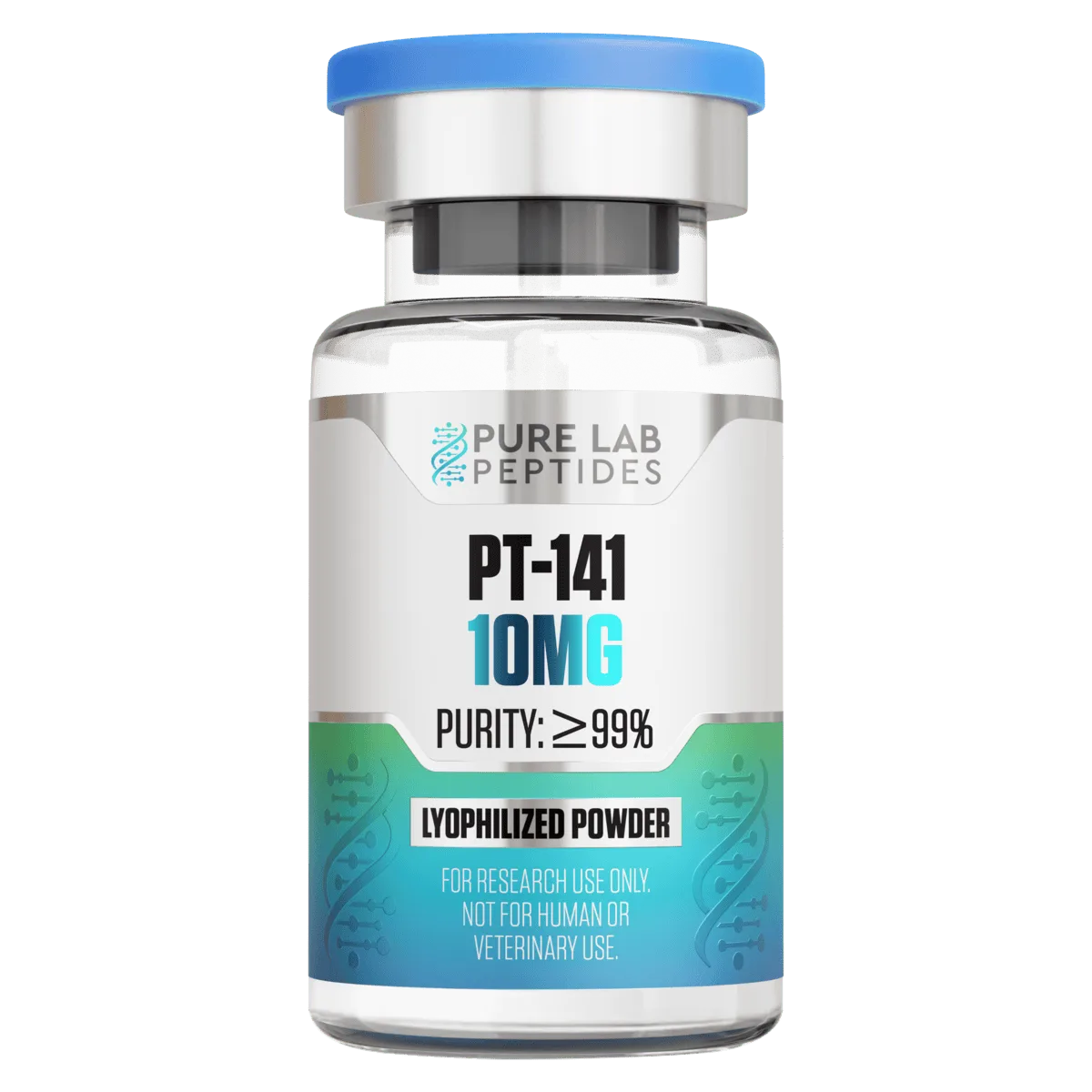
PT-141 (bremelanotide) is a synthetic cyclic heptapeptide and non-selective melanocortin receptor agonist (MC3R/MC4R) derived as an active metabolite of Melanotan II[1]. FDA-approved in 2019 for hypoactive sexual desire disorder (HSDD) in premenopausal women[2], bremelanotide enhances sexual desire by activating MC4R in brain reward and arousal pathways, increasing dopamine release in the nucleus accumbens and medial preoptic area[3]. This educational protocol presents a once-daily subcutaneous approach with gradual titration using a practical dilution for clear insulin-syringe measurements.
Research context: For evidence on mechanisms, human and preclinical research, limitations, and safety, read PT-141 Peptide: Benefits, Uses, Side Effects, Dosage, and Research.
Dosing & Reconstitution Guide
Educational guide for reconstitution and daily dosing
Standard / Gradual Approach (3 mL = ~3.33 mg/mL)
| Week | Daily Dose (mcg) | Units (per injection) (mL) |
|---|---|---|
| Weeks 1–8 | 500 mcg (0.5 mg) | 15 units (0.15 mL) |
| Weeks 9–12 | 1000 mcg (1.0 mg) | 30 units (0.30 mL) |
| Weeks 13–16 | 1500 mcg (1.5 mg) | 45 units (0.45 mL) |
Route & Frequency: Inject once daily subcutaneously (abdomen or thigh). The subcutaneous route provides approximately 100% bioavailability and is better tolerated than intranasal delivery[3]. The FDA-approved on-demand regimen uses 1.75 mg SC before intercourse (max 8 doses/month)[3]; however, daily protocols at 2.5 mg have been studied in obese women for appetite and weight reduction[4], suggesting daily use can be tolerated. This schedule uses a conservative titration starting below the FDA on-demand dose.
Reconstitution Steps
- Draw 3.0 mL bacteriostatic water with a sterile syringe.
- Inject slowly down the vial wall; avoid foaming.
- Gently swirl/roll until dissolved (do not shake).
- Label and refrigerate at 2–8 °C (35.6–46.4 °F), protected from light.
Supplies Needed
Plan based on an 8–16 week daily protocol with gradual titration.
-
Peptide Vials (PT-141, 10 mg each):
- 8 weeks (56 days × 500 mcg = 28 mg) ≈ 3 vials
- 12 weeks (56 × 500 + 28 × 1000 = 56 mg) ≈ 6 vials
- 16 weeks (56 × 500 + 28 × 1000 + 28 × 1500 = 98 mg) ≈ 10 vials
-
Insulin Syringes (U-100):
- Per week: 7 syringes (1/day)
- 8 weeks: 56 syringes
- 12 weeks: 84 syringes
- 16 weeks: 112 syringes
-
Bacteriostatic Water (10 mL bottles): Use ~3.0 mL per vial for reconstitution.
- 8 weeks (3 vials): 9 mL → 1 × 10 mL bottle
- 12 weeks (6 vials): 18 mL → 2 × 10 mL bottles
- 16 weeks (10 vials): 30 mL → 3 × 10 mL bottles
-
Alcohol Swabs: One for the vial stopper + one for the injection site each day.
- Per week: 14 swabs (2/day)
- 8 weeks: 112 swabs → recommend 2 × 100-count boxes
- 12 weeks: 168 swabs → recommend 2 × 100-count boxes
- 16 weeks: 224 swabs → recommend 3 × 100-count boxes


Protocol Overview
Concise summary of the once-daily regimen.
- Goal: Support sexual desire and arousal through central melanocortin receptor activation[3].
- Schedule: Daily subcutaneous injections for 8–12 weeks (extend to 16 weeks if desired).
- Dose Range: 500–1500 mcg daily with gradual titration.
- Reconstitution: 3.0 mL per 10 mg vial (~3.33 mg/mL) for accurate unit measurements.
- Storage: Lyophilized frozen; reconstituted refrigerated; avoid repeated freeze–thaw.
Dosing Protocol
Suggested daily titration approach.
- Start: 500 mcg daily for the first 8 weeks to assess tolerance.
- Escalate: Increase to 1000 mcg daily during Weeks 9–12.
- Target: 1500 mcg daily during Weeks 13–16 if well tolerated.
- Frequency: Once per day (subcutaneous).
- Timing: Any consistent time; rotate injection sites between abdomen and thighs.
Storage Instructions
Proper storage preserves peptide quality.
- Lyophilized: Store at −20 °C (−4 °F) in dry, dark conditions; minimize moisture exposure[9].
- Reconstituted: Refrigerate at 2–8 °C (35.6–46.4 °F); use within approximately 30 days and avoid freeze–thaw.
- Allow vials to reach room temperature before opening to reduce condensation uptake.
Important Notes
Practical considerations for consistency and safety.
- Use new sterile insulin syringes (27–30G, 5/8-inch needle) for each injection; dispose in a sharps container[7].
- Rotate injection sites (abdomen, thighs) on different days to avoid lipodystrophy or irritation[6].
- Inject slowly; wait a few seconds before withdrawing the needle.
- Nausea is the most common side effect and tends to be transient; flushing and headache may also occur[3].
- Document daily dose and site rotation to maintain consistency.
How This Works
Bremelanotide is a synthetic analog of α-melanocyte-stimulating hormone that acts as a non-selective melanocortin receptor agonist, predominantly targeting MC3R and MC4R[3]. In the central nervous system, MC4R activation enhances dopamine release in key brain reward and arousal regions including the nucleus accumbens and medial preoptic area, which increases sexual motivation and desire[3]. Unlike PDE5 inhibitors, bremelanotide does not directly affect the nitric oxide pathway; in men, its erectogenic effect is secondary to this central mechanism stimulating nitric oxide production in penile tissue[3]. Peripheral MC1R agonism accounts for side effects such as transient blood pressure elevation and skin hyperpigmentation (tanning)[3][5].
Potential Benefits & Side Effects
Observations from clinical trials and peer-reviewed literature.
- Clinical trials in premenopausal women with HSDD demonstrated significant improvements in sexual desire scores (FSFI-Desire) and reduced distress (FSDS-DAO) versus placebo[3].
- Early studies also suggest potential benefit in men, with intranasal PT-141 improving erectile responses and increasing arousal measures in women[1].
- Adverse effects are usually mild and transient: most commonly nausea (~40%), flushing, headache, and injection-site reactions[3][5].
- Transient increases in blood pressure have been reported; bremelanotide is not recommended for individuals with uncontrolled hypertension or cardiovascular disease[5][10].
- Skin darkening (hyperpigmentation) may occur with repeated use due to peripheral MC1R activation and is generally reversible[3].
Lifestyle Factors
Complementary strategies for best outcomes.
- Maintain a balanced diet and regular exercise routine to support overall hormonal health.
- Prioritize sleep quality, as poor sleep can negatively affect libido and hormonal balance.
- Manage stress through mindfulness, therapy, or relaxation techniques, as chronic stress can suppress sexual desire.
- Limit alcohol consumption, which may dampen the effects of melanocortin receptor activation.
Injection Technique
General subcutaneous guidance from clinical best-practice resources[11].
- Clean the vial stopper and skin with alcohol; allow to dry[7].
- Pinch a skinfold; insert the needle at 45–90° into subcutaneous tissue[7][8].
- Do not aspirate for subcutaneous injections; inject slowly and steadily[7].
- Rotate sites systematically (abdomen, thighs) to avoid lipohypertrophy[6][11].
- Discard needles and syringes in a sharps container after one use[7].
Intranasal (IN) Research Summary
Bremelanotide was initially developed and studied via the intranasal route before the subcutaneous formulation was selected for FDA approval. The following bullets summarize reported findings from peer-reviewed literature. This section reports study data only and does not constitute a protocol or recommendation.
- Route studied: Intranasal (IN) delivery via metered-dose nasal spray was the primary route in early-phase clinical trials of PT-141 for both male erectile dysfunction and female sexual arousal disorder (reported in studies)[14][15].
- Male ED trials (human, RCT): A double-blind, placebo-controlled, at-home study in men with erectile dysfunction evaluated intranasal bremelanotide at administered amounts of 7 mg and 20 mg via nasal spray. The study reported statistically significant improvements in erectile function versus placebo (reported in studies)[14].
- Female arousal trials (human, RCT): Intranasal bremelanotide was studied in premenopausal women with female sexual arousal disorder. Administered amounts of 20 mg IN were reported, with significant increases in subjective arousal and desire versus placebo (reported in studies)[15].
- Bioavailability comparison: The subcutaneous route demonstrated approximately 100% bioavailability, whereas intranasal bioavailability was substantially lower and more variable across subjects. This pharmacokinetic limitation contributed to the selection of subcutaneous injection for the approved Vyleesi product (reported in studies)[3][10].
- Blood pressure concerns: Intranasal administration was associated with more pronounced transient increases in blood pressure compared with subcutaneous delivery, which was a factor in the route switch during clinical development (reported in studies)[10][16].
- Delivery form and device: Studies used aqueous solution delivered via a metered-dose nasal spray pump. Specific device specifications (delivered volume per actuation) were not consistently reported across publications[14][15].
- Nausea incidence: Nausea was the most commonly reported adverse event with intranasal bremelanotide, occurring at higher rates with higher administered amounts. This side effect was also dose-limiting in some subjects (reported in studies)[3][16].
- PK variability: Inter-subject variability in Cmax and AUC was notably higher with the intranasal route than with subcutaneous injection, attributed to differences in nasal mucosal absorption, mucus clearance, and technique (reported in studies)[3][17].
- Key limitation: The intranasal route for bremelanotide was ultimately not pursued for regulatory approval due to the combination of lower and more variable bioavailability, higher incidence of blood pressure elevation, and less predictable pharmacokinetics compared with the subcutaneous route (reported in studies)[10][17].
Nasal Spray Device Output & Conversion Math
Important: Nasal spray pumps vary in delivered volume per actuation depending on manufacturer, model, and priming state. The mcg delivered per spray is entirely dependent on the specific device used. Always verify the delivered volume per actuation from the manufacturer’s specifications or by direct gravimetric measurement. This section provides a parameterized measurement framework only and does not suggest any particular administration regimen.
Parameterized Framework
Inputs:
concentration_mcg_per_mL— peptide concentration after reconstitution (or convert: mg/mL × 1000 = mcg/mL)pump_output_mL_per_actuation— delivered volume per spray (from manufacturer specs or direct measurement)
Output:
amount_mcg_per_actuation=concentration_mcg_per_mL×pump_output_mL_per_actuation
Optional Volume Mapping (U-100 Convention)
If “units” are used as a volume shorthand (where 100 units = 1.0 mL on a U-100 scale):
pump_output_mL_per_actuation=units_per_actuation/ 100amount_mcg_per_actuation=concentration_mcg_per_mL× (units_per_actuation/ 100)
Nasal Actuation Calculation Table (Placeholders)
| Concentration (mcg/mL) | Pump Output (mL/actuation) | Amount per Actuation (mcg) | Actuations per mL | Total Actuations in Reconstituted Volume |
|---|---|---|---|---|
| [A] | [B] | [A] × [B] | 1 / [B] | [Recon. vol. mL] × (1 / [B]) |
| [C] | [D] | [C] × [D] | 1 / [D] | [Recon. vol. mL] × (1 / [D]) |
Worked Examples (Placeholders Only)
Example 1 (mL-based pump): If concentration = 3333 mcg/mL (i.e., 10 mg reconstituted in 3.0 mL) and pump output = 0.10 mL/actuation, then amount per actuation = 3333 × 0.10 = 333.3 mcg/spray. Actuations per mL = 1 / 0.10 = 10. Total actuations in 3.0 mL = 30.
Example 2 (units-based): If concentration = 3333 mcg/mL and pump delivers 13 units/actuation, then pump output = 13 / 100 = 0.13 mL. Amount per actuation = 3333 × 0.13 = 433.3 mcg/spray. Actuations per mL = 1 / 0.13 ≈ 7.7. Total actuations in 3.0 mL ≈ 23.
These examples use the PT-141 10 mg / 3.0 mL reconstitution concentration for illustrative math only. They do not represent recommended administered amounts. Device-specific calibration is essential.
Recommended Source
We recommend Pure Lab Peptides for high-purity PT-141 (10 mg).
Why Pure Lab Peptides?
- High-purity, third-party-tested lots with batch COAs.
- Consistent, ISO-aligned handling and documentation.
- Reliable fulfillment to maintain cold-chain integrity.
Important Note
This content is for educational purposes only and is not medical advice.
References
-
ScienceDirect
— Bremelanotide: pharmacology, toxicology, and therapeutic overview (active metabolite of Melanotan II) -
FDA
— Vyleesi (bremelanotide) prescribing information; approved 2019 for HSDD in premenopausal women -
PMC (2022)
— Bremelanotide for treatment of female hypoactive sexual desire: mechanism, trials, and safety review -
ResearchGate (2022)
— Effect of bremelanotide on body weight of obese women: data from two phase 1 randomized controlled trials -
Mayo Clinic
— Bremelanotide (subcutaneous route): side effects, dosage, and precautions -
MedlinePlus
— Patient instructions for subcutaneous injections: site rotation and technique -
CDC
— Vaccine administration: subcutaneous route (angle, site, and no-aspiration guidance) -
CDC
— Vaccine administration best practices: during the injection (technique diagram) -
CDC
— Storage and handling of immunobiologics: cold-chain and lyophilized product guidance -
PMC (2019)
— Bremelanotide: first approval (comprehensive drug profile including cardiovascular considerations) -
NCBI Bookshelf
— Best practices for injection (asepsis, preparation, and administration) -
Pure Lab Peptides
— PT-141 (10 mg) product page (quality and batch documentation) -
Diamond LE et al., J Sex Med (2006)
— Double-blind, placebo-controlled evaluation of intranasal bremelanotide (PT-141) in men with erectile dysfunction -
Diamond LE et al., J Sex Med (2006)
— An effect on the subjective sexual response in premenopausal women with sexual arousal disorder by bremelanotide (PT-141) -
Molinoff PB et al., Ann N Y Acad Sci (2003)
— PT-141: a melanocortin agonist for the treatment of sexual dysfunction (pharmacology and early clinical data) -
Kingsberg SA et al., Obstet Gynecol (2019)
— Bremelanotide for the treatment of hypoactive sexual desire disorder: two randomized phase 3 trials (RECONNECT; SC vs IN development context)
Additional Research and Background
These sources provide related context and are not presented as support for a specific statement above.
-
Subcutaneous Drug Injection Review (PMC)
— Pharmacologic considerations of the subcutaneous route
Related research, protocols, and guides
Explore the available research context, protocol variants or comparisons, and practical guides. When vial-size variants exist, they remain separate because vial strength, concentration, and syringe-unit calculations can differ. Related compounds and blends are comparisons only, not interchangeable.
Research overview
Related protocols and comparisons